
A Distributed Approach for Inferring Production Systems
Proceedings of the Tenth International Joint Conference on Artificial Intelligence. Architectures and Languages. Pages 62-66.
© 1987 International Joint Conferences on Artificial Intelligence
Abstract
Tools for building production systems encounter the problem of low performance, and many researchers are working on the improvements of performance of th~se to?ls. This paper proposes a distribu~ed al?pr<?ach for mfen:ng production systems. The resultmg ~~s~buted productH;m systems are expected to be built over dtstnbuted ~ystems ~1th broadcast capability, and production rules on differc:nt ~ttes work in a cooperative way with only a few_c~mmumc~u.ons between them. Working memory on a local stte IS made vlSlble to rules on remote sites. A tool for building distributed production systems, called DPS, has been imp~emented . D~S not only supports elegant constructs for ~xpressmg th~ ~~pactty of distributed inference but also provtdes the facthttes for building clusters of rules. Wi~ these facilities, ~PS allows users to make the inference engme focus on a particular set of rules. This paper also describes the knowledge representation and other features about DPS.
- Buchnan,B.G. and Shortliffe, E.H., Eds, Rule-Based Expert Systems, Addison Wesley, Reading, MA, 1984.
- Ensor, J.R. and Gabbe, J.D. "Transactional Blackboard", Proc. of UCAI, pp 340-344, Los Angles, 1985.
- Erman, L.D., Hayes-Roth, F., Lesserr, V.R. and Reddy, D.R., "The Hearsay-II Speech-Understanding System: Integrating knowledge to solve uncertainty", Computing Surveys, Vol.12, pp 213-253, 1980.
- Fickas, S. "Design Issues in a Rule-Based System", ACM SIGPLAN, Vol. 20, pp 208-215, 1985.
- Forgy, C., OPS5 User's Manual , Dep. of computer science, CMU, 1981.
- Forgy, C., "Rete: A Fast Algorithm for the Many Pattern/Many Object Pattern Match Problem", Artificial Intelligence, Vol. 19, pp 17-37, 1982.
- Ishida, T. and Stolfo, S.J., "Towards the Parallel Execution of Rules in Production Systems Programs", Proc. of IEEE Internaional Conf. on Parallel Processing, pp 568-575, 1985.
- Lesser, V.R. and Corkill, D.D. "Functionally accurate cooperative distributed systems", IEEE Trans. on System, Man, Cybernetics, Vol. SMC-11, No.I, pp 81-96, Jan. 1981.
- Neiman,D. and Martin, J., "Rule-Based Programming in OPS83", AI Expert, Premier,1986, 54-65.
- Nii, H. P. and Aiello, N.,"AGE(attempt to generalize): A Knowledge-Based Program for Building Knowledge- Based Programs", Proc. of IJCAI, pp 645-655, Toyko, Japan, 1979. IJCAI
- Nii, H. P., Feigenbaum, E. A., Anton, J. J. and Rockmore, A. J., "Signal-to-symbol transformation: HASP/SlAP case study", AI Magazine, Vol. 3, No. 2, . pp 23-35, 1982.
- Schor, M. I., Daly, T.P., Lee, H. S. and Tibbitts, B.R., "Advances in Rete Pattern Matching", Proc. of AAAI, pp 226-234, Philadelphia, 1986.
- Smith, R.G. and Davis, R., "Frameworks for Cooperation in Distributed Problem Solving", IEEE Trans. on system, man, and cybernetics, Vol. SMC-11, No. 1, Jan. 1981.
- Stolfo, S.J. and Miranker, D.P., "DADO: A Parallel Processor for Expert Systems", Proc. of IEEE International Conf. on Parallel Processing, pp 74-82, 1984.
- Tocoro, M. and Ishikawa; Y., "An Object-Oriented Approach To Knowledge Systems", Proc. of the international Conf. on Fifth Generation Computer Systems, pp 623-631, Tokyo, Japan, 1984.
References were extracted automatically from the PDF and may contain errors.
Full text extracted automatically from the PDF; figures, tables and equations may differ. The PDF is the version of record.
I. Introduction
The development of tools for building rule-based systems has evolved in several directions. Consultation-based tools use the backward-chaining reasoning mechanism [1], together with questioning-and-answering facilities to achieve goals. Systems and tools with blackboard architecture [3,10,11] emphasize on the integration of complicated heuristic control and uncertain knowledge. There are also researches focusing on the architecture of forward-chaining reasoning mechanism, especially those derived from Rete algorithm [12,14].
The major advantages of production system tools such as OPS5 [5] and ORBS [4] are derived from the elegance, expressiveness and moderate complexity of their knowledge constructs. Users can create lists of attributes about concepts and a set of production rules each of which has condition elements to match against user-defmed concepts, and actions to take when conditions are satisfied. The fact that condition elements of each rule join the relationship between concepts suggests more powerful expressiveness than other tools do. However, they pay for the expressive power of production rules. For example, OPS5 has to do more work on complex pattern-matching. Rete algorithm [6] for many-pattern /many-object pattern match problems was introduced to resolve the problem. Nevertheless, low performance is still a disadvantage of OPS5. So far, several approaches have been proposed to improve it, such as reWriting OPS5 into OPS83 [9] in C, improving the inference mechanism of OPS5 by eliminating unnecessary matching and supporting more powerful constructs for building production rules [12] , and introducing parallel architectures [14, 7] to exploit the parallelism of pattern-matching and rule-firing.
In this paper, we propose a model for distributed processing of production systems. In this model, a production system, which can be constructed as a vinual integrated Rete network [6], is distributed over a distributed system or a local area network. Knowledge distribution is done by users. Subsystems on different sites are almost autonomous, and they can cooperate with each other. This greatly exploits the parallelism between subsystems since unrelated subsystems can run in parallel. A tool named DPS is constructed under this model. Moreover, we also support other features to improve the performance of production systems, including the split of Rete network on a single site into a cluster of subnets, object-based knowledge representation, and enhanced rule facilities.
II. Knowledge representation
The attraction of expressive power of knowledge representation in OPS5 has a great influence on the scheme of knowledge representation of DPS. We found that one of the reasons that make OPS5 popular comes from the semantic meanings of production rules. Since a rule consists of a condition part (LHS) and an action part (RHS), a rule can join the relationship between different concepts described in LHS, and then execute r_esponding actions in RHS. The representative manner and complexity of such rules are at similar level of human thoughts, and hence facilitates the work of knowledge engineering.
In general, DPS has OPS5-like syntax of rules. In addition to the LHS and RHS, each rule of DPS may be given an attribute. When rules are interpreted, those with the same attribute are constructed as a sub-Rete-network which is used to narrow the inference space during execution of the systems. Moreover, users are allowed to use a prefix "?" or "? site-name" in a condition element to represent a condition element which matches against the working memory on remote sites. Such condition elements are called remote condition elements. This will be described later in more details.
DPS allows users to define object-based concepts [15], i.e., each concept is described as a list of attributes and is associated with any number of methods which are invoked by passing messages to an instance (working memory element, or wme) of the concept. The following is an example to illustrate the general form of knowledge representation in DPS. ·
(remote-site sensing-station)
; declare the remote sites
(object monager name location situation)
; declare object "manager"
;whose attributes include "name", "location" and "situation"
(object store-house location material (status safe)) ; declare object ; "store-house". "safe " is default value of "status" attribute
(object material name stock property)
; declare object "material"
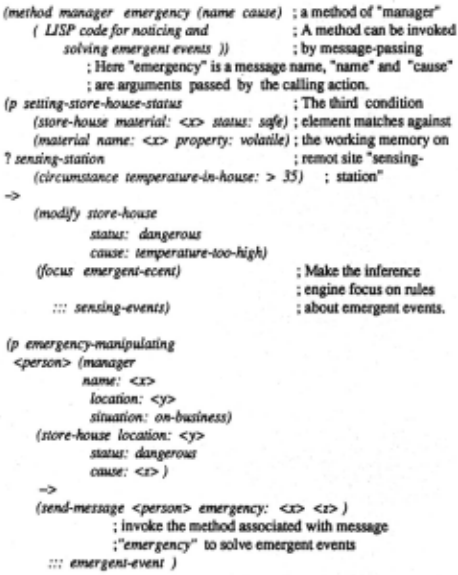
The RHS of a rule allows an action to invoke a LISP procedure by message-passing. This procedure not only accepts arguments passed from calling actions, but also uses as variables the attributes in the matched wme. Compared with the "call" action in OPS5 which demands the special treatment of passed arguments, message-passing of DPS simplifies the use of procedure calls. The RHS of a rule also allows actions to control inference engine and manipulate working memory.
Rule Clustering
The ORBS production system [ 4] and blackboard systems such as Hearsay-IT [3, 8], HASP [11] and AGE [10] allow rules to be grouped into related collections. There is generally a pointer that designates the current collection. Only rules from the current collection are allowed to match against working memory. There are several attractive language properties of rule clustering: it allows a complex space to be broken into more understandable pieces; it tends to simplify rule debugging because the debugging space can be narrowed to one rule cluster instead of the whole rule base; and it allows the system developer to reuse components (the rule clusters) found to be useful in the past.
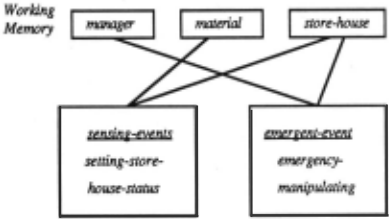
In DPS, a rule can be given an attribute at the field indicated by the symbol":::". Rules with the same attribute are grouped together. A subsystem on one site has a working memory and a number of rules grouped into a number of clusters, if needed. The inference engine may focus its inference space on one or more rule clusters. The switching of inference space among these clusters is guided by the selection of appropriate rule attribute. Fig.1 shows two rule clusters mentioned above and the working memory they share on the local site. When the rule setting-store-house is fired, the execution of (focus emergent-event) changes the inference space to the emergent-event cluster to manipulate emergent events.
Furthermore, since systems like OPS5 and its various derivatives use the Rete algorithm for the pattern match function, part of the efficiency comes from sharing pattern matching test which are identical among all the rules that have the tests. However, the OPS5 Rete shares results of join tests only if the patterns are the same starting from the first one. Thus it is hard to get the benefits of shared tests. When a new working memory element is created, all the beta join nodes of satisfied tests should be modified. If later the working memory element is removed, these beta nodes should be modified all over again. It will be wasteful if very few of these rules are fired during the addition-then-deletion of the same working memory element.
Here, we allow the rules to be grouped into several collections, only rules from the current collection are allowed to match. In this way, the addition-then-deletion of the same woring memory element will not cause the beta-node modification in other clusters. This tends to improve the performance. An example is given later in section IV.
ill. Distributed inference of production rules
In DPS, users at one site of a local area network can share the knowledge resident on remote sites, and production rules on different sites can interact with others according to the shared knowledge. DPS is expected to provide elegant syntax to express the distributed inference of production rules.
There are two major reasons why DPS supports the capacity of distributed computation. First, knowledge distribution can be done by users. Since a single rule is the grain-size of a predictable action sequence and knowledge distribution should be based on knowledge, researchers who worked on the exploitation of parallel production systems on parallel computers [7] have found that it is difficult to automatically distribute knowledge over processors. The distributed system approach, allowing users to distribute knowledge as they wish, can do better distribution of knowledge with the guideness of users. Hence, it exploits higher parallelism than the parallel approach on parallel computers. Second, with appropriate distribution of knowledge, systems written in DPS can solve distributed problems with two forms of cooperation between working sites: task-sharing and result-sharing [13]. Several nodes can participate in a single job and partial results between nodes can be shared to produce further results.
The distributed production systems built by DPS are expected to be divided into several autonomous subsystems, each of which resides on a single site and can proceed match-action cycles concurrently with each other. DPS
supposes only a few communications are needed among these subsystems. In order to exploit the capability of distributed inference easily, DPS supports several facilities as elegant as possible. As an example shown in Fig. 2, users can build and distribute rules on a nework which consists of sites X, Y, and z.
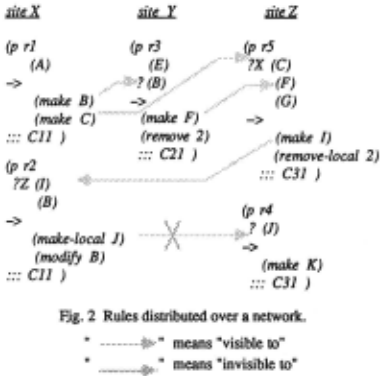
The symbol "? " means the specified condition element is a remote condition element which matches against working memory on remote sites, and "? site " matches against the working memory on the specified r~mote si~e .. ~he remove-local action is used to make the spectfied wme mvtstble to the local site; and if the removed wme was created on the same local site, then its effect is the same as that of remove action, i.e., that wme is invisible to all sites. The make action creates a new wme visible to all sites. The make-local action is similar to make action except that the visibility of the newly created wme is limited in the local. site. It is used to hide a private working memory from other sttes. In addition, the action part of a rule may also include a remote method invocation by sending a message to the matched remote wme. With these facilities, users can manage private and shared working memory and respond to remote situations.
IV. Implementation
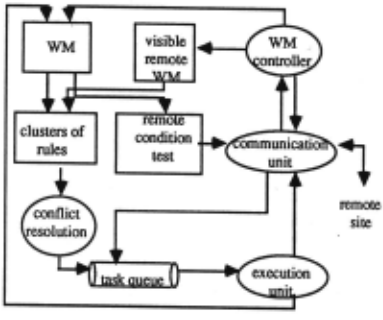
In general, DPS interpreter acts in matching-action cycles like OPS5 but remote condition elements and additional tasks must be c~nsidered. The system architecture of DPS is sho:wn in Fig.3. Working Memory (WM) collects· data wh~ch production rules will match against. Visible R~mote Work!ng Memory contains data, received from remote sttes~ that sansfy remote condition elements of rules on the local s1te. Remote Condition Test is the set of condition elements extracted from remote rules which match against WM on the current site. Let's
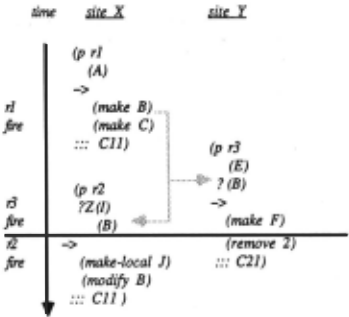
consider the example shown in Fig. 2. During the session of rule interpretation on site Y, the re~ote co~dition e~ement (!J) in rule r3 is broadcast to remote s1tes. Stte X wlll recetve condition element (B) and then build it in Remote Condition Test. Whenever a wme that satisfies (B) is newly created on site X it will be automatically transmitted to the Visible Remote WM 'on site Y. This saves communications during the execution of systems. WM Controller is responsible for maintaining the consistency of data ~tween the WM on the local site and visible WMs on remote sttes.
IV.l Rule clustering
In DPS, there is an activity pointer which designates the current cluster. The initial value of the pointer is given by users at the beginning of execution. Each time when the RHS actions of a rule are executed, it may cause some variation in working memory. Since the working memory is shared by the clusters on the site, new working memory elements should be known to the noncurrent clusters. Here, we go around the problem with a simple and clear approach.
DPS gives each cluster a last-time-tag, which records the last working memory time tag for current cluster when switching to another cluster. When later this cluster is selected as the current cluster, it should match the working memory elements since the one whose time tag is immediately greater than last-time-tag. In this way, each cluster, when behaving as the current cluster, knows the variation since it switched to another cluster. Thus the addition-then-deletion of the same working memory element may affect only current cluster because noncurrent ones do not know the occurrence of addition-then-deletion event. All they can see are the elements exist in the working memory. For example, consider the two clusters in Fig.4.
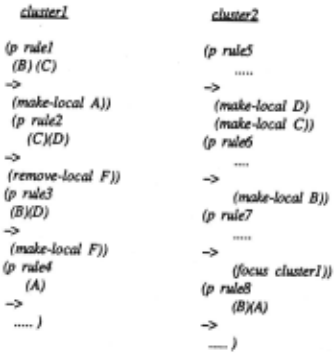
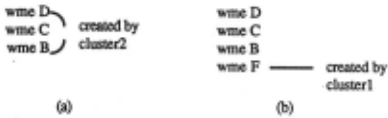
If c~ent cl~ster is cluster2 and at flrst ruleS is flred, (i.e. there. ~x1st working memory elements A and C that satisfies cond1tton elements (A) and (C). ) then new working memory ~le~ents D an~ C are added to working memory. Next, if rule6 1s f1red, ~orkmg me~ory element B is added to working memory. Fmally, rule7 1s fired and cluster! is selected to be the current cluster. The working memory so far is shown in Fig. S(a).
In cluster!, rulel and rule2 are satisfied and added to conflict set. According to the resolution strategy, rulel is fired first and it adds element A to working memory. This causes an instantiation of rule4 to be added to conflict set. Next, rule3 is fired and element F is added to working memory. Finally, rule2 is fired, and element A is deleted. The instantiation of rule4 should be deleted from conflict set. Later when cluster2 is selected as the current cluster, all it can see is working memory element F (as in Fig. S(b)). The addition-then-deletion of working memory element A has no effect on cluster2. This improves performance significantly when there are many identical condition elements among the clusters.
N.2 Distributed inference
The remote condition elements of rules are examined during the time of rule interpretation. DPS interpreter creates a special rule in the target site(s) for each remote condition element. The syntax of a special rule is:
(p <special-name>
< the remote condition element>
-->
<send 1 <target-site> :<cluster> :<address of co"esponding &mem node>
::: <remote-condition-test> )
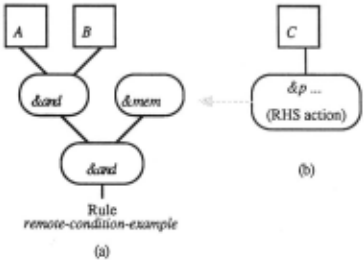
<?nee the special rule is built, it can match against the working memory on remote sites. If the special rule is fired by a remote DPS system, then its RHS action is executed and the result is sent back to the local site. When received by the local DPS system, the matched data will be put into the Visible Remote WM and then copied to the specifled &mem node. This Il_lakes Rete n~twor~s. which distributed over cooperating sues, form a vmual mtegrated Rete network since there exist virtual channels between special rules in target sites and &mem node in the local site; i.e., local rules sense changes on remote ~ imm~ately after they occurred. For example, the rule, which contams a remote condition element, in site-A:
results in the Rete networks shown in Fig. 6.
If a firing rule causes an execution of "make-local" ("remove-local") action, the working memory element is added ~o (removed from) workin~ m~mory , and may trigger another mference cycle. If the act1on IS "make", which allow a new working memory element to be visible to remote sites, then the worki~g memory element should be matched not only by the rules m current cluster but also by the special rules in remote-condition- test cluster on local site. This seems natural because the working memory elements created by "make" actions are visible globally and may be tested by some remote ~l~s. The "remove:· action.removes working memory elements VISible to remote sites, so It must be implemented in a special way.
IV.3 Task scheduling
DPS system maintains a task queue on each site, which orders the tasks generated by the inference engine and the communication unit. We have four kinds of tasks. They are 1) remote-test rule building, 2) message passing, 3) remote deletion _or modification of working memory element task, 4) RHS acttons of selected rules.
When interpreting a rule containing remote condition elements, DPS interpreter creates a remote-test rule building task for each remote condition element and puts them in the task queue. When selected by the task scheduler, the task will be sent to the communication unit and then the remote sites, then executed by remote DPS interpreter. For the balance of DPS system, rules in the execution set resulting from conflict resolution are not evaluated immediately. They are grouped into a task, put into the task queue and rated by the task scheduler. They cannot be executed until selected by the scheduler. When the communication unit receives a request for building a special rule for remote condition element, the request is also treated as a task and must be put into the task queue. Rules in the remote-condition-test cluster are conditions received from remote DPS systems, along with a RHS action which sends the matched wme to a target site. If anyone of them is satisfied, its RHS action should be executed immediately instead of being put into the task queue, since the execution has no effect on the local working memory.
N .4 Consistency maintenance
Let's consider the previously mentioned example in Fig. 7. After rule rl on site X has fired, it may happen that the condition parts of rule r2 on site X and rule r3 on site Yare both satisfied, and rule r3 may remove wme B just before rule r2 fires . Here, inconsistency arises between workin~ m~~ory on site X and site Y. Other situations may result m smular inconsistency. DPS solves this problem ?Y accessing ~he shared working memory elements (wmes) via locks. Working memory controller is responsible for the manipulation of locks of wmes according the following disciplines.
- . Before a rule, whose condition part contains rerno~e condition elements, would fire, DPS has to request the wnte locks of matched remote wmes if these wmes are to be changed by the rule and the read locks if these wmes are not to be changed.
- . Read locks are shared, and many rules on different sites may concurrently read a wme. Write locks are exclusive, and no other rules may access a locked wme while its write locks is held by a rule .
- . DPS requests locks for a rule only when the LHS of this rule is satisfied and its RHS is placed in the task queue.
- . A rule can fire only after the involving locks are available, ~d all locks held by a rule are released until the end of execunon of the rule .
- . Write lock requests made to read-locked wme are queued until all read locks are released .
- . WM controller serves lock requests with first-come-frrst serve scheme .
- . When the write lock of a wme is held by a rule, WM controller refuses all lock requests made to the same wme until the lock is released (since this wme is modified or no longer exists). Hence, a rule task in .t~e task queue is canceled if one of lock requests made by It IS refused.
- Modification of a shared wme is made visible to involving remote sites.
These disciplines guarantee the consistency of visible WM between cooperating sites.
V. Performance evaluation
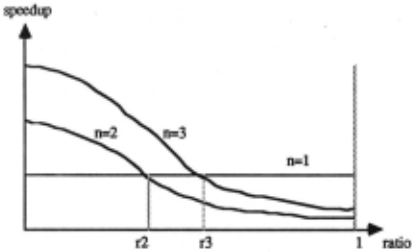
Since DPS leaves the work of initial knowledge distribution to users, the performance of DPS is conceivably related to the way how ~sers distribute ~heir kn~wledge on cooperating sites. Accor<;li.ng to ~ur expenme~ts, If an overall production system is partitioned mto n appropnate subsyste~s, each of which excutes almost autonomously on one sHe with only a few communications to/from other sites, then the performance would approximate n t~es hi!lher than that o~ the original system that executes on a smgle site. However, If an overall system is partitioned into subsystems in such a way that rules on each site always match remote working memory elements, and hence rules on different site can only fire sequentially, then the performance would greatly degrade, .even worse than that of the original system that executes on a smgle site. Fig.8 illustrates speedup and degeneration for the performance of DPS, where x-a.x~s means the ra~o of the t~tal number of satisfied remote condinon elements dunng execunon to the total number of satisfied condition elements, and n means the number of subsystems. The curve marked 'n=l' is illustrated as comparison. The values of threshold ratios rl and r2 for curve 'n=2' and 'n=3' are closely related to communication cost. The less the communications cost, the higher the ratios are; hence, higher speedup would be achieved.
VI. Conclusion
In order to improve the performance of production systems, a number of reseaches focus on the parallel processing of production systems. In this paper, we propose an approach for building distributed production systems. We have attempted to show the development model used to build DPS programs and the environment that surrounds the language. One of the major objectives of DPS is to enhance performance of production systems. DPS supports elegant constructs for users to express the distributed inference of production rules. Rules on different sites work in a cooperative way and only a few communications are needed: A~other objective of DPS i~ .to propose a model f~r. distnbuted inference. Since condition tests for remote condltlon elements are built on remote sites during interpretation session, communications needed in matching-action cycles are minimized. In addition, DPS also supports facilities to split inference engine on a local site into a number of subsets, each of which would focus on the inference about a particular event
The prototype of DPS system is now implemented in Common Lisp on a HP LAN which conn~cts th;~~ HP 9000/320 workstations. Due to the lack of efficient facihttes to support interprocess communication, communication cost has influence on performance of this prototype. In current stage, DPS does not consider the ability of dynamic migration of knowledge. Users are required to divide the en~ire a~plication into partitions, and spr~ad the~ ~n a~propnat~ Sites on a distributed system. Insplte of this httle u~co~veme~ce, DPS, with elegant constructs and a po:ve~ul ~Is~Ibuted mfere~ce mechanism, is a useful tool for bulldmg distributed production systems.
@inproceedings{ijcai1987p12,
  title     = {A Distributed Approach for Inferring Production Systems},
  author    = {Hsu, Ching-Chi and Wu, Shao-Ming and Wu, Jan-Jan},
  booktitle = {Proceedings of the Tenth International Joint Conference on
               Artificial Intelligence, {IJCAI-87}},
  publisher = {International Joint Conferences on Artificial Intelligence},
  editor    = {John McDermott},
  pages     = {62--66},
  year      = {1987},
  note      = {Architectures and Languages},
  url       = {https://ijcai.org/proceedings/1987/12},
}
TY - CPAPER TI - A Distributed Approach for Inferring Production Systems AU - Hsu, Ching-Chi AU - Wu, Shao-Ming AU - Wu, Jan-Jan T2 - Proceedings of the Tenth International Joint Conference on Artificial Intelligence, IJCAI-87 PB - International Joint Conferences on Artificial Intelligence PY - 1987 SP - 62 EP - 66 UR - https://ijcai.org/proceedings/1987/12 ER -Copied
Machine-readable versions of this paper, for tools and AI agents:





