
Feedback as a Coindexing Mechanism in Connectionist Architectures
Proceedings of the Tenth International Joint Conference on Artificial Intelligence. Natural Language. Pages 602-609.
© 1987 International Joint Conferences on Artificial Intelligence
Abstract
Co-occurrence constraints play an important role in rule-based systems such as natural language processing. The constraints appear in many forms including agreement restrictions (e .g .. number agreement between subjects and predicates). selectional restrictions on complement types. and filler-gap movement dependencies. A general account of such constraints is given in a parallel execution model for rule-based systems - Active Production Networks (APNs). The APN model is similar to connectionist (or spreading activation) models. but explicitly provides a functional interpretation of rule-based phenomena such as variable binding. multiple instantiations (including recursion) . and contextual expectations. Co-occurrence constraints are represented by a theory of coindexing and trace capture. based on a feedback mechanism . Several examples of constraint processing are presented which . surprisingly. also include phenomena such as phonological nulls and contraction.
- Bresnan, J. (Ed.) 1982 The Memal Representation of Grammatical Relations . MIT Press, Cambridge.
- Massachusetts.
- Chomsky. N . 1982 Lectures on Governmellt and Bind• ing . Foris Publications, Dordrecht. Holland.
- Collins. A . and Loftus. E. F. 1975 A Spreading• Activation Theory of Semantic Processing. Psycho• logical Rev.iew 82: 407-428 .
- Cottrell. G . W. 1984 A Model of Lexical Access of Ambiguous Words. AAA/-84. Austin. Texas: 61-67.
- Fahlman. S. 1979 NETL: A System for Representing and Using Real-World Knowledge . MIT Press. Cam• bridge. Massachusetts.
- Fahlman. S. E.; Hinton. G. E .; and Sejnowski. T . J. 1983 Massively Parallel Architectures for AI: NETL, Thistle, and Boltzmann Machines. AAAI-83. Washington , D.C .: 109-113.
- Feldman, J. A. and Ballard. D. H . 1982 Connectionist Models and their Properties. Cognitive Science 6: 205-254.
- Gazdar. G.; Klein. E.; Pullum, G.; and Sag. I. 1985 Generalized Phrase Structure Grammar. Harvard .University Press, Cambridge. Massachusetts.
- Hinton, G. F. 1981 Shape Representation in Parallel Systems. Proceedings of the 7th IJCAI. Vancouver, • B.C.: 1088-1096. IJCAI
- Hopfield. J. J. 1982 Neural Networks and Physical Systems with Emergent Collective Computational Abilities. Proc. Nat/. Acad. Sci . 79: 2554-2558.
- Hopfield, J . J. and Tank, D. W. 1985 "Neural" Com• putation of Decisions in Optimization Problems . Biological Cybernetics 52: 141-152.
- Jackendoff. R . 1977 X-Bar Syntax: A Study of Phrase Structure. MIT Press. Cambridge, Massachusetts.
- Jones, M. A. 1983 Activation-Based Parsing. Proceed- ings of the 8th /JCAI. Karlsruhe. West Germany: 678-682 .
- Jones. M. A . and Driscoll. A . S. 1985 Movement in Active Production Networks. Proceedings of the 610 NATURALLANGUAGE 23rd Annual Meeting of the Association for Computa• tiona{ Linguistics. Chicago: 161•166.
- Jones , M. A . 1986 Active Production Networks-An Activation-Based Parsing Model. released paper (submitted for publication), AT&T Bell Labora- tories .
- Kirkpatrick. S.; Gelatt. Jr. , C. D.; and Vecchi. M. P. 1983 Optimization by Simulated Annealing. Sci- ence 220: 671-680 .
- Litman. D. 1985 Linguistic Coherence: A Plan-Based Alternative . Proceedings of the 24th Annual Meeting of the Association for Computational Linguistics. New York : 215-223.
- Minsky, M. and Papert , S. 1972 Perceptrons. MIT Press, Cambridge. Massachusetts.
- Otten, R. H . J . M. and van Ginneken. L. P. P. P. 1984 Floorplan Design Using Simulated Annealing . International Conference on Computer-Aided Design . Santa Clara , California : 96-98.
- Quillian, M. R. 1968 Semantic Memory. In: Minsky .
- M. L., Ed .. Semamic Information Processing . MIT Press, Cambridge. Massachusetts: 227-270 .
- Rumelhart , D. E . and McClelland, J. L . 1986 Parallel Distributed Processing. MIT Press , Cambridge .
- Massachusetts.
- Sabbah, D. 1982 A Connectionist Approach to Visual Recognition . Technical Report 107. University of Rochester, Rochester , New York .
- Selfridge.
- G . 1958 Pandemonium : A Paradigm for Learning. In: Uhr, L .. Ed .. Pattern Recognition . Wiley . New York : 237-250.
- Selman, B. 1985 Rule-Based Processing in a Connec- tionist System for Natural Language Understand- ing. Technical Report CSRI-168. University of Toronto, Toronto. Canada .
- Touretzky. D. S. and Hinton. G. E. 1985 Symbols Among the Neurons : Details of a Connectionist Inference Architecture. Proceedings of the 9th IJCAI. Los Angeles, California: 244-248. IJCAI
- Waltz . D. L. and Pollack . J. B. 1984 Phenomenologi- cally Plausible Parsing AAA/-84. Austin. Texas : 335-339.
- Woods. W. A . 1970 Transition Network Grammars for Natural Language Analysis. Communications of the ACM 13(10): 591-606.
- Woods, W. A. 1980 Cascaded ATN Grammars. AJCL 6(1): 1-12.
References were extracted automatically from the PDF and may contain errors.
Full text extracted automatically from the PDF; figures, tables and equations may differ. The PDF is the version of record.
1. Introduction
There has been an increasing interest by research ers in cognitive science and artificial intelligence in parallel processing models. Examples include Anderson's ACT* system (Anderson 1983), the work on connectionism at Rochester (Feldman and Ballard 1982), the Boltzmann machine model (Fahlman 1979; Fahlman, Hinton and Sejnowski 1983), and the models of Hopfield (1982) and Kirkpatrick (Kirkpatrick, Gelatt and Vecchi 1983). The common theme in this research is that intelligent activity can be modeled by large networks of simple processing elements that use some restricted form of message passing on a mas sively parallel basis. The models are somewhat simi lar to earlier neural network or spreading activation theories of human cognitive processes (Selfridge 1958; Minsky and Papert 1972; Quillian 1968; Collins and Loftus 1975), but benefit from advances in knowledge representation, production systems and learning algo rithms. For example. several learning algorithms for multi-stage networks have recently been discovered. including the back-propagation learning algorithm of Rumelhart (Rumelhart and McClelland 1986). The lack of such learning algorithms was one obstacle to
2. The APN \lode[
Each connector (node) in an Active Production Network is defined by an expression that describes the message patterns to which it responds and the resulting messages that are propagated. For conveni ence. each non-leaf connector is viewed as being pri marily an input connector (multiple inputs. one out put) or an output connector (multiple outputs. one input)." Figure 1 shows a simple APN and the corresponding rule-based description. The connector names in an APN are uninterpreted but are usually chosen to reflect the concepts which they represent . APNs bear some resemblance to rule connection graphs for theorem provers and graphical representa tions for grammars such as Augmented Transition Networks (ATNs) (Woods 1970). As in connectionist models. however. the APN network simultaneously represents the data (grammar. facts . rules) of the pro cess and the process itself.
A comparison of the rules in Figure 1(b) with the network in Figure 1(a) reveals that the set of connec tors has been explicitly designed to correspond to familiar concepts in rule-based systems. while retain ing a clear interpretation in the activation-based model. The input connectors. for example. include disjunction and conjunction. The conjunctive connec tors , furthermore . divide into synchronous and asyn chronous types. and the asynchronous conjunctions may be ordered (sequence) or unordered. · Terminal symbols correspond to network leaves having no inputs. Other common rule notations can be built out of these basic building blocks. Optionality. as in the VP rule. is expressed by a combination of disjunction and sequence. Repetition can be represented as recursive optionality. The unordered. asynchronous input conjunction (not shown in Figure 1) is useful in grammars for non-configurational (free word order) languages. for specifying order-free. conjunctive. semantic relationships and for representing unbounded movement. ·
The association of lexical and non-lexical features is. often described in first-order rule languages by elevating lexical categories to predicates having asso ciated terms to represent non-lexical features . The synchronous input conjunction performs this feature association or concept specialization. Specialization primarily defines feature sets and enforces selectional restrictions by intersecting features from orthogonal featur~ dimensions. For example , the concepts V [-trans J and V [+trans] specialize the concept V .** The connector. which averages its inputs. is termed "synchronous" because its response is maximal when all of the inputs simultaneously reach their maximum values .
· In general, we will relax this convention to allow multiple dis junctive outputs (for input connectors) or disjunctive inputs (for output connectors). Prior definitions of the APN framework (Jones 1983; Jones and Driscoll 1985) were equivalently stated in node-based rather than connector-based terms . Nodes were defined with arbitrary amounts of nested input logic. The more atomic, connector-based scheme has proved more flexible and straightforward to implement .
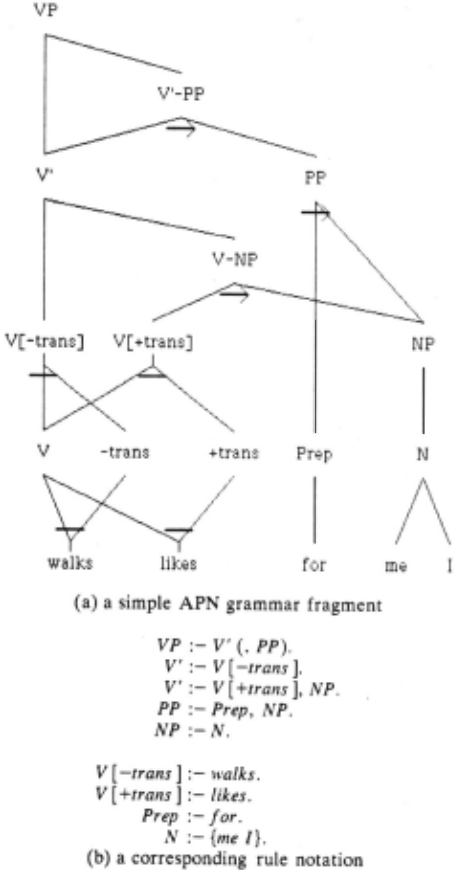
Disjunctive and conjunctive output connectors dis tribute activation to (possibly) multiple connectors. Competing hypotheses arise from multiple disjunctive outputs. In the lexicon. for example. output disjunc tions occur where there are multiple word senses or multiple feature values in a single dimension. Output conjunctions distribute activation along multiple feature dimensions. It is often convenient. as in Fig ure 1(b ). to organize a grammar into rules which con vey phrase structure (generally input connector logic) and rules which express lexical properties (output connector logic) . Ordered and unordered output feedback connectors (not shown in Figure 1) are dis cussed in a later section on coindexing.
·· Of course, V [-trans) can also be considered a specialization of -trans.
In the basic cycle of execution in an APN parser. each word (or morpheme) in a sentence initiates mes sage passing activity in the network through the corresponding (usually leaf) connector of the net work; thus. the words supply exogenous inputs to the network. A uniform activation algorithm specifies the message passing behavior of each type of connec tor in response to the messages that it receives. In general , activation messages sweep "upward" in the network to instantiate or further instantiate the rules represented by the connectors in the network. Par tially instantiated asynchronous rules initiate expecta tion messages "downward" through the network to contextually prime it. In parsing terms. the expecta tion messages dynamically compute a left-branching reachability set.
Messages are simple , having only an associated time and value. They do not encode complex struc tures such as entire binding lists , parse trees. feature lists or meaning representations. Similarly. the local processing of messages by connectors consists of sim ple operations such as maximizing input values. Con sequently, the local computation time is bounded and the "result" of a computation consists entirely of the activation trace and the new state of the network. The information present in the activation trace can be interpreted to create a more traditional parse tree representation. For similar connectionist views. see Feldman and Ballard (1982) and Rumelhart and McClelland (1986). A comparison of marker passing. value passing and unrestricted message passing sys tems is given by Fahlman, Hinton and Sejnowski (1983).
Message values are subject to the following decay function:
where f (t) is the message value at time t. and f (t 0) is the value of the most recent message. from time t 0 . For the sake of efficiency in the current sequential simulation. the implementation numbers the input events and associates these integral "times" with the values sent in messages. The value is dynamically recomputed as necessary according to the decay func tion.
3. An Example
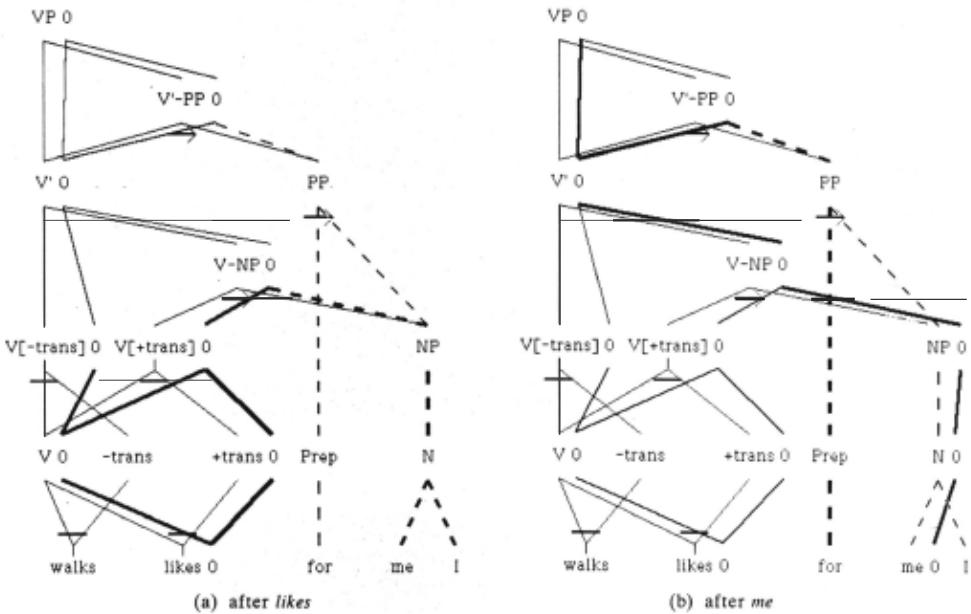
Before we enter a more formal discussion. a sim ple example should help to convey a feel for the execution behavior of the APN model. Figure 2 illus trate the operation of the APN in Figure 1 on the input string likes me. The subscripted connectors and links which appear to the right of the defined net work represent the activation trace. The trace may be thought of as either an embedded state in the defined network or as a newly constructed copy or instance of a subgraph of the defined network. For expository purposes, the following discussion adopts the latter view. The widths of the links in Figure 2 crudely approximate activation levels which are actu ally represented as real numbers in the range [-MAX, +MAX]. The width of the output links from a con nector indicates whether its pattern is fully (level = +MAX) or partially (0 < level < +MAX) satisfied. Expectations are shown by dashed lines in widths which analogously illustrate full (level = -MAX) or partial (-MAX < level < 0) activation levels. Unac tivated links are shown by a thin solid line.
Figure 2(a) shows the network after the message passing activity spawned by the exogenous input likes . The activation messages passed upward in the net work cause new connectors (or states) VO. +transO. V[+trans]O. etc. to be instantiated. Disjunctive input connectors (e.g .. VPO) maximize their inputs. Input sequences (e.g .. V-NPO) respond weakly to the first · input. using it primarily to gate the second input value. Expectation messages are propagated down ward from V-NPO (opposite in sign, but equal in mag nitude to the value of the first input) to conditio~ the network for an NP . At the end of each cycle of mes sage passing. the most highly-expected leaves represent the new. primed context.
In Figure 2(b). me is introduced and activation proceeds upward in the presence of the expectations . Expectation messages do not instantiate rules. but they can dynamically alter the behavior of the net work. At NP, the expectations from V-NPO cause it (rather than PP. for example) to receive the activa tion message . Thus the network exhibits nonmono tonic behavior dependent upon the processing con text. In different expectation environments. the same input sequence can lead to different activation pat terns .
It may help to compare the APN execution model with that of Prolog. Prolog uses backward-chaining, static rule ordering and backtracking for non determinism. Roughly. APNs use forward-chaining. dynamic rule ordering (based on expectations which are passed by backward-chaining) and parallelism. The message passing activity in the network has a for mal inference analog. From an activation-based per spective, the rules in Figure l(b) may be understood as universally quantified by an input event. For example. the rule V [+trans ]:-likes is formally represented as (''x) likes (x)-V (x) ,, +trans (x). An input event at time x 0 will activate likes (xo) and effectively instantiate the rule by universal specialization and modus ponens. Once an input has been bound, its activation value can modulate in response to further input events which it dominates. Jones (1986) lists inference schemas that describe the semantics of activation messages for APN connectors.
The value of VPO and hence the expectations from any input sequences being driven above VPO are con tinuously modulated up and down as the constituents below it are started and progress to completion. The final value of VPO, in Figure 2(b). is +MAX. indicat ing that the phrase was successfully parsed. If a PP attachment were to commence at this point. the value of VPO would be lowered until the PP ··popped'' by raising its value . It is this raising and lowering of activation levels. a kind of distributed pushing and popping of context, that promotes generally context free descriptions (augmented by coindexing con straints) of the syntactic base of natural languages . A similar phenomenon may extend to other levels of description (e .g .. see Litman (1985) for a discussion of nested discourse contexts).
Another interesting property of the APN execu tion model is that an ungrammatical input may be recognized. but the overall score computed for the phrase will be penalized. Unlike rigid rule-based systerns where rules discretely succeed or fail. APN rules are "leaky" and may partially succeed. This situation arises, for example. when obligatory sequences or conjunctions are only partially satisfied. Also. a small percentage of an expectation value received by an input sequence connector is distri buted to the second input; consequently . the nearest attachment can be found even when constituents are missing.
4. Colndexing
The grammar writing style exemplified in Figure 1 introduced a number of important representational paradigms including the wi~espread use of feature1 and specialization in an X style grammar. In X theory, rules fenerally have the form xn .... (CJ) ... (Cj )-xn- -(Cj+l) · · · (Ck). where each Ci is either a full projection of a lexical category or a grammatical formative (Jackendoff 1977). The remainder of this paper addresses the problem of how to represent the numerous co-occurrence constraints that must be added to the context-free skeleton. We will focus primarily on agreement restrictions and selectional restrictions on complements. although a related application of the techniques may apply to filler-gap movement dependencies as well (Jones l985).
A common type of constraint. technically dis tinguished here as fea ture agreement. occurs when the values of features in two constituents may vary. but must match . In logic programming. feature agree ment is implicitly specified by using the same variable name and requiring that the variable assignments unify. For example. determiner-noun number agree ment is written as:
Another type of co-occurrence constraint. feawre selection. occurs in situations in which the presense of a particular feature constrains the value of another feature in a complement. For example. the rule for transitive VPs in Figure l fails to capture the case constraint on the object NP. A more accurate description is:
One account is that the +trans feature controls the case of the NP. A similar (if not the same) feature of prepositions controls case in PPs. The same method can be used to define complement and adjunct condi tions in general (e .g., voice , mood. tense) . Unfor tunately, the usual logic programming style does not make the dependence of +obj upon +trans explicit as in the feature agreement case. The rule language being developed in an APN compiler project syntacti cally distinguishes several types of feature depen dency.
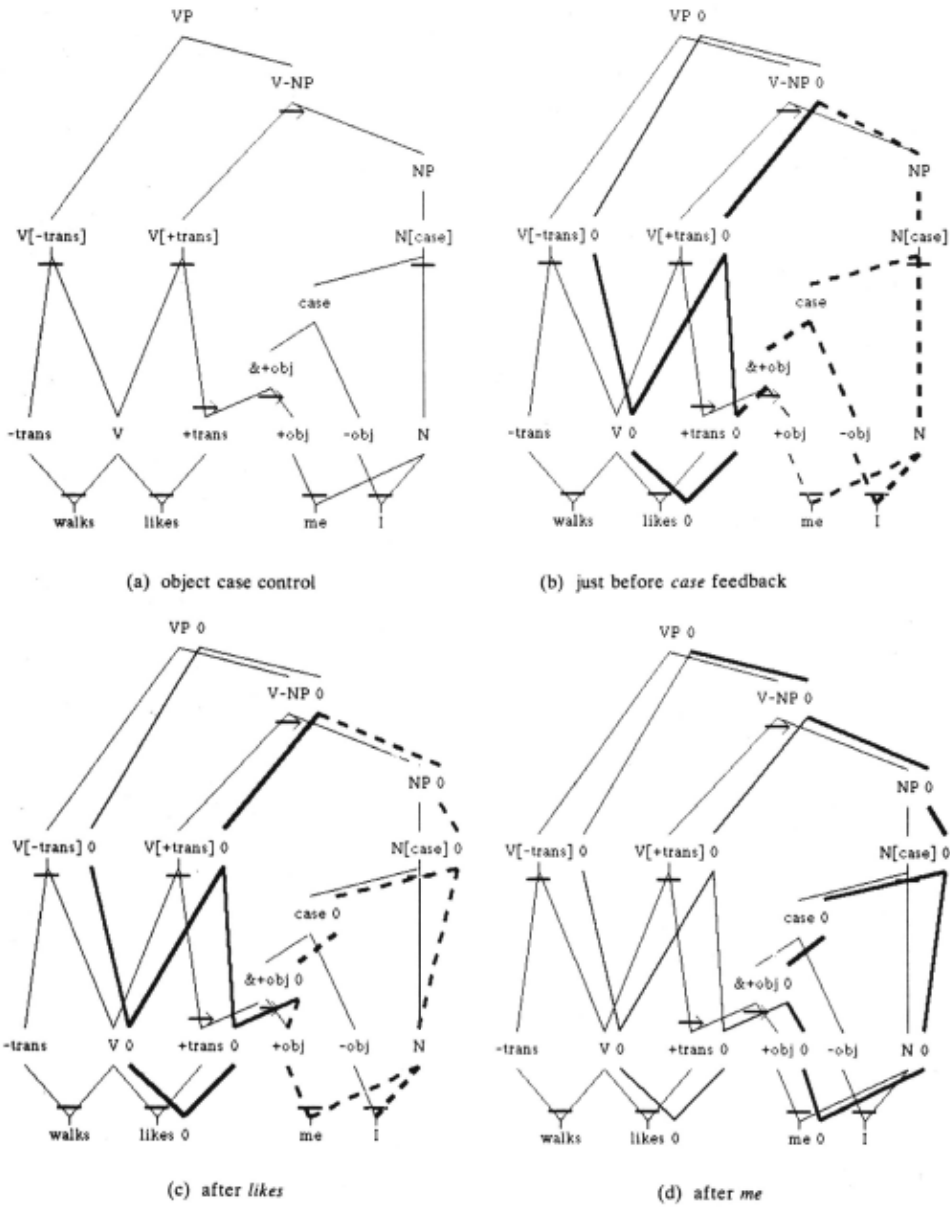
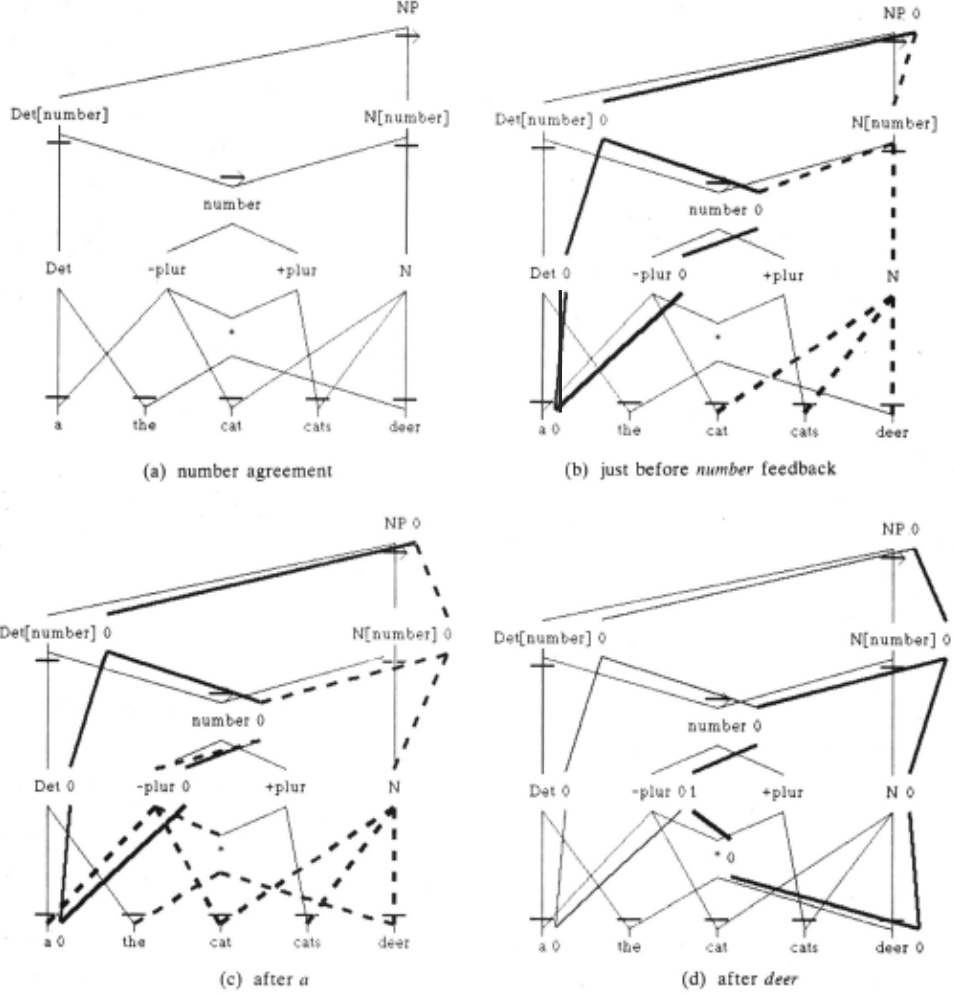
Feature agreement and feature selection both specify coindexing relationships. The general method for coindexing in the APN framework requires an activation trace along a feedback path between the coindexed feature , represented by an output feedback connector. and an asynchronous input conjunction which dominates it. As expectations feed back to the coindexed point, the coindexed feature is released into the new expectation environment creating a new activation trace. The trace effectively pre-instantiates the next input in the asynchronous input conjunction, constraining it to possess the selected features . Note that this trace capture occurs during the time frame of the current input without advancing in the input string. The feedback response threshold can be tuned to disallow feedback through distant (weak. non the head-feature convention prevalent in linguistic
head) paths; this effectively implements a version of theories .
The captured trace produces different effects depending on the form of the grammar that contains it. In the feature selection case. shown in Figure 3 and discussed below. the expectations are transferred to the selected featlire(s) . For feature agreement. as in Figure 4, the expectations feed back directly to the coindexed feature . Feature control is thus a lexical property; for example. the +obj feature must conJOin to the NP head at the level of the lexicon. below anv phrase structure specifier sequences. The expectatio~ levels for the selected feature(s) will be modulated together with those of the head (N) by any interven ing context.
Figures 3(b)-(d) illustrate the APN feature selec tion technique applied to object case control for tran sitive verbs with the phrase likes me. Figure 3(b) shows the network state after activation from the verb. Note that an object NP instance has alreadv been created and an input sequence is used t~ transfer the expectations to +obj feature . In Figure 3(c). after me. the +obj feature was correctly bound. Note that a lexical entry not possessing a feature of type +obj (such as /) would fail to satisfy the expecta tions of caseO and would be penalized accordingly.
Figures 4(b)-(d) shows an example of feature agreement with the phrase a deer. In Figures 4(b )-(c), the activation from numberO is integrated ·with the sig nal from DetO and fed back to to theN side of the NP. where it is captured. The e~pectations "hop off" the trace at ·the disjunctive input connector numberO, which posts expectations for the connector ( -plur) that spawned its currently active input. The expectation feedback prevents the full binding of the numberO connector to an instance. but results in a pattern spe cialization. Effectively, this causes the rule (Vx) -plur (x)-number (x 0 ) to become active . In Fig ure 4(d), numberO is rebound to the new feature value -plur 1.
The unordered output feedback connector. xand>. captures more general feature agreement relation ships than seq>; multiple . matching input sequences can specify different input orders. In English subject-verb agreement , for example, the tensed verb element precedes the subject in questions and follows the subject in declaratives. As in the case of the input connectors seq< and xand<. seq> is really just a spe cial case of xand> in which the ordering is strict.
The reader should note that the feature dimen sions of number and lexical category in the NP gram mar of Figure 4(a), for example. are orthogonal. The syntactic number agreement can be layered onto an initial. over-generalized grammar that permitted any determiner and noun combination on the basis of lexi cal category alone . The number feature can also be coindexed to verbs for subject-verb agreement. This kind of error correction is non-destructive. i.e .. previ ous network fragments do not have to be eliminated or completely rewritten. This property may be espe cially relevant for learning algorithms or incremental compiling approaches. Since the computations in each feature dimension proceed in parallel , the accu racy is improved without a penalty in (parallel) per formance . The intersection of relatively simple feature systems thus gives rise to complex behavi:or . Woods (l980) offers a similar example of cascaded context-free ATN grammars which recognize a context-sensitive language .
4.1 Phonological Nulls
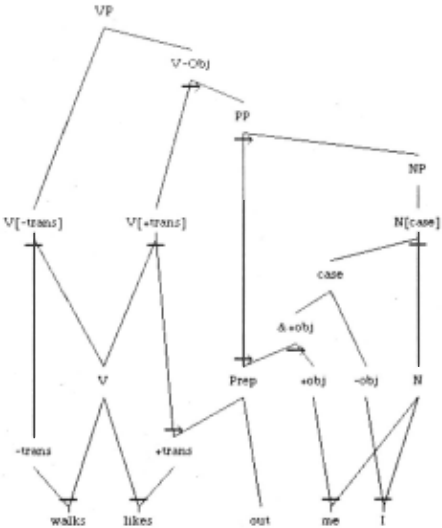
Linguistic theories have postulated the existence of phonologically null elements which contribute to the parsing of a sentence . Government-Binding Theory (Chomsky '1982). recognizes four different types of empty categories. In contrast. Generalized Phrase Structure Grammar (GPSG) (Gazdar 1985). and Lexical Functional Grammar (LFG) (Bresnan 1982) use a single empty category. Empty categories typically relate to missing NPs and wh movement (dis cussed in the following section). but there are also other applications. In some accounts. for example. a phonologically null preposition. <1>. appears before the object NP to assign case to it. Figure 5 illustrates how the network in Figure 3(a) could be modified to represent this theory . The same general principle used for feature selection is applied to preinstantiate the lexical category itself (instead of one of its features) . Upon feedback to +trans. it will insert itself as the null preposition. In turn. as a preposi tion, it will then pre-select the +obj feature for the object NP. This has the advantage of localizing NP ca~e control to the preposition only.
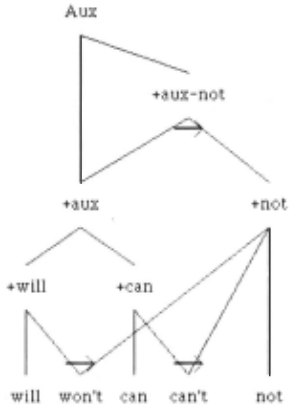
Interestingly, a similar principle can be used in the representation of phonological contractions or com pounds. Figure 6 illustrates the idea for auxiliary negation contractions. The feedback onto the con traction completes the respelling of can't , for exam ple, into can not.
5. Conclusions
Although more work is needed to understand how to model syntactic and semantic processing in activation-based schemes , several key representa tional techniques have been developed. The tech niques include the intersection and synchronization of modular rule systems, specialization. feature selec tion, feature agreement and phonological nulls. In addition; a general grammar writing methodology_ based on the features and phrase structure style of X theory , modularity. and feature coindexing has been proposed. This choice is consistent with trends in linguistics away from transformational theories toward modular theories such as Government-Binding Theory or perhaps some form of phrase structure grammar such as GPSG. It is our hope that adjustments in linguistic theory and in the APr-.; model will produce a parsimonious account of the expressive power of natural languages . The current APN model has evolved over the last three years and should prob ably be taken as representative of a class of possible approaches .
The parallel execution model of APNs has several advantages over serial models . Besides the abilitv to maintain multiple hypotheses in parallel. ·the bandwidth among collections of modules (knowledge sources) can be quite high. Large numbers of features can be activated simultaneously in multiple modules ; conversely. the collective context from these knowledge sources is also simultaneously projected in the form of expectations to reduce the nondetermin ism engendered from any single source alone. Furth ermore. the model can be used for both recognition and generation processes.
Unlike most connectionist models. we have tried to model explicitly the functional characteristics of rule based systems such as variable binding. feature selection and agreement, multiple instantiations (including recursion), and contextual expectations. Although we are supportive of connectionist efforts to develop neural models and learning algorithms. we feel that there is also a need for research efforts such as the APN model to reach toward them from what is known about rule-based systems. Efforts from both directions can help prune the space of possible models. offer additional levels of description. and bridge the "symbol" gap. ·
ACKNOWLEDGEMESTS
I owe a particular debt to Guy Story who. besides providing programming support for the APN system. has also contributed valuably to the insights presented in this paper.
REFERESCES
- Anderson, J . R. 1983 The Architecture of Cognition . Harvard University Press. Cambridge, Mas sachusetts.
- Bresnan, J. (Ed.) 1982 The Memal Representation of Grammatical Relations . MIT Press, Cambridge. Massachusetts.
- Chomsky. N. 1982 Lectures on Governmellt and Bind· ing. Foris Publications, Dordrecht. Holland.
- Collins. A. and Loftus. E. F. 1975 A Spreading· Activation Theory of Semantic Processing. Psycho· logical Rev.iew 82: 407-428.
- Cottrell. G. W. 1984 A Model of Lexical Access of Ambiguous Words. AAA/-84. Austin. Texas: 61-67.
- Fahlman. S. 1979 NETL: A System for Representing and Using Real-World Knowledge. MIT Press. Cam· bridge. Massachusetts.
- Fahlman. S. E. ; Hinton. G. E.; and Sejnowski. T. J. 1983 Massively Parallel Architectures for AI: NETL, Thistle, and Boltzmann Machines. AAAI-83. Washington, D.C.: 109-113.
- Feldman, J. A. and Ballard. D. H. 1982 Connectionist Models and their Properties. Cognitive Science 6: 205-254.
- Gazdar. G.; Klein. E.; Pullum, G.; and Sag. I. 1985 Generalized Phrase Structure Grammar. Harvard .University Press, Cambridge. Massachusetts.
- Hinton, G. F. 1981 Shape Representation in Parallel Systems. Proceedings of the 7th IJCAI. Vancouver, · B.C.: 1088-1096.
- Hopfield. J. J. 1982 Neural Networks and Physical Systems with Emergent Collective Computational Abilities. Proc. Nat/. Acad. Sci . 79: 2554-2558.
- Hopfield, J . J. and Tank, D. W. 1985 "Neural" Com· putation of Decisions in Optimization Problems . Biological Cybernetics 52: 141-152.
- Jackendoff. R. 1977 X-Bar Syntax: A Study of Phrase Structure. MIT Press. Cambridge, Massachusetts.
- Jones, M. A. 1983 Activation-Based Parsing. Proceed ings of the 8th /JCAI. Karlsruhe. West Germany: 678-682 .
- Jones. M. A. and Driscoll. A. S. 1985 Movement in Active Production Networks. Proceedings of the
- 23rd Annual Meeting of the Association for Computa· tiona{ Linguistics. Chicago: 161·166.
- Jones , M. A. 1986 Active Production Networks- An Activation-Based Parsing Model. released paper (submitted for publication), AT&T Bell Labora tories .
- Kirkpatrick. S.; Gelatt. Jr. , C. D. ; and Vecchi. M. P. 1983 Optimization by Simulated Annealing. Sci ence 220: 671-680.
- Litman. D. 1985 Linguistic Coherence: A Plan-Based Alternative. Proceedings of the 24th Annual Meeting of the Association for Computational Linguistics. New York : 215-223.
- Minsky, M. and Papert , S. 1972 Perceptrons. MIT Press, Cambridge. Massachusetts.
- Otten, R. H. J . M. and van Ginneken. L. P. P. P. 1984 Floorplan Design Using Simulated Annealing. International Conference on Computer-Aided Design . Santa Clara, California: 96-98.
- Quillian, M. R. 1968 Semantic Memory. In: Minsky . M. L., Ed .. Semamic Information Processing. MIT Press, Cambridge. Massachusetts: 227-270.
- Rumelhart , D. E. and McClelland, J. L. 1986 Parallel Distributed Processing. MIT Press , Cambridge . Massachusetts.
- Sabbah, D. 1982 A Connectionist Approach to Visual Recognition. Technical Report 107. University of Rochester, Rochester , New York .
- Selfridge. 0 . G . 1958 Pandemonium: A Paradigm for Learning. In: Uhr, L .. Ed .. Pattern Recognition . Wiley. New York : 237-250.
- Selman, B. 1985 Rule-Based Processing in a Connec tionist System for Natural Language Understand ing. Technical Report CSRI-168. University of Toronto, Toronto. Canada.
- Touretzky. D. S. and Hinton. G. E. 1985 Symbols Among the Neurons : Details of a Connectionist Inference Architecture. Proceedings of the 9th IJCAI. Los Angeles, California: 244-248.
- Waltz. D. L. and Pollack . J. B. 1984 Phenomenologi cally Plausible Parsing AAA/-84. Austin. Texas: 335-339.
- Woods. W. A. 1970 Transition Network Grammars for Natural Language Analysis. Communications of the ACM 13(10): 591-606.
- Woods, W. A. 1980 Cascaded ATN Grammars. AJCL 6(1): 1-12.
@inproceedings{ijcai1987p119,
  title     = {Feedback as a Coindexing Mechanism in Connectionist Architectures},
  author    = {Jones, Mark A.},
  booktitle = {Proceedings of the Tenth International Joint Conference on
               Artificial Intelligence, {IJCAI-87}},
  publisher = {International Joint Conferences on Artificial Intelligence},
  editor    = {John McDermott},
  pages     = {602--609},
  year      = {1987},
  note      = {Natural Language},
  url       = {https://ijcai.org/proceedings/1987/119},
}
TY - CPAPER TI - Feedback as a Coindexing Mechanism in Connectionist Architectures AU - Jones, Mark A. T2 - Proceedings of the Tenth International Joint Conference on Artificial Intelligence, IJCAI-87 PB - International Joint Conferences on Artificial Intelligence PY - 1987 SP - 602 EP - 609 UR - https://ijcai.org/proceedings/1987/119 ER -Copied
Machine-readable versions of this paper, for tools and AI agents:





