
Neat Explanation of Proof Trees
Proceedings of the Ninth International Joint Conference on Artificial Intelligence. Expert Systems. Pages 379-380.
© 1985 International Joint Conferences on Artificial Intelligence
Abstract
It is essential that the reasoning of an expert system can be explained and justified. In the paper simple ideas for providing comprehensive explanations of deductions are presented. The method is to transform the proof tree to a more comprehensive proof tree from which a neat explanation directly can be extracted. The tran sformation of proof trees is a way to view the problem of explaining the reasoning of an expert system. The ideas presented in this paper are easy to implement. Furthermore , the transformation for reducing chains of specifications of a concept seems to be applicable in general. The transformation for introducing a new name for a compilation of concepts depends on the problem domain.
- Amsler, R. A.: Tile Stractare of tile Merriam• Weblfer Pocket Dic- tionarl/, Technical Report TR-164, University of Texas, Austin, 1980.
- Carlsson, M. and K. M. Kahn: LM-Prolog Urer ManatU, Upmail Technical Report 24, Department of Computing Science, Uppsala University, 1984.
- Parsaye, K.: Datab4re Management, Knotoletlge Bare Management antl Ezpert S 111tem Deoelopment in PROLOG, Proc. IJCAI-83, Karlsruhe, DDR, 1983.
- Pereira, F ., L. Pereira, and D. Warren: DEC-10 PROLOG """ Gaitle, Department of Artificial Intelligence, University of Edin- burgh, 1977.
- Robinson, J . A.: Logic: Form antl Fanction, Edinburgh University Press, Edinburgh, 1979.
- Swartout, W. R.: Ezplaining antl Jaltifuing Ezpert Conralting Program•, Proc. IJCAI-81, Toronto, Canada, 1981.
- Walker, A.: PROLOG/EX1, An Inference Engine tollicll Ezplain• Both. Ye• antl No An•toer•, Proc. IJCAI-83, Karlsruhe, DDR, 1983.
- Wallis, J . W. and H. Shortlilfe: Calfomizetl Ezplanation• U•ing Ca .. tJI Knotoletlge, in Buchanan and Shortlilfe, "Rule-Based Ex- pert Systems" , Addison-Wesley, 1984.
References were extracted automatically from the PDF and may contain errors.
Full text extracted automatically from the PDF; figures, tables and equations may differ. The PDF is the version of record.
NEAT EXPLANATION OF PROOF TREES
Agneta Eriksson and Anna-Lena Johansson
UPMAIL, Uppsala Univei'Sity P.O. Box 2059, S - 750 02 Uppsala Sweden
Anyone who is either a father or a mother is a parent.
ABSTRACT
It is essential that the reasoning of an expert system can be ex plained and justified. In the paper simple ideas for providing com prehensive explanations of deductions are presented. The method is to transform the proof tree to a more comprehensive proof tree from which a neat explanation directly can be extracted.
The transformation of proof trees is a way to view the problem of explaining the reasoning of an expert system. The ideas presented in this paper are easy to implement. Furthermore, the transformation for reducing chains of specifications of a concept seems to be applica ble in general. The transformation for introducing a new name for a compilation of concepts depends on the problem domain.
INTRODUCTION
A fundamental part of an expert system design is its ability to ex plain and justify a line of reasoning (Pai'Saye, 1983), (Swartout, 1981), (Walker, 1983) , (Wallis and Shortli1re, 1984). In this paper we outline some principles for providing comprehensible explanations of deduc tions, i.e. why a fact is derived. The interesting problem of explaining why a fact cannot be derived is not the subject of this paper.
We will focus on expert systems designed and implemented in a logic programming environment. The domain knowledge is expressed as an axiom set in the form of Hom-clauses. A program clause either describes a sentence that is unconditionally true, such as "The color of grass is green"
or a conditional sentence, "x and y are playmates if both x and y are children and live at the same place"
In a logic programming language such as Prolog (Pereira et Ill, 1977) , (Carlsson and Kahn, 1984) answei'S to questions are deduced from the set of axioms by resolution (Robinson, 1979).
II PROOF TREES
We illustrate the ideas with easy and comprehensible relations.
Two persons x and y are related if they have an ancestor in com mon.
The individual y is an ancestor of x if the parent of x is y or if y is an ancestor of the parent of x.
This work is supported by the National Swedish Board for Technical Development (STU)
In order to draw conclusions about family-relations concerning spe cific individuals we need some basic facts about the fathei'S and moth ers. We state that: the father of Ada is John, ... , the mother of Tim is Pia.
| Father(Ada,John) - | (6) |
| Father(Per,John) - | (7) |
| Father(Pia,Per) - | (8) |
| Father(Eva,Per) - | (9) |
| Mother(Tom,Eva) - | (10) |
| Mother(Tim,Pia) - | (11) |
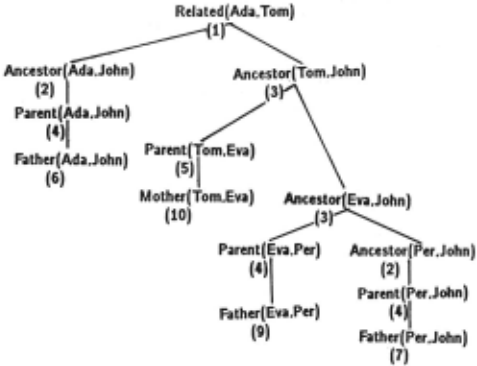
Let us study an AND-tree constructed for the proof of the formula Related(Ada,Tom) . The root of the proof tree is Related(Ada,Tom). When both Ancestor(Ada,z) and Ancestor(Tom,z) are deduced we can apply rule (1) to obtain Related(Ada,Tom). In Figure 1 below, the complete proof tree is shown.
III TRANSFORMATION OF PROOF TREES
Let us try to formulate rules for transforming proof trees.
When we interpret the rules as "definitional" in the sense that the precondition is a restatement of the conclusion, then in a rule of the form
Q is a specification of the concept P; Q is more precise than P. If we find an application of a specification rule in the proof tree, we can compact the tree by eliminating the consequence of the rule. Formally we can justify the transformation by the following reasoning: the two rules
implies the rule
An application of the two former rules (13) and (14) can be re placed by an application of the new rule (15). The new rule is re dundant, it does not add to the derivable set of theorems but the rule provides us with a neater explanation of the proof tree. However, we do not want to increase the number of eligible rules. The rules derived from the original axiom set are used only as rewrite rules of the proof trees. All nodes in a proof tree except the root and the leaves can be eliminated by deriving and applying deduced rules. Rules of the type (12) give an example of nodes that can be eliminated without loss as long as the chain has a limited length. Since the depth of an hierarchy of definitions tends to be shallow (Amsler, 1980) the transformation seems to be useful. However, it is essential that nodes important to the understanding of the solution are kept in the proof tree. If the rules are of the type "cause-effect", where the conclusion follows from the preconditions by some mechanism, the chain of reasoning can be much longer. In order to distinguish rules illustrating a principal idea in the domain, rules could be augmented with a measure of importance in the manner suggested by (Wallis and Shortlilfe, 1984). The use of importence metrics will then inhibit the elimination of concepts P; if the importence measure exceeds a certain limit.
Using the described technique we can derive a redundant rule
from the two rules (2) and (4). Consequently, in a proof tree, all sub trees to the left in the figure below can be replaced by the subtree to the right .
Let us try to make the proof tree presented in Figure 1 easier to grasp by deducing further redundant rules. The rule
can be derived from rules (1) and (16). The rules
can be derived from rule (3) together with (4) and (5) respectively. From (18) and (16) we can derive
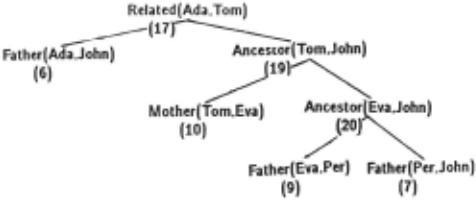
The proof tree for a proof that John is an ancestor of Ada is a subtree of the tree in Figure 1. Applying the derived rules, (16)- (20) we get the following tree Another way to transform a proof tree is to introduce a new con cept that is a specification of an earlier concept and a compilation of other concepts already present. In our example we can introduce the rewrite rules
Grandfather is a specification of a certain type of ancestorship, we can break up the recursive chain of ancestors by introducing grandpar ents. By adding the rule (21) we are able to eliminate the ancestor node in situations where the rule (22) is applicable.
We can derive the rules
The proof tree in Figure 2 can be reduced to the more comprehen sible tree where the occurrence of node Ancestor(Eva,John) is replaced by the node Grandfather(Eva,John).
The resulting proof tree depends on the rewrite rules that are provided. Each user can in these rules express their own view. When there are competing rewrite rules a_ selection mechanism has to be used.
IV PRESENTATION OF PROOF TREES
A. Stepwise presentation
When we have a non trivial proof tree it is essential to make the explanation sufficiently abstract. We make use of the tree structure for a stepwise presention of the proof tree. The first step of the explanation includes the root and its sons. The next step focus on some of the sons. This also offers the user possibilities to direct the presentation according to the her interests.
We look at a transformed tree for the proof of Related(Pia,Tom). In this tree both a new rule and a new fact appear
The tree is shown in Figure 3.
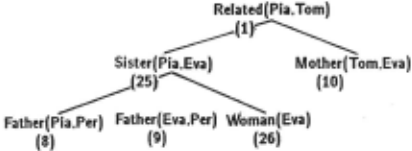
In the presentation we start to explain why Pia and Tom are re lated in terms of the information in the nodes at the underlying level in the tree.
We can continue the presentation with explaining why Tom's mother is a sister of Pia.
In order to make the explanation easier to read we present a clause using expressionforms connected to the predicates. For example the predicate Father(x,y) has the form "The father of x is y". In a corre sponding way we write Ancestor(x,y) and Related(x,y) as "An ancestor of x is y" and "x and y are related".
An instance of a rule, i. e. a node with its directly underlying nodes, we express "A since B" if the rule is A +- B. For example,
Ancestor(Ada,John) +- Father(Ada,John)
we express as "An ancestor of Ada is John since the father of Ada is John".
B. Filtering unlntereatlng valuea
In a proof tree, the arguments of the predicates have been in stantiated to values that satisfy the formula in the root node. In an explanation we are not interested in all of the values. To present all of them is inconvenient .
A conjunction where two parts share values can be expressed in a form where the shared values are eliminated. To explain why Ada and Tom are related, see Figure 2, by naming every person in the tree is more unclear than if we rewrite the expression omitting some names. The presentation "Ada and Tom are related since the father of Ada is John and a grandfather of Eva is John and the mother of Tom is Eva" is less clear than "Ada and Tom are related since the father of Ada is a grandfather of the mother of Tom".
We can eliminate "uninteresting" values by reformulating predi cates as functions and use these as values. For example, a conjunction of two predicates sharing a value can be reformulated as one of the predicates taking a representing function of the other as value. Anal ogously for conjunctions of three or more predicates. We illuminate it by an example
Father(Ada,x), Grandfather(Eva,x)
"The father of Ada is a grandfather of Eva" . In this explanation, "a grandfather of Eva" is a representing function for the grandfather relation and is substituted for x in the father relation.
Our approach is to avoid including instantiations that don't appear in the current root . We want to explain the conclusion without includ ing values appearing only in the precondition of a rule. Our example in previous section would become
Related(Pia,Tom) +- Sister(Pia,Eva), Mother(Tom,Eva)
"Pia and Tom are related since a sister of Pia is the mother of Tom", thus suppressing the value "Eva".
Reordering of conjunctions with common values can be necessary. A rule with a conjunction like
Cousin(Tom,Tim) +- Mother(Tom,Eva), Mother(Tim,Pia), Sister(Pia,Eva)
has to be reordered according to the common values. This rule becomes
Cousin(Tom,Tim) +- Mother(Tom,Eva), Sister(Pia,Eva), M other(Tim,Pia)
The explanation is "Tom and Tim are cousins since the mother of Tom is a sister of the mother of Tim".
C. Same valuea at correapondlng placea
If there is a conjunction of instantiations of the same predicate and the common uninteresting values are corresponding arguments, the expression will be clearer if we point out this fact . We express
Father(Ada,x), Father(Per,x)
as " the father of Ada is the same as the father of Per" .
D. Cuatomlsed explanation·
An important issue for obtaining clarity of explanations is to avoid presenting facts that already are known to the user.
General knowledge in our domain could for example be what names are names of women and what are names of men. If we are going to present the following rule Sister(Eva,Pia) +- Father(Eva,Per), Father(Pia,Per), Woman(Eva)
we can assume that the fact that Eva is a woman is general knowledge and suppress it. The explanation viii be "Eva is a sister of Pia since the father of Eva is the same as the father of Pia" .
Specific knowledge possessed by the user would also be taken care of. li is possible that the user is not totally naive, some facts may be well known to her and it would only be negative to repeat them.
We assume that the user is a near friend of parts of our example family and knows that Eva is the mother of Tom. Then we present
Related(Pia,Tom) +- Sister(Pia,Eva), Mother(Tom,Eva)
as "Pia and Tom are related since a sister of Pia is Eva" .
V CONCLUSIONS
The transformation of proof trees is a way to view the problem of explaining the reasoning of an expert system. The principal ideas presented in this paper are fairly easy to implement. Furthermore the transformation for reducing chains of specifications of concepts seems to be generally applicable. The transformation for introducing a new name for a compilation of concepts depends on the problem domain.
The solution to the problem of presenting the proof trees described in this paper is simple. Further work to improve upon the naturalness of the presentations lead into the area of natural language processing.
@inproceedings{ijcai1985p71,
  title     = {Neat Explanation of Proof Trees},
  author    = {Eriksson, Agneta and Johansson, Anna-Lena},
  booktitle = {Proceedings of the Ninth International Joint Conference on
               Artificial Intelligence, {IJCAI-85}},
  publisher = {International Joint Conferences on Artificial Intelligence},
  editor    = {Aravind Joshi},
  pages     = {379--380},
  year      = {1985},
  note      = {Expert Systems},
  url       = {https://ijcai.org/proceedings/1985/71},
}
TY - CPAPER TI - Neat Explanation of Proof Trees AU - Eriksson, Agneta AU - Johansson, Anna-Lena T2 - Proceedings of the Ninth International Joint Conference on Artificial Intelligence, IJCAI-85 PB - International Joint Conferences on Artificial Intelligence PY - 1985 SP - 379 EP - 380 UR - https://ijcai.org/proceedings/1985/71 ER -Copied
Machine-readable versions of this paper, for tools and AI agents:
 Welcome
 Future Conferences
 AI Journal Division
 IJCAI Proceedings
 About IJCAI
 IJCAI Awards