
Representing Procedural Knowledge in Expert Systems: An Application to Process Control
Proceedings of the Ninth International Joint Conference on Artificial Intelligence. Expert Systems. Pages 345-351.
© 1985 International Joint Conferences on Artificial Intelligence
Abstract
The paper presents a novel expert system architecture which supports explicit representation and effective use of both declarative and procedural knowledge . These two types of expert knowledge are represented by means of production rules and event-graphs respectively, and they are processed by a unified inference engine . Communication between the rule level and the event-graph level is based on a full visibility of each level on the internal state of the other, and it is structured in such a way as to allow each level to exert control on the other . This structure offers several advantages over more traditional architectures . Knowledge representation is more natural and transparent ; knowledge acquisition turns out to be easier as pieces of knowledge can be immediately represented without the need of complex transformation and restructuring; inference is more effective due to reduced non- determinism resulting from explicit representation of fragments of procedural knowledge in eventgraphs; finally, explanations are more natural and understandable . The proposed architecture has been adopted for the design of PROP, an expert system for on-line monitoring of the cycle water pollution in a thermal power plant . PROP is running on a SUN-2 workstation and has been tested on a sample of real cases
- Buchanan, B.G. and Duda, R.O. (1983). Principles of Rule- Based Expert Systems. In M.C. Yovits (Ed.), Advances in Computers 22, Academic Press, New York, NY, 163-216.
- Davis R. (1980a). Meta-Rules: Reasoning about Control. Artificial Intelligence 15, 179-222.
- Davis R. (1980b). Content Reference: Reasoning about Rules. Artificial Intelligence 15, 223-239.
- Davis R. and Smith R.G. (1983). Negotiation as a Metaphor For Distributed Problem Solving. Artificial Intelligence 20, 63-109.
- Friedland P. (1981). Acquisition of procedural knowledge from domain expert . Proc. 7th Int. Joint Conf. on Artificial Intelligence, Vancouver, BC, Canada, 856-861.
- Genesereth M. (1983). An Overview of Meta-level Architec- ture. Proc. 3rd Nat. Conf. on Artificial Intelligence, Wash- ington, DC, 119-124.
- Georgeti M.P. (1982). Procedural Control in Production Sys- tems. Artificial Intelligence 18, 175-201.
- Georgeti M.P. and Bonello U. (1983). Procedural Expert Sys- tems. Proc. 8th Int. Joint Conf. on Artificial Intelligence, Karlsruhe, FRG, 151-157.
- D'Angelo A., Guida G., Pighin M., and Tasso C. (1985). A Mechanism for Representing and Using Meta-knowledge in Rule-Based Systems. In M.M. Gupta, A. Kandel, W. Bandler and J.B. Kiszka (Eds.), Approximate Reasoning in Expert Systems, North-Holland, Amsterdam, NL (to appear).
- Hayes-Roth F., Waterman D.A., and Lenat D. (Eds.) (1983) . Building Expert Systems, Addison-Welsey, Reading, MA.
- Hudiicka A. and Lesser V. (1984). Meta-Level Control Through Fault Detection and Diagnosis. Proc. 4th Nat. Conf. on Artificial Intelligence, Austin, TX, 153-161.
- Kahn G. (1984). On When Diagnostic Systems Want To Do Without Causal Knowledge. In T. O'Shea (Ed.), ECAI-84: Advances in Artificial Intelligence, Elsevier Science, Amsterdam, NL, 21-30.
- Nelson W. (1982). REACTOR: An Expert System For Diagnosis and Treatment of Nuclear Reactor Accidents. Proc. Zth Nat. Conf. on Artificial Intelligence, Pittsburgh, PA, 296-301.
- Nii H.P., Feigenbaum E.A., Anton J.J., and Rockmore A.J. (1982). Signal-to-Symbol Transformation: HASP/SlAP Case Study. The AI Magazine 3(1), 23-36
- Reisig W. (1982) . Petrinetze, Springer-Verlag, Berlin, FRG.
- Underwood W.E. (1982). A CSA Model-Based Nuclear Power Plant Consultant. Proc. Zth Nat. Canf. on Artificial Intelli- gence, Pittsburgh, PA, 302-305.
References were extracted automatically from the PDF and may contain errors.
Full text extracted automatically from the PDF; figures, tables and equations may differ. The PDF is the version of record.
REPRESENTING PROCEDURAL KNOWLEDGE IN EXPERT SYSTEMS: AN APPIJCATION TO PROCESS CONTROL
Massimo Gallanti (·), Giovanni Guida(&), Luca Spampinato (+ ), Alberto Stefanini (·)
(·) CISE, P.O. Box 12081, 20134 Milano, Italy (&) Politecnico di Milano, Artificial Intelligence Project, Milano, Italy ( +) Quinary, Milano, Italy
suitable to large classes of challenging application domains, where, on the other hand, usual programming methods fail .
A major reason for the success of expert system tech nology is the way knowledge on the problem domain can be represented to the system. This offers in fact several highly desirable features , such as:
- ability to represent knowledge in a highly declarative way, without bothering about its use;
- possibility of describing fragmentary, ill-structured, approximate, uncertain, heuristic knowledge, that IS often of crucial importance in applications;
- possibility of incrementally creating, debugging, and updating very large knowledge bases.
These features have made rule-based systems a real success in all those application domains where knowledge involved is mainly declarative and fragmentary in nature (Buchanan and Duda, 1983).
The wave of such successes , as well as increasing interest in the industrial world, has led artificial intelligence research ers to tackle new classes of problems where, in addition to declarative and fragmentary knowledge, a lot of well struc tured chunks of procedural knowledge is naturally available and has to be represented and used (Friedland, 1981) . Con sider, for example, such areas as decision making, fault detection and diagnosis of complex systems, sensory data interpretation, monitoring of industrial processes, etc . .
In these cases, it would be foolish to disperse the avatlable procedural knowledge into a flat declarative representation. In fact, this would be costly and heavy with respect to knowledge acquisition, as it implies complex fragmentation and coding of knowledge . Moreover, it would cause a serious overload of the inference mechanism with the additional task of reconstructing, through a heavy non-deterministic search process, the correct procedural constraints between scattered fragments of knowledge . Finally, it would make the explanation mechanism of the inference engine very complex, quite unnatural. and practically useless.
It is evident that, for a number of applications where the classical rule-based system paradigm is not fully ade quate, a new mechanism is needed, which can combine the structured coding of procedural knowledge proper of tradi tional programming with the declarative representation typical of a pure rule-based system.
The issue of representing and using procedural knowledge in rule-based systems has been widely addressed in recent years in the frame of the studies about meta knowledge (Davis, 1980a, 1980b; Georgeff, 1982; Genesereth, 1983; D'Angelo, Guida, Pighin, and Tasso, 1985) . But the focus of attention is here more on the procedural aspect of control knowledge rather than on a fusion of procedural and declarative representations both at meta-level and domain level.
This topic has been only recently addressed in a neat way in
The paper presents a novel expert system architecture which supports explicit representation and effective use of both declarative and procedural knowledge . These two types of expert knowledge are represented by means of produc tion rules and event-graphs respectively, and they are pro cessed by a unified inference engine. Communication between the rule level and the event-graph level is based on a full visibility of each level on the internal state of the other, and it is structured in such a way as to allow each level to exert control on the other.
This structure offers several advantages over more tradi tional architectures . Knowledge representation is more natural and transparent; knowledge acquisition turns out to be easier as pieces of knowledge can be immediately represented without the need of complex transformation and restructuring; inference is more effective due to reduced non-determinism resulting from explicit represen tation of fragments of procedural knowledge in event graphs; finally, explanations are more natural and under standable .
The proposed architecture has been adopted for the design of PROP, an expert system for on-line monitoring of the cycle water pollution in a thermal power plant. PROP is run ning on a SUN-2 workstation and has been tested on a sam ple of real cases.
INTRODUCTION
The artificial intelligence community has been success fully applying, since the mid-seventies, new powerful rule based techniques to applications that could not be faced with more traditional approaches . In fact, the complexity of any classical solution was so evident as to discourage their use from the beginning.
Rule-based system technology (Hayes-Roth, Waterman, and Lenat, 1983) has offered a basic advantage over traditional programming: it has enabled the programmer to tackle problem solving at a higher level of abstraction and in a more flexible and natural way. The usual activities of prob lem analysis, invention of a solution algorithm, and pro gramming are replaced in the expert system approach by the representation of knowledge about the application domain (including available resources, constraints, and problem solving skills), of the specific problem to be solved, and of the goal to be achieved. Responsibility about how to use knowledge in order to solve the problem is left to the system, and the programmer only has to represent what is known about the problem and is likely to be relevant to its solution. The new concept of knowledge-based problem solving appears, therefore, as another way of programming,
(+)Also with Universita' di Milano, lstituto di Cibernetica, Milano, Italy
This reselll'ch has been supported by ENEL-DSR (Ente Nazionale per l'Energia Elettrica- Direzione Studi e Ricerche).
(Georgeff and Bonollo, 1983). Their approach combines explicit representation of fragments of procedural knowledge with a mechanism for pattern-directed invoca tion (both goal-directed and data-driven). This approach allows effective solution of a class of practical problems, specially of consultation type, and discloses the challenging issue of heterogeneous knowledge representation in the design of expert system architectures.
The purpose of the work reported in this paper is the development and experimentation of a new approach to the integration of rule-based mechanism and computation according to procedural knowledge, that can meet the fol lowing goals:
- effective and natural representation of pieces of pro cedural knowledge by means of a powerful and general language;
- use of production rules for representing declarative knowledge;
- integration of the two components into a unitary infer ence mechanism.
This research effort yielded to the proposal of a novel expert system architecture that has been tested in the design and implementation of PROP, an expert system for malfunction diagnosis and process surveillance concerning on-line monitoring of water pollution in a thermal power plant.
The purpose of this paper is to introduce and discuss the main features of the new proposed architecture and to illustrate the results obtained in a practical application. The general organization of the proposed expert system paradigm is first introduced and compared to related works. Afterwards, the application addressed is briefiy described, and the specific architecture of the implemented expert system is illustrated. Examples of PROP operations are presented. Finally, research results are critically evaluated and possible extensions of the proposed approach
are outlined.
PRODUCTION RULES AND EVENT GRAPHS
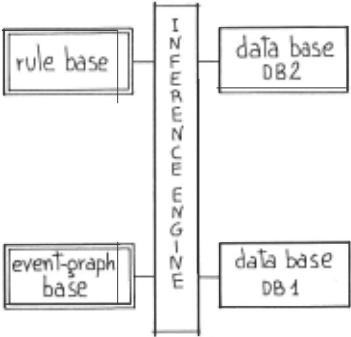
The general architecture of the novel expert system paradigm we have developed is shown in Figure 1. It comprises two knowledge bases, namely a rule base and an event-graph base. The former is used to contain declara tive knowledge expressed by means of usual production rules, while the latter embodies procedural knowledge represented through event-graphs.
I-- The notion of event-graph shares several features with the Petri net formalism (Reisig, 1982).
Figure 1 - Basic system architecture
We disregard here the formal definition of an event-graph and only focus on its basic expressive features. An event-gruph (EG) is a directed graph with two types of nodes, namely places and events, and a marking concept. Nodes termed places are graphically represented as circles and nodes termed events are graphically represented as boxes. Directed arcs can only connect nodes of different type. Events are labeled with two expressions, specifying a condition and an action respectively. A sample EG is shown in Figure 2.
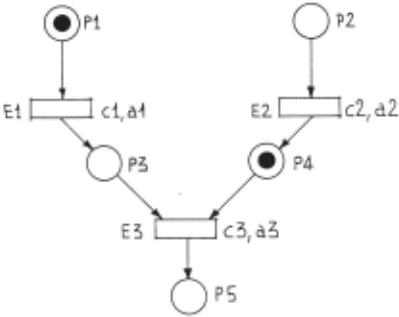
A place can contain a mark; an EG can have an arbitrary number of marks: the set of all marked places defines the current mark:mg of the EG. For example, the current mark ing of the EG in Figure 2 is !Pl. P4j. An initial marking is defined for each EG.
An event is enabled if all its ancestor places, called the 'input places, are marked. An event can fire, i.e. it is active, if it is enabled and its condition is true.
We define as current conditions of an EG the set of condi tions labeling the enabled events. For example, the current conditions of the EG in Figure 2 is ! c 1j. An EG is active, (resp., enabled) if at least one of its events is active (resp., enabled). F'i:ring an event means unrnarking its input places and marking all its successor places, called the output places. Firing an event also causes the execution of the action specified in the event. Current marking thus evolves by means of event firing.
We stress that the concept of event-graph embodies a static and a dynamic part. The static part, i.e. the definition of places, arcs, and events with conditions and actions (plus the initial marking), represents the code of a chunk of pro cedural knowledge. The dynamic behaviour of an event graph is represented by the sequence of current markings that the event-graph goes through as a consequence of suc cessive event firing. Thus, the static part of an event-graph may be activated in different contexts and produce several images corresponding to different current markings, similar to a re-entrant procedure which can be executed several times in parallel with different parameters.
Two data bases, DBl and DB2, are available to the sys tem to be used by EGs and rules. They contain knowledge on the current state of the inference process and also con stitute the link between the system and the external world (user, environment, etc.), as they can accept input data and produce output messages. Data bases DB1 and DB2 are first initialized with information coming from outside (initial problem description) . A modified recognize-act cycle is then entered, which is controlled by the achievement of a i\Oal condition. This cycle comprises two phases: (see Ftgure 3)
- event-graph level phase :
EGs are first matched with the content of DBl. The set of enabled EGs is determined and conftict resolution is performed. The current conditions of selected (enabled) events of EGs are then matched with the con tent of DB1 and the set of active EGs is determined. Conflict resolution is performed again. All selected (active) events are eventually fired in parallel, and the corresponding actions are executed on DB1 and DB2;
rules are first matched with the content of DB2. The set of active rules is then determined and conflict resolu tion is performed. Selected rule /s is /are eventually
- rule level phase: executed on DB2 and DB1.
~~~ze VB ! and VBZ
Jtepea.t
<event-gJtaph level pha6e>
ma.tc.h event-g~taph ba6e wdh VB! and dete~t m<.ne enabled event g~taphJ.,
Jte/.>olve c.on6uct
ma.tc.h ~.>elected event-gJtaphJ., wah VB1 and de;te!trrU.ne a~ve event-gJtaphJ.,
6~e all a~ve event!.> and exac.ute Jtelevant a~on!.> on VB! and VBZ
<ILU..te level pha6e>
ma.tc.h Jtule ba6e wdh VBZ and dete!trrU.ne c.on6uct ~.>et
Jte/.>olve c.on6uct
exec.ute ~.>elected Jtule/1.> on VBZ and VBI
u~ goal c.on~on
Figure 3 - Basic mode of operation of the inference engine
The architecture above sketched is very general. Both levels can contain representation of domain knowledge and meta-lmowledge, and both DB1 and DB2 can embody knowledge on the problem and control knowledge on the problem solving strategy. The rule base can be organized according to any of the usual structuring techniques, such as partitioning, meta-rules, etc . Also the event-graph base can be given arbitrarily complex structure by defining rela tions among EGs .
Both the event-graph and rule levels maintain in their own data base (DB1 and DB2 respectively) the information needed for their operation (computation and deduction respectively) . Whenever some information has to be shared by the two levels it must be duplicated in the two data bases.
Each of the two levels can exert control on the other: rules can influence the operations of event-graphs by forcing, conditioning, or suspending their activation through modifications of the current markings stored in DB1; on the other hand, EGs actions can change the conditions for matching rules by modifying the content of DB2.
The novel expert system paradigm above introduced embodies the features of usual rule-based paradigm as well as the ones proper of imperative programming languages. The most relevant contribution of our approach is the definition of an environment where these two components can naturally cooperate in a problem solving task. In this respect, it shares some characteristics with the work of Georgetf and Bonello (1963) , but it also includes several new points:
- the visibility of the system on pieces of procedural knowledge is not limited to input/output information (procedural abstraction) ; specific mechanisms are pro vided to access the internal state and influence the dynamic behaviour of EGs;
- the design of the right dimension of pieces of pro cedural knowledge is not a critical point as intermedi ate results of partial EG computations can be accessed and used (note that generally too small fragments tend to reduce the advantages of having explicit representa tion of procedural lmowledge, while too large chunks imply the possibility of long, useless computations, as once a procedural area is entered its interruption causes the loss of all intermediate results) ;
representation and use of declarative knowledge is not limited to the invocation part of a knowledge area.
PROBLEII ANALYSYS AND SYSl'EM SPECIFICATIONS
In this section we focus on the problem of on-line mon itoring of water pollution in a thermal power plant that has been used as a testbed for the new expert system architec ture introduced in the previous section.
The usefulness of artificial intelligence techniques for assisting and advising the operator of a power plant in case of accidents has already been stressed in (Nelson 1962) and (Underwood 1962). Our problem, even if it is not concerned with plant safety, lies in this application area. The aim of the system is to avoid damages to critical subsystems of the power plant and to limit plant unavailability caused by chemical agents , by means of early fault detection and diag nosis, and appropriate intervention.
A simplified schema of a thermal power plant is given in Figure 4. In order to ensure the correct operation of the plant and to preserve the materials constituting some criti cal subparts, the cycle water must be kept as pure as possi ble. In fact, possible pollutants dissolved in the cycle water may react with the plant in different ways, mainly at high temperature, giving both oxidation products and acids that can damage the tubes, the walls of the boiler, and the rotat ing parts of the turbine.
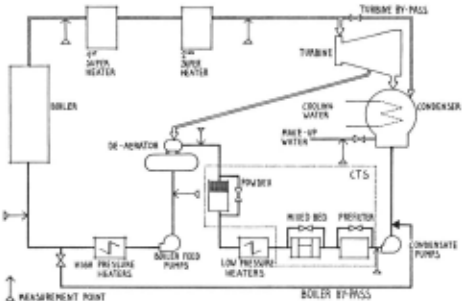
Therefore a chemical treatment subsystem (CTS) is included in the plant and is used by a human operator to clean the cycle water whenever it is affected by some pollu tant . The CTS includes two different kinds of filters :
- the mixed bed, containing ion exchange resins, that operates a chemical filtering;
- the prefilter and the powdex, containing cellulose and pulverized resin respectively, that remove oxides through a physical filtering.
The insertion level of the filters is regulated by the operator depending on the nature and quantity of the pollutants in the water.
Pollutants of different kinds can enter into the cycle:
- marine or river water carrying salts and sand (through the condens <)r) ;
- air (in particular, oxygen and carbonic dioxide) ;
- cellulose and resins released by the CTS itself.
Pollution phenomena are controlled by continuous measuring of several chemical parameters (total conduc tivity, acid conductivity, oxygen concentration, etc.) at several points of the cycle (see Figure 4) .
The control equipment currently installed in the plant can automatically open the valves that by-pass the critical subsystems (e.g., boiler or turbine) when one of the above mentioned chemical parameters at a single measurement point increase beyond a fixed threshold level, in order to avoid immediate damage . The task of the operator is to prevent the pollution reaching this limit situation by prop erly activating the CTS as soon as some sensors show abnor mal values . In fact, when a limit situation occurs, some components of the plant may have already been damaged, and, in any case, the by-pass of a critical subsystem causes a significant loss of power.
During working time the chemical staff can advise the operator on the most appropriate actions to be taken to control an incipient pollution phenomenon; during the night, week-end, and holidays the operator must follow the instructions in a handbook.
The operative procedure above described has often proved to be unsatisfactory for several reasons:
- The operator usually guesses that a pollution phenomenon is occurring only when the sensors show highly abnormal values, so that the corrective action is not as timely as it should be .
- Sometimes, the presence of a pollutant can be detected only by correlating the temporal trends of different parameters. These correlations require expertise not available to the operator.
- The operator is inclined to reason in terms of short time effects. Therefore, he often underestimates slight pollutions that, however, can generate long term dam age.
- When the operator has to manage situations without the advice of the chemical staff, he is often in trouble as the procedures specified in the handbook are too simple and schematic and turn out to be be useless in complex cases.
In order to face these problems, we have investigated the possibility of using a computer-based system that can acquire chemical parameters from the sensors on the plant and give advice to the operator. A preliminary analysis of the knowledge required to recognize abnormal situations, identify the kind of pollutant, and suggest the proper intervention has shown that expert system methodology can be more advantageous than traditional approaches .
This led to the design and implementation of PROP, a real time expert system that can assist the CTS operator. PROP directly acquires data from the plant through sensors at a fixed time rate . These measurements concern general information on the plant (e.g., flow rate, etc .) , chemical parameters (e.g ., acid conductivity, oxygen concentration, etc .), and states of some subsystems (e.g ., mixed bed inser tion, de-aerator valve position, etc.) . Moreover, through the keyboard, the operator can introduce further information that cannot be directly acquired by sensors (e.g., results of off-line chemical analyses, etc.) .
As soon as an anomaly is detected, PROP displays a set of hypotheses on the operator console, that can explain the malfunctioning . Afterwards, the system keeps the evolving situation under control. tries to focus on the most plausible hypothesis, and suggests proper interventions.
After the situation has been brought to normality, PROP closes the diagnosis/intervention session, informs the operator as to the success of the undertaken interventions, and resumes normal monitoring activity.
KNOWLEDGE REPRESENTATION
Expert knowledge involved in the problem illustrated in the previous section can be organized at three different lev els. The human expert uses, in fact, three kinds of knowledge : each of them is involved in a particular class of activities .
Data interpretation level
It comprises the techniques that make the expert able to collect and analyze information about the behaviour of a large number of chemical and state parameter s and to derive a representation of the state of the plant from the point of view of cycle water pollution. In other words, it contains knowledge about how to observe the plant in order to translate parameter values and trends into sym bolic, higher level conceptual representation.
A data interpretation activity is, for example, the early perception of an alarm condition detected by correlat ing a fast power decrease with a smooth rise, after a definite time interval, of the acid conductivity measured before the de-aerator .
Such reasoning can be carried out only by paying a tten tion to a restricted set of the available signals and parameters, with a precise concept of what one is looking for. The human expert is able to carry out a rather large number of different data interpretation activities and to choose the right one taking into account the current state of his hypotheses and expectations.
Diagnosis /intervention level
It comprises the techniques currently utilized for fault diagnosis, i.e. for recognizing one or more of the possible pollution causes and for performing appropriate recovery actions . Each diagnosis /intervention activity descr ibes the hypotheses, expectations, and actions that relate to a specific pollution situation. It specifies which data interpretation activities have to be started, and how their results have to be evaluated in order to validate (or reject) a certain diagnosis .
The confirmation of a suspected condenser leakage and the control of the leakage propagation along the plant are, for example, the tasks of two diagnosis/intervention activities .
Control level
When an abnormal situation is detected in the plant , the expert formulates a number of hypothetical diagnoses . Each of them can be validated or rejected by means of a diagnosis/intervention activity, and all of these tasks must be carried on in parallel. In a given instant the state of each diagnosis/intervention activity and the results, though partial, of each related data interpreta tion activity give an image of the state of the plant from the point of view of a hypothetical diagnosis.
Before a single diagnosis is definitely ascertained or when concurrent pollutions take place, the expert has to manage relationships and confiicts among all the active diagnosis /intervention activities. Moreover, successful results achieved by a specific diagnosis/intervention activity are often detrimental to other ones. In general, in dealing with complex situations, chunks of information concerning the state of several diagnosis/intervention activities are to be compared.
For example, a diagnosis/intervention activity which is concerned with propagation of a condenser leakage must inhibit consideration of all the diagnosis/intervention activities that assume a fault in a subsystem that is located further down the condenser in the cycle (e .g., powdex, de-aerator, etc.).
The human expert carries out this crucial control task by means of strategic knowledge, that makes him able to activate, deactivate, privilege, and influence the diagnosis /intervention activities necessary to globally diagnose and control the behaviour of the plant .
Data interpretation and diagnosis/intervention activities can be easily expressed in a procedural language. They can, in fact , be naturally seen as pieces of procedural knowledge:
- data interpretation activities are procedures that specify a sequence (with selections and iterations) of elementary observations of the plant;
- diagnosis/intervention activities are higher-level pro cedures that comprise as elementary steps the invoca tions and consultations of a number of data interpreta tion activities.
A main point is that the dynamic behaviour of such pro cedures must be easily observed and influenced from out side. Procedures are important here not only for the r esults they can compute, but specially for the intermedi ate computations they perform. The diagnosis/intervention level works on the behaviour of the data interpretation activities, and the control level must exert its influence on both diagnosis/intervention and data interpretation activities . ·
Expert knowledge that deals with time, which is of cru cial importance in on-line applications, has an explicit role in our application at the data interpretation level only. In fact, experts explicitly refer to time relations only when they describe the procedures they use for observing the behaviour of the plant. The procedural nature of data interpretation level knowledge makes it easy to represent such temporal statements explicitly as time interval meas urements.
Control knowledge is more declarative and fragmentary in nature . It can be represented by means of production rules to be used in a non-deterministic way.
The knowledge analysis above developed can be usefully compared to the approaches of Nii, Feigenbaum, Anton, and Rockmore ( 1982) on HASP /SlAP, of Kahn ( 1982) on MUD, and of Hudlicka and Lesser (1984) on FDD.
We believe that the model above introduced for the analysis of knowledge involved in the diagnosis of cycle water pollution of a thermal power plant embodies several features of general significance . It could easily be applied to a large class of tasks concerning real-time fault detec tion, diagnosis, and intervention in complex systems.
PROP ARClDTECTURE
Now we can merge the knowledge analysis above developed with the general architecture proposed.
The procedural knowledge of the data interpretation and diagnosis /intervention levels can be properly represented in the event graph-base as a collection of independent EGs. Though data interpretation and diagnosis /intervention EGs have the same syntactic representation, their events are labeled with expressions of two different languages:
- Expressions appearing in data interpretation EGs must be evaluated with respect to chemical and state param eters acquired from the sensors (stored in DBl), or with respect to time intervals. A condition referring to a time interval starts a counter the first time it is evaluated and it remains false until the time interval has expired.
- Expressions of diagnosis/intervention EGs, on the other hand, refer to the markings of data interpretation EGs.
Current markings of EGs are represented in DB1 and dupli cated in DB2 in such a way as to be explicitly and directly accessible by the rule level too. The evaluation of a condi tion bound to an event of a diagnosis/intervention EG that refers to a not yet enabled data interpretation EG causes its enabling, i.e . the places in its initial marking are marked. Therefore, a data interpretation EG has a current marking for each diagnosis/intervention EG that uses it. This represents the capability of the system to exploit, in an independent way, a single data interpretation procedure in different contexts.
Both EG base and DB1 are naturally partitioned. In fact, it must be possible to distinguish data interpretation EGs from diagnosis/intervention ones in the EG base and each of the independent markings of the data interpretation EGs in DBl.
Control level knowledge fits in the rule base . It ls represented by production rules whose conditions and actions refer to markings of both data interpretation and diagnosis /intervention EGs.
Moreover, a credibility value is defined for each active diagnosis/intervention EG. It represents the promise for the EG to be most appropriate, up to the moment, for explain ing the ongoing phenomenon and for suggesting the right actions on the plant . The maintenance of the credibility values is provided by the control level. They are used in confiict resolution activities.
As EG markings and credibility values seem to be the only information required by the control level in our partic ular application, we have merged in the implementation DBl and DB2 into a single data base. This simplifies and speeds up system operation without loss of power. In fact, as pointed out above, in our application declarative knowledge has a controlling role only.
AN EXAMPLE
PROP has been implemented in Franz Lisp on a SUN-2 workstation at CISE laboratories and it has been tested on recorded patterns comprising a wide variety of different operating situations. A pilot on-site installation of PROP is presently being developed.
This section illustrates a few examples of PROP opera tion. For easier understanding the examples are reported in a simplified way.
The examples refer to the diagnosis of pollution aris ing in the condenser. To detect this kind of anomaly as soon as it occurs, the human expert must focus on the set of chemical parameters measured around the condenser. In particular, the increase of the acid conductivity between the condenser inlet and outlet must be considered a significant event. Therefore a data interpretation activity (CONDENSER-CONTROL) concerning chemical parameter trends in the condenser has been defined. Acid conductivity increase beyond the normal level is an elementary observa tion included in this data interpretation activity. When such an event occurs, the human expert realizes that a pollution from the condenser is likely to take place, and he immedi ately defines some objectives that will support his succes sive observations and suggests proper corrective actions . The main objectives considered in this situation are reported below: each of them is represented in PROP by a diagnosis/intervention activity (mentioned in parentheses):
- control of the pollution trend in relation to the inter vention undertaken to remove the cause of pollution (CONDENSER-LEAKAGE);
- control of the pollution propagation along the plant (in particular towards the boiler) and reduction of the pol lution effects by means of insertion of CTS filters (CONDENSER-LEAKAGE-PROPAGATION);
- detection of the kind and source of pollution. In fact, pollution can be due to cooling water (COOLING WATER-LEAKAGE), to air contamination from conden sate pumps (AIR-CONTAMINATION), or to impurities of make-up water (POLLUTANT-FROM-MAKE-UP-WATER) .
Figure 5a illustrates the EG representing the CONDENSER LEAKAGE diagnosis /intervention activity. Events are labelled here with conditions only. The general form of a condition is a logical expression involving predicates of the type: (<DATA-INT-ACT-NAME> in <PLACE-NAME>), that is true if, at evaluation time, the place <PLACE-NAME> in the data interpretation EG <DATA-INT-ACT-NAME> is marked.
When the CONDENSER-CONTROL data interpretation activity has a mark in the place LEAKAGE-DETECTION, the places in initial marking (FIRST-RISE) of the CONDENSER-LEAKAGE EG are marked.
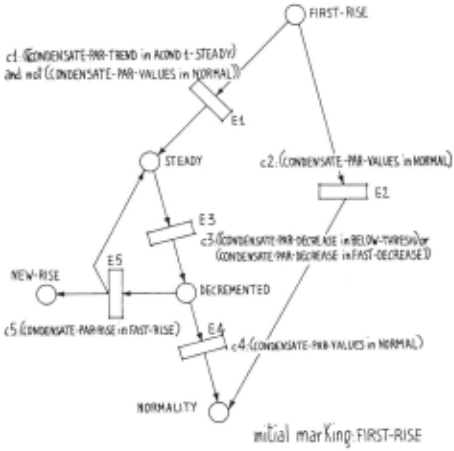
The evolution of the diagnosis/intervention activity accord ing to the CONDENSER-LEAKAGE EG depends on the following events :
- The ratio between acid conductivities at condenser inlet and outlet becomes stable (STEADY) . In this case the pollution is assumed to have reached a defined value.
- The ratio between acid conductivities at condenser inlet and outlet shows a peak, i.e., the acid conductivity suddenly increases and then rapidly comes back to normal values (NORMALITY) .
- The acid conductivity keeps a steady value for a while and then decreases as a result of an appropriate inter vention, but without reaching a normal value (DECRE MENTED).
- Pollution comes back to normal values (NORMALI1Y) .
- Pollution increases again (NEW-RISE).
When the place FIRST-RISE of the CONDENSER-LEAKAGE EG is marked, events El and E2 are enabled. The data interpretation activities CONDENSATE-PAR-TREND and CONDENSATE-PAR-VALUE are started. Event El will fire when the CONDENSATE-PAR-TREND EG has the ACONDl STEADY place marked and event E2 has not yet fired.
In Figure 5b we show the the CONDENSATE-PAR-TREND EG. This EG verifies whether the acid conductivity increase measured at the condenser outlet has reached an abnormal value. Moreover, it checks the oxygen concentration varia tion during the conductivity increase. As mentioned above, this data interpretation activity is used to verify the condi tion cl of event El in the CONDENSER-LEAKAGE EG. Other information given by this EG (e.g., check of the oxygen increase) is used by control level rules (RULE-29 - see below).
Predicates of data interpretation EGs are evaluated with respect to an object oriented organization of the acquisition buffers and of the low level numerical programs, i.e . average and derivative calculations, etc. This choice was made to increase system flexibility in the interface with either a possible simulation environment or an operational one. A complete description of this representation schema is beyond the aim of this paper, so that a rather free predi cate calculus-like notation is adopted in the EG of Figure 5b. Most of the expressions that label events in the CONDENSATE-PAR-TREND EG are self-explanatory. In addi tion, we point out the following:
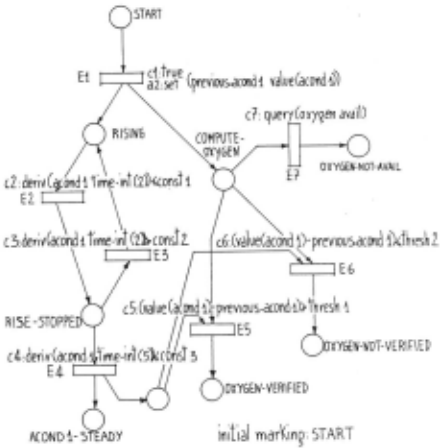
- An action (setting the local variable 'previous-acond1') is associated with event E1. In the other events the action field is empty.
- In events E2, E3, and E4, the evaluation of the predi cates c2, c3 and c4 involves a call to a numerical pro gram that computes the average slope on a specified time interval.
- In events E5 and E6 the predicates c5 and c6 specify the difference between values of a parameter in two different instants.
- The function "query", in event E7 means that PROP will ask to the human operator the values necessary to compute the truth value of condition c7.
Some examples of rules defined at the control level are shown in Figure 6.
In the action side of RULE-29 the enabling or two diagnosis /intervention activities is defined. These diagnosis /intervention activities are enabled in order to investigate the pollution source: the former (AIR-FROM CONDENSER) verifies whether air contamination (for exam ple from a condensate pump) is present, the latter (POLLUTANT-FROM-MAKE-UP-WATER) considers impurities coming from the make-up water.
RULE-29
CONDENSER-LEAKAGE in STEADY and CONDENSATE-PAR-TRENDS
invoked-by CONDENSER-LEAKAGE
in OXYGEN-VERIFIED
enable AIR-FROM-CONDENSER
enable POLLUTANT-FROM-MAKE-UP-WATER
RULE-55
CONDENSER-LEAKAGE IN ACTIVE and POLLUTANT-FROM-MAKE-UP-WATER in WAIT-CONFIR MATION and AIR-FROM-CONDENSER in VERIFIED
.then
.then
deactiva-te POLLUTANT-FROM-MAKE-UP-WATER
Figure 6- Examples of rules
The premise of RULE-29 is satisfied if:
- the CONDENSER-LEAKAGE diagnosis/intervention activity has been enabled and it verifies that the pollu tion level has stopped increasing, that is, its EG has the place STEADY marked;
- the CONDENSATE-PAR-TRENDS data interpretation activity activated by the CONDENSER-LEAKAGE diagnosis/intervention activity verifies an increase of oxygen concentration.
Note that the two diagnosis/intervention activities enabled by RULE-29 are concurrently involved in the explanation of the same phenomenon. The management of the results obtained from these two different points of view is accom plished by means of other control level rules, with the aim of definitely validating one hypothesis and rejecting the other.
For example, RULE-55 disregards the hypothesis that the pollution is due to the make-up water (deactivate POLLUTANT-FROM-MAKE-UP-WATER) because, in the mean time, the hypothesis of air contamination from the con denser (AIR-FROM-CONDENSER) has been verified (its VERI FIED place is marked). This takes place even if the POLLUTANT-FROM-MAKE-UP-WATER EG cannot yet give definite results as it is still waiting for the firing of some of its events.
CONCLUSIONS
The work done with PROP has allowed definition and testing of a novel rule-based system architecture support ing heterogeneous knowledge representation. The proposed approach is expected to offer three major advantages:
- the knowledge representation mechanism constituted by the fusion of production rules and event-graphs makes knowledge acquisition more effective and easy and knowledge organization more transparent and natural;
- non-determinism is limited to those aspect of the prob lem domain which actually imply non-deterministic operation, and is not used extensively thus overcoming fictitious search problems deriving from a poor knowledge representation schema;
- explanation capability can closely follow the path of human reasoning, as a consequence both of the natur alness of knowledge representation and of the con strained non-determinism of the inference process .
The research has disclosed several new issues to be considered in future work. Among these we stress the exten sion of the proposed architecture to include explicit representation of the communication net connecting heterogeneous knowledge chunks (Davis and Smith, 1983), thus overcoming the limitations of the simple communication schema currently adopted. Moreover, expli cit temporal reasoning, credibility values computation and propagation, and the implications of the proposed architec ture on meta-level structure are going to be investigated.
ACKNOWLEDGMENTS
The construction of the knowledge base of PROP has been possible thanks to the experts of several ENEL Depart ments (Construction, Operation and Research & Develop ment Departments) who have cooperated with CJSE in the frame of an internal ENEL working group. We are indebted to the above Departments for the support and contribution offered. In particular, we would like to thank Giovanni Qua dri of ENEL-DCO, Flavio Bacci of ENEL-DPT, and Raffaele Pas cali of ENEL-DSR.
REFERENCE:)
Buchanan, B.G. and Duda, R.O. (1983). Principles of Rule Based Expert Systems. In M.C. Yovits (Ed.), Advances in Computers 22, Academic Press, New York, NY, 163-216.
Davis R. (1980a). Meta-Rules: Reasoning about Control. Artificial Intelligence 15, 179-222.
Davis R. (1980b). Content Reference: Reasoning about Rules. Artificial Intelligence 15, 223-239.
Davis R. and Smith R.G. (1983). Negotiation as a Metaphor For Distributed Problem Solving. Artificial Intelligence 20, 63-109.
Friedland P. (1981). Acquisition of procedural knowledge from domain expert . Proc. 7th Int. Joint Conf. on Artificial Intelligence, Vancouver, BC, Canada, 856-861.
Genesereth M. (1983). An Overview of Meta-level Architec ture. Proc. 3rd Nat. Conf. on Artificial Intelligence, Wash ington, DC, 119-124.
Georgeti M.P. (1982). Procedural Control in Production Sys tems. Artificial Intelligence 18, 175-201.
Georgeti M.P. and Bonello U. (1983). Procedural Expert Sys tems. Proc. 8th Int. Joint Conf. on Artificial Intelligence, Karlsruhe, FRG, 151-157.
D'Angelo A., Guida G., Pighin M., and Tasso C. (1985). A Mechanism for Representing and Using Meta-knowledge in Rule-Based Systems. In M.M. Gupta, A. Kandel, W. Bandler and J.B. Kiszka (Eds.), Approximate Reasoning in Expert Systems, North-Holland, Amsterdam, NL (to appear).
Hayes-Roth F., Waterman D.A., and Lenat D. (Eds.) (1983) . Building Expert Systems, Addison-Welsey, Reading, MA.
Hudiicka A. and Lesser V. (1984). Meta-Level Control Through Fault Detection and Diagnosis. Proc. 4th Nat. Conf. on Artificial Intelligence, Austin, TX, 153-161. ··
Kahn G. (1984). On When Diagnostic Systems Want To Do Without Causal Knowledge. In T. O'Shea (Ed.), ECAI-84: Advances in Artificial Intelligence, Elsevier Science, Amsterdam, NL, 21-30.
Nelson W. (1982). REACTOR: An Expert System For Diagnosis and Treatment of Nuclear Reactor Accidents. Proc. Zth Nat. Conf. on Artificial Intelligence, Pittsburgh, PA, 296-301.
Nii H.P., Feigenbaum E.A., Anton J.J., and Rockmore A.J. (1982). Signal-to-Symbol Transformation: HASP/SlAP Case Study. The AI Magazine 3(1), 23-36
Reisig W. (1982) . Petrinetze, Springer-Verlag, Berlin, FRG. Underwood W.E. (1982). A CSA Model-Based Nuclear Power Plant Consultant. Proc. Zth Nat. Canf. on Artificial Intelli gence, Pittsburgh, PA, 302-305.
@inproceedings{ijcai1985p66,
  title     = {Representing Procedural Knowledge in Expert Systems: An Application to Process Control},
  author    = {Gallanti, Massimo and Guida, Giovanni and Spampinato, Luca and Stefanini, Alberto},
  booktitle = {Proceedings of the Ninth International Joint Conference on
               Artificial Intelligence, {IJCAI-85}},
  publisher = {International Joint Conferences on Artificial Intelligence},
  editor    = {Aravind Joshi},
  pages     = {345--351},
  year      = {1985},
  note      = {Expert Systems},
  url       = {https://ijcai.org/proceedings/1985/66},
}
TY - CPAPER TI - Representing Procedural Knowledge in Expert Systems: An Application to Process Control AU - Gallanti, Massimo AU - Guida, Giovanni AU - Spampinato, Luca AU - Stefanini, Alberto T2 - Proceedings of the Ninth International Joint Conference on Artificial Intelligence, IJCAI-85 PB - International Joint Conferences on Artificial Intelligence PY - 1985 SP - 345 EP - 351 UR - https://ijcai.org/proceedings/1985/66 ER -Copied
Machine-readable versions of this paper, for tools and AI agents:





