
Parallel Formulation of Evidential-Reasoning Theories
Proceedings of the Ninth International Joint Conference on Artificial Intelligence. Expert Systems. Pages 321-326.
© 1985 International Joint Conferences on Artificial Intelligence
Abstract
There ia no general consensus on bow best to attack evidential-reasoning (ER) problems, paniculady in expert-ayatem applications. Several approaches have evolved, but they have their roots in divene fields, eucb u etatiatice and pbiloeopby, and have neither a common terminology nor a common eet of ueumptiona. The research reported here provides two useful results. Firat, it etructures the evidential-reasoning problem in a general paradigm robust enough to be of practical uee in design and construction of expert eyateme. Second, it ueee tbia paradigm to formulate five important theoretical approaches in a parallel fubion in order to identify key ueumptione, eimilaritles, and differences. The five approaches diecueeed are clueical Bays, convex Bayee, Dempeter-Sbafer, Kyburg, and poeeibility.
- The p&rallel formulation il beins extended &o include other approaches, auch u Shortliffe'• certainty theory and Cohen'• endoreemen& theory. (2) Computational experiment. are beins carried out in order to compare the evolution of belief a&&tes when controlled by different approach-. Thie ahould ultimately re~ult in pidelin• &hat can aid Ul in choolins &he moe& appropriate eviden&i&l-reuonins approach for different typ• of experi-q1&em tub. REFERENCES
- Bl -Bellman, R., and Zadeh, L. Deciaion-m&kins in a Fuuy Environment. Technie&l Report ERL-89-8, Electronict Reaeareh Laboratory, Univerlity of California, Berkeley, 1989.
- B2 -Blackwell, D., and Glrehlck, M. Theory 21 Games and S&atillle&l Deellio!!!, WUey, New York, 19M.
- Cl -Chernoff, H., and Moaee, L. Elemenl!I'Y Deciaion Theory, WUey, New York, 1959.
- Dl -Demplter, A.P. A ceneraliu&ion of Bayesian inference. ~ Royal Stat. Soc., 80(2), 206-247, (1908).
- D2 -Duda, R., Hart, P., and NU.On, N. Subjective Bayeli&n Method. for rule-bued inference q1tema. In Proceediop 21 AFIPS 1978 National Computer Conference, pp. 1075-1082, 1978.
- G1 -Galnee, B. Fundamen&&ll of deciaion: probabUie&ic, poaeibUie&ic, and other forma of uncertainty in deciaion analyllil.
- J1 -Jeffrey, R. The Lolic !!f Decillion, 21'd edition, Univerlity of Chicaco Pre~~, Chieaco, 1988.
- Kl -Kyburc, H.E., Jr. The Lol!ie&l Found&tiona of S&&til&ie&l Inference, Reidel, Boe&on:l9u.
- - K2 -Kyburc, B.E., Jr. Bayeli&n and non-Bayeli&n evidential upd&tinJ. Teehnie&l Report 189, Univerlity of Rochelter Computer Science Department, 1984.
- L1 -Levi, I. The Enterprlae !!f Knowledse, MIT Pre~~, Cambridse, M-., 1980.
- M1 -Mamdani, E., O.&erp.&rd, J., and Lembealil, E. Uae of fuuy lope for lmplemen&ins rule-bued control of indUI&rial proc-. In ~ Seta and Deciaion Analnia. B.
- Zimmerman, L. Zadeh, and B. G&lnee, eda., North-Holland, Ama&erdam, pp. 4211-445, 1984.
- Sl -Shafer, G. ~ Mathematical Theory 21 Evidence, Princeton U niverlity Pre~~, Princeton, N.J., 1978. S2 -Strat, T. ContinuoUI belief fune&iona for evidential reuoninJ. In Proceedinp 21 &he National Conference on Artificial ln&eJll&enee, pp. 808-818, 1984.
- T1 -Thompeon, T. Evidential reuonins in expert qa&ema for imace an&iylie. Technical Report 1008, Artificial lnteJllsenee Project, SYI&em Plumins Corporation, 1985.
- Zl -Zadeh, L. A theory of approximate reuonins. Machine IntelliJenee ~. pp. 149-194, J. Hayee, D. Michie, and L. Kulich, edit., Wiley, New York, 1979.
References were extracted automatically from the PDF and may contain errors.
Full text extracted automatically from the PDF; figures, tables and equations may differ. The PDF is the version of record.
PARALLEL JOitMULATION OJ EVID:INTIAL-ItEASONJNG TIIEOJUJ:S
Terence R. Thompson
Artificial Intelligence Project, System Planning Corporation 1500 Wilaon Boulevard, Arlington, VA 22209
Background Elements Tbia portion of the paradigm containe a definition of the domain of diecouree, that is, of the world-model to which we eball apply the ER procese. It also containl current knowledge of that world ineluding, poesibly, knowledge of the coet of various actione in that world. Knowledge ia deecribed in terms of belief states.
Obeervation Reporte - Tbia portion of the paradigm dscribs the etructure and content of reporte about the external world that are the raw material for rev~~~on of the knowledge embedded in the background.
Updating Mecbaniem Tbia portion of the paradigm deecribs the ueumptione, rules, and alcoritbme need to reviee knowledce upon receipt of obaervation reports.
Decieion Mecbaniem - Tbia portion of the paradigm describes the a.umptione, rules, and algorithms ueed to cbooee among various coureee of action given revieed knowledge of the world.
We eball uee tbia paradigm u a framework for the remainder of the paper.
II. THEORETICAL APPROACHES
We will diecUIB . five ml,jor approaches to evidential reasonlnc: clueical Bayes, convex Bayes, Dempeter-Shafer, Kyburg, and poeeibility. Each will be preeented eeparaiely uaing the etructured ER paradigm described above.
Backpund Elements - The background in tbia approach coneiats of three elements: ( 1) an algebra of statement., (2) a probability function defined over tbia algebra, and (3) a utility function defined over the aame algebra. The algebra defines the domain of diecouree, the probability function ueigne degrees of belief to elements of the domain, and the utility function provides a meane of reaching decieione in the domain when coupled with the decieion mecbaniem.
The algebra ueed in the clueical Bayes approach coneiate of baee elements, operators, and statements obtained by application of the operaiore to the baee elements. The baee
ABSTRACT
There ia no general consensus on bow best to attack evidential-reasoning (ER) problems, paniculady in expert-ayatem applications. Several approaches have evolved, but they have their roots in divene fields, eucb u etatiatice and pbiloeopby, and have neither a common terminology nor a common eet of ueumptiona. The research reported here provides two useful results. Firat, it etructures the evidential-reasoning problem in a general paradigm robust enough to be of practical uee in design and construction of expert eyateme. Second, it ueee tbia paradigm to formulate five important theoretical approaches in a parallel fubion in order to identify key ueumptione, eimilaritles, and differences. The five approaches diecueeed are clueical Bays, convex Bayee, Dempeter-Sbafer, Kyburg, and poeeibility.
I. STRUCTURING THE PROBLEM
The handling of evidence ia a central element in eucb expert-eyetem applicatione u diagnoeia, integration, and control. In moat tub, evidence accumulates over time to dynamically aftect uncertaintis, eo that the declelon preferred earlier may differ from the one preferred later. However, delaying a decieion ia often not feuible, Iince tbie may forecloee opportunities or increaee coats. Thus, it ia important to underetand bow accumulating evidence will afted the decielon proc- In the face of uncertainty.
The evidential-reasoning (ER) problem may be expreeeed in the following way: given reporte about the world, and a eet of current beliefs about the world, bow eball I reviae my beliefs u new reporte are received? Reporte may range from the simple to the complex, referring to various objects and events, and may contain various uncertainties. Beliefs also range from the simple to the complex, and have a notoriously obecure structure.
The fact that eeveral different theoretical approaches to evidential reasoning have evolved makes it difficult to formulate and anewer important qustione of application. For example, what are the rule for etructuring the reporte about the world that feed raw material into the updating ecbems advocated by each theoretical approach? What are the conetraints on ER that are implicit (and explicit) in application of each of the approachs?
Tbia leads us to eeek a atructured paradigm broad enough to encompue the modele ueociated with each approach. Such a paradigm can be conetructed in four parte u follows:
element. are .. umed to be mutually exduaive, so the application of the disjunctive operaior alone expanda the bue element. into the set of all pOIIIible lepl statement. about the domain of diecourae.
For example, if there are four mutually exduaive bue elements labelled ·1·, ·2·, ·a·, and ·4·, then the set of lepl atatementa hu the followinc members:
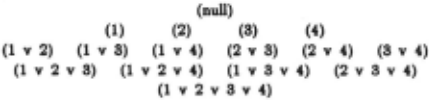
In ceneral, there will be N. lepl lltatementa when there are n bue elements, where
The second m~or element of the backcround ill a probability function defined over the algebra of ltatementa that obeys the following axioma:
In addition, the sum of the probabilities aalgned to the bue element. ill required to be one.
The probability function aalgna numbers to the lepl lltatementa baaed upon these axioms. For example, if the probabilities -igned to the four bue elements are each 0.26, then the lepl etatementa have the following p-valuea:
The third m~or element of the backcround ill a utility function defined over the algebra of ltatementa. Thill Ia often co.-rued u a loea function; it gives the loea, fu· incurred when the IQ action Ia taken in the face of the atate of nature corresponding to the J'la bue element in the algebra (B2, 01, J1).
Observation Repone - The observation repone are direct uaignmenta of new p-valuee to element. of the algebra of etatementa. That i.e, they aalgn a number to certain propoaitiona that may be conatrued u a new degree of belief in the truth-value of that proposition. The wignment of thle new p-value cauaea a re-aalgnment of p-values to all other atatementa in the algebra via the updating meehanlem.
There are several ways in which thia direct ueignment of new p-valuee may be viewed:
- Each observation report could coneiat of the ueignment of a lingle p-value of 1.0 to some element in the algebra of statementa.
- Each observation report could conaiat of the uaignment of a lingle p-value in the interval (0,11 to some element in the algebra.
- Each observation report could conaiat of the uaignment of two p-valuee in the interval [0,11 to some element in the algebra. These serve u lower and upper p-valuee for the element.
The primary effect of these different views ill upon the size of the algebra of statement.. The number of statements required is largest under the ftret view, Iince we muet have a lingle statement corresponding to each and every pOIIIible observation (value read on a meter, etc.). The other views allow ue to use fewer statements, since we may map several obaervationa onto a lingle statement. Ordinarily, only the first view ia utiliud in the dueical Bayes approach.
Updating Mecbanlem - The clueical Bayesian approach reate upon Bayes' Rule for calculating posterior probabilities of states of nature from two items: (1) prior probabilities on those states, and (2) conditional probabilities for evidence given certain states of nature. In symbolic form,
where P(S 1 1E 1 ) ill the posterior probability of state S 1 given evidence E 1 , P(S 1 ) ia the a priori probability of state S 1 (i.e., before evidence ia taken into account), P(E 1 [S1) Ia the conditional probability of EJ given atate sl.
If we have a probability or degree-of-belief distribution on the evidence, P(E.), we compute the current p-value for each atate of nature from the posterior probabilities and the evidential p-values according to a conditionalization formula such u
where we aaume thu the diarbution on the evidence ia normalized to one. V ariaiiona on thia . formula are poeeible dependinc upon the atructure of the alcebra of a\Uementa. Note thu the formula ueed here ia compuible with the first and aeeond interpretationa of obaervuion reports.
In terms of the alcebra of 1\Uementa diaeu.ed thua fv, there ia no nec-.ry differentiuion between wecoriea of atuementa in the alcebra. Thu ia, obaervuion reports could be received for any one of the atuementa.
Some writers expllcltly divide the statement. in the alcebra into two diatinct cl ... : hypotheaea and evidence (e.c., D2). Hypotheaea are often ealled atuea of nuure, while evidence is often termed . a meuurement. In any cue, the buic idea ia thu there ia a directionality or hierarchy in the web of inference: we reason from evidence to hypotheaea.
There may be an advantace in takinc 10me form of hierarchical approach. Firat, the inferential reluionahipa between atuementa in the alcebra are made more explicit than they are in the undifferentiued alcebra. Second, the computational burden uaociued with each upduinc cycle may be leaaened in thu the effect. of an obaervuion report are limited to portiona of the hierarchy explicitly connected with the etuement aet thu is the aubject of the report.
Whether or not the approach ia hierarchical, if we uee the ftrat lnterpretulon of obaervulon report~, the updulnc meehaniam operUea juat once. We have the a priori P(S1), we receive an obaervuion report thu aaip a p-value of 1.0 to one of the evidential atU.menta, and we ealcu!Ue a new set of pcv<St>·
Under the aecond and third interpretuiona of obaervuion reports, p-valuea may be Ieee than 1.0 and may therefore chance over time. Upduinc eyclea could thua continue u lone u new reports are received.
Deciaion Meehaniam - Given thu the upduinc meehaniam providea ua with p-valuea for the etatea of nuure, and given thu the backcround contains a meuure of utility in the form of a lou function, we can formulate the expected lou of the i~ action u foUowa:
where the summation ia over the j atuea of nuure. The ceneral Bayeisian deeiaion function is simply to choae, whenever a deciaion ia required, the action thu correaponda to the minimum expected lou.
B. Convex Bayea
Backmund Elements - The backcround in thia approach, llke the cluaieal Bayea approach, conaiata of three element~: (1) an alcebra of atuementa, (2) a probability function defined over thia algebra, and. (3) a utility or !0111 function defined over the aame alcebra. Theae element. aerve the aame functiona u in the duaical approach. The alcebra acain conaiata of baae element., operatora, and atatementa obtained by appllwion of the operUora to the baae element~.
The probability function in the convex Bayea approach differs in a alcnificant way from the function in the duaical approach. Here the function ia a convex aet of p-functiona (L1 ). That Ia, the belief atue ia not characterized by a Bingle function, but by a aet of functions having the property of convexity: the aet contains every linear combinuion of any two members of the aet. In ceneral, if there are n baae element., the belief state will correspond to a domain in a apace of (n-1) dimenaiona, since the n~ component of the belief atue can be determined if (n-1) component. are known.
Obaervuion Reports - The convex Bayea approach, like the duaieal approach, conatruea the obaervuion reports u direct uaipmenta of new p-valuea to element. of the algebra of atuementa. Thia new p-value acain c:auaee a re-ualcnment of p-valuea to alJ other atuementa in the alcebra via the updatinc mechaniam.
In addition to the three interpretuiona of obaervation reports previouly diaelllled, there ia now a fourth way in which uaipment of new p-valuea may be viewed:
(4) Some obaervuion reports could conaiat of the uelcnment of two or more linked bounda on the convex aet of p-valuee. Theae bounda are linked in the aenae that they jointly epecify limite on the set.
All before, the primary effect of theae different interpretuiona ia upon the eiu of the alcebra of etatementa.
Upduing Mechanism - The updatinc meehaniam in the convex Bayea approach operUea much like the upduing meehaniam of the eluaical Bayea approach. The key difference ia thu the entire convex aet of functions comprising the belief atue ia used, rather than a llincle function.
All before, we uae Bayea' Theorem to obtain conditional probabilitiea baaed upon the obaervuion report~. The formulae are similar to thoae in the dueical Bayea approach, but each probability ia now indexed: P r ia the r~ member of a convex eet of probability functiona. Each new evidential input thus inducea a mapping from one convex aet of p-functiona to another convex aet.
It would eeem that the computuional burden of the upduinc meehaniam will be increued by uae of the convex eet of p-functiona in place of a Bingle function. However, little work hu been done in actual computation of updated convex belief atuea, 10 the extent of thia burden ia unclear at preaent.
Deeiaion Meehaniam - Upper and lower probabilitiea for 10me atuement in the alcebra can be taken from the convex eet of P ,(S 1 1E 1 ) uainc the technique of eupportinc linea, planea, or hyper-planee (L1). However, no ceneral procedure exiata to handle upper and lower bounda in a utility function.
One method of attack ia to euppoae thu the deciaion indicated ia the one thu minimiaee the expeded !0111 u wu done in the dueical Bayea approach. Uainc the convex eeta of P ,(S 1 (E 1 ) and P ,(E 1 ), we derive upper and lower bounda on each P cu<S 1 ) 10 thu, for each action, there are now upper and lower bounda on the expected 10111. Such expected-lou intervale for clifferent adions will, in general, overlap. No generally accepted method for choice of actions hu yet been developed, althou1h Kyburg (Kl) ud Levi (L1) have explored minimax technique&.
C. Dempeter-Shafer
Backsround Elements - The background in thia approach, 6ke the first two approachea, conaiata of three elements: (1) lUI algebra of 1tatementa, (2) a m- function defined over lhil al1ebra, ud (8) a utility function defined over the B&me algebra. The elements eerve the ~&me purpoeee u before, but the utility function hu received 6ttle attention in the 6terature. It will be required, however, in practical app6cations.
The m- function eervee u the buic vehiele for &Mipment ud manipulation of degree~ of be6ef. M- il diltributed aero· the set of 1ubeeta of the elements of the domain of dilcourse, that il, over the set S of (2 exp :21') propositions constructed from the :21' uoma that were in tum constructed from the n bue elements.
The m- function M 1 for subset At of S hu the following propertiee:
The value of M 1 (f 1 ) ie taken to be the weight of belief that ie ucribed juet to ~· The ~ for which M 1 (~) ie nonzero are called focal elements of Mr S"mce S il itaelf a member of S, M 1 (S) deacribee the weight of belief unueiped to any smaller aubset of S; thia il generally termed the uncertainty.
Thia approach providea two meuurea of belief state for a liven proposition Q: eupport (SPT) ud plaueibi6ty (PLS). They are calculated u follow· (S1,S2):
The support for Q il thue the eum of the m- attributed to all statements that imply Q, while the plausibility of Q il one minlll the IUpport for the DegUiOD of Q. The piauaibility can aleo be expre.ed u the eum of the m- attributed to all eubeeta of S that contain some element of Q. It follow· that the plausibility of Q il alwaye greater than or equal to the aupport for Q.
The be6ef etate eoncernin1 Q can be written u an interval lllin1 SPT(Q) u the lower endpoint ud PLS(Q) u the upper. Some authon deacribe thia u lUI interval-valued probability on Q. Kyburg hu shown (K2) that elosed convex seta of d&Mical probabi6ty functions cu represent be6ef stuee in a fuhion that indudee the m--function representation u a epedal case.
The background aleo containa meana of tranaluin1 obeervuion reports into m- functiona. One method i1 that of a m--funetion diltributlon; thil diatribution provid· a normallr.ed meuure of the m- to be uliped to each element of the domain in the event of each p018ible obeervuion. These diltributions are analocoue to the e1--conditional probability density functions of atandard probability theory.
Obeervation .&!2!!!! - Obeervuion reporta, at leut to the extent that they are expected to meah with m--function diltributiona, conaiat of atuementa Hke the following:
1 The brightn- of object X il between 1.2 and 1.e.·
·object X il aurrounded by between 2 and 8 objects of aimilar brightne-. 1
·In reclon Y, the expectation of encountering an object of e1- 0 1 ia much hlcher than that of any other et-.·
Each type of obeervuion report il taken to generate a aeparate m- function. Thia preaenta no problem u Ions u it ia completely dear that the evidential impact of a given report can be properly uliped to particular eubeeta of the domain of dilcourse. However, how the domain of diaeourse il to be atructured in order to (U&riUitee thia proper ulipment il not a trivial muter, aince we must enaure the induaion of eubaeta that can eerve u redpienta of m- from each ud every obeervuion report that will be received in performuce of a liven tuk.
Updatin& Mechanlam - Suppoae that we have received two obeervuion report· that have individually en1endered m functions M 1 and M,. We combine M 1 and M, to form a new m- function, M 1 2t defined over aubeeta of the domain of dilcourae. In l)'mbollc form,
where the first aummuion, L; 1 , il over all ~ and ~ auch that (f1 () ~) = f11, while the second eummuion, ~. il over all ~ ud ~ euch that (~ () ~) = null.
The upduin1 procedure -umee that a current m funetion, M 1 , il available and that a new m- function, ~ hu been presented (bued upon new obeervuions). M 1 and M, are combined to form M 1 2t ud thie II uaed u the current function lhould other new m- functions be preaented.
Deeieion Mechaniam - The type of deeieion mechaniam compatible with the Dempeter-Shafer approach ie not well undentood. Support and plausibility functions for each statement in the domain of diaeourse can be calculated bued upon the current m- function. These may be uaed u upper and lower bounda upon the probability of each atuement, but there il u yet no accepted, 1eneral mechaniam for deeieion-makin1 bued upon these bounda.
An expected-10111 conatruction parallel to the cla.ieal and convex Bayeaian approachea can be clll'ried out if we eonatrue P cu<~) u an interval bounded by SPT(~) and PLS(~). This givea rise to diflieultiea of overlapping intervale eimilar to those encountered in the convex Bayea approach.
D.~
Back!Il'Ound Elements - The background in this approach alao coneiats of three elements: (1) an algebra of statements, (2) a p-function defined over this algebra, and (3) a utility or 101111 function defined over the same algebra. The elements serve the same functiona u before, but several important difference& merit diac:uaeion.
Firat, the concept of probability embraced by thia approach ia epistemological. This means that probability ia actually a deacriptor of credibility relative to aome body of knowledge. In addition, the p-value uaed in this approach ia an interval on (0,11.
Second, Kyburg uaea direct inference to a.ign p-valuea to hypotheaea baaed upon knowledge of frequenciea without requiring the a.ignment of precise a priori p-valuea. He alao providea formal criteria for determining which evidence ia relevant to a given statiatieal hypotheaia and which ia not.
Direct inference refers to the manner in which knowledge of chances (or frequencies, or objective probabilitiea) influencea bellef statea about the outcomea of triala involving chance setups. In Kyburg's approach, some portion of the algebra of statements hu the status of a body of knowledge containing statements about relative frequenciea of occurrence of several characteristics in various clueea.
Observation Reports - Observation reports in this approach can again be conatrued u statements in the algebra. When coupled with appropriate knowledge of relative frequencies, they usip new p-valuea to other elements of the algebra.
There ia just one form of obeervation report in this approach: each coneiata of the identification of the clus or cluees to which the observed object belongs. Knowledge of relative frequenciea then determinea how to usip two p-valuea in the interval (0,11 to some element in the algebra.
Updatin1 Mechanism - The Kyburg approach uaea direct inference for updating. In aome special cues, this givea results that can be obtained from Bayea' Theorem (K1).
In ord~ to show how the principle of direct inference ia
applied to the updating process, we conaider an example. The body of knowledge ia taken to coneiat of the following statements:
- The fraction of members of clus 0 1 that have
- property P Uea in the interval (L 1 ,U 11.
- The fraction of members of 0 2 that have P llea in (L 20 U~.
- The fraction of members of 0 12 that have P
liea in (L12'u 121. where 012 ia the intersection of 01 and 02"
The hypotheaia of intereat ia that an item selected from clus 0 12 hu property P.
In this approach, criteria known u K-relevance and K-irrelevance (L1) provide a means of determining which evidence ia relevant to a given statiatieal hypothesi~ and which ia not. K -irrelevance refers to a mandatory lack of impact of a given piece of information on our deliberationa concerning the credibility of a certain statiatieal hypothesi~. The information concerning 02 in the body of knowledge ia K-irrelevant if and only if the following conditione obtain:
- The current body of knowledge impliea that (L1,U 11 ia either a subinterval of (L 12 ,U 12 1 or identieal to it.
- The current body of knowledge implies that (L1,U11 ia either a subinterval of (L 20 U 2 1 or identieal
- to it.
In our example, if the information concerning 0 2 ia K -irrelevant, then the information concerning 0 1 ia the total information K -relevant to the hypotheeia.
K -irrelevance ia thus a formal criterion that tells ua whether or not knowledge of a specific relative frequency should influence our degree of belief that a member of 0 12 hu property
P. Suppose we know that:
- The fraction of Swedes who are Proteatant liea in (a,bl.
- The fraction of vieiton to Lourdea who are Swedish liea in (c,dl.
- The fraction of Swedish vieiton to Lourdea who are alao Proteatant liea in (e,fl.
Alao suppose that we wiah to attach the appropriate degree of belief to the hypotheaia that a particular person ia a Proteatant, given that he ia a Swedish vieitor to Lourdes. Intuitively, we suspect that the valuea of a, b, c, d, e, and f will influence this desree of belief. K -irrelevance formalizes this proceee.
Kyburg's principle of direct inference hu a eimple form, once the criterion of K-irrelevance hu been applied to the body of knowledge. If the information concerning 0 1 ia the total information K -relevant to the hypotheeis, then the degree of belief to be usigned to the hypothesi~ ia just the interval IL1,U1I·
The upshot of this process ia that the Kyburg approach recommends, 1n many cues, that different lntervala of degrees of belief be embraced. This hu the consequence that the evolution of p-valuea u evidence accumulate& will follow a different trajectory through the space of belief states. That this different trajectory may have important practical impact seems reuonable, but remaiua to be demonatrated in a eyatematic fuhlon.
Dec:iaion Mec:haniam The KybUJ'( approac:h offera interval-valued p-functioDL ~ hu been diec:UIIed above for both the convex Bayea and Dempeter-Sbafer approac:h-, there il currently no reneral dedaion mec:haniam available for interval-valued p-functloDL
E. P Olaibllity
Bac:lurround Elements - The bac:krround in this approac:b conaiata of three elements: (1) an alpbra of statements, (2) decree-of-membership fundiona defined over this alpbra, and (8) a set of fuuy dec:illion functiona defined over the aame alrebra. The alrebra dellnea the domain of diec:ourae, the memberablp functiona uaip deere- of memberablp to elements of the domain, and the dedaion functiona provide a means of reac:hinr dedaiona in the domain.
The decree-of-memberablp function il defined in terms of a fuuy set. Suc:b a set ia made up of ordered pairs that uaip a decree of membership in the fuuy set to eac:h value of a Biven c:baraderiatic:. The fuuy set ia then denoted by A = {"fiP 1 }, where "t ia the IQ value of the c:baraderiatic and p1 ia the decree of memberablp of "t in the set. In Zadeh's fuuy lofc, p-valuea obey the followin( axioms (G1,Z1):
The bac:krround also contaiua definitiona of fuuy predicatea appropriate to the domain of diec:ourae. For ex&mple, the followinr statements define the fuuy predicate ·LR· (low refledance):
- ·A refledance of 0.0 ia low with decree 1.0.·
- ·A reflectance of 1.0 ia low with decree 0.6.·
- ·A reflectance of 2.0 ia low with decree 0.1.·
The fuuy set would then be represented by LR = {011.0, 110.6, 210.1}.
Obeervation Reports - Obeervation reports in the po.ibllity approac:h provide the raw material for -ipment of deere- of memberablp. That il, they are statements that .t&bliab the value of a c:barac:teriatic of an objec:t. Application of the membership function then determinea the decree of memberablp of that objed in relevant fuuy seta. For ex&mple, the report ·reflectance of objec:t Z ia 1.0· would eatabliab the decree of memberablp of Z in the cl- of low-reflec:tance objec:u u 0.6.
Updatin1 Mec:haniam - The poaaibllity approac:h combinea evidence in the followinr fubion. Suppose we desire to cla.ify a certain objec:t into one of n cl--, cr ·· c.. Bued upon evidence E1, we develop membership fundiona p 11 throu(h p 18 to form the fuuy set
Similarly, for evidence E 21
We comblne k seta of evidence to obtain
where the p(k) 1 , ··· , p(k) 8 are intt(rated membership fundiona for eac:h of the n cl-. These are obtained from
where Dxu il one of several alternative fuuy dec:iaion functiona:
Ute of DID, suneau that E 1 and E 2 interac:t in a a more or leea independent fuhlon, and that the presence of a smaller p-value ebould be preserved. Use of Dpro suneata that E1 and E 2 interac:t like identical, independent triala, eo that repetitive obeervationa cause marked c:banr· in relative valuea of membership. Use of Dcoa suneata that E 1 and E 2 interac:t in a reinforc:inr fuhlon, so that membership ia intermediate between the two input valuea.
Dec:iaion Mec:haniam - The dec:iaion mec:haniam in the poeaibllity approac:h ia bued upon the concepts of the fuuy goal and the fuuy conatraint. The eeaential idea ia that dec:iaiona are determined by the confluence of roala and conatrainta, and that all three are expreaaible u fuuy seta (81).
For ex&mple, suppose that the domain of diec:ourae hu been constructed to allow expreaaion of roala and conatrainta in the aame alrebra of atatementa, {S 1 , ..· , s.}. Then the expreeaion of roala and conatrainta would be embodied in the fuuy seta
The confluence of roala and conatrainta ia expreeaed by the fuuy set
where the m 1 ..,, ··· , m..., are intt(rated membership functiona for the roala and conatrainta. These are obtained from
where Dxu ia one of the fuuy dec:iaion functiona diec:uaeed above. fundiona developed. General criteria for choice &mons these deciaion in experi-II)'Siem applie&tiona have yet to be Once the confluence aet, DEC(G,C), hu been conatrueted, the question remaina &e to which deciaion ie indicated. Several proceduree are followed in the literature (B1, M1). The moet notable are: (1) choice of the action havinJ the Jre&t·t DEC deane of memberehip, (2) choice of an action that ie a mixture of all actiona weipted aceorcfinc to their DEC depoee~ of membership, and (8) choice of an action that ie an equal mixture of the two actiona havinJ the minimum and maximum DEC depoee~ of membership. Like the deciaion funetiona themselves, Jenera! criteria for choice &mODJ these deciaion indieatore in expert-1)'8tem applie&tiona have yet to be developed.
III. DISCUSSION
From thie p&rallel formulation of approaches, we ean identify several important eimU&rities and differences:
- The structure, but not nece.&rily the content, of the &lsebra of at&tementa Ia limUar aeroee the approachea.
- All approaches, with the exception of the poaeibility approach, depend on formulation of a utility or !011 function to arrive at deciaio111.
- Structuree Jiven to belief 1t&tes are lipificantly different. They may be pointe, interv&la, convex seta, or fuuy seta.
- Component& of the upd&tinl meeh&nlam differ llipificantly, but the approaches fall into three ma,jor eatesories: those that uae Bayes' Theorem exduaively (d&aeie&l and convex Bayes), those that allow ita uae under eenaln· conditiona (Kyburc) or uae a derivative form (DempHer-Sh&fer), and those that do not Ule it at all (poaeibility ).
- Component& of the deciaion meeh&niem &l&o differ. Extenaion of the expected-lOll technique from the eaae of point-valued belief It&t· to &he cues of interval-valued or convex-eel belief lt&tes may be poaeible, but preeieely how &hie il to be done remaina an open qu·&ion. The fuuy deciaion rules operatins on &he confluence of fuuy so&ll and conatrain&l appear &o be unique.
The moe& I&Jien& limll&rity in &he approach· ie &he dependence upon an &lsebra of 1&&temen&l &hat lh&rply deftn· the domain of diaeouree. Thla &lpbra il a fixed framework within which all obaerv&tiona are interpreted, all upd&tinJ oecure, and all deciaiona are made. None of &he approaches dilcu.ed here explicitly addreeeee the illue of a dynamic &lsebra &hat adap&l to ch&DJinc real-world condhioDL
In BUm, much remaina &o be done &o develop a dear undere&andios of these and other approaches &o evidential reuonins. Re.evdl in our laboratory il con&inuins &Ions two principal lines:
- The p&rallel formulation il beins extended &o include other approaches, auch u Shortliffe'· certainty theory and Cohen'· endoreemen& theory.
- Computational experiment. are beins carried out in order to compare the evolution of belief a&&tes when controlled by different approach-.
Thie ahould ultimately re~ult in pidelin· &hat can aid Ul in choolins &he moe& appropriate eviden&i&l-reuonins approach for different typ· of experi-q1&em tub.
@inproceedings{ijcai1985p61,
  title     = {Parallel Formulation of Evidential-Reasoning Theories},
  author    = {Thompson, Terence R.},
  booktitle = {Proceedings of the Ninth International Joint Conference on
               Artificial Intelligence, {IJCAI-85}},
  publisher = {International Joint Conferences on Artificial Intelligence},
  editor    = {Aravind Joshi},
  pages     = {321--326},
  year      = {1985},
  note      = {Expert Systems},
  url       = {https://ijcai.org/proceedings/1985/61},
}
TY - CPAPER TI - Parallel Formulation of Evidential-Reasoning Theories AU - Thompson, Terence R. T2 - Proceedings of the Ninth International Joint Conference on Artificial Intelligence, IJCAI-85 PB - International Joint Conferences on Artificial Intelligence PY - 1985 SP - 321 EP - 326 UR - https://ijcai.org/proceedings/1985/61 ER -Copied
Machine-readable versions of this paper, for tools and AI agents:
 Welcome
 Future Conferences
 AI Journal Division
 IJCAI Proceedings
 About IJCAI
 IJCAI Awards