
Synthesis by Completion
Proceedings of the Ninth International Joint Conference on Artificial Intelligence. Automatic Programming. Pages 208-213.
© 1985 International Joint Conferences on Artificial Intelligence
Abstract
The Knuth-Bendix completion procedure was introduced as a means of deriving canonical term-rewriting systems to serve as decision procedures for given equational theories. The procedure generates new rewrite rules to resolve ambiguities resulting from existing rules that overlap. We propose using this procedure to synth es ize logic programs, as well as functional programs, from specifications and domain knowledge expressed as equivalencepreserving rewrite rules. An implementation is underway.
- Boyer-Moore-79]
- Boyer, R. S., and Moore, J S. A Com- putational Logic. Academic Press, New York , 1979.
- Burstall-Darlington-77]
- Burstall, R. M., and Darlington, J. "A transformation system for developing recursive programs". J. of the Association for Computing Machinery, Vol. 24, No.1 (Jan. 1977}, pp . 44-67.
- Burstall, R: M., Mac- Queen, D. B., and Sannella, D. T. "HOPE: An experi- mental applicative language". Conference Record of the 1980 LISP Conference, Stanford, CA (1980}, pp. 136-143.
- Clark, K. L. "The synthesis and verification of logic programs", Research Report DOC 81/36, Department of Computing, Imperial College, London, England, Sept. 1981.
- Dershowitz, N. "Orderings for term- rewriting systems". J. Theoretical Computer Science, Vol. 17, No. 3 (Mar. 1982}, pp. 279-301.
- Dershowitz, N. "Computing with rewrite systems". Information and Control (1985, to appear).
- Fages, F. "Formes canoniques dans les algebras booleennes, et application a Ia demonstration automatique en logique de premier ordre", These, . Universite de Paris VI, Paris, France, June 1983.
- Futatsugi,etal.-84]
- Futatsugi, K., Goguen , J. A., Jouan- naud, J. P., and Meseguer, J. "Principles of OBJ2", Centre de Recherche en Informatiqu e de Nancy, Nancy, France, 1984.
- Hoffmann-O'Donnell-82]
- Hoffmann, C. M., and O'Donnell, M. J. "Programming with equations". Transactions on Programming Languages and Sys- tems, Vol. 4, No. 1 (Jan . 1982} , pp. 83-ll2.
- Hogger, C. J. "Derivation of logic pro- grams". J. of the Association for Compu.ting Machinery , Vol. 28, No.2 (Apr. 1981} , pp. 372-392.
- Hsiang-Dershowitz-83]
- Hsiang, J., and Dershowitz, N. " Rewrite methods for clausal and non-clausal theorem proving". Proc. Tenth EATCS International Colloquium on Automata, Languages and Program- ming, Barcelona, Spain (July 1983}, pp . 331-346. [Hu_et-Opp en-80]
- Hu et, G ., and Oppen , D. C. "Equa- tions and rewrite rules: A survey". In: Formal Language Theory: Perspectives and Open Proble ms, R. Book, ed. Academic Press, New York, 1980, pp . 349-405.
- Hullot , J. M. "Compilation de formes canoniques dans les theories equationnelles", These, Universite de Paris-Sud, Orsay, France, Nov . 1980.
- Kapur, D., and Sivakumar, G. "Experiments with and architecture of RRL , a rewrite rule laboratory". Proc. NSF Workshop on the Rewrite Rule Laboratory, Schenectady, NY (Sept. 1983} , pp. 33-56.
- Knuth, D. E., and Bendix, P. B. "Simple word problems in universal algebras". In: Computational Problems in Abstract Algebra, J. Leech , ed. Pergamon Press, 1970, pp . 263-297.
- Kounalis-Zhang-85]
- Kounalis, E., and Zhang, H. "A general completeness test for equational specifications", Unpublished report , Centre de Recherche en Informatique de Nancy, Nancy, France, 1985.
- Kowalski-74]
- Kowalski, R. A. "Predicate logic as pro- gramming language". Proc . IFIP Congress, Amster- dam, The Netherlands (1974}, pp. 569-574.
- Kowalski-79]
- Kowalski, R. A. Logic for Problem Solv- ing. North-Holland, Amsterdam , 1979.
- Lescanne, P. "Computer experiments with the REVE term rewriting system generator " . Proc. Tenth Symposium on Principles of Programming Languages, Austin, TX (Jan . 1983} , pp. 99-108.
- Manna-Waldinger-80]
- Manna, Z. , and Waldinger, R. J. " A ded uctive approach to program synthesis". ACM Transactions on Programming Languages and Sys- tems, Vol. 2, No. 1 (Jan . 1980}, pp . 90-121.
- Peterson-Stickel-81]
- Peterson, G. E., and Stickel, M. E. "Complete sets of redu ctions for some equational theories". J. of the Association for Computing Machinery, Vol. 28, No. 2 (Apr. 1981} , pp. 233-264.
- Thiel, J. J. "Stop losing sleep over incomplete data type specifications". Proc. Eleventh Symposium on Principles of Programming Languages, Salt Lake City, UT (Jan . 1984}.
- Turner, D. A. "SASL language manual" , University of St. Andrews, 1979.
References were extracted automatically from the PDF and may contain errors.
Full text extracted automatically from the PDF; figures, tables and equations may differ. The PDF is the version of record.
1. INTRODUCTION
A (first-order) functional (applicative) program is a set of directed equations, used to compute by replacing instances of left-hand sides with the value of the right hand sides. For example, the following is a program for concatenating two lists of elements:
| Functional List Append |
|---|
| append(U,V) <= if V=nil then V else car(U)·append(cdr(U),V) |
where <= has the declarative meaning "is equal" (nil is the empty list and · denotes the cons function). Given the term
it will compute the result of appending the two ele ments a and b in the list a ·b ·nil [with parentheses, that should be a ·( b ·nil)] to the front of the list c ·d ·e ·nil. A logic program [Kowalski-7 4] is a set of Horn clauses used as a pattern-directed program that searches for output terms that satisfy a given goal for given input terms. In this paradigm, the append pro gram would be expressed in two statements:
| Logical List Append |
|---|
| append (nil ,V,V) append(A ·U,V,A W) append(U,V,W) |
SYNTHESIS BY COMPLETION*
Nachum Dershowitz Department of Computer Science University of Illinois Urbana, 11 61801 U.S.A.
where :- has the declarative meaning "is implied by". Given a goal
this program computes the appended list Z =a ·b ·c ·d ·e ·nil. Throughout this paper we follow the convention of using lower· case for constants and upper case for free (universally quantified) variables.
A rewrite system is a set of directed equations (or equivalences) used as a nondeterministic pattern directed program that returns as output a simplified term equal to a given input term. (See [Huet-Oppen-80] for a survey.) For example, the following is a three-rule rewrite system for append:
| List Append | |
|---|---|
| append (nil , V) | V |
| append(U,nil) | U |
| append(A·V,V) | A ·append(U,V) |
Rules may be applied in any order to any matching sub term until no further applications are possible. Thus, applying the rules to the term
one gets either the rewrite sequence
append (a ·nil ,nil) ""* a ·append (nil ,nil) ""* a ·nil, or (using only the second rule) simply
Such pattern-directed functional programming is avail able in SASL [Turner-79], HOPE [Burstall-MacQueen Sannella-80], 0BJ2 [Futatsugi,etal.-84], rewrite languages [Hoffmann-O'Donnell-82], and PLANNER-like languages.
In this paper, we describe how the Knuth-Bendix completion procedure [Knuth-Bendix-70] may be used to generate programs from their (equational) specifications. The completion procedure was originally suggested as a means of generating rewrite systems that can be used to decide the validity of identities in equational theories. Given a finite set £ of equations and a monotonic, well founded ordering >- on terms, the procedure generates new rules that follow from [ . Each rule 1-r generated by the procedure is a reduction with respect to :>-, i.e. t :>- t 1 whenever t ~t 1 ( t rewrites to t 1 ) by a single appli cation of the rule, and each rule is sound for [, i.e. I =r follows from [ by " replacing equals by equals." Imple mentations of the complet ion procedure include REVE [Lescanne-83], RRL at GE [Kapur-Sivakumar-83], and FORMEL at lNRIA [Hullot-80].
A rewrite system synthesized by the completion procedure (and not containing nested defined symbols on left-hand sides) can be translated into a terminating functional program in a straightforward manner~with the pattern-directed invocation eliminated, if desired. For example, the above rewrite system for append could translate to
Function definitions can be translated into Horn clauses in the standard manner [by encoding a rule like f(X)-g(h(X)) as a clause f(X)=Z :- h(X)=Y, g(Y)=Z]. Logic programs differ from fun ctional ones in t.hat output variables in a goal are instantiated by unification with the head of a clause. Rewrite rules equating conjunctions correspond to Horn clauses which may be used to solve goals in that way. For example, a rule of the form
corresponds to the two Horn clauses (one for each con junct. that appears on on ly one side):
a rule P-true corresponds to the assertion P. In this way , the above logic-program for append follows from the two-rule system:
Note that, in general, a logic program formed from a rewrite system in this way is not guaranteed to ter minate when backtracking is employed in the search for solu tions to a given goal.
A rewrite system is complete (as a functional or logic program) if the patterns on the left-hand sides of its rules cover all possible (variable-free) input values. One can determine that a program is complete, and all cases are covered, using methods described in [Thiel-84, Dershowitz-85, Kounalis-Zhang-85] .
Not all rewrite systems correspond to functional or logic programs. Rewrite rules with nested defined sym bols on their left-hand side do not have a straightfor ward analogue in all functional languages. And equivalences between formulae other than conjunctions do not have Horn clause counterparts. [Dershowitz-85] describes how a restricted form of completion, called "nar rowing, " can be used as an interpreter for logic programs expressed as rewrite rules that are not neces sari ly Horn clauses.
2. COMPLETION
Before we present the completion procedure, we need to define the notion of "critical pair." Let L-R and L 1 -R 1 be two (not necessarily different) rules in a system R whose variables have been renamed, if neces sary, so that they are distinct. We say that L 1 overlaps L, if the latter has a su bterm that unifies with the former. More formally, L 1 overlaps L if L contains a (nonvariable) subterm S embedded in some context C~to indicate this we write L=C[S]~such that there is a (most general) substitution u for the variables of the two rules for which S u=L 1 u. If L overlaps L 1 , then the overlapped term Lu (L after making the substitu tion u) can be rewritten to either Ru or C[R 1 ]u. These two terms, R u and C [R 1 ]u, are called a critical pair of R.
The comp letion procedure takes as input a finite set [ of equations and a program to compute a mono tonic well-founded ordering :>-. (By "monotonic" we mean that C[T]u:>-C[T 1 ]u whenever T:>-T 1 , for any con text C, substitution u, and terms T and T 1 .) The pro cedure then generates new rules, each of which is a sound reduction:
Completion Procedure
Repeat as long as equations are left in [. If none remain, terminate successfully.
[1] Choose an equation M=N (or N=M) from [ such that M;-N. If none ex1sts, backtrack and undo previous choice. If all choices have been ex hausted, terminate with fa ilure (abort).
[2] Add the rule M -N to R.
[3] Use M - N (followed by any rules in R) to reduce the right-hand sides of existing rules to their normal forms .
[4] Add to [ all critical pairs formed from R using M-N.
[5] Remove all the old rules from R whose left-hand side contains an instance of M.
- Use R to reduce both sides of equations in [ to their nor·mal forms. Remove any equation that reduces to identity.
In general, the completion procedure may go on generating an infinite number of new rules. But, some times, despite the backtracking in Step [1], a particular choice of (partial) ordering >- forces the whole pro cedure to fail with all equations unorientable. On the other hand, as long as the completion procedure does not terminate in failure, for any equation M =N that follows (logically) from the given rules R (considered as equations), the procedure will eventually generate enough rules for M and N to reduce to the identical term. For this to be the case, the procedure must exe cute fairly, by which we mean that no orientable equa tion remains in t forever.
The completion procedure has been extended [Peterson-Stickel-81, Fages-83) to rewrite systems that contain associative-commutative function symbols (pos sibly with identity element) by considering a somewhat extended notion of critical pair and a unification algo rithm for associative-commutative symbols. If f is an associative-commutative symbol, then critical pairs are also formed from overlapped terms of the form f (L'u,X u)=Lu, where X is a new variable, and to which two rules L-R and L'-R' (both with associative-commutative outermost symbols) may be applied.
3. SYNTHESIS
Like other theorem-proving methods, completion can be applied to the task of automatic program syn thesis from specifications. The completion procedure itself does the "folding" (that is, the introduction of recursive calls) based upon the axiomatization of the problem domain. Other work on the synthesis of recur sive programs includes [Burstall-Darlington-77, Manna Waldinger-80, Clark-81, Hogger-81). Specifications are expressed as rewrite rules, i.e. as directed equations or equivalences. The importance of using equivalences in specifications, rather than implications has been pointed out in [Kowalski-79, Hogger-81], and others. Heuristic aspects of the synthesis problem are not addressed in this paper.
Assume that we wish to synthesize a program for some function (or predicate) f, and are given an axiomatization t of the problem domain. We can start the completion procedure off with t and run it until a program R is generated that computes f. (In our examples, we will skip the first stage of completion, starting off with already oriented rules for t , and considering critical pairs as necessary.) The monotonic well-founded ordering supplied to the completion pro cedure should ensure that terms containing "specification" symbols are greater than corresponding terms containing the defined goal symbol, which in turn should be greater than the constant true. The choice of ordering guides the synthesis and will affect the program derived . Given the "right" ordering, the pro cedure will find a program, if it does not abort on account of inability to orient any equation into a rule, and if a program exists that does not require auxiliary definitions. (See [Dershowitz-85] .) When auxiliary pro cedures are needed, their definition may be supplied by the user.
As a simple example of the use of completion to "fold" and "unfold," we synthesize an efficient program to reverse a list, given the naive version that uses append ( cf. the same problem in [Burstall-Darlington77)). The naive program is
The synthesis requires a definition of the auxiliary func tion rev:
the append system of Section 1:
and the theorem (associativity of append):
Completion proceeds as follows: The left-hand sides of rules (3) and (5) can be unified by letting Z in (3) be nil and V in (5) be reverse (Y). That generates the crit ical pair
Since we want reverse to use rev, the ordering supplied to the completion procedure should make anything con taining reverse bigger than a term that does not . That way, the above equation is oriented into a rule
The next step is to overlap the naive reverse program with the definition of rev. Unifying the left-hand side of (1) with the subterm reverse(Y) of (3), by letting Y =nil, gives rise to the critical pair
the left side of which reduces, using ( 4), to just Z. There being only one possible way to orient the equa tion Z=rev(nil ,Z) into a (terminating) reduction, that pair results in the rule
Overlapping (3) now with the left-hand side of (2), let ting Y =A ·X gives the critical pair
append(append(reverse(X),A ·nii) ,Z) = rev(A ·X,Z). Associativity of append (7) comes in here, rewriting the left side to append (reverse (X),append (A ·nil ,Z)), which becomes rev(X,A ·Z) by applying (6), (4), and (3). With an appropriate ordering (one that begins by look ing at the first argument of rev, on which the intended program recurs), that gives the rule
The three rules generated by completion, viz. (810), serve as a functional program for reverse, one that does not itself use append:
| List Reversal | |
|---|---|
| reverse(Y) | rev(Y,nil) |
| rev(nil ,Z) | z |
| rev(AX,Z) | rev(X,A ·Z) |
This program is complete, since Y covers all lists for reverse and (nil ,Z) and (A ·X ,Z) cover all possible pairs of lists for rev . The program is terminating, since completion used a well-founded ordering to the rules.
4. LOGIC PROGRAMS
Suppose that we are given the following definition of multiplication (for natural numbers):
where + and x are associative and commutative (with ident ities 0 and 1, respectively) , and that we wish to synthesize a program for integer division. We will also need the following four facts , expressed as simplification rules:
Positive integers are represented in unary, as sums of ones. (Associativity and commutativity are needed so that U + W, for example, can be matched with 1+1+1+1, with V=V=1+1.)
The completion procedure starts off with the above rules (1-6) and the specification
The procedure is also given a recursive path ordering (see [Dershowitz-82]) in which function symbols are ordered (from "heavier" to "lighter"): 8, =, <, div, + , 1, 0, true. The synthesis proceeds is as follows:
By overlapping (1) Mx0-+0 on the specification (7) (uni fying Y + 1 with M and Q with 0), we get
By overlapping the fact (4) V=U-+true on (8) (unifying X, U, and O+R- the unification algorithm takes the identity 0+ R=R into account), and simplifying the resulting left side X sY 8 true to X sY via (3), we get
Next, by overlapping the fact (5) UsU +Z-+true on (9) (unifying U with X andY with X +Z), we obtain
Now, by using (9) to reduce RsY in the specification (7) to div(R,Y+1,0,R), and multiplying out (Y+1)xQ using (2), we get
Overlapping (ll) with (2) Mx(N + 1)-+MxN + M (let ting Q =N + 1) yields
Finally, by overlapping the fact (6) U+W=V+W-+U=V on (12) (using associativity and commutativity of + to let W=Y+1, V=YxN+N+R, and X =V + Y + 1), we obtain the critical pair
The left side reduces by (ll) to div(U,Y+1 ,N,R) , yield ing the rule
Rules ( 10) and ( 13) together are a complete pro gram. Renaming variables and putting into Horn clause form, we have the following:
| Integer Division |
|---|
| div(X,X+Z+1,0,X) |
| div(X+Y+1,Y+1 ,Q+1,R) :- div(X,Y+1 ,Q,R) |
The second rule is the recursive case (denominator not greater than numerator); the first is the base case (denominator is greater). The program is complete, since, for any nonnegative integer a and positive integer b, the input pair (x,y) matches (X,X+Z+1) when a <b and (X+ Y + 1,Y + 1) when a ?!!b (X is taken to be 0 for a =b). Executing this program as it stands requires associative-commutative unification for + , with 0 as its identity element; getting around that would require additional programs for unary subtraction and companson.
5. FORWARD REASONING
In this section, we synthesize a rewrite system that can be used to search for an integral position P such that th e input value X lies between f(P) and f(P+1) , for monotonically nondecreasing function f. The resul tant logic program computes by "forward reasoning" [Kowalski-79], from facts towards the goal.
The following propositional calculus system ( cf. [Hsiang-Dershowitz-83]) can provide additional logical capability for specifications:
| Propositional Calculus | |
|---|---|
| .u | V=false |
| uvv | (U8V)=V=V |
| U:::>V | (U8V)=V |
| U 8 true | u |
| U 8 false | false |
| U8U | u |
| V=true | u |
| V=V | true |
| (U=V)8W | (U8W)=(V8W)=W |
where-, is "not," 8 is "and ," Vis "inclusive-or,"= is "equivalence," and :::> is "implies." Both 8 and = are implicitly associative and commutative. That means, for example, that the rule U 8 U -u applied to (p 8 q) 8 p yields p 8 q . Since these two functions are associative, there is no significance to their parenthesi zation, and terms are accordingly "flattened" by remov ing embeddings of associative functions symbols, e.g. (p 8 q) 8 p is written p 8 q 8 p . The above system simplifies any two equivalent propositional formulae to the same unique irreducible term.
The completion procedure starts off with the out put specification
(X lies between P and P+ 1), input specification
(! is monotonically nondecreasing and X lies between A and A+ N), and facts about transitivity of inequal ity:
(Any implication of the form U:::>V can be expressed by a rule U 8 V-U.) The synthesis requires the program mer to introduce a generalization pos(P,V) of search(P), and to introduce halving of integers, to guide the synthesis to binary search, rather than linear search. (The ordering on symbols has pos between the specification symbols and the goal symbol search.)
The first step is a requisite generalization of (1) on the part of the programmer:
replacing 1 with Y, and meaning that X lies between P and P+ Y. This generates the rule
in place of ( 1), as well as
by overlapping (7) with (3) and (4). Transitivity (5,6), together with (2), generate
.Jn turn , these and (7) generate
Together, rules (8,10,13,14) give a nondeterministic search program:
| Nondeterministic Search | |
|---|---|
| sem·ch (P) pos(A ,N) | pos(P,1) |
| pos(P,V) | pos(P,V+W) 8 X <f(P+V) |
| pos(P+V,W) | pos(P,V+W) 8 X~f(P+V) |
Note that the left-hand side of a rewrite rule becomes the list of premisses of a clause used for forward reasoning.
To derive a binary search program, we introduce the following definition of halving:
This generates
from (13) and (14) . Rules (8,10,16,17) constitute the binary-search program:
| Binary Search |
|---|
| search(P) pos(P,1) pos(A ,N) pos(P,Y+2) pos(P,Y) 8 X <f(P + (Y+2)) pos(P + (Y+2),(Y+1)+2) pos(P,Y) 8 X~f(P+(Y+2)) |
Given values for X, A , and N, along with programs for f and +, this program computes P such that search (P) holds. Starting from the axiom pos (A ,N) , it tests in equalities to add new facts of the form pos (P ,Y), until the fact pos(P,1), and its consequence search(P), are generated.
6. AUXILIARY PROCEDURES
The above approach requires that a program be specifi ed equationally. That means that it may be necessary to give recursive definitions of predicates appearing in specifications. (There is a comparable need of definitions for verification purposes in [Boyer Moore-79].) For example, the following insertion-sort program
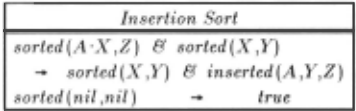
requires the additional rules
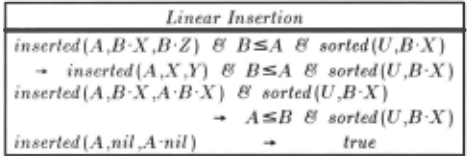
along with "more primitive" rules for inequality.
The specification for the above program may be stated as a conjunction of the requirements that the list Z be ordered in nondecreasing order and that it be a permutation of the list X:
ordered(Z) & permuted(X,Z) Given the facts sorted(X,Z).(1)
(an empty list is ordered) and
(any list is a permutation of itself), the desired base case
is generated.
To generate the recursive case, an auxiliary definition is required . To indicate the desire to sort a list by first sorting its tail, the following definition is added:
From this, completion generates the following sequence of rules: Using the definition of ::>
Using the associativity and commutativity of = (mean ing equivalence) in overlapping the fact U =U-+ false with (6) , adding =sorted(X,Y) to both sides of the rules, gives
after simplifying the resultant left side with U=false-+U. Overlapping the fact U & U-+U with (7) adds the conjunct sorted(X,Y) to both sides. Then simplifying the resulting critical pair, using proposi tional rules, gives
The latter is the desired recursive call.
The next stage is to synthesize the auxiliary pro gram. Adding the fact
will generate the two base cases
Generating the recursive case of inserted requires much more information about ordered. The predicate ordered can be defined in terms of smaller:
i.e. a list beginning with an element B is ordered if (and only if) B is smaller than each element in the remainder of the list and the remainder is itself ordered. The predicate smaller can be defined by
In addition, one needs to know that
This fact must either be given as true, or can itself be proved using the completion procedure. (For the use of completion for inductive theorem proving, see, for example, [Huet-Oppen-80].) The result is
7. IMPLEMENTATION
An implementation of these ideas is underway at the University of Illinois. It is being embedded within the rewrite system environments REVE [Lescanne-83] and RRL [Kapur-Sivakumar-83]. In practice, we have not encountered any difficulty in using the well-founded orderings supplied with these systems to successfully guide the synthesis of programs. Pruning futile paths, on the other hand , is a difficult problem.
ACKNOWLEDGEMENT
I thank Alan Josephson for his critical readings and critical implementation work.
@inproceedings{ijcai1985p38,
  title     = {Synthesis by Completion},
  author    = {Dershowitz, Nachum},
  booktitle = {Proceedings of the Ninth International Joint Conference on
               Artificial Intelligence, {IJCAI-85}},
  publisher = {International Joint Conferences on Artificial Intelligence},
  editor    = {Aravind Joshi},
  pages     = {208--213},
  year      = {1985},
  note      = {Automatic Programming},
  url       = {https://ijcai.org/proceedings/1985/38},
}
TY - CPAPER TI - Synthesis by Completion AU - Dershowitz, Nachum T2 - Proceedings of the Ninth International Joint Conference on Artificial Intelligence, IJCAI-85 PB - International Joint Conferences on Artificial Intelligence PY - 1985 SP - 208 EP - 213 UR - https://ijcai.org/proceedings/1985/38 ER -Copied
Machine-readable versions of this paper, for tools and AI agents:





