
An Approach to Dependency Directed Backtracking Using Domain Specific Knowledge
Proceedings of the Ninth International Joint Conference on Artificial Intelligence. Automated Reasoning. Pages 188-189.
© 1985 International Joint Conferences on Artificial Intelligence
Abstract
We describe a problem solver that usea non-chronological backtracking in situations involving tradeoffs. 'Ibe novel aspect of the problem solver is it ability to weigh advantages and disadvantages of alternatives at choice points. Whenever untenable situations arise, this information is available to the backtracker to determine the most appropriate baclttracldna point. By endowing the backtracker with acceu to domain-specific knowledge, a highly contextual approacb to reasoning in dependency directed baclttrackina situations can be achieved.
- de Kleer, J., Doyle, J., Steele, G. and Sussman, G., AMORD : Explicit Control of Reasoning, Proceedings of the Symposium on Artificial Intelligence and Programming Languages, 1977.
- Dhar, Vasant., PLANET: An Intelligent Decision Support System for the Formulation and Investigation of Formal Planning Models, Ph.D. Thesis, University of Pittsburgh, 1984.
- Doyle, Jon., Truth Maintenance Systems for Problem Solving, TR-419, Massachusetts Institute of Technology, Artificial Intelligence Laboratory, 1978. IJCAI
- Doyle, Jon., A Truth Maintenance System, Artificial Int.lllgence, June, 1979.
- S. Doyle, Jon., A Model For Deliberation, Action, and Introspection, MIT-AI TR-S81, May 1980.
- McAllester, D., Reasoning Utility Package, AI Laboratory Memo 667, April 1982.
- McDermott, Drew. and Doyle, Jon., Non-Monotonic Logic I, Artificial Intelligence Nos 1 and 2, April 1980 (special issue).
- Stallman, Richard. and Sussman, Gerald., Forward Reasoning and Dependency-Directed Backtracking in a System for Computer-Aided Circuit Analysis, ArtVfclal llat.lllg•nc•, volume 9, No.2, October 1977, pp 135-196.
- Stefik, Mark., Planning with Constraints, Stanford University, Computer Science Department, STAN-CS-80-784, 1980
References were extracted automatically from the PDF and may contain errors.
Full text extracted automatically from the PDF; figures, tables and equations may differ. The PDF is the version of record.
1. Iatrodadloa
An area of investigation now commonly referred to as "Dependency Directed Reasoning," hu had a major impact on AI research in the Jut decade (de Klccr ct.al, 1977; Doyle, 1978, 1979, 1980; McAllcster, 1980; Stallman and Sussman, 1977). In this paper we describe some dependency directed reasoning features of a problem solver called PLANET (Dhar, 1984). It hu been designed to help planning managers in a large computer manufacturing company with the formulation and investigation of models for allocation of resources. Since the process of resource planning 1 involves making assumptions that arc continually subject to revision, dependency information plays a crucial role in the maintenance and incremental change of planning models. What is of particular interest in this paper is a heuristic procedure for dependency directed backtracking that addresses one drawback of existing dependency frameworks, namely, determining what belief (set of assumptions) in an existing model to change whenever an undesirable state arises.
2. The Need for Depeadeacy Directed B8Cktnc:kiJii
The problem of formulating a resource planning model has two important features. Fint, u assumptions about various parts of the task environment arc made, choices in other parts of the environment arc constrained. Second, there arc usually resource requirement tradcoffs among the alternatives that can be made. .These features arc operationalizcd in PLANET in terms of a "compute· quicsce-gucss" cycle u in MOLGEN (Steflk, 1980) where processing continues with existing constraints until a quiescent state is reached. When the program quiesccs, but has not completely solved the problem, it creates a new constraint by "guessing" and restarts processing. The guess is based on a heuristic evaluation of alternative choices. The cycle of computc-quicscc-gucss continues until the problem is solved.
·we use the term plan and pltJnnlns to refer to b~UIMu (manufaaurina or resource) plan(ina), and not a plan as normally understood in AI. A manl4actWTins plan is an interrelated set of choices about various parts of the manufacturing process. A ruourct plan indicates the typel and amounts of resources a manufacturina plan requires.
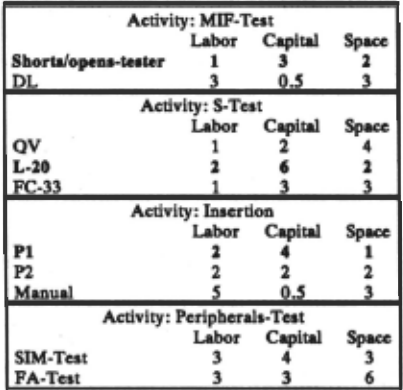
Table 1 shows various resource requirements for carrying out four manufacturing activities. For example, resource requirements for "S·tcst," which an activity that tests assembled modules, depends on the choice of testing devices. In choosing among such alternatives, the program picks the most "balanced" alternative in light of the organization's resource availability picture at the time. Because these choices arc made successively using limited look-ahcad, 2 it leaves open the possibility that some resource constraint will be violated, thereby forcing the problem solver to undo one or more of its previous choices.
As an example, let us consider a situation where the three choices indicated in table 1 have been made when saving space wu considered more important than saving capital. Further, assume that at this point in the plan formulation, there is only $2 million more left to be allocated. With this "money is no object" attitude the program is now in trouble. It cannot chose either the SIM-testcr or the FA-tester, as either choice would consume more than the remaining capital. Clearly, some previous selection must be undone to alleviate the problem and several maneuvers arc available. Under such circumstances, the problem solver must be capable of reasoning about the most rational course of action rather than simply making a blind selection. In the following paragraphs, we present a formal treatment of PLANET's backtracking method.
3. Depeadeacy Dlreeted R_..Dinl Ia PLANET
The data dependency and backtracking mechanisms of PLANET arc built on top of RUP (McAllcster, 1980). An ovcrconstraincd state is equivalent to a RUP contradiction. When ovcrconstraincd, PLANET must find and retract an existing choice that contributed to the unacceptable state of affairs. An alternative choice is then made as a
'It does not know bow many choices still need to be made, i.e. bow much of the model still needl to be crafted, and what the tradeoffs involved will be.
Table 1
These tables indicate rcsource-rcquircmcnts/tradcoffs for four decisions. The selected alternative in the fint three is in bold type. The units of Labor arc workcn working, Capital is in millions of dollars, and Space is in thousands of square feet of floor space.
replacement, and processing continuca. We refer to this backtracking behavior as Second Gue111D1.
Whenever the program is quiescent and must resort to guessing it is making a "Forc·d Cltolc·"· In such situations, several alternatives typically exist. We call each forced choice a deelllon level item. Each of the alternatives available in the context of a decision level item is called a aeleetlon level item, Note that for any given decision level item there exista a set of at leut two selection level items. For exposition, we will denote particular decision level items with a aubscripted D and denote particular selection level items with a subscripted S. Sets of either will be denoted in italics, i.e. D, and S.
When the program is processing a decision level item it is gueuing. The gueu is to pick some element from a set of selection level items. When the gueu i1 made, only heuristic estimates of resource tradeoff· are available to evaluate the mcrita of particular alternative~. By the time the program finds itaelf in an over-constrained state considerable computation could have been done in developing a more accurate asseument of resource consumption and establishing other constrainta. This information is not available to PLANET when guessing but is available when second guessing. The key point here is that the evaluation function used by the second guesser is more accurate than the evaluation function used by the guesser, allowing problem solving to continue with the benefit of new hindsight.
When the program becomes over-constrained it bas processed several decision level items. We call the set of these items b. For each D1Ei> there is a set, S1 of alternative selection level items (choice) that could have been guessed. We call the distinguished gueu in S1 as Set· Thus, the set of all selection level cboicca (gucssca) that
A subset, S , of ~ contains all S gueues that have contributed to the over-constrained state. S can be computed by chasing current dependency information. The subset, D, of b - the set of decision level items that need to be reconsidered - is derivable from S.
Given D, the second gueuer can reuon, in a "given what I know now" manner, about two related issues:
Detenalne wbich element of D to reconsider.
Recollllder, find a different selection for the chosen decision item.
To elaborate, consider the previously described situation where PLANET bu suddenly realized that it is about to over allocate capital by at leut $1 million. From table 1, we sec that the setS is {shorts/opens-tester, L-20, P1}. The set D is then {MIF-test, S.Test, Insertion}. Examination of D reveals that s-Test is the best decision level item to reconsider. The set {L-20 QV FC-33} is then scrutinized using the added information that an acceptable choice would have to consume at least $1 million less than L-20. Note that in second guessing, PLANET bas access to information that was not available when it fint attempted to process the decision level item S-Tcst. Quite literally, it is using hindsight.
The set of choices in S arc indeed responsible for the over constrained state. We claim that the identification of a scapegoat in S and ita replacement is made more rational by examining each selection level candidate in the context of ita decision level item. Furthermore, each of the decision level items should be compared and contrasted. This distinction is important ·· the selection level items are the retractable "assumptions", but second gucasing pivota around the decision level items.
4. ReuoDed Allertloa ud Retracdoa of ~pU...
In order to facilitate a rational reconsideration of choices, we provide explicit structures that maintain context at the decision level. Whenever a contradiction arises, the program can usc this plus information on the type of constraint violation to determine which assumptions to retract to best alleviate the problem. Each choice is represented u a structured object (enclosed within braces):
{decision: D 1
selection : S1
alternatives : { sl, .... s.}

disadvantages : ((S1(RlR2 .. Rn))(S2(RlR2 · · · Rn)))
advantages : ((S1(RlR2 .. Rn))(S2(RlR2 · · · Rn)))} The "advantages" and "disadvantages" slota are lists of dotted pairs; the fint clement in a pair is a selection item (an alternative to the selection S1), and the second is a list of resource categories for which the alternative is advantageous or disadvantageous respectively. Whenever an unac.c:eptable allocation of resource, R, arises, the program invokes a two step procedure to determine its revised set of choices. First, all decision level items disregarding R as a disadvantage are recorded. Then, the combined pool of selection level items are compared to determine the selection best alleviating the underlying problem. The object representation of the S-Test decision in our example would be:
{decision: (modules: S-Test)
selection : L-20
alternatives : (QV FC-33)
disadvantages : ((QV labor capital)(FC-33 labor capital))
advantages : ((QV space)(FC-33 space))}
In this example, PLANET correctly identified three decision points as having disregarded capital. It identifies S-Test as the decision level item to reconsider, and modifies the selection associated with it. The important aspect of this examination is that it had a specific goal: Identify the decision level items that contribute to the over constrained situation that also disregard the down side on the resource for which a constraint bas been violated. In effect, the procedure focuses on a problem specific set of contributing factors instead of merely finding some basic set of entailment.
PLANET routinely makes these kinds of revisions. When faced with the task of reevaluating previous choices, it applies both problem specific and domain specific knowledge to identify the choice. In doing so, it uses hindsight - the current problem state - to identify its backtracking point. Like other non-chronological backtrackers (Stallman and Sussman, 1977; Doyle, 1979; McAllester, 1980) only those inferences dependent on the choice ere retracted.
5. Limitations aad CoDdudlDa Remarb
In the example considered above, a detailed comparison of the resource implications of alternative selections was possible. Unfortunately, this is not always the cue. If the set of potential backtracking points identified includes choices about the more abstract parts of a manufacturing plan where detailed resource requirements have not yet been assessed, a quantitative comparison is not possible. Projecting the consequences of the various maneuvers is then difficult. Further, if long chains of dependencies exist, the program might pick as its best move one that involves undoing large parts of the partially formulated plan since this would free up the maximum amount of the scarce resource. In other situations, a revision might only alleviate the problem marginally, allowing it to recur a few steps later. Finally, a limitation of the existing backtracking scheme is that the program is unable to recognize situations where it might be better off retracting a combination of choices as opposed to a single decision. We are currently working on ways by which domain specific knowledge about these situations may be represented in terms of dependency information and made accessible to the back tracker.
In conclusion, the issues raised here have been driven by a complex, real-world problem where existing formalisms proved to be useful but inadequate in modeling the essential nature of the problem. We have developed a scheme whereby a backtracker might assess more rationally the reasons for an untenable situation, and modify its existing set of choices in light of the evolving scenario of constraints. While the methods outlined above are preliminary, they represent a step toward a more general method for reasoned introduction and retraction of assumptions for decision situations where tradcoffs are involved.
Referencea
- de Kleer, J., Doyle, J., Steele, G. and Sussman, G., AMORD : Explicit Control of Reasoning, Proceedings of the Symposium on Artificial Intelligence and Programming Languages, 1977.
- Dhar, Vasant., PLANET: An Intelligent Decision Support System for the Formulation and Investigation of Formal Planning Models, Ph.D. Thesis, University of Pittsburgh, 1984.
- Doyle, Jon., Truth Maintenance Systems for Problem Solving, TR-419, Massachusetts Institute of Technology, Artificial Intelligence Laboratory, 1978.
- Doyle, Jon., A Truth Maintenance System, Artificial Int.lllgence, June, 1979.
- Doyle, Jon., A Model For Deliberation, Action, and Introspection, MIT-AI TR-S81, May 1980.
- McAllester, D., Reasoning Utility Package, AI Laboratory Memo 667, April 1982.
- McDermott, Drew. and Doyle, Jon., Non-Monotonic Logic I, Artificial Intelligence Nos 1 and 2, April 1980 (special issue).
- Stallman, Richard. and Sussman, Gerald., Forward Reasoning and Dependency-Directed Backtracking in a System for Computer-Aided Circuit Analysis, ArtVfclal llat.lllg·nc·, volume 9, No.2, October 1977, pp 135-196.
- Stefik, Mark., Planning with Constraints, Stanford University, Computer Science Department, STAN-CS-80-784, 1980
@inproceedings{ijcai1985p34,
  title     = {An Approach to Dependency Directed Backtracking Using Domain Specific Knowledge},
  author    = {Dhar, Vasant},
  booktitle = {Proceedings of the Ninth International Joint Conference on
               Artificial Intelligence, {IJCAI-85}},
  publisher = {International Joint Conferences on Artificial Intelligence},
  editor    = {Aravind Joshi},
  pages     = {188--189},
  year      = {1985},
  note      = {Automated Reasoning},
  url       = {https://ijcai.org/proceedings/1985/34},
}
TY - CPAPER TI - An Approach to Dependency Directed Backtracking Using Domain Specific Knowledge AU - Dhar, Vasant T2 - Proceedings of the Ninth International Joint Conference on Artificial Intelligence, IJCAI-85 PB - International Joint Conferences on Artificial Intelligence PY - 1985 SP - 188 EP - 189 UR - https://ijcai.org/proceedings/1985/34 ER -Copied
Machine-readable versions of this paper, for tools and AI agents:





