
The US and Japan Cooperative AI Research and Development
Proceedings of the Ninth International Joint Conference on Artificial Intelligence. General. Pages 1303-1304.
© 1985 International Joint Conferences on Artificial Intelligence
Abstract
This paper examines the ernerging relationship between the US and Japan with respect to Artificial Intelligence and the significant trend towards US-Japan cooperative AI research and development. This trend is underscored by the increasing investment by both nations to develop massive 5th generation computer technology. The importance of the US and Japan's relationship is amplified by these two nations being the world's largest high technology producers and trading partners. One rrust fully appreciate the future course of events as the two nations open up new markets, estimated at tens of billions of dollars in AI hardware, software ·and related Services by the 1990's. AI has greater implications for collaboration versus ruthless competition, as in other markets, due to the uniqueness of opportunity AI offers the US and Japan for rrutual growth. AI will offer unique ways for the US and Japan to grow closer with greater understanding of two otherwise extremely different social and economic systems. This does not diminish the importance of other countries growing closer through AI in this way, but rather demonstrates the greatest example of cooperation with the greatest total economic rewards.
Full text extracted automatically from the PDF; figures, tables and equations may differ. The PDF is the version of record.
THE US & JAPAN COOPERATIVE Al RESEARCH & DEVELOPMENT
Howard E. Jacobson
Jacobson Corporation 610 Newport Center Dr. Newport Beach, CA 92660
towards increasing diplomatic and economic relations, trust and stability may be lost in the process. This illustrates the basic need to create more effective tools for the US and Japanese government and commercial interests to better interact. The fit for AI here is ideal. As our overall markets continue to grow and overlap, there becomes a higher price for failure and a greater reward for successful negotiation and cooperation. This is one of the original concepts for AI technology.
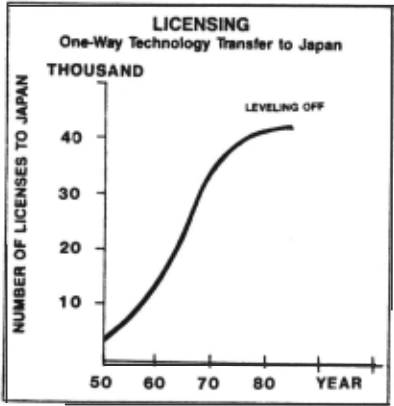
. To gai~ better insight into the depth of th1s ~rend 1n our changing high technology relat1ons, the last 30 years are revealing. When Japan was rebuilding its economy after the War ~any US _firms licensed technology to their ' lndustnal Counterparts. The licensing of technology was a natural fit for both sides, but the co~sequences were unimagined. This period shows 1n excess of 38,000 licenses transacted from the US to Japan.
The chart below illustrates the increase and t~en leveling-off of US originated technology l1censes to Japan. The historic curve is in direct rel~tion to Japan's economic rebuilding and expans1on to the gradual decrease in dependence on foreign technology, as internal 1nnovat1on became more practical and effective.
ABSTRACT
This paper examines the ernerging relationship between the US and Japan with respect to Artificial Intelligence and the significant trend towards US-Japan cooperative AI research and development. This trend is underscored by the increasing investment by both nations to develop massive 5th generation computer technology. The importance of the US and Japan's relationship is amplified by these two nations being the world's largest high technology producers and trading partners. One rrust fully appreciate the future course of events as the two nations open up new markets, estimated at tens of billions of dollars in AI hardware, software ·and related Services by the 1990's. AI has greater implications for collaboration versus ruthless competition, as in other markets, due to the uniqueness of opportunity AI offers the US and Japan for rrutual growth. AI will offer unique ways for the US and Japan to grow closer with greater understanding of two otherwise extremely different social and economic systems. This does not diminish the importance of other countries growing closer through AI in this way, but rather demonstrates the greatest example of cooperation with the greatest total economic rewards.
CHANSES IN US-JAPAN HIGH TECH RELATIONS
Japan has demonstrated a most effective competitive strategy in most marketplaces, which has, as some observe, threatened the basic underpinnings of the US economy. More specifically, the great desire by Japanese firms to be number one has created an overall uneasiness for most US firms about the future. The 1 ast few years has seen a growi ng di scontent from Americans towards Japan and recently resulted in the strengest Post-War trade protection backlash ever witnessed towards Japan.
Thankfully, the leaders in both countries have gone to great lengths to avert a trade war, whose consequences would only prove destructive to each economy. This latest round of measures shows an unprecedented willingness from Japan to protect good relations with the US. Prime Minister Nakasone is urging the liberalization of freer trade to benefit the trade imbalance. The risk, however, is that by the US using threats This change in Japan 1 s dependence on US technology is revolutionizing the relations between the world 1 s two largest suppliers of high technology goods and services. The effects of this change wil~ be positive, if the US and Japan can f1nd effect1ve ways to work productively with each other _in partnerships to advance technology through pr1vate market means. It will also ease the trade frictions that have resulted due to the $35 billion trade imbalance.
Corr~cti~g.this imbalance, many US firms are now cr~at1ng JOlnt ventures instead of simply l1cens1ng the1r technology. This is because they began valu1ng the rewards of selling in Japan 1 s market, at least as an equity partner. I'Umerous US a~d Japanese_firms in the computer, robotics, hybr1d electron1cs and high technology services sectors have been finding ways to join efforts.
Currently, Japan is changing its role from te~hnology assimilator to technology innovator. Th1s upsets a long-held belief that Japan only takes t~chnology and lacks innovation. Japan had used th1s method successfully for many generations, but recently a change has taken place. ~apan recognized the poor reputation created 1n 1nternational markets due to technolgy assimilation. It was felt that further lnternational resistance to this method by dev~loped countries would be expressed against buy1 ng Japanese products.
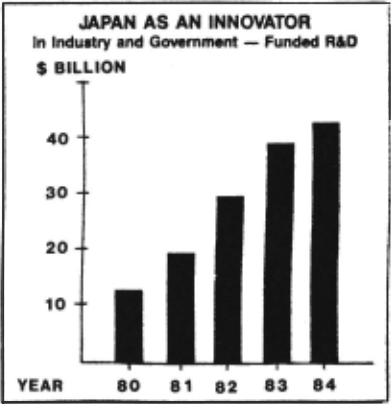
Beca~se the ~ajority of Japan 1 s economy is based on 1nternat1onal trade, MITI, the Ministry ~or Intern~tion~l Trade and Industry, in 1981, 1ssu~d a d1r~ct1ve towards Japanese innovation and 1n~ernat1onal R&D collaboration. In 1982, MIT! f1nanced $740 million for technology R&D all Japanese government R&D totaled $6.2 billion and the total ~ov~rnment and private R&D of Japan exceeded $27 b1ll1on. This is impressive because it pushed their R&D as a percentage of GNP ahead to challenge the US. 1981 saw the creation of ICOT, the Institute for the 5th Generation Computer Technology, which caused a severe sense of threat to the US.
Since then, that sense of threat may be subsiding. This is a clear indication of a new Japanese strategy, which has started to set the course for new era of US Japan high technology re 1 at i ons. Thi s i ncrease in Japan 1 s R&D innovation does not remove the historical US leadership in innovation. Rather, it acts to add parity to an otherwise unbalanced relationship. The issue of technology lifespans growing shorter will always equalize any dominance in technology before too long.
Even thou gh ICOT 1 s 10-year severa 1 hundred million dollar strategy appears' ominous the fact isthat it is not out of line with what'the US is investing by individual firms in such ambitious future development. · The reason i t appears threatening is that the figures are pooled into one sum. If you add a 11 the US fi rms R&D expenditures on 5th generation computer technology from 1981 to 1991, you might find it exceeding Japan 1 s ICOT by a healthy margin. We must not get caught in the trap of who gets how much of the AI market alone, but how we can proceed together for optimum benefit.
THE EFFECTIVE US-JAPAN AI BLUEPRINT
Assuming that great improvement can be made by joining certain efforts in US-Japan AI work, what is an effective method? As an example, Japan has created its industry and government consortium, ICOT, as a 10-year effort to produce a 5th generation computer. The reason was to develop standards and create efficiency by nonduplicated costs of development. Some critics view this as a way to upset the balance of power in the world of technology. In reality, collaboration was a wise decision and US firms have recently been finding ways to implement this. As the US Antitrust laws were loosened and further R&D incentives created, US firms took advantage of pooling technology efforts to maximize returns for their investors. In a way, this increases US competitiveness far beyond a less productive process.
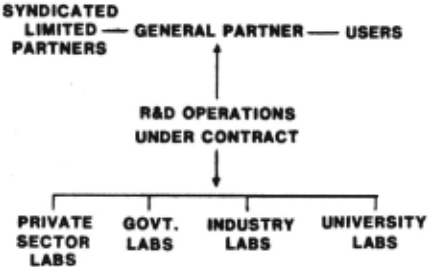
The next logical step is to combine talents on priority projects for the US and Japan using the method on the following page. This US-Japan AI R&D Limited Partnership is patterned after the US Department of Commerce blueprint for collaboration. The DOC Office of Productivity, Technology and Innovation has created a system that allows laboratories, partners and the marketplace of end-users to benefit by organized association, similar in some ways to the ICOT formula.
This diagram below gives a clear sample of the way in which US and Japanese scientists and commercial firms can team tagether on projects that will help the government or business interests interact more effectively using AI systems. The many labs in Japan that have started using AI in solving problems with symbolic processing make a good starting point to institute this model. The general partner is relied on to guide all interests effectively towards the proper commercialization of the technology. The syndicated limited partners may have a direct need for the technology in their own businesses, in addition to sharing in royalties when the application is delivered to the end-users.
US & JAPAN Al R&D LIMITED PARTNERSHIP
In looking at US-Japan Cooperative AI opportunities, there are some basic balancing factors. 1) The US outweighs Japan in AI Software talent 25 to 1. 2) There are numerous AI projects beyond ICOT, jn Japan that more readily avail themselves to US collaboration. 3) The flow of capital will probably come from both US and Japanese firms, equally. 4) Japan recently approved a 50-year software protection. Each of these factors describes the natural attraction of US and Japanese interests to produce AI products for mutual benefit.
THE CURREIT US-JAPAI AI PICTURE
What is the most effective way to strengthen US-Japan ·relations using AI? We anticipate AI having a broad impact on the entirety of industry. The principle of technology diffusion by greatest cost-benefit is the first determining factor to identify commercial applications. Certainly, the forces of commercialization are rapidly enjoining the labs to produce the first AI applications marketed to industry. As the labs begin to gain greater awareness of what form their art is taking commercially, the process becomes streamlined. Therefore with respect to enjoining US and Japan AI talent, it is dependent on the commercializing forces to seize their most applicable opportunities.
The first and foremost areas of application for US-Japan AI cooperative development include: Telecommunications, International Trade, International Finance, Manufacturing and International Diplomacy and Negotiation. These areas have the greatest promise due to the political and economic ramifications being experienced by the two countries. As Japan opens its markets to US producers, they will need to develop competent AI systems for conducting business smoothly with Japan. US banks, securities firms, and manufacturers will be testing their skills and luck with the new opportunity to reach a market of 114 million people. Their expectations will be more easily reached with the enhancement of AI applications to guide their transactions and operations.
In reverse fashion, the Japanese firms doing business in the US will be able to reach greater efficiency by Setting AI decison systems to their advantage. The area of machine translation is one that is more appealing to Japan because of their dependence on trade with the US. But, as trade equalizes, more US interest in commercial translation systems will be expressed.
The area of AI machine translation has been explored for years and most believe that commercially viable systems are beginning tobe released. The Wilson Center, in Washington, DC, recently organized a program called "Getting America Read~ For Japanese Science and Technology". This explored the progress between our countries, as more knowledge is gained of the Japanese language. An AI translation system for Japanese was revealed by Bravice International, Inc. As technical progress moves ahead, AI voice recognition translation technology will appear. This has tremendous benefit for our countries.
This type of merging mutual technological interests is serving to elevate the quality of our lives dramatically, expanding the cumulative marketplaces and ensuring the growth of our free markets' cooperation.
~Conference was sponsored by the Wilson Center's Asia Program and The MIT-Japan Science and Technology Program. It focused on the Japanese language, machine translation technology, US policy on language training and technical Japanese.
ACliOWLEDGEMEITS
Mr. Howard E. Jacobson, Executive Vice President of the Jacobson Corporation, serves as chair to the IJCAI panel on US-Japan Cooperation in AI R&D. His professional background includes thr formation and management of US-Japan R&D partnerships in Artificial Intelligence, Computer Hardware, Robotics and Biotechnology. Mr. Jacobson was the Special Advisor to the US Presidential Commission on Industrial Competitiveness regarding US-Japan relations and is a member of several international scientific associations. Mr. Jacobson's degree is in Economics from Claremont McKenna College (CMC).
@inproceedings{ijcai1985p262,
  title     = {The US and Japan Cooperative AI Research and Development},
  author    = {Jacobson, Howard E.},
  booktitle = {Proceedings of the Ninth International Joint Conference on
               Artificial Intelligence, {IJCAI-85}},
  publisher = {International Joint Conferences on Artificial Intelligence},
  editor    = {Aravind Joshi},
  pages     = {1303--1304},
  year      = {1985},
  note      = {General},
  url       = {https://ijcai.org/proceedings/1985/262},
}
TY - CPAPER TI - The US and Japan Cooperative AI Research and Development AU - Jacobson, Howard E. T2 - Proceedings of the Ninth International Joint Conference on Artificial Intelligence, IJCAI-85 PB - International Joint Conferences on Artificial Intelligence PY - 1985 SP - 1303 EP - 1304 UR - https://ijcai.org/proceedings/1985/262 ER -Copied
Machine-readable versions of this paper, for tools and AI agents:





