
SAPHIR + RESEDA: A New Approach to Intelligent Data Base Access
Proceedings of the Ninth International Joint Conference on Artificial Intelligence. Natural Language. Pages 855-856.
© 1985 International Joint Conferences on Artificial Intelligence
Abstract
Thls paper descrlbes a transportable natural language Interface to databases, augmented wlth a knowledge base and tnference techntques. The tnferance mechantsm. based on a classtcal expert system's type of approach. allows. when needed, to automatlcally convert an Input query lnto another one whtch ts •samanttcally close•. Accordtng to RESEDA's theory, •semantlcally close• means that tha answer to the transformed query tmpltes what could have been the answeF" to the ortgtnal quastton . The presented system lntegratas natural language processlng, expert system and kriowladge representatlon technology to provlde a cooperattve database access.
- <1> Gross, M. M6thodes en syntaxe . Paris: Hermann , 1975 .
- <2> Hoeppner, W .. T . Chrlstaller, H. Marburge r, K. Morlk , B . Nebel . M. O'Leary and W. Wahlster , ' Beyond Oomaln-lndependence ', ln ~P~r~o~c~• ~o~f--~I~J~C~A~I~-~8~34 , Karlsruhe.
- W. Germany, 1983.
- <3> Hemphlll L . and J . Rhyne , A Model for Know ledge Repre- sentatton in Natural Language Ouery Systems, Research Raport Labaratory RJ 2304(31046) , IBM Research Laooratory. San Jose, September 1978 .
- <4> Kaplan, S . J . "Cooperat tve Natural Language Ouery System" . vol 19 (1982) 165-187 . Responses from a Portable Arttfictal Inte ll igence, <5> Normier, B . Jenvier 1984 . SAPHIR-Presentat ion genera le, ERL! .
- <6> Norm i er , B., M-E . Aubert , G. Clemenctn, B . Euzenat , S . Lacep, N. Lellouche , A. Ogonowskt and J . Vega, Extension da la gestton du dtalogue, Rapport ftnal (Marche DRET 83/234), ERLI . Decembre 1984 .
- 7> Euzenat . B ., B . Normier, A. Ogonowsk i and G . P . Zarri, Las mecan ismes d 'i nference dans l 'i nterroqation de bases de donnees relationnelles en langage naturel. Convention ADI-84-068 rapport Intermediaire N . 1, ERLI. Juin 1984a <8> Euzenat , B ., B . Normter , A. Ogonowskt and G. P . Zarri , Les mecan t smes d 'i nference dans l'1nterrogation de b a ses de donnees relationnelles en langage natur el, Convention ADI-84-068 rappor t f i nal , ERL! . Decembre 1984b .
- <9> Zarr t, G . P. " An Out lt ne of the Representation and Use of Temporal Data in the RESEDA System" . Information Technology: Research and Development, vol 2 ( 1983) 89-108 .
- <10> Zar ri , G . P . '' Ex pe r t Systems and Informat1on Retr i eval : an Exper i ment in the Domain of Btographical Oata Manage me nt ". tn Developments in Expert Systems,
- Coombs M. J . ed . Londrn: Academ ic Press. ~984a .
- <11> Zarri, G. P. " Constructing and Uttl izing a Large Fact Oatabase Using Al Techniques", tn Proc . of the First International Workshop on Ex pert Oa t abase Systems, Univ of South Ca rol tna , College of Bus iness Administration.
- Kerschberg L . ed . 1984b .
- <12> Zarri, G . P . "Intelligent Informati on Retrieval : an Interesting Appl ication Area for the New Generation Com- puter Systems" . i n Proc of the International Conference on Ftfth Generat t on Computer Systems. Tok yo, Japan. 1984c .
References were extracted automatically from the PDF and may contain errors.
Full text extracted automatically from the PDF; figures, tables and equations may differ. The PDF is the version of record.
1. lNTRODUCTION
Most of the exlstlng natural language Interfaces (NL!s) to databases - too numerous to be ctted - free the user from learnlng the cumbersome and dlfflcult syntax of for mal database query languages . Still they lmpose a very strlct semantlc modal, whlch corresponds to the way a real world domaln ls represented ln a partlcular database (DB) .
lt 1s therefore dlff1cult to produce e ·valid question" w;thout being aware of the structure of the database concerned. Thts tssue ts the matn concern of the SAPHIR+RESEOA (Euzenat et al., 19B4a, 1984b) research pro ject at ERLI. · SAPHIR (Normler, 1984, Normler et al ., 1984) our bases, ts relatlvely transportable, domaln tndependent NLI to data in the course of betng provtded wtth e general knowledge base (KB) and assocleted tnference mechantsms.
Before golng lnto the technlcal detalls of thls new system , let us show a typlcal problem that SAPHIR+RESEDA will be able to handle.
Suppose that you want to ask a questton such as "who hasever been tn the us·. and that youn staff management database does not contatn any tnformatton concerntng the employees ' excurstons . Suppose further that the OB knows tnstead where each one of them was born and what thetr degrees are.
Ustng stmple common sense knowledge, wtthout accesstng the database, we can tell the user that although we do not expltcttly know who has been tn the USA, we can neverthe less lock for people born there and/or having an American degree . lf the user accepts thts proposal then we trans mit the modlfied query to thP. OBMS .
· This research was supported tn part by the ·Agence de 1 'lnformat1que· research contract AOI-84-068 .
Howaver, tn many cases the quary wtll not map dtrect ly onto the database.
Instead of simply tell 1ng the user that his question 1s not Mthe questton to ask·. we will try to transform hts request tnto something meantngful in the parttcular data base and semanttcally close to the original request - th1s part of the system 1s based on G.P. Zarri's RESEDA syste~ (Zarr1, 1983, 1984a, 1984b, 1984c) . We def1ne ·quest1on1" tobe semanttcally close to "quest1on2" tff the answer to ·quastton1· ts tmplted by the answer to ·questton2·.
III. THE KNOWLEDGE BASE
To achteve thts, we need of course the knowledge of what ts ·semanttcally close·.
In the example presented above the system was able to transform the original questton. because tt knew that ·tf a person ts born in a parttcular place then that person must have been tn that place at least for a short pertod of time· .
The secend a .l ternat1ve of the transformed query ts produced because the system knows that ~tn order to obtatn a degree, a person has to attend courses at a parttcular universtty or da some research werk at that untverstty· and that ·tn both cases the person had to be physically present there at one time or another ~ (to stmpltfy the presented example we deltberatly tgnore all the cases of exceptton to thts rule).
It follows from the example that the system mantpu· lates rather general common sense knowledge .
We dectded to take the domatn of staff management as our test-bed . However we still need to represent some more generat , extra-domatn knowledge .
From a technical point af vtew , aur overall knawledge base is dtvtded tnto a number af sma\ler knowledge bases , as tllustrated tn Ftgure 2 .
·---------------------------------- -- ---------------·
·---------------------------------------------------·
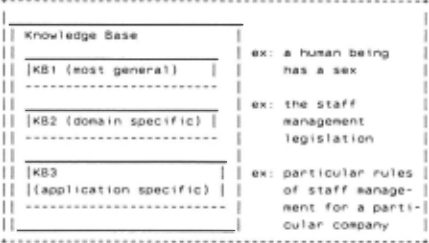
KB1 contains btts of any appl tcation (of course, knowledge that are usable tt w1ll never be complete) . in
K82 conta1ns generat knowledge for a particular domatn We hope to develop a certatn number of K82s (wtth a common K81 nucleus) for each real world domatn that our system ~11 1 have to deal wlth .
Each K81 · KB2 couple ts transportable ·as ts·, as lang as we da not swttch to a completely different domatn .
Note that KB3 1s not spec1f1c of a particular database, the system can .use the same KB3 1 n order to access d t f fer ent personnet databases of the same company .
The model of the database 1tself (the most spectftc level of knowledge) ts not tncluded here stnce tt does not take part dtrectly tn the transfermatten process.
IV. TYPES OF KNOWLEDGE.
Any one of the KBs menttoned above may contatn two types of knowledge : factual knowledge and rules (repres ented in a formalism based on RESEDA) .
A. Factual knowledge
A fact such that ·a untverstty 1s a p1ece of factual knowledge, h1ghl1ghted part of F1gure 3. 1s in a c1ty . .. ", wh1ch 1s represented by the
+---------------------------------------------------+
+---------------------------------------------------+
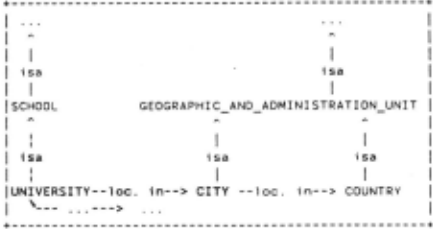
Th1s frame-1 ike network descrtbes *specif1c-generic* type of relations (*tsa· links ; we allow polyh1erarch1es) used as matehing cr1teria when applying rules (cf below) . Other specific relations (used in the rules, fo·r example topological ones) are also present in the network.
This representation does not have the full power of frame systems stnce presently there ts no procedural know ledge represented in the network .
B. Rules
Currently we have two types of rules :
- 1 . Transformation rules .
- 2 . Standardization rules
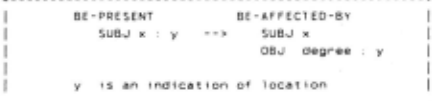
A fact such as *if a person (x) has rece ived ("BE-AFFECTEO-BY") a degree in a particular place (y) tnen that person has been (*BE-PRESENT ~ ) 1n that place~ . which ts a transformation rule, ts represented as \n Figure 4 .
+--------------------------------- ------------------·
Ftgure 4
Note that :
- a . Thls ls a deep case repreaentatlon wlth a llmlted num ber of predlcatea ("deep verbs").
- The dlrectlon of the arrow ls followlng RESEDA's con ventlon. From a practlcal polnt of vlaw the arrow lndlcates that the rlght-hand slde achema ls allowed to replace somethlng that matches the left-hand slde sche ma. Conceptually lt means that the Information possl bly retrleved uslng the rlght-hand slde schama lmplles the Information searched for, by the (original) left hand slde schema .
Rules can place restrlctlons on variables (as ls the case ln RESEDA). For lnstance, tha rule shown abova could have raqulrad that ·x· be a hUman belng. Thla rule would then apply for ·x · y·, where ·y· ts known tobe a teacher . The match (betwaa_n x and y) ls made posslbla, bacause we have storad ln the factual knowledge reprasentatlon the fact that ·teacher 'ts_a' human_betng· .
Standardlzatlon rules ara used to translate the parser's output (contatntng surfaca varbs) tnto a more canonlcal form, l . e . usable by transformatlon rules . All of the standardlzatlon rules belang to the KB1 Ievel, as they are absolutely general .
V. THE INFERENCE ENGINE
We are ln the course of developplng (December 84) a P.rototype verston wtth an ·exhausttve· engtne, meaning that all the posslble transformatlons are executed (wlth simple destructlve chronologlcal backtracklng) untll a representatton ts found. Thts approach ts very close to the RESEDA lnference englne (see Zarrl. 1984c , for a descrlptlon of the later one)
Thls slmpllstlc approach ls justlfled slnce our current knowledge baseconteins only *KB3* types of knowledge.·· We are planntng to move onto more sophtsttcated approaches (ex. choostng among several representattons tn the data base of the same quest Ion, a.s.o ... ) after the prototype has been well tested .
VI . CONCLUSIONS
The presented Nll system 1~ destgned to tackle tssues such as transportabtllty and "helpful understandtng" of a natve user.
Transportabillty, the ftrst tssue , has been examlned in many research systems, however ali of these seem to lack a clear dtsttnctton between different levels of transportabll ity of the knowledge represented (HAM-ANS, Hoeppner et al . 1983 seems to be an except Ion) .
In addlt ion SAPHIR+RESEDA ls uslng general common sense knowledge (reference Hemphlll and Rhyne. 1978, descrtbes a project where the use of Schank 's general formaltsm tn OB quertes has been explored, but tts goals seem tobe more 1 tmtted than ours) .
The secend tssue as deftned tn the ts somewhat close to · cooper·tlon· CO-OP system (Kaplan. 1982) . Kaplan however seems to constder onl y the case where the OB pro duces a null answer . We be l teve hts end our approach to be complementary .
Our rulaa (temporarlly) hava a very apeciflc content, l . e. they have not been "factored out·. Thla Ia due to tha fact that only a 1 lmlted number of querlas hava been test ed on a slngle database (we are beglnnlng the Implementa tion phase , foll.owtng a one year study perlod).
Our system uses rules to produce a OB query , thts ts stmtlar to a deducttve OBMS approach . However our rules are not formal and we never access the database 1n the course of transfermatten (because tn most real world cas es lt ls prohlbltlvely expens i ve) .
@inproceedings{ijcai1985p169,
  title     = {SAPHIR + RESEDA: A New Approach to Intelligent Data Base Access},
  author    = {Euzenat, Bernard and Normier, Bernard and Ogonowski, Antoine and Zarri, Gian Piero},
  booktitle = {Proceedings of the Ninth International Joint Conference on
               Artificial Intelligence, {IJCAI-85}},
  publisher = {International Joint Conferences on Artificial Intelligence},
  editor    = {Aravind Joshi},
  pages     = {855--856},
  year      = {1985},
  note      = {Natural Language},
  url       = {https://ijcai.org/proceedings/1985/169},
}
TY - CPAPER TI - SAPHIR + RESEDA: A New Approach to Intelligent Data Base Access AU - Euzenat, Bernard AU - Normier, Bernard AU - Ogonowski, Antoine AU - Zarri, Gian Piero T2 - Proceedings of the Ninth International Joint Conference on Artificial Intelligence, IJCAI-85 PB - International Joint Conferences on Artificial Intelligence PY - 1985 SP - 855 EP - 856 UR - https://ijcai.org/proceedings/1985/169 ER -Copied
Machine-readable versions of this paper, for tools and AI agents:





