
Understanding Analogies in Editorials
Proceedings of the Ninth International Joint Conference on Artificial Intelligence. Natural Language. Pages 845-846.
© 1985 International Joint Conferences on Artificial Intelligence
Abstract
The widespread use of analogy in human communication underscores the need for a system which can recognize and understand analogies. This paper presents a theory of analogy recognition and comprehension, using as a domain letters to the editor of a weekly news magazine. Some of the issues facing a system which understands analogies in this domain are identified, initial work on this program is reviewed, and work in progress is discussed .
- Alvarado, S.J., Dyer, M.G., Flowers, M. "Understanding Edi- torials: The Process of Reasoning Comprehension," Techni- cal Report UCLA-AI-85-3, University of California, Los Angeles, 1985.
- Carbonell, J .G. "Learning by Analogy: Formulating and Gen- eralizing Plans from Past Experience", in Machine Learning, R.S. Michalski, J.G. Carbonell, and T.M. Mitchell, eds., Tioga, Palo Alto CA, 1983.
- Dyer, Michael G. In-Depth Underltanding: A Computer Model of Integrated Proceuing for Narrative Comprehen1ion. MIT Press, Cambridge MA, 1983.
- Edwards, Gary R. A Rule and Frame Sy1tem, Ver~ion e.e. Hughes Artificial Intelligence Center, Calabasas CA, 1984.
- Flowers, M., McGuire, R., and Birnbaum, L. "Adversary Arguments and the Logic of Personal Attacks", in Strategie• for Natural Language Proceuing, Wendy G. Lehnert and Martin H. Ringle, eds., Lawrence Erlbaum Associates, Hills- dale NJ, 1982.
- Lakoff, G. and Johnson, M. Metaphor~ We Live By. Chicago University Press, 1980.
- Lebowitz, Michael. "Generalization and Memory in an Integrated Understanding System", Research Report #186, Yale University Computer Science Department of Computer Science, November 1980.
- Lehnert, W.G. The Proceu of Quution An1wering. Lawrence Erlbaum Associates, Hillsdale NJ, 1978.
- Minsky, M. "A Framework for Representing Knowledge", in The P1ychology of Computer Vi1ion, P. Winston, ed ., McGraw-Hill, NY, 1975.
- Ortony, A. (Ed.) Metaphor and Thought. Cambridge University Press, Cambr1dge, 1979.
- Schank, R., and Abelson, R. Scriptl Plan1 Goall and Under- ltanding. Lawrence Erlbaum Associates, Hillsdale NJ, 1977.
- Schank, R.C. Dynamic Memory. Cambridge University Press, Cambridge, 1982.
- Sternberg, R.J. /ntelligence, Information Proceuing and Ana- logical Rea1oning: the Componential Analyai1 of Human Abilitie1. Lawrence Erlbaum Associates, Hillsdale NJ, 1977.
- Christison, Robert. From "Letters", in TIME, 24 October 1983.
- Winston, P .H. "Learning new principles from precedents and examples", Artificial Intelligence, 19:3, November 1982, p.321.
References were extracted automatically from the PDF and may contain errors.
Full text extracted automatically from the PDF; figures, tables and equations may differ. The PDF is the version of record.
UNDERSTANDING ANALOGIES IN EDITORIALS
Stephanie E. Augu1t · Michael G. Dver
Artiflcial Intelligence Laboratory Computer Science Department, 3531 BH University of California Los Angeles, California 90024 net address: AUGUSTQUCLA-LOCUS.ARPA
JULIP is on the use of analogies in editorials. In cantrast to the work by Winston and Lebowitz, the objective of JULIP is to implement a theory of analogy recognition, representation, and access for question answering. A completed JULIP sys tem will accept as input a Ietter to the editor in English con taining an analogy. Our challenge will be to recognize the presence of the analogy in the Ietter to the editor, map analo gaus elements together, and perform any transformations needed to complete the analogy. Our system will demoostrate that it understands the analogy via an English language ques tion answer session with the user.
II The lssuea Facing JULIP
Consider the following hypothetical Ietter to an editor: HIGH-TECH-1
Some people are against computers because computers eliminate people's jobs. However, the automobile industry did the same thing to people in the horse carriage ind ustry . Yet consumer demand for autos was strong enough that eventually more jobs were created in the auto industry than were lost in the horse carriage industry . In the end, the economy benefltted by the introd·Jction of the new technology.
Informal protocols show that readers give the following answers when questioned on their understanding of this text:
- Ql : To what is the computer industry being compared?
- Al : THE COMPUTER INDUSTRY IS BEING COMPARED TO THE AUTOMOBILE INDUSTRY.
- Q2: What did the auto industry do to people in the horse carriage industry?
- A2: PEOPLE IN THE HORSE CARRlAGE INDUSTRY LOST JOBS.
- A3: Why is the computer industry being compared to the auto industry?
- Q3: 80TH INDUSTRIES INITlALL Y ELIMINA TED JOBS BUT ULTIMA TEL Y CREATED MORE JOBS THAN THEY ELIM INATED.
- Q4: What will bappen as computers eliminate jobs?
- A4: AN EVEN GREATER NUMBER OF NEW JOBS WILL BE CREATED.
Both the textual clues and an understanding of the mechanics of editorials and arguments are used in recognizing and following an analogy. Since JULIP's domain is letters to the editor, work on JULIP also encompasses a theory of edi torial comprehension and draws upon previous work on argu ment structures and rules (Fiowers, McGuire, and Birnbaum, 1982).
How can all these elements -- analogical reasoning, edi torial comprehension, and argumentation ·· be combined with natural language understanding! Our approach is to base the natural language comprehension component on BORIS (Dyer83), an integrated natural language understanding sys tem for narratives. The work by Flowers et al. on representa tion of beliefs and the structure of arguments is a key part of our representation of an editorial Ietter (Fiowers, McGuire, and Birnbaum, 1982). Memory or~anizatinn and causal rea·
ABSTRACT
The widespread use of analogy in human communication underscores the need for a system which can recognize and understand analogies. This paper presents a theory of anal ogy recognition and comprehension, using as a domain letters to the editor of a weekly news magazine. Some of the issues facing a system which understands analogies in this domain are identified, initial work on this program is reviewed, and work in progress is discussed.
I lntroduction
People often rely on analogy as a vehicle for conveying ideas. Researchers in linguistics, education, psychology and other academic disciplines have studied this use of analogy and met aphor in depth (LakofJ and Johnson, 1980) (Ortony, 1979) (Sternberg, 1977). Recent investigations by AI research· ers into computational models of analogical reasoning include (Carbonell , 1983), in which Garboneil outlines extensions to means-ends analysis which make use of past experience in solving new problems, thus integrating skill refinement and plan acquisition processes. There are few computational theories on the use of analogy in editorials, conversations, debates, narratives or other natural language text. Two examples of work in this area are Winston's work on learning by analogy (Winston, 1982) and Lebowitz' IPP (Lebowitz, 1980).
In Winston's system, a teacher supplied a precedent set ting story to the system and then gave the system as an exer cise a second story and a conclusion which was known to be true about the precedent. The system was able to reason why the conclusion was true for the precedent, and show how it was also true for the second story. While Winston's system was able to perform some analogical reasoning on the narra tives, it did not recognize the narratives as being analogaus without the assistance of the teacher.
IPP compared new wire service stories to similar events previously stored in memory. Lebowitz used in frame-like structures (Minsky, 1975) to index events in memory accord ing to their similarities and difJerences. IPP was successful in finding events similar to the new one and was able to form generalizations allowing it to learn about its domain. How ever, IPP did not form specific analogical mappings and did not deal with disputes, arguments, or beliefs.
JULIP is a Computer program which is part or the OpEd project (Aivarado, Dyer, and Flowers, 1985). The goal of OpEd is to develop a theory about the process of reasoning comprehension in the domain of P.ditorials. The focus of soning components are based upon Schank's work (Schank, 1982) (Schank, 1977). Our implementation of JULIP'S ques tion answer processing draws upon Lehnert's work in this area (Lehnert, 1978).
This work is supported in part by the Artilicial Intelligence Center, Hughes Aircraft. Company, Calabasas CA, and by a gran t from the W.M. Keck Foundation.
· Also affiliated with the Software Engineering Division, Electro Optical and Data Systems Group, Hughes Aircraft Company, EI Segundo, CA 90245.
m How Do You Know the Analogy Ia Tbere!
Understanding an editorial requires that the reader iden tify the dispute being presented, and the technique being used to support or refute the author's arguments. Analogy is one of these techniques. There are two main indicators of the pres ence of an analogy: 1) textual clues, and 2) conceptual similar ities. JULIP relies upon both of these indicators to identify the presence of an analogy.
A. Textual Clues
Use of textual clues provides the most direct technique for introducing an analogy into an editorial Ietter. In this case, the author uses a phrase such as ·the same thing· or ·similar to· or ·so it is· to link the source to the target. This technique is used in the following Ietter:
REVOLUTION
Tbe Soviets are dolng the same thtng in Lebanon tbat tbey did in Viet Nam. By supplying tbe Syrians and tbe Druze witb weapons, tbe U.S.S.R. is rostering internal feuds and abetting tbe downfall of Lebanon. (Cbristison, 1983)
In REVOLUTION, the reader is explicitly called upon to map the Soviets' role in Viet Nam in the past to the Soviets' role in Lebanon today. It is assumed that the reader has prior knowledge of what the Soviets did in VietNam.
B. Conceptual Similarities
People can readily detect the presence of an analogy even in the absence of textual clues, as seen in the following example:
DESTRUGTION
Tbe Soviets are bornhing people in Afganistan. But tbe U.S. killcd people in Vietnam. Wbat does labeHing tbe Soviet's actions as despicable say about our own action!
A reader identifies both events as instances of destruction. This indicates that the concepts representing the text are categorized in memory by type. To provide this capability in a computer program, conceptual representations must be categorized as they are built, and linked together in the order in which they are encountered. The contents of these groups must be checked as new elements are added to them. When similar conceptual representations are encountered, similarity measures and other heuristics must be employed to determine whether an analogy is intended.
IV Constructing a Representation or the Analogy in an Editorial Letter
HIGH-TECH-1 serves as a typical editorialletter contain ing an analogy. Here we present the analysis that JULIP is being designed to perform in building the representation of HIGH-TECH-1 in memory.
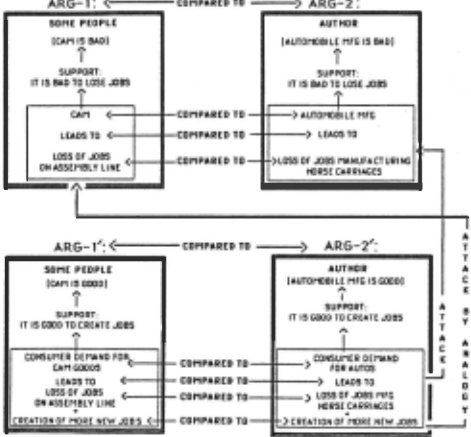
The author of HIGH-TECH-1 first brings up the issue (ARG-1) of introduction of computers into manufacturing, where robots are being used on the assembly lines. The author makes the point that this automation is causing people who would normally work on the assembly lines to lose their jobs. This is understood as a belief that .computer aided manufacturing (CAM) is bad. This belief is justified by the fact that computers cause people to sulfer job loss, and that losing a job is something bad.
Since this is a Ietter to an editor, JULIP must expect the author of the article to either defend or attack the original point. JULIP sees the author's argument begin to unfold in the second sentence, when the conjunction ·however· pro vides a lexical clue that a dispute regarding the argument is about to be introduced.
In sentence 2, JULIP is introduced to a new topic , the automobile industry and its relationship to the horse carriage industry. Encountering the phrase ·did the same thing· must cause JULIP to search memory for the most recent causal structure (CAM Ieads to job loss) and try to make a mapping to it. JULIP must map the auto industry to CAM and infer that the auto industry caused people in the horse carriage industry to lose jobs. Comparison links between the first causal structure and the second, and between the antecedents of both and the consequents of both will be added to these structures to reßect the mapping. By analogy to ARG-1, JULIP must form the second argument, ARG-2, reßecting the beliefthat manufacturing of automobiles was bad.
JULIP must interpret the concepts represented by sen tence 3 as a contradiction to ARG-2. Flowers et al. note that an argument can be contradicted by an attack on the belief espoused, by attack on the justification given for that belief, or by attack on the claim that the justification supports the belief. Lack of a value judgement on manufacturing of autos, and Iack of a contradiction to the claim that job loss is bad rule out the first and second attack strategies. JULIP's knowledge of the consumer demand/manufacturer supply cycle and its relationship to an increased job market must guide it to the realization that manufacturing automobiles actually led to the creation of additional new jobs. This con tradiction of the justification given for ARG-2 must cause JULIP to recognize that ARG-2 is invalid. The comparison links indicate that ARG-2 is parallel to ARG-1, so justification for ARG-1 as weil as ARG-I itself must now be viewed as suspect.
After reading sentence 4, JULIP must to build ARG-2' as an alternate to ARG-2, reflecting the beliefthat manufactur ing of automobiles is good, justified by the fact that the econ omy ended up actually improving as a result of the introduc tion of automobiles to the marketplace. By analogy, a representation for an alternate argument to ARG-I must now be built, reflecting the belief that computer aided manufactur ing is actually good, since it too will Iead to new jobs and an improved economy. Thus the conceptual represep.tation for this analogy has been completed in memory.
Figure I depicts the basic elements of the completed representation of HIGH-TECH-I.
V Answering Questions About the Analogy
JULIP is being designed to answer questions related to the mapping of source and target in the analogy, the transforms required to complete the analogy, and the basis of the analogy. Techniques for answering these types of questions draws upon Lehnert's theory of question answering (Lehnert, 1978), which 'is being augmented to handle questions peculiar to accessing the conceptual representation of an anal ogy. For example, questions regarding analogical mapping such as Ql above, are basically concept completion questions that require traversing a new type of link; in this case, the comparison link.
VI Work in Progress
Work on JULIP up to this point has concentrated on developing a conceptual representation or the text or HIGH-TECH-1. We examined the text of this Ietter in detail in an effort to identify the lexical items, demons, and domain knowledge that must be available to the parser in order to develop a plausible conceptual representation of HIGH TECH-I in memory. This approach enabled us to test the robustness or the representation, without being distracted by parser and coding implementing details.
JULIP currently works with a hand coded conceptual representation of the HIGH-TECH-1 analogy built in memory using ARF (Edwards, 1984), a knowledge representation tool which supports both static and dynamic property inheritance. JULIP accepts queries in conceptual representation form. It searches the completed graph in memory and returns a con ceptual representation or its fi.ndings to the User. The ques tion answer session is implemented via ARF queries on the representation.
Vll Future Work
We are now developing the parsing and generation com ponents of JULIP to enable it to handle verbatim input.
The next step for JULIP is to translate our theory into the demons and lexical entries needed to support analogy recognition and comprehension in DYPAR, the parsing com ponent of BORIS (Dyer, 1983). Our theory will continue to develop as we collect additional examples of letters to the edi tor containing analogies and human protocols for understand ing them. JULIP's current objective is to demonstrate under standing of editorial analogies given to the program in English through a natural language question answer session with the user. Future objectives of the project will address the issues of incorporation or conclusions drawn from the analogies into long term memory, and generation of analogies.
vm Conclusions
JULIP draws upon knowledge of editorial comprehension, argumentation, and integrated natural language understand ing systems to develop a theory of analogy comprehension in the domain ·of letters to the editor. We have shown how both lexical cues and comparison of conceptual similarities trigger recognition of analogies in editorials letters. Our conceptual representation of an analogy in memory utilizes comparison links to map analogaus elements to each other and to tie tagether parallel arguments. These links must be created and traversed during understanding as the representation or the completed analogy is built in memory. Question answer pro cessing utilizes these links to demonstrate the system's under standing of the completed analogy.
@inproceedings{ijcai1985p166,
  title     = {Understanding Analogies in Editorials},
  author    = {August, Stephanie E. and Dyer, Michael G.},
  booktitle = {Proceedings of the Ninth International Joint Conference on
               Artificial Intelligence, {IJCAI-85}},
  publisher = {International Joint Conferences on Artificial Intelligence},
  editor    = {Aravind Joshi},
  pages     = {845--846},
  year      = {1985},
  note      = {Natural Language},
  url       = {https://ijcai.org/proceedings/1985/166},
}
TY - CPAPER TI - Understanding Analogies in Editorials AU - August, Stephanie E. AU - Dyer, Michael G. T2 - Proceedings of the Ninth International Joint Conference on Artificial Intelligence, IJCAI-85 PB - International Joint Conferences on Artificial Intelligence PY - 1985 SP - 845 EP - 846 UR - https://ijcai.org/proceedings/1985/166 ER -Copied
Machine-readable versions of this paper, for tools and AI agents:
 Welcome
 Future Conferences
 AI Journal Division
 IJCAI Proceedings
 About IJCAI
 IJCAI Awards