
VOX - An Extensible Natural Language Processor
Proceedings of the Ninth International Joint Conference on Artificial Intelligence. Natural Language. Pages 821-824.
© 1985 International Joint Conferences on Artificial Intelligence
Abstract
VOX is a Natural Language Processor whose knowledge can be extended by interaction with a user. VOX consists of a text analyzer and an extensibility system that share a knowledge base. The extensibility system Iets the user add vocabulary , concepts, phrases, events, and seenarios to the knowledge base. The analyzer uses information obtained in this way to understand previously unhandled text. The underlying knowledge representation of VOX, called Co nc eptual Grammar, has been developed to meet the severe requirements of extensibility. Conceptual Grammar uniformly represents syntactic and semantic information, and permits modular addition of knowledge.
- l1J
- Granger, R.H. (1984). The NOMAD System: Expectation-Based Detection and Gorreetion of Errors during Understanding of Syntactically and Semantically IIJ-Formed Text. American Journal of Computational Linguistics. v.9, no.3-4.
- Grosz, Barbara J. (1983). TEAM: A Transportable Natural Language Interface System. Conference on Applied Natural Language Processing, Santa Monica.
- Grosz, Barbara J. and Mark E. Stickel (1984). Research on Interactive Acquisition and Use of Knowledge. SRI Technical Report.
- Hendrix, Gary G. (1977). The LIFER Manual: A Guide to BuHding Practical Natural Language Inter- faces. SRI Technical Note 138.
- SJ Meyers, Amnon (1983). Conceptual Grammar. AI Project, ICS Department, Irvine, California. UC Irvine Technical Report 215.
- Wilensky, Robert and Yigal Arens (1980). PHRAN- A Knowledge Based Approach to Natural Language Analysis. UC Berkeley. Electronic Research Labara- tory Memorandum No. UCB/ERL M80/34.
- Wilensky, Robert, Yigal Arens, and David Chin (1984). Talking to UNIX in English: An Overview of UC. CACMvoJ. 27, no. 6, pp.574-593.
References were extracted automatically from the PDF and may contain errors.
Full text extracted automatically from the PDF; figures, tables and equations may differ. The PDF is the version of record.
1. INTRODUCTION
The ability to learn is one of the most important charac teristics of intelligent systems. To approach such an abil ity, we first must build systemS"" that can accept new knowledge automatically . . By continually enhancing the extensibility capabilities of such systems, we can begin to address the problems of general learning.
Critical to extensibility is the underlying knowledge representation. The more powerful and flexible the knowledge representation, the more easily extensibility capabilities can be built and improved.
VOX (Vocabulary Extension System) is a Natural Language Processing system that emphasizes automatic extensibility. In VOX, extensibility capabilities are developed hand-in-hand with the knowledge representa tion. The knowledge representation, called Conceptual Grammar [5], supports a bottom-up study of language, by representing both very general and very specific knowledge. As generalizations about language are :!iscovered, they are incorporated into the representation.
Currently, VOX allows automatic addition of vocabulary and action-oriented events and scenarios. The user may build knowledge hierarchies of scenarios, events, nouns, verbs, adjectives, and other parts of speech, as weil as specifying a variety of semantic and syntactic information
1.1 EXAMPLES
We will illustrate how VOX works by adding the se quence of events for a simple Naval 'attack' scenario:
ship searches for ship.
ship sights ship. ship approaches ship. ship attacks ship.
ship damages ship.
We will add the words, the individual events, and the en tire scenario to the system. Then, we will show a text analysis example that uses this knowledge. (User inputs are in boldface, in the examples below.]
MACRO NOUN EXAMPLE:
Enter singular form of noun: ship Enter plural form of noun: ships
Enter synonym or more general concept: platform
Macro noun is an extensibility capability for adding nouns. The words 'ship', 'ships', as weil as the more abstract concepts ship(noun) and ship(np) are added to the knowledge base by macro noun. A phrase like "the 3 green ships" will be found to be equivalent to ship(np), for example. By specifying 'platform', the user places 'ship' into a conceptual hierarchy of nouns already con taining 'platform'. ('Platform' is a Navy word for any thing that a missile can be fired from. Thus, a base, a submarine, and an aircraft are all platforms.)
Macro verbis similar to macro noun. In addition to con cepts for words, verb, and verb phrase Ievels, macro verb creates concepts for the event and frame Ievel. For exam ple, in adding the verb search, the concepts search(event) and search(frame) will be created.
Assurne that all the word-level items in the simple attack scenario have been added using macro noun, macro verb, and macros for other parts of speech. Next, we add an event:
Thu work u 1upporkd by the Naval Ocean Sy&terru Center, under NOSO Grant N66001-83-0-oess.
MACRO EVENT EXAMPLE:
Enter an event:
ship search location for ship
1 2 3 4 5
Semantic information
Enter position of the following:
actor = 1
act = 2
object = 5
instrument = _
location = 3
time=_
Enter a concept that the event suggests: search
Syntaxinformation
Enter position of subject: 1
Enter voice of act (active or passive) : active
Optionality information
Enter starting points of event: 1
Enter end points of event: 5
Enter skipping points for event:
Element 1 can skip to: _
Element 2 can skip to: 4
Element 3 can skip to: _
Entry for new event = ship-search
Macro event Iets the user add standard events to the knowledge base. These events are templates, and will match much more than the literal words "ship search lo cation for ship". Macro event uses the abstract concepts ship(np), search(vp), rather than the word-level .concep~s. The event added is treated not just as a semant1c restrJc· tion, but as a full-fledged concept. The concept <ship· search-location-for-ship> is stored in the knowledge base under the entry 'ship-search'. We can use concepts such as this to add new scenarios, as will be shown below. This specific event-concept is added to a hierarchy of events by suggesting the generic 'search' event.
The user specifies the semantic case (actor, act, location, etc.) of each element in the event. The user specifies that the phrase starts with element 1 and ends with element 5. The syntactic component of VOX's grammar handles in complete forms such as "ship searched the area", so the user need not specify that element 3 is a possible end of the event phrase. The user specifies that element 3 can be skipped over; that is, "The ship searched for the sub marine", omitting a location element, is correct English. The user specifies this because it varies on a case-by-case basis. For example, in the sentence "Ship conducted at tack on submarine", "attack" could not be omitted.
Assurne that all events of the simple attack scenario have been entered using macro event. Next, we· invoke macro frame to add the entire scenario.
MACRO FRAME EXAMPLE:
Enter the events of the frame:
1 ship-search
2 ship-sight
3 ship-approach
4 ship-attack
- 5 ship-damage
Briefly describe the frame: ship attacks ship
Semantic Information
Enter the main event: 4
Enter events needed in a complete text: 2 4 5
Enter concept suggested by frame: attack
Enter number of actor roles: 2
Enter a word for actor 1: ship
Actor 1 is subject in which events? 1 2 3 4 5
Actor 1 is object in which events? _
Enter a word for actor 2: ship
Actor 2 is subject in which events? _
Actor 2 is object in which events? 1 2 3 4 5
Optionality Information
Enter starting points for frame: 1 2 3 4 5
Enter end points for frame: 4 5
Enter skipping points for frame:
Element 1 can skip to: 3 4 5
Element 2 can skip to: 4 5
Element 3 can skip to: 5
Entry for frame = ship-attack
Macro frame is similar in many ways to macro event. In particular, this specific scenario is given full concept status and is placed under the entry 'ship-attack' (Note: the e~try 'ship-attack' holds both events and scenarios.) We entered it into a hierarchy of seenarios by having it suggest the generic attack(frame) concept.
Optionality information: The user specifies that the description of the scenario could start with any of the events in it and skip over any events. For example, a complete text might read "damaged sub". On the other hand, we require that an attack scenario end with an at tack or darnage event (event 4 or 5) .
Having entered this scenario into the system, we can make use of it to understand texts that deal with a 'ship attacking ship' scenario. Here is an example of the kind of text VOX analyzes using the scenario just entered.
VOX TEXT ANALYSIS EXAMPLE
( Constellation is message sender.)
Type message:
at 1235T bad searched area. damaged sub.
INTERPRETATION 1 OF 1. MESSAGE FEATURES
ERROR: missing event = attack
ERROR: missing event = sight
ERROR: missing object =sub
ERROR: missing actor = constellation
ERROR: missing actor = constellation
REWORDED MESSAGE
constellation had searched area for sub at 1235 t. constellation damaged sub.
Frame = ship attacks ship
When analyzing text, VOX builds a frame-based representation of the underlying meaning, which is used for checking and correcting syntactic and semantic prob lems. VOX reports errors found and produces a reworded version of the input text . VOX's use of extensibility ses· sion information in the above example is fairly Straight forward.
2. CONCEPTUAL GRAMMAR
We describe the Conceptual Grammar knowledge representation, which forms the foundation of the extensi· bility and analysis capabilities of VOX.
2.1 INTRODUCTION
Conceptual Grammar (CG) is a framework for the representation of conceptual information. The unit of knowledge in CG is the concept. A concept is an atomic representation of anything that can be verbalized. In our notation, a concept is depicted by a description of the concept enclosed in angle brackets. For example,
<aircraft carrier (noun)>
is an atomic representation of the concept "aircraft car· rier". We often omit the angle brackets and hyphenate the description, for simplicity:
aircraft-carrier or <aircraft-carrier>
Concepts can be combined to form phrases. Most phrases have associated concepts to represent their meaning. Concepts and phrases suggest, or reduce to, other concepts by means of grammar rules. Some typical rules in CG are shown in Figure 1.
| ( A) aircraft carrier | ·····> aircraft-carrier |
| (B) aircraft-carrier | ·····> ship |
| (C) attack (vp) | ·····> attack (event) |
| (D) ship | ·····> noun |
| (E) det quan adj noun | ·····> <specific np> |
FIGURE 1
In rule (A), a phrase suggests its atomic representation. The phrase "aircraft carrier" has no corresponding single English word, yet it is a well-defined object , so we represent it with an atomic concept.
Rule (B) is an example of a hierarchical rule. The hierar· chy is an important organizing principle of CG. CG has semantic hierarchies of nouns, adjectives, and some other parts of speech, as weil as events and Scenarios. For ex ample, a scenario where a ship attacks a submarine is a. more specific instance of one where a platform attacks a platform, which is a more specific version of the generic attack scenario, and so on. ('platform' is a Navy word for anything that missiles can be fired from.)
Rule ( C) illustrates a second organizing principle of CG ·· conceptuallevels. When we speak of 'attack', we may be talking about the word itself, the verb, the action, the event , or an entire scenario. CG treats all of these facets as explicit concepts. The lower-level semantic concepts correspond to the syntactic concepts word, verb, verb phrase, and so on. The higher semantic Ievels of event and frame (or scenario) have no precise syntactic equivalent. A frame could correspond to a sentence, a paragraph, or even a novel.
The different Ievels of semantic concepts allow semantic phrases to be represented unambiguously in CG. Note how the concept of 'ship' is used in
- <ship(np)> <attack(vp)> <submarine(np)>
(2) <ship(noun)> <ahoy(word)> <'!'>
- <ship(word) > <hyphen> <shape(word)>
Phrase ( 1) would match a text like "The 3 US destroyers will attack the enemy sub". Phrase (2) matches only "ship ahoy!", "destroyers ahoy!", etc. Phrase (3) matches only "ship-shape". Conceptual Ievels allow se mantic phrases to be represented with a high degree of precision.
An important dass of rules in CG is concerned with the transitions between semantic and syntactic phrases. In Figure 1 above, rule (D) shows a semantic concept sug gesting a syntactic concept, while rule (E) shows the re verse. Rule (E) is an example of a restriction rule. It suggests a specific noun-phrase concept corresponding to the noun on the left-hand-side of the rule. We will dis· cuss this kind of rule in more detail in the next section.
2.2. EXAMPLE
We show, step-by-step, how CG analyzes
"Green ship will fire 2 missiles at 1230pm at submarine".
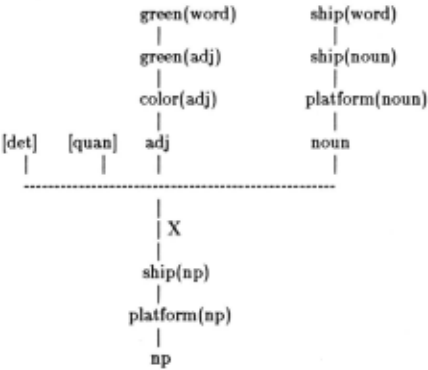
Most important here is step X, which uses the rule:
Since <ship (noun)> gave rise to the noun in the left hand-side of the above rule, this rule suggests <ship (np)>. In essence, "green ship" has been condensed to the semantic concept <ship (np)>.
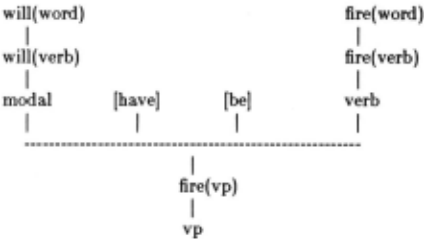
Here again, we are using a semantic restriction rule:
This rule finds the most specific possible semantic in stance of the verb, and suggests its corresponding vp level.
"2 missiles" is analyzed similarly to "green ship".
The detailed analysis of the prepositional phrases "at 1230pm" and "at submarine" is omitted for simplicity. Both will suggest the concept <adv>, which corresponds to prepositional and adverbial phrases. Also, we represent a Iist of adverbial phrases by <x>, for short .
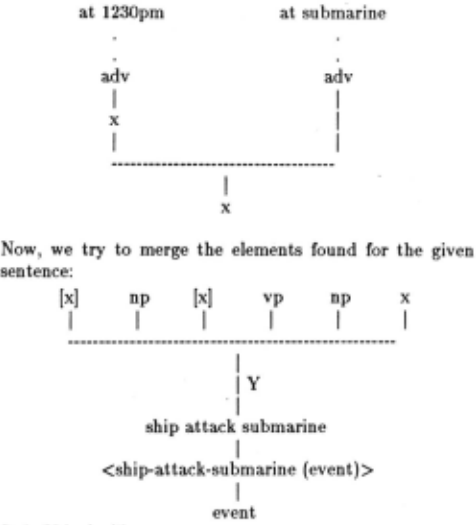
Rule Y Iooks like
The task of rule Y is to find specific events in the data base; in this case, it found the event "ship attack subma rine". Now, rule Y is highly sophisticated, and we will describe some of the actions that it took. First , note that "ship fired missile at submarine" is syntactically am biguous. "At submarine" could be analyzed as a preposi tional phrase, or " fire ... at" could be recognized as a prepositional verb with its associated particle. Rule Y knows about both of these possibilities. It checks the kind of verb, and uses one of the rules A or B according ly:
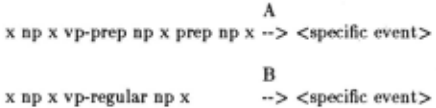
If the verb can be prepositional, rule Y Iooks for rules such as
In our case, it will find and use this rule. Having found that "will fire 2 missiles at" corresponds to an 'attack' concept, rule Y Iooks for the most specific possible event of the type
<ship> <attack> <submarine>
or
<platform> <attack> <platform>
and so on. Once the most specific possible event is found, rule Y suggests it. Note that rule Y has to search through the adverbial-list to find possible prepositional particles for the prepositional verb, and that it rejected the time adverbial because the knowledge base has no information about attacks on 'time'.
Rules like Y form a critical part of CG. They not only provide a mapping from surface text to underlying con cepts, but also handle syntactic ambiguity in a unified and non-combinatorially explosive fashion. (Using rules A and B instead of Y would always result in two in terpretations, whereas Y chooses the best one.)
Another example of such a rule is
x np x <vp (passive)> x --> <specific event>
w hich handles forms like
The ship was attacked by the submarine Missiles were fired at ship by submarine Mi8siles were fired by submarine at ship
again, in non-combinatorially explosive fashion. Further more, this rule is able to search for active-voice events, thus allowing most event knowledge to be stored in active voice. If desired, this rule can transform passive voice sentences to active voice. Another critical rule is
<event-list> -----> <specific frame>
The task of this rule is to find a single frame (or scenario) which will unify a sequence of events, and to try to deter mine the causal relationship of all the events. This rule embodies some of the analyzer's frame-selection mechan isms.
3. RELATED WORK
VOX is a revised version of NOMAD !IJ.
CG developed from our attempt to reconcile the PHRAN approach !6] with traditional syntax theories, a.nd to sys temize the representation of phrasal knowledge.
We know of several efforts to build automatically extensi ble NLP systems: The Teacher component of UC !7], LIFER !4], KLAUS l3J, TEAM [2], and others. The suc cess of these efforts depends, ultimately, on the underly ing knowledge representation, including both conceptual and linguistic knowledge. We find that CG provides a framework for both productive and nonproductive linguis tic knowledge, while the other systems mentioned tend to concentrate on one type or the other. Also, CG alone provides for automatic addition of scenarios.
ACKNOWLEDGMENT
Thanks to Richard Granger for his support and for criti quing this paper, Karin Klein for proofreading it, and Laura Yoklavich for formatting it.
@inproceedings{ijcai1985p161,
  title     = {VOX - An Extensible Natural Language Processor},
  author    = {Meyers, Amnon},
  booktitle = {Proceedings of the Ninth International Joint Conference on
               Artificial Intelligence, {IJCAI-85}},
  publisher = {International Joint Conferences on Artificial Intelligence},
  editor    = {Aravind Joshi},
  pages     = {821--824},
  year      = {1985},
  note      = {Natural Language},
  url       = {https://ijcai.org/proceedings/1985/161},
}
TY - CPAPER TI - VOX - An Extensible Natural Language Processor AU - Meyers, Amnon T2 - Proceedings of the Ninth International Joint Conference on Artificial Intelligence, IJCAI-85 PB - International Joint Conferences on Artificial Intelligence PY - 1985 SP - 821 EP - 824 UR - https://ijcai.org/proceedings/1985/161 ER -Copied
Machine-readable versions of this paper, for tools and AI agents:





