
NON-VONs Applicability to Three AI Task Areas
Proceedings of the Ninth International Joint Conference on Artificial Intelligence. AI Architectures. Pages 61-71.
© 1985 International Joint Conferences on Artificial Intelligence
Abstract
NON-VON 1s a massively parallel machine constructed using custom VLSI chips, each containing a number of simple processing elements. A preliminary prototype is now operational at Columbia University . The machine is mtended to provide highly efficient support for a wide range of artificial intelligence and other symbolic applications . This paper briefly d es cribes the current verswn of the NON-VON machine and presents evidence for its applicability to the execution of OPS5 production systems, a number of low- and intermediate-level computer vision tasks, and certain "difficult" relational algebraic operations relevant to knowledge base management . Analytic and simulation results are presented for a number of algorithms . The data suggest that NON-VON could provide a performance improvement of as much as two to three orders of magnitude over a conventional sequential machine for a wide range of AI tasks.
- Banerjee, J., R. I. Baum, D. K. Hsiao, and K. Kannan, "Concepts and Capabilities of a Database Computer", ACM Transactions on Database Systems, voL 3, no. 4, 1978.
- Codd, E. F ., "Relational Completeness of Data Base Sublanguages", in R. Rustin (ed ), Courant Computer Science Symposium 6: Data Base Systems, Prentice- Hall, Inc , 1972.
- Copeland, G. P, G . J. Lipovski, and S Y W . Su, "The Architecture of CASSM A Cellular System for Nonnumeric Processing", Proceedings of the First Annual Symposium on Computer Architecture, 1973.
- Coulouris, G. F., J. M. Evans, and R. W. Mitchell, "Towards Content Addressing m Databases", Computer Journal, vol 15, no. 2, 1972.
- Deering, M. F., "Hardware and Software Architectures for Efficient AI", AAAI-84, Proceedings of the National Conference on Artificial Intelligence, pp . 73-78, August, 1984.
- DeWitt, D. 1., "DIRECT--A Multiprocessor Organization for Supporting Relational Database Management Systems", IEEE Transactions on Computers, voL c-28, no. 6, June, 1979.
- DeWitt, D. J. and P B Hawthorn, Evaluation of Database Machine Journal of Digital Systems, 1982.
- "A Performance Architectures", Duff, M. J. B., "A Large Scale Integrated Circuit Array Parallel Processor", Proceedings of the lEE
- Hillyer, B. K and David Elliot Sh aw, "Exec ution of Produ ction Systems on a Massively P arallel Mac hine", Technical Report, Department of Computer Science, Columbia University, September, 1984.
- Ibrahim , H. A H , Image Understanding Algorithms on Fine-Grained Tree-Structured SIMD Machines, Ph .D. Thesis, Departm ent of Computer Science , Columbi a University , October, 1984.
- Kent, E. , M. Shneier, and R. Lumia, "NBS Pipelined Im age Processing Engine", Workshop on Algorithm- Guided Parallel Architectures For Automatic Target Recognition , Leesburg , VA Jul y 1984 .
- Knowlton, K , "Progressive Transmission of Gray-S cale and Bin ary Pi ctures by Simple, Effi cient, and Lossless Encoding Schemes", Proceedings of the IEEE, voL 68, no. 7, July, 1980 .
- Knuth , D. E, The Art of Computer Programming, vol. 1: Fundamen tal Algorithms, Addison-Wesley, 1969 .
- Kushner, T. , A. U. Wu , and A Rose nfeld, "Image Processing on ZMOB", IEEE Transactions on Computers, voL 31. , no. 10 , October, 1982 .
- Langdon, G . G ., "A Note on Associative Processors for Data Management" , Transactions on Database Systems, voL 3, no. 2, June, 1978.
- Lin , C S , D. C P Smit h and l M. Smith, "The Design of a Rotating Associative Memory for Relational Database Applications" , Transactions on Database Systems, voL 1, no. 1, March , 1976 .
- Marks, P ., "Low Level Vision Using an Array Processor", Computer Graphics and Image Processing, voL 14, pp . 287-292, 1980 .
- McDermott, l "Rl: A Rule-Based Computer Systems", Techni cal Report Computer Science Department, University, April 1980. Configurer of CMU-CS-80-11 9, Carnegie-Mellon Moto-oka, T . and K Fuchi, "The Architectures in the Fifth Generation Computers" , in R. E. A Mason (ed .), Information Processing 83, September 1983.
- Ozkarahan, E. A, S. A. Schuster, and K C Smith, "A Data Base Processor" , Technical Report CSRG-43, Computer Systems Research Group, University of Toronto, September, 197 4.
- Potter, l L., "Image Processing on the Massively P ar allel Processor", IEEE Computer, voL 16, no . 1, January, 1983.
- Shaw, D. E and T . M. Sabety , "An Eight-Processor Chip for a Massively Parallel Mac hine", T ec hnical R eport, Computer Science Departm ent, Columbia University, July, 1984 .
- Slotnik, D. L , "Logic P er Track Devices", in F Alt (ed ), Advances in Computers, voL 10, Academi c Press, New York, 1970.
- Sternberg, S. R , "Biomedical Image Processing", IEEE Computer, voL 16, no . 1, January , 1983.
- Stolfo, S. J, "Five Algorithms for PS Exec ution on the DADO Machine", T echnical Report, Computer Science Department, Columbi a University, [AAAI-84, Procee dings of the National Conference on Artificial Intelligence). August, 1984 .
- Stolfo, S. J and D. E Shaw, "DADO : a Tree- Structured Machine Architecture for Production Systems" , National Conference on Artificial Intelligence, 1982 .
- Siegel, H. J , L. J Siegel, F . C . Kemmerer, P . T. Mueller, H. E Smalley, and S D . Smith , "PASM A Partionable SIMD/MIMD System for Image Processing and Pattern Recognition", IEEE Transactions on Computers, voL 30, no . 12, December, 1981.
- S Tanimoto, Processing", "A Pyramidal Approac h to Parallel Technical Report, Computer Science S. Tanimoto and A. Klinger , Structured Computer Vision, Academic Press, 1980 .
- Uhr, L., "Recognition Cones, and Som e T est R esults", in A. R Hanson and E M . Rise man (eds ), Computer Vision Systems, Academic Press, 1980 .
- Unger , S H., "A Computer Oriented Towards Spatial Problems" , Proceedings of the IRE, p. 1744, 1958.
- Wiederhold, G ., "Knowledge and Dat abase Management", IEEE Software Magazine , vol. 1 no . 1, January , 1984, pp. 63-73.
References were extracted automatically from the PDF and may contain errors.
Full text extracted automatically from the PDF; figures, tables and equations may differ. The PDF is the version of record.
1 Introduction
A strong case can be made that the most formidable challenges now facing artificial intelligence researchers have little to do with problems of computational efficiency. Indeed, the development of high-performance hardware is clearly not a sufficient condition for the implementation of systems having human-like cognitive capacities. A number of researchers now believe, however, that as progress is made in understanding and mechanizing intelligent behavior, the availability of such hardware may ultimately prove to be a necessary condition in the case of certain AI tasks of practical importance .
Several researchers [Fahlman, 1980; Shaw, 1980; Hillis, 1981; Stolfo and Shaw, 1982; Moto-Oka and Fuchi , 1983; Deering, 1984] have proposed machines The central goal of the NON-VON project is the investigation of massively parallel computer architectures capable of providing significant performance and cost/performance improvements by comparison with conventional von Neumann machines in a wide range of artificial intelligence and other symbolic applications. In this paper, we provide some evidence of NON-VON's range of applicability within the space of AI problems by briefly describing certain algorithms, asymptotic results, analytical performance projections, and instruction-level simulation data involving three distinct AI task areas rule-based inferencing, computer VISIOn, and knowledge base management.
1This research · was supported in part by the Defense Adyanced Research Projects Agency, under contract N00039-84-C-0165, m part by the New York State Center for Advanced Technology in Computers and Information Systems at Columbia University, and in part by an IBM Faculty Development Award.
The following section provides a brief overview of the NON-VON machine family. In Section 3, we report the results of a detailed projection of the machine's performance in executing OPS5 production systems, based on data derived from Gupta and Forgy's investigation of six existing production systems at Cargnegie-Mellon University [Gupta and Forgy, 1983; Gupta, 1984] In Section 4, we review a number of low- and intermediate-level computer VISion algorithms for the NON-VON machine that have been developed and simulated at the functional and instruction levels. Section 5 presents the results of a projection of NON-VON's performance on certain Al relevant database management benchmarks formulated by Hawthorn and DeWitt [1982], using the analytical techniques employed by those researchers. The final section summarizes our results and attempts to characterize the essential architectural and algorithmic principles which would appear to be responsible for NON-VON's strong performance in these superficially dissimilar AI application areas.
2 The NON-VON Architecture
The name NON-VON is used to describe a family of massively parallel machines that have been under investigation at Columbia since 1980. The top level organization of the current version of the general NON-VON architecture is shown in Figure 1. A num her of distinct machine configurations have been defined and evaluated, however, based in part on the fact that some of the applications that have been investigated require only a subset of the subsystems comprised by the general NON-VON machine, and in part on the evolution of the architecture over time in response to experimental findings. An overview of the NON-VON machine family is provided in [Shaw, 1984].
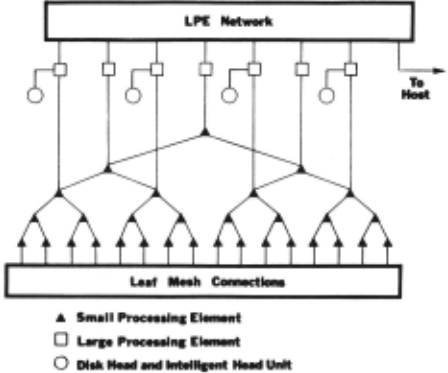
Central to all members of the NON-VON family IS a massively parallel active memory. The active memory is composed of a very large number (as many as a million, Ill a full-scale "supercomputer" configuration, and between 4K and 32K in the low cost configurations evaluated in this paper) of simple, area-efficient small processing elements (SPE's), which are implemented using custom VLSI circuits. The most recently fabricated active memory chip contains eight 8-bit processing elements; a detailed description of this chip can be found in [Shaw and Sabety, 1984] Each SPE comprises a small local RAM2, a modest amount of processing logic, and an I/0 switch that permits the machine to be dynamically reconfigured to support various forms of inter-processor communication.
2 In order to maximize circuit yield, each SPE was fabricated with only 32 bytes of local RAM in the current working prototype; in a production version of the machine, however, each SPE would probably contain the maximum amount of local RAM supported by the instruction set, which is 256 bytes.
In the current version of the general NON-VON machine, the SPE's are configured as a complete binary tree whose leaves are also interconnected to form a two-dimensional orthogonal mesh. Each node of the active memory tree, with the exception of the leaves and root, is thus connected to three neighboring SPE's, which are called the parent, left child, and right child of the node in question. (Aspects of the chip-, board-, and system-level packaging of the active memory tree are discussed in [Shaw, 1985] ) Each leaf is connected to its parent and to its four mesh adjacent SPE's, which are called its north, south, east, and west neighbors. In addition, the 1/0 switches may be dynamically configured in such a way as to support communication between any pmr of nodes that would be adjacent in an inorder enumeration [Knuth, 1969] of the active memory tree.
NON-VON programs are not stored within the small RAM associated with each SPE, but are instead broadcast to the active m.emory by one or more large processing elements (LPE's), each based on an off-the shelf 32-bit microprocessor (a Motorola 68020, in the current design) having a significant amount of local RAM. In the simplest NON-VON configuration, which was also the first to be implemented, the entire active memory operates under the control of a single LPE 3 which broadcasts instructions through a high-speed interface called the active memory controller for simultaneous execution by all enabled SPE's. This simple configuration thus restricts NON-VON's operation to what Flynn [1972] has called the single instruction stream, multiple data stream (SIMD) mode of execution.
The current version of the general NON-VON design, however, provides for a number of LPE's, each capable of broadcasting an independent stream of instructions to some subtree of the active memory tree, as first described Ill [Stolfo and Shaw, 1982] Specifically, each SPE above a certam fixed level in the active memory tree is connected to its own LPE and active memory controller, which is capable of sending an independent instruction sequence to control the corresponding active memory subtree. The LPE's in the general machine are interconnected using a high bandwidth, low latency two-stage interconnection scheme called a rootpoint network [Shaw, 1985a] The incorporation of a number of communicating LPE's gives the general NON-VON architecture the capacity for multiple instruction stream, multiple data stream (MIMD) and multiple SIMD (MSIMD) execution, multi tasking applications, and multi-user operation (Further discussion may be found in [Shaw, 1984])
3 The prototype now in operation uses a VAX 11/750 in place of the Motorola 68020.
The general NON-VON architecture also includes a secondary processing subsystem based on a bank of "intelligent" rotating storage devices. Specifically, each LPE at a particular, fixed level within the active memory tree is connected to a single-head Winchester disk drive, permitting high-bandwidth parallel I/0. Associated with each disk head is a small amount of logic capable of dynamically examining and performing certain simple computations (hash coding, for example) on the data passing beneath it . (Further discussion may be found in [Shaw, 1980] and [Shaw, 1982] .)
Only a subset of the features of the general NON-VON architecture are in fact required to perform the benchmark tasks described in this paper. The particular configuration assumed for each task will be described in the three sections in which the results themselves are presented.
One of the most important aspects of the NON VON active memory is the highly efficient hardware support it provides for a set of associative processing primitives that have proven useful in a wide range of AI applications. The machine's very fine granularity allows processmg elements to be associated with mdividual data elements, offering the user the capabilities of an unusually powerful and flexible content-addressable memory. Hardware features of the active memory support the massively parallel manipulation of data elements of arbitrary length. Large data elements may span more than one SPE, or several small ones may be packed within a single SPE. It is expected that systems software will ultimately hide the detailed mapping between processing elements and data elements from the programmer, allowing the user to deal with such abstractions as sets of "intelligent records" which may be thought of as capable of manipulating their own contents m paralleL
Among the hardware features provided within the SPE's to support these associative processmg capabilities are
- 1 Logic allowing a string broadcast by the controlling LPE to be very rapidly matched against the contents of all SPE's in paralleL Using the special NON-VON string matching instructions, a single-instruction mner loop for string matching may be implemented, allowing matching to occur at approximately 3 million bytes per second per SPE in the new prototype now under construction. A large active memory should thus be capable of matching at an aggregate rate of more than a trillion bytes per second.
- The inclusion of both eight-bit and one-bit registers and RAM, allowing sets of data elements to be conveniently marked and manipulated in parallel in various ways. Such operations are facilitated by the ALU, which provides highly efficient support for logical operations on one-bit flags.
- A special one-bit register called the ENABLE flag . All SPE's in which the ENABLE flag is set to zero are disabled, and ignore all instructions until the subsequent execution of an ENABLE instruction, which "awakens" all SPE's. This mechanism, variants of which have been used in a number of other parallel machines, facilitates parallel operations on selected sets of data elements identified on the basis of some aspect of their contents.
- A multiple match resolution instruction called RESOLVE, which may be used to mark a single member (the one which would occur first in an inorder traversal of the active memory tree) of a specified set of SPE's. Together with the REPORT instruction which transfers data from a single enabled SPE to the controlling LPE, this technique may be used to sequentially enumerate the members of an arbitrary marked set of data elements in time linear in the cardinality of the set .
These associative processmg mechanisms are employed m a number of the algorithms whose performance IS reported Ill this paper. Further discussion of the use of NON-VON's active memory to support various associative processing techniques may be found in [Shaw, 1982] .
3 Production Systems
After several decades of research on artificial intelligence, rule-based production systems have emerged as one of the most important and w1dely employed tools for the implementation of expert systems and other AI software While the modulanty, perspicuity, and ease of modification and augmentatwn which are characteristic of rule-based systems offer a number of potential advantages in the execution of many large-scale AI tasks, their use in such applications is in some cases very costly m executwn time. This poses particular problems in the case of real-time applications and other tasks characterized by severe and inflexible time constraints The poss1b1hty of using parallel hardware to accelerate the execution of production systems is thus of considerable interest.
Forgy [1980] considered the problem of executing production systems in parallel on the ILLIAC IV, but was forced to significantly modify the production system paradigm m order to obtain reasonable performance . Stolfo and Shaw [1982] subsequently proposed a highly parallel machine called DADO, which was intended specifically for the execution of production systems; an early prototype of the DADO machine is presently operational. More recently, members of the DADO project have investigated a number of issues related to languages and algorithms for the parallel execution of production systems [Stolfo, 1984] .
As a first step m evaluating NON-VON's performance in the domain of rule-based systems, we have implemented and analyzed an algorithm [Hillyer and Shaw, 1984] for the parallel execution of production systems implemented using the language OPSS [Forgy, 1981]. which was developed by researchers at Carnegie-Mellon University. OPSS was chosen as the vehicle for our investigations into parallel execution of production systems for several reasons:
- 1 It is widely known, and has been evaluated favorably by other researchers [Hayes-Roth, et al., 1983] .
- It has been used to build a large and successful commercial production system [McDermott, 1980] .
- Static and dynamic characteristics of six substantial OPSS production systems have already been measured [Gupta and Forgy, 1983] .
- Its speed can be increased significantly by parallel execution, despite the fact that the language was designed for sequential processmg.
The NON-VON OPSS algorithm may be regarded as a parallel version of Forgy's Rete Match [1982] algorithm, which exploits the observation that firing an OPSS production causes only a few changes to working memory, and that these changes have few effects on the conflict set. This observation may be exploited, even on a sequential machine, if the production system is compiled into a dataflow graph, with state information saved at each node during execution. A change to working memory is entered into initial nodes of the graph . Consequent state changes then propagate through the graph, updating information stored m intermediate nodes. State changes m terminal nodes of the graph represent changes to the conflict set .
The execution cycle for an OPSS production system has three phases: match, select, and act. In the Rete Match algorithm, the match phase has two steps. First, intra-condition tests are executed to check that attributes in a working memory element satisfy the specified relational operators, and that variables occurring more than once in a condition element are bound consistently. Subsequently, inter condition tests are performed to verify consistent binding of variables across multiple condition elements in a production's left-hand side. The NON-VON OPSS algorithm, which was implemented and tested by Bruce Hillyer using the NON-VON instruction-level simulator, achieves · its performance and cost/performance advantages primarily by accelerating the execution of these two components of the match phase in the case of working memory additions, and by replacing them with a more highly parallel associative step m the case of working memory deletions.
The NON-VON OPSS algorithm is based on an algorithm by Gupta [1984] (his Algorithm 3) This algorithm was designed for the DADO machine [Stolfo and Shaw, 1982]. m a prototype configuration consisting of 1023 identical "off-the-shelf" 8-bit mi croprocessors. The NON-VON algorithm assumes 33 LPE's (or 32 LPE's and one dedicated host machine), each of which is somewhat more powerful than a DADO PE, and 16K SPE's, which make possible a greater degree of associative parallelism. The 32 "non host" LPE's are assumed to be attached at the fifth level of the active memory tree; · the LPE's that would be associated with the first through fourth levels in a fully general NON-VON machine are not required for the execution of this algorithm The high-bandwidth LPE network is also not required, and could be replaced with a simple bus without significantly degrading performance m the production systems application.
In the NON-VON OPSS algorithm, intracondition testing is performed in the active memory using two massively parallel SIMD computation steps. The first step simultaneously evaluates individual terms of all condition elements. The second step determines the satisfaction of all condition elements in a single parallel communication step, requiring time proportional to the number of terms in the longest condition element. 4 The synchronous nature of SIMD execution was found not to limit the rate of processing m this phase.
The more limited potential for parallelism embodied in the inter-condition testing step is captured using a multiple-SIMD execution discipline, in which independent instruction streams are broadcast to 32 separate active memory subtrees by the 32 LPE's. Pure SIMD processing would have been a serious constraint during this portion of the execution, since evaluation of the Rete dataflow graphs presents a high degree of data sensitivity. The use of active memory subtrees, on the other hand, significantly enhances the power of the LPE's by providing a fast associative search capability. The select and act phases, which have little inherent parallelism in OPS5, are performed sequentially by a single LPE (or by an attached host processor), although a modest speedup is obtained by overlapping a portion of these computations with the subsequent match phase
An experimental compiler and runtime system for the execution of OPS5 on a one-LPE NON-VON has been written and tested on an instruction-level simulator. In order to predict the algorithm's performance when executing real production systems, its running time was calculated based on measurements obtained by Gupta and Forgy [1983] of the static and dynamic charactenstJcs of SIX actual production systems, which had an average of 910 inference rules each. By counting the number of NON-VON instructions, it has been possible to determine the number of clock cycles required for each of the SIMD processing steps under the assumptions implicit in Gupta and Forgy's data. By adding approximate over head values for non-overlapped execution in the LPE's 5 , we have been able to predict with reasonable accuracy the time required per production firing cycle 6 , and hence the rate of production system execution on
NON-VON.
According to these calculations, the NON-VON configuration outlined above should reqmre 1108
4 This can be improved to time logarithmic in the number of terms in the longest condition element with a worst-case 50% decrease in memory utilization, using techniques closely related to the allocation schemes for database records described by Shaw and Hillyer [1982j.
5 The figures given for host and LPE processing are estimates, unlike the SPE figures, which are derived from actual code.
6 we have assumed that the only actions in the right-hand sides of productions are additions, deletions, and modifications of working memory elements. The right-hand side of a production expressed in OPS5 can cause arbitrarily large amounts of 1/0 and can call any function written in LISP, but the time consumed by such operations does not provide any information about the performance of the production system inferencing engine.
microseconds per production firing, yielding an execution rate of 903 productions per second. By way of comparison, A LISP-based OPS5 interpreter executing the sequential Rete Match algorithm on a VAX 11/780 typically fires between 1 and 5 rules per second, while a Bliss-based interpreter executes between 5 and 12 productions per second [Gupta, 1984 (personal communication)] The NON-VON machine configuration assumed Ill these calculations would embody 2048 custom chips, each containing 8 SPE's, and about 660 chips for the 33 LPE's. The hardware cost of such a system is projected to be somewhere between that of a VAX 11/780 and a DECSystem-20 NON-VON's cost/performance ratio in executing OPS5 production systems is thus estimated to be approximately two orders of magnitude better than that of a conventional sequential machine in practice . Furthermore, our analysis suggests that the machine's relative performance advantage should increase as the production system becomes larger .
A detailed discussion of the assumptions underlying the above projections, and of the precise manner in which our results were derived, can be found in [Hillyer and Shaw, 1984] .
4 Computer Vision
A number of operations performed by commercial and experimental image understanding systems are extremely time-consuming when executed on a conventional sequential machine. For this reason substantial efforts have already been made to develo~ special-purpose machines and algorithms adapted to various computer vision tasks. The machines described in the literature may, for the most part, be divided into four general architectural categories:
- Pipelined architectures such as the NBS Pipelined Image Processing Engine [Kent, Shneier and Lumia, 1984] and the Cytocomputer [Sternberg, 1983], in which the task at hand 1s typically divided into a number of functions and each stage in the pipeline is configured by a control unit to perform one function .
- Mesh-connected architectures [Unger, 1958], such as CLIP4 [Duff, 1976], MPP [Potter, 1983], and the ICL DAP [Marks, 1980], which are based on a rectangular array of (typically one-bit) processing elements, each connected to its nearest four or eight neighbors, and each corresponding to a either a single pixel or a small rectangular
- Multiprocessor architectures, examples of which include PASM [Siegel, et al., 1981] and ZMOB [Kushner, et al., 1982]. in which a number of general-purpose microcomputers cooperate to solve a given Image understanding task, communicating through some form of processor interconnection network.
- Hierarchical architectures, including cone and pyramid machines [Uhr, 1978; Hanson and Riseman, 1980; Dyer, 1981; Tanimoto, 1983]. in which the original Image IS progressively reduced through the application of successive transformations in a manner analogous to that apparently employed in the human visual system.
The general NON-VON architecture provides efficient support for most of the parallel VIsion algorithms typically executed on each of the last three classes of architectures; in addition, many of the algorithms executed on pipelined vision machines may be transformed into SIMD algorithms amenable to execution within NON-VON's active memory. While we expect NON-VON to prove highly useful for all levels of computer vision applications, from low-level signal processmg and the extraction of primitive geometric properties through high-level object recognition and scene analysis, our work to date has concentrated largely on low- and intermediate-level computer vision tasks.
A number of image understanding algorithms have been developed and tested using a functional simulator, and in some cases, the NON-VON machine instruction level simulator. In particular, algorithms have been developed for:
- Image correlation
- Image histogramming
- Image thresholding
- Union, intersection, and difference of two binary Images
- Connected component labeling
- Euler number of connected components
- Component area
- Component perimeter
- Component center of gravity
- Component eccentricity
- 11 . The Hough transform
- The "moving light display" problem
These tasks were chosen to span several levels of image understanding applications, and to assess NON VON's applicability to a number of different kinds of operations arismg in the course of constructing integrated vision systems. Preliminary analytical and simulation results suggest that NON-VON should provide significant performance and cost/performance advantages over sequential machines for each of these tasks, and should in a number of cases improve on the best results reported in the literature for special purpose visiOn architectures and other highly parallel machines.
Two hierarchical data structures that may be implemented naturally on the NON-VON machine are employed in the NON-VON algorithms for these tasks. The first is the multi-resolution pyramid [Tanimoto and Klinger, 1980]. which represents the original (binary or gray-scale) image at a number of different levels of detail, each containing one quarter of the number of pixels present at the next highest level of detail. Multi-resolution pyramids are implemented on NON-VON by storing the original image in the (mesh connected) leaf SPE's and the less detailed levels in the internal SPE's. The latter process is based on a straightforward mapping of the natural quartic tree interpretation of the multi-resolution pyramid onto the active memory's binary tree structure.
The second data structure used to represent images in the NON-VON machine is a variant of the quadtree called the binary image tree, which was originally proposed by Knowlton [1980] as an encoding scheme for the compact transmission of image data. The original binary image is again stored in the leaf SPE's. Internal nodes, however, can take one of three values, which may be thought of as "black", "white" and "gray" . An internal node has the value black if its two children are both black, white if its two children are both white, and gray otherwise. This data structure is used in most of the NON-VON algorithms that operate on binary image data.
A number of aspects of the NON-VON machine architecture, exploited as part of several frequently used algorthmic techniques, are responsible for the machine's performance and cost/performance advantages in computer VISion applications. The simplest technique, which has also been employed on the original 1mage. The connected component algorithm enumerates all of these black rectangles (using the RESOLVE and REPORT instructions) one by one in order of decreasing size (or equivalently, of increasing tree level) .
As each such rectangle Ri is enumerated, it is assigned a new component number if not already labelled. Any rectangle Rj that is adjacent to Ri is then assigned the same label, as are all other rectangles previously assigned the same component number as Rj (Note that this last operation requires only a single broadcast and assignment step, independent of the number of rectangles having the same component number as R ·.) Since only one pass through the set of black rictangles in the binary image tree is required, Ibrahim's algorithm executes in time proportional to the number of rectangles, which in real images is much smaller than the number of pixels. (Details of this and other geometric algorithms for NON-VON may be found in [Ibrahim, 1984] .)
The importance of NON-VON's mesh connections m computer vision applications is illustrated by such low-level signal processing operations as image correlation and vanous types of two-dimensional filtering . The NON-VON algorithms for these operations rely on a considerable amount of communication among adjacent and nearly-adjacent neighbors in the mesh . Although Ibrahim [1984] has developed techniques to perform such operations on a "pure" tree machine that tend to minimize the need for such communication, NON-VON's mesh connections make possible a considerable increase in performance.
Other vision algorithms make use of the MSIMD execution capabilities of the general NON-VON architecture to partition a problem into a number of subproblems, each of which is solved in a different active memory subtree. In many cases, several forms of parallelism are exploited in the same algorithm. Although work on high-level image understanding on the NON-VON machine 1s still in its earliest phases, our expenence with the parallel execution of production systems suggests that significant opportunities exist for accelerating such applications as welL
5 Knowledge Base Management
A number of "real world" AI applications require the construction and manipulation of large knowledge bases. Such applications tend to be characterized by the need to access the same data in a number of different ways, often in conjunction with some form of such machines as MPP and the ICL DAP, involves the use of ordinary content-addressable arithmetic and logical operations to perform a . single operation in parallel on all pixels. This techmque 1s Illustrated m its simplest form by the algonthm for Image thresholding, m which a gray-scale Image . 1s transformed to a binary image by setting all pixels whose intensities exceed a specified threshold value to one and all other pixels to zero. A NON-VON ma~hine of size sufficient to store each pixel in its own processmg element is capable of thresholding an entire image m less than two microseconds, independent of the size of the image, by broadcasting the threshold value to all pixels and executmg a smgle parallel comparison followed by two parallel assignment operations, each executed by a separately enabled set of SPE's.
Like a number of highly parallel machines developed by other researchers, NON-VON is thus able to achieve a speedup of many orders of magmtude, and a cost/performance improvement of approximately three orders of magnitude, by comparison with a VAX.. 11/780 on simple associative operations of the kind exemplified by image thresholding. The same general technique is used in the NON-VON algonthm for image histogramming [Ibrahim, 1984], m wh1ch the bounds of a given intensity range are compared m parallel with all pixel values to identify those pixels whose values fall within a given mtens1ty range . (Histogramming IS often performed . pnor to the conversion of a gray-scale to a bmary Image in order to choose an appropriate threshold value.)
Unlike the massively parallel mesh-connected machines, however, the tree-structured connections embedded in the NON-VON active memory permit a major reduction in the time required to determine the number of pixels falling within each histogram bm. In the NON-VON algorithm, this quantity is computed through an O(log n) level-by-level addition procedure, where n is the number of pixels in the Image The running time of the algorithm is further reduced, however, by pipelining this computation for successive intensity ranges, resulting in an O(b + log . n) algorithm, where b is the number of histogram bms. The NON-VON histogram algorithm IS easily mod1hed to produce a cumulative or normalized histogram.
A different use of the active memory tree IS illustrated by Ibrahim's connected component algorithm for NON-VON [Ibrahim, 1984] . The algonthm begms by constructing the binary image tree representatiOn of the original image data, which reqmres . time logarithmic in the number of pixels. It will . be recalled that the binary image tree mcludes exphc1t representations of black rectangles of various sizes from inferencing. The need to flexibly access and deductively manipulate large knowledge bases has led a number of researchers to construct logic-based and knowledge-oriented database systems [Gallaire and Minker, 1978; Wiederhold, et a!, 1980; Shaw, 1980] whose primitive operations are based on the relational model of data [Codd, 1972]. In addition, many knowledge-based systems that do not make explicit use of relational data structures or access primitives nonetheless employ equivalent or closely analogous representation formalisms and operations at some leveL
Unfortunately, knowledge base management systems tend to rely heavily on such "difficult" operations as the relational join, whose execution may be extremely time-consuming on a sequential machine, particularly in the case of large databases. Several researchers [Shaw, 1980; Moto-oka and Fuchi, 1983] have thus proposed using special hardware supporting the rapid execution of such database primitives in constructing systems designed for AI applications Algorithms for a number of database primitives have been developed for the NON-VON machine, including:
- Select
- Project
- Join
- Union
- Intersection
- Set Difference
- Aggregation
- Various statistical operations
To evaluate NON-VON's applicability to the kinds of database operations most relevant to AI applications, a detailed analysis was performed of the machine's projected performance on a set of benchmark quenes formulated by Hawthorn and DeWitt [1982] These authors presented an analysis of the predicted performance of a number of database machine architectures (specifically, RAP [Ozkarahan, et a!, 1974]. CASSM [Copeland, et a!, 1973]. DBC [Banerjee, et a!, 1979]. DIRECT [DeWitt, 1979]. CAFS [Coulouris, et a!, 1972]. and associative disks [Langdon, 1978; Lin, et a!, 1976; Slotnik, 1970]) on three relational database quenes.
In evaluating NON-VON, we used the same three queries and similar techniques for performance analysis and for the adjustment of machine configuration to control for hardware cost. In particular, we assumed a NON-VON configuration having 4K SPE's (512 8processor chips), 16 disk drives, and a single LPE -- a configuration comparable in each relevant dimension to that of the other machines considered in the Hawthorn and DeWitt analysis.
Hawthorn and DeWitt's first query is a simple relational selection operation. Their analysis predicted that all six of the architectures they exam·ined would have roughly comparable performance on this query. Our analysis, using the same techniques, predicts that NON-VON should achieve slightly, but not significantly faster performance on this simple selection query. The lack of a significant performance difference between NON-VON and the six database machines evaluated by Hawthorn and DeWitt is attributable to the fact that all seven machines are capable of the kinds of simple associative processing techniques required to achieve close to the maxim urn performance permitted by the aggregate disk transfer rate of their (cost normalized) banks of disk drives. It is on the more demanding queries frequently found in AI-oriented applications that NON-VON is able to offer a greater relative advantage. Table 1 summarizes our results and those of Hawthorn and DeWitt for the first sample query.
| Response times in Best lorst | seconds | |
|---|---|---|
| Associative Disks, CAFS | 0 .089 | 0.267 |
| CASSU | 0 . 156 | 0 .334 |
| DBC | 0 .095 | 0 . 273 |
| DIRECT | 0 .066 | 0.490 |
| RAP | 0.066 | 0 .493 |
| NON-VON | 0 .042 | 0 . 267 |
The second query, which may have more immediate relevance to complex knowledge base management applications, involves a relational join operation. On this query, NON-VON achieves a performance improvement of approximately an order of magnitude over the six database machines evaluated by Hawthorn and DeWitt, as indicated in Table 2.
There are three reasons for NON-VON's surprising speed, even by comparison with DIRECT, which is the fastest of the other database machines on this query . The first is that DIRECT stores entire records in its cache when processing, while NON-VON
Associative Disks Response times in seconds Best
5.04
lorst
5.90
CASSK
DBC
DIRECT
RAP
5.04
5.90
15 .50
2.37
7 . 06
15 .83
3.24
14 . 18
CAFS
NON-VON
14 .48
14.81
0.21
0.67
Table 2: Query 2, Hawthorn and DeWitt
projects over those attributes that are of interest discarding the rest. Second, DIRECT reads data fro~ one of its 8 (faster) disk drives, while NON-VON loads one of the argument relations in parallel through all 16 heads of its (slower) drives. (Unlike NON-VON, DIRECT would not benefit greatly from the use of parallel disk transfers; DeWitt and Hawthorn [1982] est1mate that parallel disk input would improve the join performance of architectures like DIRECT by only 4%.) Third, DIRECT performs a sequential search through one of the argument relations for each tuple of the other relation it considers, in contrast with NON-VON's associative matching followed by fast enumeration of responders usmg RESOLVE and REPORT instructions.
The final query considered by DeWitt and Hawthorn involves an aggregation operation in which the tuples in the argument relation are divided into groups according to the values of two attributes and the sum of the values of a third attribute is com~uted separately for each group . Using associative processing techniques (both internal and external), together with the capability for fast addition provided by the active memory's tree connections, NON-VON again achieves significant performance improvements over the other architectures evaluated by Hawthorn and DeWitt. While the authors do not explicitly present the times required by the machines they studied for this query, a graph 1s provided from which these times were estimated. Comparative results for this query are presented m Table 3.
Further details of the assumptions and analysis underlying the results presented above may be found in [Hillyer, Shaw and Nigam, 1984]
---------------------------------------------------
| Response times Best | in seconds lorst | |
|---|---|---|
| Associative Disks | 1.6 | 2.2 |
| CAFS | 1.6 | 2.2 |
| CASSK | 0.6 | 0.8 |
| RAP | 0.8 | 1.5 |
| DBC | 0.7 | 1.8 |
| DIRECT | 0.2 | 0 .5 |
| NON-VON | 0.05 | 0 .27 |
---------------------------------------------------
Table 3: Query 3, Hawthorn and DeWitt
---------------------------------------------------
6 Conclusions
It IS dangerous to attempt to draw firm conclusions about the range of applicability of a novel computer architecture over a wide range of apphcatwns on the basis of a relatively small number of benchmark tasks. Based on our research to date however, it would appear that the general NON-VON architecture may offer significant performance and cost/performance advantages over both conventional and, Ill a number of cases, special-purpose machines in at least three superficially disparate artificial mtelhgence task areas.
In particular, we have presented a number of algorithms, analytic performance projections, and s1mulatwn results suggesting that NON-VON is capable of rapid and cost-effective performance on a number of tasks in the areas of production system execution, low- and mtermed1ate-level 1mage understanding and knowledge base management Although ' the magmtudes of the projected performance and cost/performance advantages are different for different tasks, performance improvements of as much as two to five orders of magnitude, and cost/performance advantages of as much as two to three orders of magnitude, have been predicted in many cases.
Different aspects of the NON-VON architecture appear to be responsible for the machine's advantages Ill different problem areas. It is nonetheless possible to 1dent1fy a relatively small number of features several of which are typically operative in the case of any single application, to which the machine's advantages may be attributed:
- The effective exploitation of an unusually high degree of parallelism, which is made possible by the very fine granularity of the active memory .
- The extensive use of broadcast communication, high-speed contentaddressable matching, and other associative processing techniques.
- The use of the active memory tree to execate algebraically commutative and associative operations (such as sum and maximum) in logarithmic time.
- The exploitation of other physical and logical interconnection topologies to support a number of problem-specific communication functions.
- The capacity for SIMD, MIMD and MSIMD execution, and for a mixture of synchronous and asyncronous execution within a single algorithm.
- The simplicity and cost-effectiveness with which the machine can be implemented using currently available technology.
Although not all of these architectural features are relevant to every AI application, each is exploited in different ways in a number of different algorithms While it is difficult to rigorously explicate the intuitive notion of computational generality, NON-VON would seem to have many of the properties of a rather general machine having a number of widely applicable architectural features, as opposed to an amalgam of special-purpose subsystems, each performing a fixed, application-specific task.
It is of course of interest that NON-VON may be able to exceed the performance of the fastest special-purpose machines described in the literature for the execution of some of the tasks considered in this paper. Of potentially greater practical significance than NON-VON's superior performance in any one particular task area, however, is the range of diverse AI tasks that would appear to be efficiently executable within a single machine. While there Is still insufficient evidence to adequately evaluate the extent to which the NON-VON architecture might serve as the basis for a high-performance "general AI machine", the work described in this paper may represent an early, preliminary step toward the ultimate development of such machines.
ACKNOWLEDGEMENTS
Bruce Hillyer was directly responsible for implementing, simulating, and analyzing most of the database management and production system algorithms discussed in this paper. The NON-VON image understanding work we have described is largely attributable to Hussein Ibrahim and John Kender. More generally, the author wishes to acknowledge the direct and indirect contributions of the NON-VON hardware implementation team, under the direction of Ted Sabety; of Dong Choi, who was responsible for much of the simulation software used to obtain the results we have reported; and of the other PhD. students and research staff members associated with the NON-VON project, without whose efforts this work would not have been possible .
@inproceedings{ijcai1985p13,
  title     = {NON-VONs Applicability to Three AI Task Areas},
  author    = {Shaw, David E.},
  booktitle = {Proceedings of the Ninth International Joint Conference on
               Artificial Intelligence, {IJCAI-85}},
  publisher = {International Joint Conferences on Artificial Intelligence},
  editor    = {Aravind Joshi},
  pages     = {61--71},
  year      = {1985},
  note      = {AI Architectures},
  url       = {https://ijcai.org/proceedings/1985/13},
}
TY - CPAPER TI - NON-VONs Applicability to Three AI Task Areas AU - Shaw, David E. T2 - Proceedings of the Ninth International Joint Conference on Artificial Intelligence, IJCAI-85 PB - International Joint Conferences on Artificial Intelligence PY - 1985 SP - 61 EP - 71 UR - https://ijcai.org/proceedings/1985/13 ER -Copied
Machine-readable versions of this paper, for tools and AI agents:





