
An Essential Hybrid Reasoning System: Knowledge and Symbol Level Accounts of KRYPTON
Proceedings of the Ninth International Joint Conference on Artificial Intelligence. Knowledge Representation. Pages 532-538.
© 1985 International Joint Conferences on Artificial Intelligence
Abstract
Hybrid inference systems are an important way to address the fact that intelligent systems have muiltifaceted representational and reasoning competence. KRYPTON is an experimental prototype that competently handles both terminological and assertional knowledge; these two kinds of information are tightly linked by having sentences in an assertional component be formed using struct ured complex predicates defined in a complementary terminological component. KRYPTON is unique in that it combines in a completely integrated fashion a frame-based description language and a first-order resolution theorem-prover. We give here both a formal Knowledge Leve l view of the user interface to KRYPTON and the technical Symbol Level details of the integration of the two disparate components, thus providing an essential picture of the abstract function that KRYPTON computes and the implementation tec hnology needed to make it work. We also illustrate the kind of complex question the system can answer.
- [Anderson and Belnap, 1975] Anderson, A . R., and Belnap, N . D., Jr., Entailment: The Logic of Relevance and Necessity. Vol. 1. Princeton, NJ : Princeton University Press, 1975.
- [Brach man, 1985] Brach man, R. J ., "'I Lied About the Trees.'" AI Magazine, Vol. 6, No. 3, Fall, 1985.
- [Brachman and Levesque, 1982] Brachman, R. J., and Levesque, H. J ., "Competence in Knowledge Representation," in Proc . AAAI-82, Pittsburgh, August, 1982, 189-192.
- [Brachman and Levesque, 1984a] Brachman, R. J ., and Levesque, H. J ., "The Tractability of Subsumption in Frame-Based Description Languages," in Proc. AAAI-84, Austin, TX, August , 1984, 34-37 .
- [Brachman and Levesque, 1984b] Brachman, R. J ., and Levesque, H. J ., "What Makes a Knowledge Base Knowledgeable? A View of Databases from the Knowledge Level," in Proc. First International Workshop on Expert Database Systems, Kiawah lsi., S. C., October, 1984, 30-39.
- [Brachman and Schmolze, 1985] Brachman, R. J ., and Schmolze, J . G., "An Overview of the KL-ONE Knowledge Represen- tation System." Cognitive Science, 9(2), April-June, 1985, 171-216.
- [Brachman, et al., 1983a] Brachman, R. J ., Fikes, R. E., and Levesque, H . J., "Krypton: Integrating Terminology and Assertion," in Proc . AAAI-89, Washington, DC, August, 1983, 31-35.
- R. Brachman et al. 539 [
- [Brachman, et al., 1983b] Brachman, R . J ., Fikes, R. E., and Levesque, H. J. "Krypton: A Functional Approach to Knowledge Representation." IEEE Computer, Special Issue on Knowledge Representation, October, 1983, 67-73.
- [Brown and Burton, 1975] Brown, J. S., and Burton, R . R., "Multiple Representations of Knowledge for Tutorial Rea- soning," in Representation and Understanding: Studies in Cognitive Science. D. G . Bobrow and A . Collins, eds. New York: Academic Press, 1975, 311-349.
- [Genesereth, 1981] Genesereth, M., "The Architecture of a Mul- tiple Representation System," Memo HPP-81-6, Comp. Sci. Dept., Stanford Univ., May, 1981.
- [Kowalski, 1975] Kowalski, R., "A Proof Procedure Using Con- nection Graphs", JACM, 22(4), October, 1975, 572-595.
- [Levesque, 1984a] Levesque, H. J ., "A Fundamental Tradeoff in Knowledge Representation and Reasoning," in Proc. CSCSI-84, London, Ontario, May, 1984, 141-152.
- [Levesque, 1984b] Levesque, H. J ., "A Logic of Implicit and Ex- plicit Belief," in Proc. AAAI-84, Austin, TX, August, 1984, 198-202.
- [Levesque, 1984c] Levesque, H. J ., "Foundations of a Functional Approach to Knowledge Representation." Artificial Intelli- gence, 23(2), July, 1984, 155-212.
- [Moses, 1971] Moses, J., "Algebraic Simplification: A Guide for the Perplexed." CACM, 14.(8), August, 1971, 527-537 .
- [Newell, 1981] Newell, A., "The Knowledge Level," AI Magazine, 2(2), Summer, 1981, 1-20.
- [Patel-Schneider, 1985] Patel-Schneider, P. F ., "A Decidable First-Order Logic for Knowledge Representation," Proc . IJCAI-85. IJCAI
- [Rich, 1982] Rich, C., "Knowledge Representation Languages and Predicate Calculus: How to Have Your Cake and Eat it Too," in Proc. AAAI-82, Pittsburgh, August, 1982, 193- 196.
- [Sloman, 1971] Sloman, A., "Interactions Between Philosophy and Artificial Intelligence: The Role of Intuition and Non- Logical Reasoning in Intelligence." Artificial Intelligence, 2 (1971), 209-225. IJCAI
- [Sloman, 1984] Sloman, A ., "Why We Need Many Knowledge Representation Formalisms," British Computer Society Ex- pert Systems Conference, December, 1984.
- [Stickel, 1982] Stickel, M . E., "A Nonclausal Connection-Graph Resolution Theorem-Proving Program," in Proc. AAAI-82, Pittsburgh, August, 1982, 229-233.
- [Stickel, 1983] Stickel, M . E., "Theory Resolution: Building in Nonequational Theories," in Proc. AAAI-89, Washington, DC, August, 1983, 391-397.
- [Stickel, 1985] Stickel, M . E., "Automated Deduction by Theory Resolution," to appear in J. Automated Reasoning, 1985. IJCAI
- [Vilain, 1985] Vilain, M., "The Restricted Language Architec- ture of a Hybrid Representation System," Proc . IJCAI-85. IJCAI
References were extracted automatically from the PDF and may contain errors.
Full text extracted automatically from the PDF; figures, tables and equations may differ. The PDF is the version of record.
I Introduction
Many of today's knowledge representation {KR) systems offer their users a choice of more than one language for expression of domain knowledge. While the idea has been important to the field for many years (e.g., see [Brown and Burton, 1975] [Moses, 1971] [Sloman, 1971]), "multiple representations" seems to have recently become a popular catch phrase. Many of the modern expert system development environments wave the polyglot ban ner, and except perhaps for some stalwart first-order logicians, most everyone would probably agree that one uniform language will not serve all representational needs.
It is sometimes difficult to discern the true value of multiple languages; some of the commercial development tools seem sim ply to appeal to "the more the merrier," without any clear idea of how merrier is better. However, on the research front, there have fortunately been some coherent views expressed on the merits of bringing disparate dialects together. The arguments have mainly to do with the naturalness of expressing certain kinds of facts in certain forms {see, e.g., [Rich, 1982]), or with the efficiency of computing some inferences once some datum is massaged into a certain representational form [Genesereth, 1981]. 2
The arguments in favor of naturalness and computational su periority are important ones. However, as we have argued else where [Brachman and Levesque, 1982], there may be a simpler, more basic reason to diversify: an intelligent system has more than one kind of representational need. For example, it is in teresting to observe that so far, most KR systems only allow the expression of what we would call assertional knowledge statements of facts or beliefs. If the system uses logic or pro- Dept. of Computer Science University of Toronto Toronto, Ontario Canada M5S 1A 7
1 Fellow of the Canadian Institute for Advanced Research
'For an interesting recent paper on this general subject, see [Sloman, 1984[.
duction rules, the sentential nature of its content is self-evident (e .g., "if the infection is primary bacteremia and . .. , then there is suggestive evidence that the organism is bacteroides"). Even if the system uses frames or semantic nets, it is most likely en coding sentences of the form, "elephants are gray", or "Clyde is an armadillo" {see [Brachman, 1985] for more on this).
But what accounts for the meanings of the terms used in these sentences? In addition to representing the beliefs {or, popularly, "knowledge") of a cognitive system, we need to account at least for the complex terms {like bacteremia and armadillo, above) used in forming those beliefs. In other words, unless we intend to give up the lexical ghost and take all terms as inscrutable atomic primitives, some substantive representational explanation must be given for the noun phrases out of which the sentences expressing beliefs are constructed.
We have designed and implemented a complete hybrid reason ing system, called KRYPTON, that is significantly different from other "multiple representation" systems 3 in that it tries to pro vide exactly such an explanation. Instead of concentrating on multiple ways to perform the same inference, KRYPTON tries to span two fundamentally different types of representation and reasoning. Not only does it provide a language for composing sen tences expressing beliefs (using sentential operators of the usual sort, for conjunction, quantification, negation, etc.), it supports the definition of complex predicates to be used in those sentences (with a set of special term-forming operators, for conceptual con junction, role composition, role value restriction, etc.). Further, KRYPTON supports an appropriate set of inferences over sen tences and over complex terms. Thus, KRYPTON is at least minimally competent in both the assertional and terminological domains.
In this paper, we will describe KRYPTON in some detail mainly by addressing two questions {both of which are crucial for design ers of any representation system to answer) :
- Exactly what service is being provided to the user? The user should know, at some level not dependent on implementa tion details, what questions the system is capable of answering, and what operations are permitted that allow new information to be provided to it. He needs to know how questions put to a knowledge base will be answered strictly as a function of the information it contains, and not dependent on how the informa tion is represented. In other words, the user requires what Newell [Newell, 1981] calls a Knowledge Level account (see also [Brach man and Levesque, 1984b] [Brachman, et al., 1983b] [Levesque, 1984c]).
- How does the implementation realize the service promised? In other words, how, at the Symbol Level, is the Knowledge Level account realized? In the case of a hybrid system, the interface between the disparate parts of the hybrid is particularly impor tant .
'Except for KL-TWO [Vilain, 1985[ , whose hi·tory i· significantly inter twined with that of KRYPTON.
This paper provides detailed Knowledge and Symbol Level ac counts of KRYPTON (previous accounts [Brachman, et al., 1983a] [Brachman, et al., 1983b] gave only sketchy and informal details of what a real KRYPTON might be like). We first provide a for mal semantics that brings together meanings of terms and the subsumption relation with meanings of sentences and truth valu ations . This leads to a Knowledge Level account of KRYPTON in terms of a set of operations on knowledge bases. Subsequently, we explain how, at the Symbol Level, our implementation achieves this functionality in terms of an alteration to the meaning of unification in a resolution theorem-prover. In this section, we concentrate on the assertional component and how term defini tions affect it, since details of our terminological component have been provided elsewhere [Brachman, et al., 1983a]. We conclude the paper with some sample inferences drawn by KRYPTON, to illustrate how the two components are indeed tightly integrated, and that the system provides the kind of hybrid reasoning service promised by our Knowledge Level description.
Before we begin, it should be noted that KRYPTON's answers to the two questions posed above are more complicated and also more interesting than they would be for less ambitious systems. In the case of a "non-essential" hybrid that uses multiple repre sentations of the same facts, Question 1 can be finessed with a simple explication of the semantics of the language into which all of the multiple representations can be translated (hopefully a standard · one, as with first-order logic in MRS [Genesereth, 1981]), and an account of the translation rules used among the languages. In such systems, the multiple representations are usu ally not integrated in any important way, so Question 2 has an easy answer.
However, for an essential hybrid like KRYPTON, which at tempts to integrate two fundamentally different kinds of repre sentation and reasoning facilities, the picture is more complex. At the Knowledge Level, KRYPTON provides extra functional ity over systems based on standard first-order logic; thus, we cannot ask the user to rely on intuitive knowledge of standard formal semantics, but rather must provide a detailed explanation of how the meanings of sentences in the assertional component can be affected by the structure of descriptions in the termino logical component. At the Symbol Level, the user needs to know that, in the implementation he ·is using, complex term defini tions really will have the impact on the meaning of the believed sentences advertised in the Knowledge Level account. It is not enough to say that KRYPTON has a frame-style description lan guage for forming terms and a first-order predicate language for forming sentences- we must explain how the interpretations of the sentences by the theorem-prover depend on the definitions of the terms. As the reader will soon see, both the Knowledge Level and Symbol Level accounts must take seriously KRYPTON's hy brid structure.
II Representational Roots
As hinted above, KRYPTON is a hybrid system with two main components, one that specializes in assertional reasoning (the A Box), the other in terminological reasoning (the TBox ). Each component has its own language, and its own inference mecha msm.
KRYPTON developed mainly out of work on KL-ONE, a fairly complex representation system based on both semantic networks and frames [Brachman and Schmolze, 1985]. As KL-ONE evolved, it became evident that its strength lay in its ability to form com plex descriptions. To the extent that you could say anything at all with KL-ONE, it was with clearly impoverished assertional fa cilities. In fact, if frame-based systems in general have any advan tage, it comes from their ability to form descriptions, rather than sentences. As pointed out in [Brachman and Levesque, 1982] and [Brachman, et al., 1983b], logical languages like that of first-order predicate calculus are far superior at meeting the needs for belief representations, since they can provide for a kind of noncommit tal expression not possible with frame languages.
Given the strength of KL-ONE's terminological facilities and the weakness of its assertional ones, it seemed best to aban don the latter completely, and adopt a language better suited to sentence representation. While we would no doubt have used a more computationally tractable inference framework than full first-order logic if an appropriate one were available! we chose to build our initial KRYPTON ABox on Stickel's connection graph theorem-prover [Stickel, 1982] . While the full first-order res olution mechanism is, in a sense, too powerful for our needs [Levesque, 1984a] [Levesque, 1984b], as a first ABox it turned out to be a remarkably good fit (as will be detailed in Section IV).
The heart of KRYPTON is the connection between the two components: predicates used in the ABox are actually defined in the TBox. 5 Thus, all of the analytic inferences computed by the frame-based TBox must be available for consumption in the logic based ABox. This paper illustrates at both the Knowledge and Symbol Levels how the ABox benefits from the special-purpose definitional facilities available in the TBox.
Finally, as the reader of earlier papers on KRYPTON will note, there are potentially several versions of the TDox language that could be discussed here. While our implemented TDox includes virtually all of the operators mentioned in [Brachman, et al., 1983b], 6 not all of those operators are tightly integrated with the ABox. Therefore, we have limited our discussion in this paper to those parts of the TBox that currently can affect the meaning of sentences in the ABox. For example, while subsumption for concepts with number restrictions works in the TDox, it is not treated here, since it awaits full integration with the theorem prover.7
III Knowledge Level Operations
Although our basic ABox is a standard first-order predicate logic, its proper integration in KRYPTON demands that complex terms defined in the TBox be available for use as predicates in assertions . Thus, if the resulting assertional capability is consid ered as a predicate logic, then it is a non-standard one, in that it has both the normal sentential operators and special operators used for constructing complex predicates. In this section we will demonstrate the hybrid semantics necessary to explain the inte gration . First we present the syntax of KRYPTON's languages and their semantics; we then rigorously specify the interface that a Krypton system presents to an outside user. In particular, we will precisely define operations which allow questions to be an swered about the world or about the conceptual vocabulary being used, as well as operations which allow new information about the world to be accepted and new terms to be defined.
'We are currently working on a relevance·style ]Anderson and Belnap, 1975] limited inference mechanism (Patel-Schneider, 1985); see also (Levesque, 1984b] for properties appropriate to a belief representation.
'The mapping between symbols and their definitiom is maintained by a ·vmbol table, shared by the TBox and Ailox. PJ.,ase consult ]Brachman, et al., 1983b] and ]Brachman, et al., 1983a] for wort! on tile stn1cture of the system.
6 More precisely, we have implemented the language exactly as described in ]Brachman, et al., 1983b], except for the VRDi/1 operator, which was om mit ted for computational reasons as discusged iu [Drac:hmall a.Ial Levesque, 1984a], and the DecompRole operator.
7 Also, a note about KL·TWO seems in order hPre. The terminological lan guage in that system is much more extensive than the one ili.cus·ed here (it is almost a superset of our TBox). Given that, its computational properties are less understood, and the completeness of its subsWI!ption mechanism is somewhat in doubt (it is not clear exactly what is currently implemented and working). On the other hand, KL-TWO ust:s a wuch wore tractable (propositional) ABox. Also, as reported in ]Vilain, 1985], the method of integrating terminology and as·ertion i· quite ililfcrent in KL·TWO.
A. Syntax and Semantics
The language currently implemented in the TBox has two main categories: concepts and roles, roughly comparable to frames and slots. These are inter-defined by the following simple BNF grammar:
{concept) ::= {1-predicate-symbol) I (ConGeneric (concept)! ... {concept)n), n 2: 0 I (VRGeneric (concept) (role) (concept)) {role) ::= {2-predicate-symbol) I (RoleChain {role)! ... {role)n), n 2: 1.This language has much in common with many typical frame languages. {1-predicate-symbol) and {2-predicate-symbol) are primitive (undefined) concepts and roles. ConGeneric allows the conjunction of concepts. VRGeneric allows the specifica tion of a type restriction on the filler of a role (e.g., (VRGeneric Paper Author Scientist) would represent the concept of a paper all of whose authors were scientists) . RoleChain supports the composition of two-place relations.
For the ABox, the language we will use is that of a pure (that is, function-free) predicate calculus. 8 The grammar, then, is the following:
(wff) ::= ((k-predicate-symbol) (var)I . .. (var)k), k 2: 0 I (NOT (wff)) I (OR (wff) (wff)) I (EXISTS (var) {wff)) .It is assumed that the other usual logical connectives (conjunc tion, universal quantification, etc.) can be defined syntactically in terms of the ones provided here (we will use standard logi cal typography for these when convenient). Note that one- and two-place predicate symbols are both terms of the TBox language and components of the ABox language. To make this intersection explicit, we also define the following categories:
( TBox-symbol) ::= (1-predicate-symbol) I {2-predicate-symbol) (gsymbol) ::= {k-predicate-symbol), k 2: 0 (gterm) ::= (gsymbol) I {concept) I {role)So gterms, as they will be understood here, are either predicate symbols or composite TBox expressions and each gterm has an associated arity (1 for concepts, 2 for roles, and k for each k-place predicate symbol).
The semantics of the TBox and ABox languages is defined in terms of mappings from gsymbols to relations of the same arity over some domain. Given a domain of individuals and such a mapping, it will be possible to specify the extension of every gterm and the truth value of every sentence. 9 For the TBox language, this is defined as follows:
Definition 1 Let D be any set. Let f. be any function from gsym bols to relations over D such that f. {s) has the same arity as s . Then for any gterm e, we define the EXTENSION of e wrt f. by
- The extension of any gsymbol s is f. {s}.
- The extension of {ConGeneric e1 ... ek} is the intersection of the extensions of the e;, and D if k is 0.
8 The actual implementation described below uses function symbols of ev ery arity including constants (0-ary ones). We are omitting these here for simplicity.
9 By a 1entenu, we mean a closed wff of the ABox language.
- The extension of {VRGeneric e1 r e2} is those elements x of the extension of e1 such that (x, y) is· in the extension of r only when y is in the extension of e2 .
- .{ The extension of {RoleChain r1 ... rk) is the relational composition of the extensions of q ... r k .
For example, the extension of (VRGeneric Person Child Doc tor) would be the elements x of the extension of Person such that any !I such that (x, y) is in the extension of Child is also in the extension of Doctor; that is, the complex term stands for those persons whose children are all doctors. 10 Similarly, the extension of (RoleChain Child Child) is the set of all pairs (x, z) such that for some y, (x, y) is in the extension of Child and (y, z) is also in the extension of Child; that is, the expression stands for the Grandchild relation.
To define the semantics of the ABox language, we need the notion of an environment, which is a function from variables to elements of some domain. Given an environment 'V, a variable x, and an object o, we also define 'V[x/o] to be the environment that is exactly like 'V except that x is mapped to o. The truth of a wff is defined in terms of a mapping f. and an environment 'V as follows :
Definition 2 Let D be any set. Let f. be any function from gsym bols to relations over D such that f. {s) has the same arity as s . Let 'V be any environment over D. Then for any wff a, we define the TRUTH of a wrt to f. and 'V by
- {p X! ··. xk) is true iff ('V(x!), ... , 'V(xk)) is in the relation f. (p) .
- {NOT a) is true iff a is not true .
- { 0 R a f3) is true iff either a or f3 is true.
- .j. {EXISTS x a) is true iff for some d in D, a is true wrt to f. and 'V [xjdj.
One thing to notice about this definition is that the truth of sentences does not depend on an environment at all and so, as with gterms, the meaning of sentences is strictly a funct ion of the set D and the mapping f. .
So far, the only relation between the semantics of the TDox and the ABox languages is that both depend on the assignment f. of relations to gsymbols. However, the coupling is closer than this since TBox symbols can be defined, that is, associated with other gterms which become their definitions. The net effect is to constrain the mapping f. so that the extension of the defined symbol is the same as the extension of the gterm. To make this precise, we introduce the notion of a symbol table as follows : a symbol table S is a function from 1-place predicates to concepts and 2-place predicates to roles; for any TDox symbol g, S (g) is the gterm which is the definition of g under S. Strictly speaking, we should be careful to avoid circular definitions 11 in a symbol table, but will not do so here. In fact, we will use the convention that a gsymbol is undefined whenever S (p) equals p itself. ln other words, for any gsymbol g, we say that g is primitive wrt S when g equals S(g) . 12
A key notion given a symbol table S is that of a mapping f. being an extension function :
10 As a matter of terminology, we will say that the fillers of the Child role arc constrained to be in the extension of Doctor .
11 An example of a circular definition might b e one where S (p) is (Con Generic q r) and S(q) is (ConGeneric p ·).
11 ln particular, we assume that all k·place predicates for k brreat«·r than 2 arc> primitive.
Definition 3 Let S be a symbol table. E is an EXTENSION FUNCTION wrt S iff for every gsymbol g, E (g) is the same as the extension of S {g} wrt E .
In other words, an extension function is a mapping that obeys the definitions specified by S. For example, if pis defined by S to be the gterm (ConGeneric q r), then E(p), to be an extension function, would have to be the intersection of E(q) and E(r).
B. Outcomes and Knowledge Bases
Using the notion of an extension function defined above, we can define what it means to be a truth valuation and a subsumption relationship, which together will tell us what the world is like and how the gterms relate to each other. We define the first as follows :
Definition 4 Let S be a symbol table . Let w be a mapping from sentences to {true,false}. w is a TRUTH VALUATION wrt to S iff there is a set D and an extension function E wrt S over D such that w(o} = true iff 01. is true wrt E.
So a truth valuation is a mapping from sentences to truth values that follows the definition of truth given earlier and respects the definitions given by S. For example, if p is defined by S to be q, then any truth valuation that says that (EXISTS :r. (p :r.)) is true, must also say that (EXISTS :r. (q :r.)) is also true.
For terms, we define the subsumption relationship as follows:
Definition 5 Let S be a symbol table. Let e1 and e2 be gterms . e1 SUBSUMES e2 wrt S iff for any set D and any E that is an extension function wrt S, the extension of e1 is a superset of that of e2 .
So, for example, the gterm p always subsumes (ConGeneric p r), and if q is defined by S to be (ConGeneric p r), then p subsumes q with respect to S (for any p, q, and r) .
The notion of an outcome is that of a complete specification of what the world is like and how the gterms are interrelated. It is defined by the following:
Definition 6 An OUTCOME is a pair {=>,w) where, for some symbol table S,
- => is the subsumption relationship wrt S {so => s;: gterm X gterm}
- fl. w is a truth valuation wrt S (so w is a function from sen tences to truth values).
Note that an outcome does not determine a unique symbol table . As a very simple example, if the relation => says that the gterms p and (ConGeneric q r) subsume each other, it could have been the case that p was defined as (ConGeneric q r) or as (Con Generic r q) or even as some other expression that subsumes and is subsumed by (ConGeneric r q). The actual syntactic form of the definition of p is not considered to be relevant; what counts is the relationship between p and all other gterms.
While an outcome is a complete specification of what the world and vocabulary are like, a knowledge base is considered a partial specification of the same. Formally, we define a knowledge base to be any set of outcomes. (This is the usual convention of treating a partial :r. as the set of all complete :r.'s that are 'consistent' with it.) So the outcomes that are members of a KB are those that are consistent with the information available to the KB; the outcomes that are not members of the KB are those that can be ruled out based on the information available to the KB. So for example, if a KB knows only that o is true and that p is defined to be (ConGeneric q r), the outcomes it will contain are all those where p subsumes (ConGeneric q r) and vice-versa, and where o is true. This is not to say that the KB does not know about other truths or subsumption relationships. For example, in all the outcomes in the KB, p also subsumes (ConGeneric r 6 q), and (ORo {3) is also true. Moreover, for any KB at all, all of its outcomes have the property that p subsumes (ConGeneric p q), and every valid sentence of logic comes out true.
C. The Operations on Knowledge Bases
We are now in a position to define what operations are avail able on these abstract knowledge bases . These are the operations that actually define KRYPTON and the only ones that an imple mentation has to provide to a user.
First, we have a simple operation to get started. NEWKB creates a new knowledge base that includes no definitions or con tingent facts . NEWKB is defined this way:
In other words, the result of NEWKB is the set of all outcomes . Note that this KB does have some nontrivial properties, such as those mentioned at the end of the last section.
There are two ABox operations provided by KRYPTON. The first, called ASK, is used to determine what the world is like according to what is known. Informally, ASK takes a sentence and a KB and returns 'yes' or 'no'. The second, called TELL, is used to inform the KB of what the world is like . It takes a sentence and a KB and returns a new KB that knows that the sentence is true. More formally,
ASK[o,KB] = yes, if for each (=>,w) in KB, w(o) =true, no, otherwise. TELL[o,KB] = {(=>,w) in KB I w(o) =true} .So TELL rules out the possibility that its argument is false by retaining only those outcomes where it comes out true. Similarly, ASK answers 'yes' precisely when the possibility that o is false has been ruled out.
The TBox equivalent to TELL is called DEFINE. It takes a TBox symbol, a TBox expression and a KB and tells the KB that the symbol is defined by the expression. The equivalent to ASK is called SUBSUMES. It takes two TBox terms and returns 'yes' or 'no' according to whether the first subsumes the second based on what is known about the terms. These are defined as follows:
The TBox also has operations that have no (current) analogue in the ABox. These operations are questions that return sets of gsymbols, instead of 'yes' or 'no'. 13 The intent is that we should be able to find out what symbols have been defined and to reconstruct, for each such symbol, a definition for it. It may not be the actual definition that was used, but its effect overall would be the same. The three operations are VOCAD, which returns the gsymbols that have been defined; PRIMS, which given a TBox term returns the ultimate primitives 14 that make up the expression; and, ROLEPAIRS, which given a concept, returns a list of pairs (c, p) where p is a primitive concept and c is a list of primitive roles, and where the gterm constrains the fillers of the chain of c to be in the extension of p. These operations are defined in the following way:
13 Stick:el's theorem-prover provides answers to some assertional "wh-ques tions" but the question of an appropriate se t for KR purposes is still an open one.
"Recall that a primitive is a symbol that has no definition. Thus what tonstitutes a primitive may vary as dcfi.n.itions are acquired.
VOCAB(KB] = {p, a gsymbol I there is a different gsymbol q such that SUBSUMESiq, p,KB] = yes}. PRIMS(e,KB] = if e is a concept then {p, a 1-predicate-symbol I pis not in VOCAB(KB] and SUBSUMES(p, e,KB] = yes} if e is a role then ( q1 ... qk) where no q; is in VOCAB(KB] and SUBSUMES((RoleChain q1 ... qk),e,KB] =yes. ROLEPAIRS(e,KB] = { ((q1, .. . , qk),p) I neither p nor any q; is in VOCAB(KB] and SUBSUMES((VRGeneric e (RoleChain q1 . .. qk) p), e,KB] =yes}.Note that a gsymbol is a primitive exactly when it is not defined, that is, when it is not in VOCAB.
Given the details of this Knowledge Level account, there are a number of important properties of KRYPTON that we can prove. For example, it is easy to show that ASK and TELL have the right relationship, i.e., that ASK(a, TELL{ a, KB)] =true, for any KB, as well as any subsequent KB {TELL works monotonically- anything that is believed continues to be believed as new facts or new definitions are added). Similarly, it can be shown that DEFINE and SUBSUMES have a proper relationship, i.e.,
We can show that all of the logical truths hold in an empty KB, e.g., ASK(p V -.p, KB0 ] = yes, where KBo is the value of NEWKB( ]. We can show that all of the appropriate subsumption relationships (Brachman and Levesque, 1984a] hold in the TBox, as in, e.g.,
SUBSUMES(p1, {ConGeneric PI P2), KB] (for any KB).It can also be shown that the expanded form of a definition into only primitives (using the results of PRIMS and ROLEPAIRS) is equivalent to the original definition. Finally, and most cogent to the focus of this paper, it can be shown that the ABox and the TBox have the desired relationship. For example, universal as sertions that should follow directly from definitions can be shown to do so:
In general, because we can prove such things about KRYPTON, this kind of Knowledge Level account plays a vital part in pro viding a predictable, reliable interface for consumers of the KR service.
IV The KRYPTON Implementation
Having defined the existing KRYPTON interface, we now turn our attention to the way the service is implemented. In general, it is possible to build a hybrid KR system wherein term definitions are expressed in a special language, and then simply translated into sentences in another. This loose kind of integration at least allows a system to take some of the implications of definitions into account. However, integration of this type has two potentially se rious problems: first, contingent assertional sentences (even uni versally quantified biconditionals) simply do not have the same import as definitions and loose integration forces their conflation (contrast "every animal is either not in my field or is a cow" with "every triangle is a three-sided polygon"); second, adding more sentences to a belief-reasoner (i.e., a theorem-prover) will invariably slow it down (see (Stickel, 1985]).
In KRYPTON, we have embodied a tightly integrated hybrid architecture. We have extended the basic inference rule of the as sertional reasoning mechanism to take directly into account the structure of definitions by altering the meaning of unification. Thus, definitions of terms have a direct, complete, and correct effect on the reasoning process without slowing it down. Further, the term definition language is kept completely distinct from the assertion-making language, and is a more natural one for form ing structured definitions and for drawing definitional (analytic) inferences (e.g., subsumption). As implied above, definitions are first-class citizens in KRYPTON, and are distinct from simple contingent sentences even of similar logical form.
In this section, we describe our alteration to unification in the context of our ABox-Stickel's nonclausal connection graph resolution theorem-prover (Stickel, 1982] [Stickel, 1983] [Stickel, 1985]. This should give the reader a solid idea of how KRYP TON has been made to work, but owing to the brevity of the presentation, it is not intended to be a complete account of the ABox-TBox interface.
A. Connection Graph Theorem-Proving
A connection graph [Kowalski, 1975] is a set of wffs and a set of links between the literalsH of the wffs. For every literal that occurs in a clause input by the user or as the resolvent in a resolution step, there is a corresponding node in the graph. At the time a clause is entered each of its literals is examined and a link is created between each literal and any other literal for which there exists a unifier that causes them to be complementary. Note that there is a crucial distinction between forming a link and resolving upon a link. A link should be thought of as a marker for identifying two wffs that can be used in a resolution step . The link makes it easier to find the wffs at resolution time, but does not actually perform the resolution. It appears that in general the pre-computation of possible resolution steps allows connection graph theorem-proving to proceed faster than ordinary resolution (Kowalski, 1975] (Stickel, 1982] .
B. Residues
An important piece of information that is stored on a link is the residue between the two literals. A residue can be viewed as a statement that the literals connected by a link are contra dictory, provided that some additional information, specifically the negation of the residue, is known. When a resolution step is performed, the residue is added as a disjunct to the resolvent in the place of the resolved-away literals. In a conventional uni fication step, the residue is "false", indicating that the literals are directly contradictory; thus a conventional step adds no ad ditional information to the resolvent. However, in KRYPTON we make extensive use of complex non-empty residues for the TBox links.
For example, if we define in the TDox the concept of a Per son as something that is both a Mammal and a Thinker, and we know that Rover is not a Person and that he is a Mammal, then by definition Rover must not be a Thinker. Therefore, the liter als -.Person(R011er) and Mammai{Rover} will be linked together with a residue of -.Thinker(R011er). This link can be pictured as below, where the literals being linked occur on either side of the horizontal line, and the residue is attached below them:
15 A literal is an atomic sentence or the negation of one.
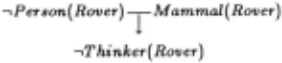
The residue wffis attached only as information associated with the link, but is not actually added to the graph until the link has been resolved upon in a resolution step. So, in this case, none of the links that would connect -,Thinker(R011er) to other literals are computed until the parent link is resolved upon. The most important consequence of this is that the residue will not be visible for use by the set of support strategy that the ABox employs to direct the progress of a proof (see below).
C. Proof Procedure and Resolution Strategy
The proof procedure used with a connection graph is quite simple. The kernel of the procedure is as follows:
- Stop if the graph contains the empty clause.
- Select any link from the graph.
- Generate the resolvent .
- Construct the new graph:
- (a) Delete the link resolved upon.
- (b) Add links for the resolvent.
5. Return to 1.
Once a given pair of literals in a pair of wffs has been resolved upon, literals that are derived in later resolution steps from the resolved-on literals cannot themselves be resolved upon. This follows from the fact that the original link is deleted before links are added between literals in the resolvent and other literals in the graph. As a result of this, connection graph resolution does not allow all the resolution steps that other methods might.
An important point to notice about the proof procedure is that it is nondeterministic. That is, the procedure places no restric tions on how the next link to be resolved upon is chosen. A given implementation must be very careful to embody a strategy that guarantees to preserve completeness of the procedure. One ob vious constraint on a suitable strategy should be that the choice of link tend to simplify the resultant graph. Another is that only links that are relevant to the query should be resolved upon.
In Stickel's theorem prover, these goals are achieved by the use of a complex evaluation function for determining the next link to schedule and by having the evaluation function use set of support as the basic resolution strategy. 16 The evaluation function also takes into account such things as how deep the search in a given direction has been and how complicated the residue on the link will be. The hope is that it will choose to ignore links that will result in a more complicated graph and that it will abandon paths that seem to be fruitless . While the evaluation function depends on heuristics and is not guaranteed to find the fastest proof in all cases, our experience shows it to work very well.
D. Terminological Link Types
The ABox is made to understand the TBox by the addition of links to the connection graph that are derived from the ter minological definitions in the TBox. Just as in the case of nor mal connection graph theorem-proving, deduction time is saved by pre-computation of possible unification steps. Further, since our definitions are structured and include a subsumption hierar chy, links constructed from them allow multiple deduction steps
16 Set of ·upport is a general strategy designed to ensure that only links that point into a "support set" are eligible for selection for the next resolution step. At the beginning of a proof the support set contains only the links between the negation of the query and other wffs. When a link is resolved upon, the old link is removed from the set, and all of the links of the resolvent are added.
(e .g., multiple applications of modus ponens} to be accomplished at once. Although we cannot provide evidence of it in the small space we have here (but see [Stickel, 1985]}, directly changing the connection graph turns out to be potentially far superior to the mere addition of "meaning postulates" in a loosely integrated system.
Our modification involves the addition of four new connection graph link types. The first three are for concept definitions, and the fourth for role definitions. To a first approximation, the links for a concept correspond to (1} links to concepts that subsume the concept, (2} links to concepts that occur (either explicitly or implicitly) as value restrictions in VRGenerics for the concept, and (3} links to roles that occur in VRGenerics for the concept. Links for the definition of a role are for su bchains of that defi nition that are themselves defined roles. At the very least, this will involve the primitive roles included in the definition.
There are two cases for each of the four basic link types, aris ing from the necessity and sufficiency of our TDox definitions. 17 These are the cases corresponding to positive and negative oc currences of a term. For example, if we know that Fred is a Per son, then we know that his not being a Thinker is immediately contradictory, so given the appropriate facts, this link would be necessary:
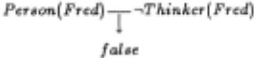
The Rover link of section IV.B shows a link required by the addition of a negative occurrence of a term.
In the next two sections, we will cover in some detail two of the necessary link types arising from concept definitions. The first of these is between a concept and all concepts that subsume it. The second is between a concept and roles that occur in a VRGeneric in the concept's definition.
In what follows, we shall use these definitions:
- Grandchild: (RoleChain Child Child}, that is, the Child of a Child .
- Woman-Student : (ConGeneric Woman Student}, that is, somebody that is both a Woman and a Student .
- Successful-Grandma: (VRGeneric Woman Grandchild Doctor), that is, a Woman all of whose Grandchildren are Doctors.
1. Concept-SuperConcept Linking
A concept P must be linked to concepts that subsume it. For this concept linking, the TBox must supply the names of all con cepts that subsume P and also all concepts that it subsumes (information that can be gotten from the TBox using the Knowl edge Level operations defined above). The reason for the latter is that we have no way of controlling the order of entry of terms . Finding a concept Q that P subsumes will allow Q to be appro priately linked up when Pis encountered.
Positive links : Each positive instance of a concept must be linked to all negative instances of concepts that subsume it when the arguments unify in the conventional fashion . No residue is associated with these links. The Fred link of the last section is an example of this link type.
17 1t should be emphasiaed that while these link connections may appear com plicated, they are not calculated repeatedly. The appropriate links are computed exactly once for each definition, at the time the definition is en tered. Therefore the apparent complexity here does not adversely affect the process of deduction.
Negative links: Each negative instance of a concept, P, must be linked to all positive instances of concepts, Q, that are subsumed by primitive concepts occurring as conjuncts in the definition of P when the arguments unify in the conventional fashion. The residue is formed by taking the definition of P, removing those pieces of it that are shared with the definition of Q, and then negating the result. For example, consider
If Sue is not a Woman-Student , but she is a Successful-Grandma, then some part of the definition of Woman-Student that does not apply to Successful-Grandma must not be true for Sue . The only piece of Woman-Student not included in the other definition is Student, so Sue must not be a Student.
2. Concept- RoleChain Linking
A concept P must be linked to each RoleChain that occurs in a VRGeneric for it. In order to do this linkage correctly, the TBox must provide the ABox, for each concept, the names of all defined RoleChains that occur in that concept, and for each defined RoleChain, the names of all concepts in which it occurs.
Positive links : For every role, R, whose definition occurs as a Role Chain or a subchain of a Role Chain in some VRGeneric in the definition of P, link P with the rest of the VRGeneric in which R occurs. So, for example, since Grandchild is defined as {RoleChain Child Child}, Child is a defined sub chain of Grand· child. Therefore, if Marge is a Successful-Grandma and has a Child, then if that Child in turn has any Children, they must all be Doctors .
Negative links: For every role, R, whose definition occurs as a subchain of a RoleChain in some VRGeneric in the definition of P , link -,P(a) and -,R(SkFn(a),SkFm(a)) (where SkFn and SkFm are both Skolem functions associated with the definition of P) . This link has as its residue the negation of the rest of the definition of P, after removing the VRGeneric in which R appears.
If Charlie has no children, then the VRGeneric for Successful Grandma holds vacuously, so for Charlie to not be a Successful· Grandma, he must fail in the only other requirement, and not be a Woman.
3. Other links
In the preceding sections we have outlined two of the major link types in our extension of unification. There are several choices for other links to use to complete the extension. Currently we have implemented one set that, while complete, 18 is probably not the best choice, as it yields some unintuitive links to assure that completeness. We have been exploring other link choices that do not of themselves ensure completeness but can be shown to be sufficient when coupled with the set of support strategy. Another approach that is being considered is to not restrict ourselves to bi nary links, that is links between two literals, but to instead make use of Stickel's more general theory resolution capabilities and use n-ary links [Stickel, 1983] [Stickel, 1985]. For example, instead of the link mentioned in the last section concerning Charlie which necessitated the addition of a residue, we might have waited until we had all three literals -,Successfui-Grandma(Charlie), -,Child(Charlie,z), and Woman(Charlie), and made a single ternary link containing no residue .
18 Because of space limitations, we are not saying here what it means to be complete and consistent with r espect to our Knowledge Level specification.
V Example Proof
In this final section, we will present a sample use of KRYPTON. We will supply some TBox definitions and a set of ABox facts and then show how KRYPTON goes about answering a query based on that information.
- TBox definitions:
Primitive Roles: Child
Primitive Concepts: Mammal, Thinker, Woman
Defined Concepts:
Person (ConGeneric Mammal Thinker) NoSon (VRGeneric Person Child Woman)
- ABox facts:
Child( Fred, Pat)
Child(Mary, Sandy)
NoSon(Fred) V NoSon(Mary)
With the facts above, we should be able to show that there is somebody in the world who is a Person and has a Child that is a Woman, even though we do not know who that somebody is. This query is formulated as 3z3y[Person(z) II Child(z,y) II W oman(y)]. The intuition behind the proof is that if Fred and Pat both have children and at least one of them is a NoSon, then whichever of them it is is himself a Person and has a Child that is a Woman (given the definition of NoS on) . That either Fred or Mary is a NoSon is insufficient information for this proof, since the definition of NoSon does not require that such a person have a Child, merely that if she has a Child , then that Child is a Woman. Note that any proof of this is going to have to use terminological information to know, for example, that the Child of whichever of them is a NoSon is also a Woman.
The proof proceeds by trying to derive a contradiction from the known facts and the negation of the query. Lines 1- 3 are t he known ABox facts that will be used in the proof. Line 4 is the negation of the query. z and y are used as universal variables.
- Child( Fred, Pat)
- Child(Mary,Sandy)
- NoSon(Fred) V NoSon(Mary)
- 4 . -,Person(z) V -,Child(z, y) V -,Woman(y)
- -,Person(Fred) V -,Woman(Pat) Normal resolution on 1 and -,Child(z, y) in 4.
- -,Person(Fred) V NoSon(Mary) V -,Child(Fred, Pat ) By 3, Fred is possibly a NoSon, which means that all his Chil dren are Women {from the terminology) . Stating that Pat is not a Woman in 5 has the consequence that Pat cannot be Fred's Child . In other words, NoSon(Fred) in 3 and -,Woman( Pat) in 5 resolve away and leave a residue of -,C hild( Fred, Pat) .
- -,Person(Fred) V NoSon(Mary) Normal resolution on 1 and -,Child( Fred, Pat) in 6.
- NoSon(Mary) By the definition of NoSon , if Fred is one then he must also be a Person, so -,Person(Fred) in 7 and NoSon(Fred) in 3 are directly contradictory.
- -,Child( Mary, y) V -,W oman(y) This time, if Mary is a NoSon , she must be a Person , so 8 and
-.Person(:z:) in 4 are directly contradictory, with Mary being sub stituted for x in the resolvent .
10. -.Child( Mary, y)
If Mary is a NoSon (as stated in 8), any Children she might have must be Women. Therefore, if there are no Women at all (as stated in 9), then Mary must have no Children . In this case, the residue, -.Child( Mary, y), was already part of the resolvent of 8 and 9, so it does not need to be added again.
11. false
Normal resolution on 10 and 2.
VI Conclusions
As we have shown, KRYPTON is a tightly integrated hybrid reasoning system that provides both terminological and asser tional facilities . At the Knowledge Level, it can be seen that assertional reasoning takes into account the definitions of terms expressed in a special-purpose frame-based description language. At the Symbol Level, it can be seen that this interface is imple mented by augmenting a theorem-prover's notion of unification to accommodate definitional relationships between predicates. Our KRYPTON implementation currently runs on a Symbolics 3600.
In some respects, this resembles what Stickel has called "theory resolution" [Stickel, 1983] [Stickel, 1985], wherein non-equational theories can be built directly into the theorem-prover. One could- at the Symbol Level-accurately call KRYPTON an im plementation of partial theory resolution, in that we have used the TBox to implement specialized reasoning procedures for cer tain tasks. However, as discussed in Section III, we have a full formal semantics at the Knowledge Level that supports the first class citizenship of descriptive terms in KRYPTON. Theory res olution allows us a convenient implementation of this idea, but does not itself provide us with the suitable semantics.
KRYPTON is different, in fact, from most other hybrid ap proaches in that it directly, and soundly, integrates two funda mentally different kinds of representation and reasoning.
@inproceedings{ijcai1985p102,
  title     = {An Essential Hybrid Reasoning System: Knowledge and Symbol Level Accounts of KRYPTON},
  author    = {Brachman, Ronald J. and Gilbert, Victoria P. and Levesque, Hector J.},
  booktitle = {Proceedings of the Ninth International Joint Conference on
               Artificial Intelligence, {IJCAI-85}},
  publisher = {International Joint Conferences on Artificial Intelligence},
  editor    = {Aravind Joshi},
  pages     = {532--538},
  year      = {1985},
  note      = {Knowledge Representation},
  url       = {https://ijcai.org/proceedings/1985/102},
}
TY - CPAPER TI - An Essential Hybrid Reasoning System: Knowledge and Symbol Level Accounts of KRYPTON AU - Brachman, Ronald J. AU - Gilbert, Victoria P. AU - Levesque, Hector J. T2 - Proceedings of the Ninth International Joint Conference on Artificial Intelligence, IJCAI-85 PB - International Joint Conferences on Artificial Intelligence PY - 1985 SP - 532 EP - 538 UR - https://ijcai.org/proceedings/1985/102 ER -Copied
Machine-readable versions of this paper, for tools and AI agents:





