
KL-Conc: A Language for Interacting With SI-Nets
Proceedings of the Eighth International Joint Conference on Artificial Intelligence. Knowledge Representation. Pages 333-335.
© 1983 International Joint Conferences on Artificial Intelligence
Abstract
This paper introduces KL-Conc language, a I<no\·lledge Representation Language based on !{ L- ' lagma, \vhich is a version of T{L-'J ~lE. The aim of KL-Conc is to simulate conceptual operations underlying natural language. Relationships and differences between KL-Conc and KL-ONE are also discussed.
- Asirelli, P., C. Lami, C. ~1ontangero, F. Turini Hanual", I.E.I.-CNR,
- G. Pacini, M. Simi, and "MAGHA-Lisp Reference Technical Note C75-13, Pisa , 1975.
- Brachman, R., E. Ciccarelli, N. Greenfeld, and ~. Yonke "KLONE Reference ~1anual", Report n. 3848, Bolt Beranek and Newman Inc., Cambridge, Massachussetts, July 1978.
- Brachman, R. ,T. "On the Epistemological Status of Semantic Networks", in N. Findler (ed.). Associative ~letworks: Representation and Use of Knowledge by Computers. New York: Academic Press, 1979.
- Brachman, R. J . . and D. ,J. Israel "Distinctions and Confusions: A Catalogue Raisonne' '', in Proc. IJCAI-R1, Vancouver, Canada, August, 1981, pp. 452-459. IJCAI
- Brachman, R. J. and H. Levesque "Assertions in KL-07' JE'' , in Schrnolze J. and R. Brachnan (Eds.), Proceedings of the 19 81 KL-mJE Workshop, Report n.4842, Dolt Beranek and Newman, Cambridge, Hassachussetts, June, 19R2.
- Cappelli, A. and L. !•1oretti "Introduzione al KL-ONE", Technical Note, ILC-NLP-1982-1, I.L.C.-C NR, Pisa, 1982.
- Cappelli, A., G. Ferrari, L. Moretti, and I. Prodanof "Integrating Syntax and Semantics", in press.
- Porta, o. and c. Vinchesi "Un Sistema per la Rappresentazione della Conoscenza: Aspetti Concettuali e di Inplementazione", unpublished thesis, Istituto di Scienze dell'Informazione, Pisa, 1981.
- Schmolze, J. G. and R. J. Brachman "Proceedings of the 1981 KL-ONE "1'7orkshop" , Report n. 4842, Bolt Beranek and Newman Inc., Cambridge, ~lassachussetts, June, 19 32.
- Woods, w. A. "Research in Natural Language Understanding", ~eport n. 4274, Bolt Beranek and Newman Inc, Cambridge, Massachussetts, 1979.
References were extracted automatically from the PDF and may contain errors.
Full text extracted automatically from the PDF; figures, tables and equations may differ. The PDF is the version of record.
KL-Conc: a Language for interacting \-lith SI-Nets
Cappelli Amedeo *, ~oretti Lorenzo*, Vinchesi Carlo
- Istituto di Linguistica Computazionale - CNR Pisa - Italy
ABSTRACT
This paper introduces KL-Conc language, a I<no\·lledge Representation Language based on !{L-'lagma, \vhich is a version of T{L-'J~lE. The aim of KL-Conc is to simulate conceptual operations underlying natural language. Relationships and differences between KL-Conc and KL-ONE are also
discussed.
I INTRODUCTION
BrachMan (1979), in examining semantic network theories, makes a classification in five levels: implementational, logical, epistemological, conceptual and linguistic. Starting from this classification, Brachman develops his epistemological approach to knowledge representation which may be summarized as follows: definition of knowledge structuring primitives such as concepts, roles and structural descriptions and the relationships between them such as cables and wires (Structured Inheritance Networks (SI-Nets)). Within this paradigm, the KL-ONE knowledge representation language has been designed and implemented. The most relevant features of this proposal
are:
- a semantic network theory well defined from a semantic viewpoint;
- the overcoming of the logical approach by individuating operations qualitatively different from those of Logic (Brachman and _+srael 1981).
II GOALS AND OBJECTIVES
Our current hypothesis is to start from the epistemological level in order to approach conceptual and linguistic levels. In other words, we shall use epistemological primitives and functions, represented in KL-Magma, a version of KL-ONE (see IV), to represent abstract objects and operations relying upon the conceptual operations of natural language.
Following these assumptions, we have designed and implemented a language (KL-Conc) which tries to simulate certain conceptual operations underlying the use of natural language. l-~Tords, syntactic relations and so on, may be described in terms of conceptual operations such as individuation of real world objects evaluation of properties of objects, tes~ of configurations of objects and so on. We shall explain our claim providing examples taken from the Italian language.
From a conceptual viewpoint, the Italian definite and indefinite article (il, un) may be described as follows: individuation of a specific real world object:
- ho visto il bambino con i capelli rossi
- (I saw the child with red hair) individuation of any one real world object:
- ho visto un bambino
- (I saw a child)
- assertion of properties of an abstract prototype:
- Il (un) cane ha quattro zampe
- (A dog has four paws)
Operations of this kind are those simulated by KL-Conc language. This allows us to directly describe linguistic entities in terms of KL-Conc language. Consequently this means the possibility of describing linguistic entities in terms of conceptual operations.
III ARCHITECTURE
This language is part of a system whose main components are shown in Figure 1.
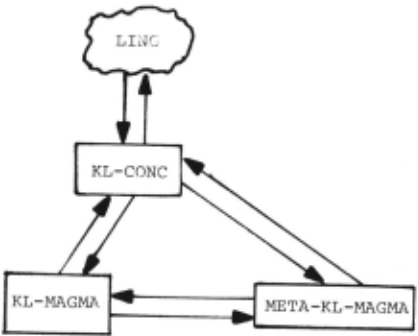
The KL-Conc, KL-~1agma and HETA-KL-Magma components \'lill be describen later. For the structure of LING component and hm1 it interacts with KL-Conc see (Cappelli, Ferrari, Moretti and Prodanof , in press).
IV KL-MAGMA
KL-11agma is a version of KL-o~m implemented in ~1A�MA-LISP (Asirelli et al. 1975) .
It is a KR language similar to that described in (BrachMan, 1979), (Brachman et al., 1978), which also takes into account the versions given in (Cappelli and Moretti, 1982) and (Porta and Vinchesi, 19 82) .
As in KL-ONE, KL-Magma allows the user to create and to handle SI-Nets. However, it is more biased than KL-ONE towards declarativity, in fact, in our current approach, KL-Magma is mainly used as a model of abstract data structures. Furthermore, search and retrieval on SI-Nets is handled at the KL-Conc level and it must follow the specifications established at this level.
KL-Conc is a knowledge representation language whose functions aim at si~ulating those typical of the conceptual system unoerlying natural language.
11ost KL-Conc functions can be' viewed as macros of KL-Magma functions structured in HAGr-1!\-LISP syntax. In this way, KL-Conc assumes a different external organization from KL-Magma language. The relationship between KL-r1agma and KL-Conc consists in the fact that KL-Conc semantics is based on the KL-Magma semantics. The latter, with its clearness and expliciteness, ensures transparency to KL-Conc.
KL-Conc functions handle real world objects \'lhich are internally represented as KL-Magma abstract data types.
The main features of KL-Conc are the following:
- real world objects can have arbitrary names; prototypes and individuals can have the same name:
- real world objects can be accessed by means of testing properties or configurations:
user
(ANYONE table)
system table3
user (ANYONE (TEST _PROPERTIES C'lUMBER leg 4)) system table14
- real world objects can be according to their appearance in accessed the time
- flow: user (LAST)
- functions operate on two different kinds of memory:
system cupboardfi
a)long-term memory: it is representeo in KL-Magma data structures and is divided in generic and individual knowledge (like KL-ONE); it is created and increased in an assertional way with the aid of metadescription (see VI).
b)working-memory: it enables to perform search and activation of objects according to the time flow; for instance, it allows the user to refer to the objects using anaphorical references.
Some KL-Conc as quantifiers; different from performing on an functions may be viewed however, they are quite the logical ones since epistemological structure.
Furhermore, they are integrated with complex tests controlling
entities in the network, testing local and non local constraints such as conceptual relationships, modality, cardinality and so on. This allows us to perform global operations which assume a natural aspect: they put together a set of episte~ological functions whose semantics is siMilar to the conceptual operations underlying natural language (see example 1. in II, where the PP "con i capelli rossi" contributes to determine the individuation of a real world object) .
Let us now describe some KL-Conc functions in order to clarify the ways in which they handle SI-Nets.
ANYONE (arbitrary name)
it returns one individual concept which individuates the generic concept named by arbitrary name, verifying the test (if present);-
som:: (arbitrary nane) it works like !\NYO;-JE except that it returns a set of individual concepts.
TEST PROPERTY VALUE (arbitrary name) it verifies -whether the value of an instance role is equal to arbitrary_name.
LAST (arbitrary name) it returns the last concept created or activated according to arbitrary_name or test (if present).
NEWIND (arbitrary name)
it creates a new individual concept and establishes it as individuator of the generic concept named by arbitrary name. If the generic concept does not exist it is created. When a description of the individual concept is given, it is used to infer the description of the generic concept; for this purpose META-KL-Magma is invoked when needed.
VI META-KL-MAGMA
META-KL-Mag~a is a representation of KL-Magma formal objects in KL-Magma. This capability of metadescription is like that described in KL-ONE paradigm. At present, our system uses metadescription of KL-Magma to test correctness of KL-Magma structures created by KL-Conc language. The concept of correctness is adopted by the system as a criterion to complete incomplete KL-Hagma structures, in this way increasing long-term ~emory.
This capability is required by the fact that by using KL-Conc one can make weak stateMents in comparison with KL-Magma formalism; in this case META-KL-Hagma can
contribute to reduce weakness.
Let us imagine, for instance, long-term memory as empty. By KL-Conc expression
(NEWIND rose (ADD PROPERTY VALUE red)) the following KL~MagMa structures are created (see Fiqure 2):
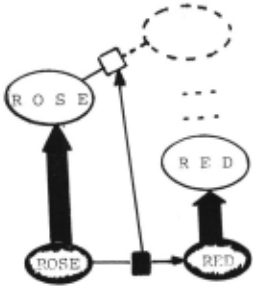
interpreting that every individual concept must be related to a generic concept and that every instance role must satisfy a generic role. It is not correct to put red (generic) as V/R of the generic role of rose because the V/R can be a more general concept than red. Nevertheless, it is obligatory to close the hierarchies at generic knowledge level by inserting a possible V/R in the generic role structure and to establish its relation with red (generic). This leads META-KL-Magma to ask the user the concept which enters as possible V/R of the generic role of rose. In this .way the user interacts with KL-Hagma via META-KL-:Hagma, using only arbitrary names or keywords of KL-Magma shown by the system.
This capability of interpreting the abstract syntax of the conceptual system is also shown by human behaviour. When hearing the following sentence:
"in the cell there is the cytoplasM" a speaker \'Ti th no knowledge of biology can associate the two items, cell and cytoplasm, in a mutual structural relationship. However, he is unable to describe the single items as he does not know to what conceptual field they belong. Nhen questionned about cell and cytoplasm he can answer according to the information given by the sentence (or paraphrasing it); furthermore, he can also realize why he cannot answer further questions whose interpretation involves knowledge about facts not present in the sentence. By HETA-KL-Magma we try to simulate this capability of "syntactic" metadescription which is independent from the effective data of knowledge. In other words, it consists in finding mechanisms able to increase the knowledge base without referring to the knowledge about real world objects.
VII CONCLUSIONS
KL-Conc tries to give answers to issues discussed in the framework of KL-O~lE (Schmolze and Brachman, 1982). In fact, by KL-Conc we intend to investigate the relationships between Terminological Box (T-Box) and Assertional Box (A-Box) , as claimed in (Brachman and Levesque, 1982).
KL-Conc is a means used to investigate the ways by which generic and individual knowledge are integrated and used in assertions. It can be viewed as a way to refer to and use T-Box in an intuitionistic manner, assuming T-Box as a reference
scheme invoked when needed.
Furthermore, the capability of I~L-Conc to cooperatively complete incomplete information given by assertions is a means of building a dynamic system. This systen can use its own knowledge but, at the same time it can create new knowleage by
interpreting its own structure.
This is a possible way, intermediate between KL-ONE and JARGON ( l<loods, 1 9 7 9) , to overcome the difficulties of interacting with a SI-Nets. In fact, while in KL-ONE the user must know the SI-Nets model, in JARGON the difficulties are partially overcome by using a rigid, restricted English-like language. In KL-Conc the user is required only to know a set of conceptual operations that simulate the ones he naturally performs using natural language.
@inproceedings{ijcai1983p77,
  title     = {KL-Conc: A Language for Interacting With SI-Nets},
  author    = {Cappelli, Amedeo and Moretti, Lorenzo and Vinchesi, Carlo},
  booktitle = {Proceedings of the Eighth International Joint Conference on
               Artificial Intelligence, {IJCAI-83}},
  publisher = {International Joint Conferences on Artificial Intelligence},
  editor    = {Alan Bundy},
  pages     = {333--335},
  year      = {1983},
  note      = {Knowledge Representation},
  url       = {https://ijcai.org/proceedings/1983/77},
}
TY - CPAPER TI - KL-Conc: A Language for Interacting With SI-Nets AU - Cappelli, Amedeo AU - Moretti, Lorenzo AU - Vinchesi, Carlo T2 - Proceedings of the Eighth International Joint Conference on Artificial Intelligence, IJCAI-83 PB - International Joint Conferences on Artificial Intelligence PY - 1983 SP - 333 EP - 335 UR - https://ijcai.org/proceedings/1983/77 ER -Copied
Machine-readable versions of this paper, for tools and AI agents:
 Welcome
 Future Conferences
 AI Journal Division
 IJCAI Proceedings
 About IJCAI
 IJCAI Awards