
Intelligent Assistants for Knowledge and Information Resources Management
Proceedings of the Eighth International Joint Conference on Artificial Intelligence. Expert Systems. Pages 170-171.
© 1983 International Joint Conferences on Artificial Intelligence
Abstract
Work in Artificial Intelligence on knowledge based technology has produced a variety of practical applications while data management systems are used in almost every commercial enterprise of any significant size. Despite the advances in both data base and knowledge base technologies there is still a large gap between the capabilities of these tools and the "paperwork and information explosion" that faces modern society. Concern with this information access problem in the United States has lead to the creation of the new field of Information Resources Management and to Federal laws and executive orders aimed at reducing paperwork and promoting more effective management of information. In this paper we outline the nature of this information management problem and describe certain AI and database technology that may help to close this information access gap. We introduce the notion of "Intelligent Assistants" for Information Resources Management(IRM) and describe how work on current approaches to "Knowledge Management" may lead to the technology necessary for the eventual creation of such intelligent assistants.
- The Diebold Report: Informa tion Resource Management, Infosystems, June, Oct ., 1979 .
- Information Resources Management: A Report of the Commission on Feder'il Paperwork, Government Printing Office, W9.shington, D.C. , 0'52-003.: 00464-0, Sept., 1977.
- Horton, F. W., Information Resource Management: Concept and Cases, Association for System s Management:-fleveland, Ohio, 1979.
- United States Public Law 96-'511: The Paperwork Reduction Act of 1980, U. S. Cong~s. Dec. 11, 1980.
- United States Executive Order 12174: Paperwork, Nov. 30, 1979.
- An Information Management Study for Headqua r- ters, Dept. of the Army, Arthur Young and Co. Washington, D.C., NTIS ADA 084841, June, 1 §79:-
- The Design of an Information Management Program for Headquarters, Dept. of the Army, Arthur Young and Co. Washington, D.C ., NTI S---xuA 08'5936, Feb. 1980.
- Administration of II: Implementing Diebold Research 196S49 , Feb. 1981. Information Resources, Part Computer Information Policy, Program, New York, Report
- Meltzer, M., Information, The Ultimate Manage- ment Resource, AMACOM, New York, 1981.
- Horton, F. W. and Information Management Information Resources 1982.
- Marchand, D.A., eds. in Public Administration, -pre;s:--Arlington, Va.
- Berry, J.F., and Cook C.M., Managing Knowledge as a Corporate Resource, NTIS ADA029891, July, 1976-:
- Kellogg, C., Knowledge Management: A practical amalgam of knowledge and database technology, in Proceedings of National Conference on Artificial Intelligence, Carnegie-Mellon Univeriity, 1982.
- Kellogg, C., Klahr, P., Travis, L., A Deduc- tive Capability for Data Management, in Systems for Larg( Data Bases, Lockemann, P.C., Neuhold E.J., edS-:J, North-Holland Publishing Co. 1976. •
References were extracted automatically from the PDF and may contain errors.
Full text extracted automatically from the PDF; figures, tables and equations may differ. The PDF is the version of record.
I ABSTRACT
Work in Artificial Intelligence on knowledge based technology has produced a variety of practi cal applications while data management systems are used in almost every commercial enterprise of any significant size. Despite the advances in both data base and knowledge base technologies there is still a large gap between the capabilities of these tools and the "paperwork and information explosion" that faces modern society. Concern with this information access problem in the United States has lead to the creation of the new field of Information Resources Management and to Federal laws and executive orders aimed at reducing paperwork and promoting more effective management of information.
Charles H. Kellogg System Development Corporation
Santa Monica. California
result, in attempting to implement the provisions of the Act, the Federal Government is beginning to grapple with some difficult management issues such as developing techniques for costing and valuing information, dealing with questions of data owner ship, and locating potentially relevant information from vast data holdings collected by different parts of the organization· for different purposes.
In this paper we outline the nature of this information management problem and describe certain AI and database technology that may help to close this information access gap. We introduce the notion of "Intelligent Assistants" for Information Resources Management(IRM) and describe how work on current approaches to "Knowledge Management" may lead to the technology necessary for the eventual creation of such intelligent assistants.
II THE NEED
A. Information Resources Management
During the past 5-7 years considerable interest has arisen in managing information as a resource of large organizations. Generally the analogy is drawn with managing other, more tradi tional resources such as people, money, or facili ties. Just as we plan, budget, and monitor the acquisition and disposition of those resources, so too should we manage the resources involved with collecting, storing, processing, transmitting, and using information. As a result, a new discipline of Information Resources Management (IRM) has appeared[2,3]. Many large organizations in govern ment and industry are establishing corporate IRM programs to monitor information-related expendi tures (including system development efforts) and to identify ways to improve the overall corporate position with regard to information resources.
In 1980 the U.S. Congress enacted the Paper work Reduction Act of 1980 (P.L. 96-511)[4] which embraces the IRM concept openly and mandates that every Federal agency adopt the IRM approach. As a Several tools are under development to assist organizations in managing their information resources. The U.S. Office of Management and Budget is constructing a Federal Information Loca tor System (FILS) to serve as a central directory of information holdings throughout the Federal Government [5]. Other agencies and corporations are developing information resource directories which maintain pertinent data about the data ele ments, files, data bases, programs, systems, hardware, communication networks, people, funds, and other resources related to information [6,7,8,9,10,11]. Metadata bases such as these are the first steps in the potentially long process of providing support to the newly appointed informa tion resources manager.
Concurrent with the development approach, and in large part responsible been the development of distributed systems and the decentralization of development function. of the IRM for it, has information the systems
B. Intelligent Information Resources Assistant
The IRM movement, in its relative infancy, has begun to address the need to identify and catalog the various information flows in helping the end user identify what information is available. But providing assistance in understanding how to use the various resources effectively is a new problem which the IRM field has yet to address. Tools and mechanisms are needed to provide the user with a consistent, intelligent interface to the disparate information resources at hand. An Intelligent Information Resources Assistant (IIRA) is required to serve as librarian, research assistant, secre tary, and staff member with regard to using infor mation resources. The IIRA would help the end-user find relevant information, select suitable process ing mechanisms, restructure the data for the selected processors, and combine the results from various sources or processes into meaningful information.
A. ~ Knowledge Management System
An important if not essential tool for the development of an ITRA is a system for knowledge management. In "Managing Knowledge as a Corporate Resource"f12] Berry and Cook describe knowledge (as opposed to data or information) as a basic resource of an enterprise and outline a series of steps to achieve a corporate knowledge management capabil ity . In "Knowledge Management: A Practical Amalgam of Knowledge and Data Base Technology"[13], Kellogg describes a strategy for transitioning from current Data Management to future Knowledge Management Sys tems .
At SDC we have constructed a series of increasingly more powerful and efficient Deduc tively Augmented Data Management (DADM) systems. The earliest system was described at the Very Large Database Conference in 1976[ 14].
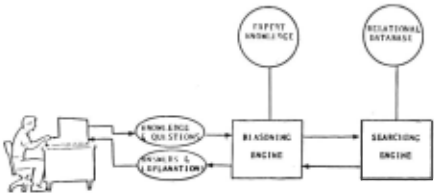
Figure 1 illustrates the basic components of our system architecture. To a searching engine (preferably but not necessarily a relational data management system) and associated database we add a reasoning engine (deductive processor) and a knowledge base of application specific expe rtise. A use r may access this combined system through a high level interface that accepts knowledge and questions in the form of logic statements and returns answers and explanations for those answers as derived facts and proofs respectively.
The current version of our Knowledge Manager (KM-1) prototype is illustrated in Figure 2. KM-1 is com posed of a logic-based deductive engine realized on a Lisp machine that plans and executes strategies for solution of deductive, database search, and compute problems related to answering a user's request for information. KM-1 can simultaneously access an external database and a local (Lisp machine) database to find and combine information necessary to create answers and explanations of those answers.
A user interacts with KM-1 via the Xerox 1100, bit-mapped display, mouse, and keyboard. A VAX 11/780 is used mainly as a file and print server for the 1100 and a Britton-Lee IDM-600 relational database machine is used to access large databases. The IDM-600 can provide access to as many as 50
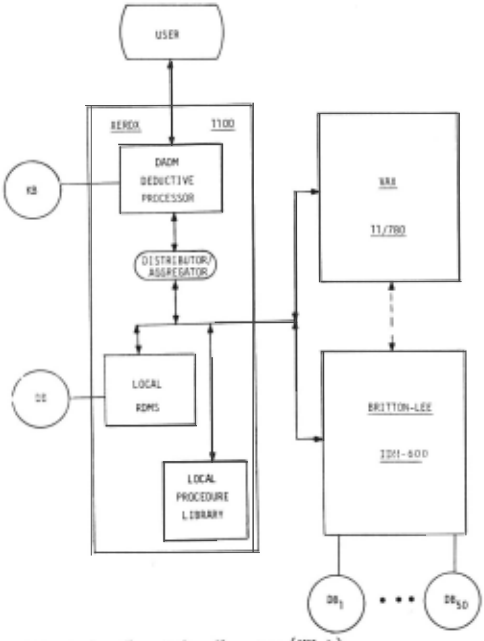
separate relational databases containing a maximum of 10 gigabytes of data. Communication between the Xerox-1100 and the VAX is by means of Ethernet. Direct communication between the 1100 and the IDM600 is achieved by a serial RS-232 interface.
B. An Intelligent Assistant for Managers
We will illustrate the operation of cation currently implemented within Manager's Assistant. an appli KM-1: The
The Manager's Assistant consists of:
- ~ A knowledge base comprising managerial exper tise
- ~ A manager-specific database of planned charges to projects
- ~ A general MIS database of actual charges to projects
- ~ A library of computable procedures for data analysis
Currently the Manager's Assistant contains knowledge about such concepts as "staffing", "plan/actual discrepancies", "personnel turnover" and many other notions that may be useful in assisting managers in their. planning and project monitoring tasks.
Consider the case of a Manager who needs to find out if there are employees available who may be candidates for transfer from one particular pro ject (PV) to another (CAD) . This question may be input to the Manager's Assistant as follows:
(FIND EMP-1 IS ASSIGNED TO PV AND EMP-1
CAN BE ASSIGNED TO CAD)
One employee is located (White) who meets these conditions. Figure 3 illustrates the information displayed on the Xerox 1100 as a result of deduc tively guided database search. To obtain this information the system first creates a "search/compute" plan consisting of thirteen con strained relations . Ten of the relations comprise a database access strategy that is distributed to the two database systems. The remaLnLng relations are computed via Lisp procedures applied to tuples returned from database search.
The evidence tree shown in Figure 3
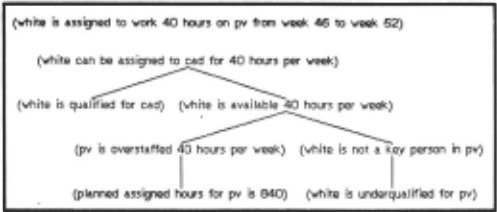
displays the two top level conclusions (White is assigned to PV and he can be assigned to CAD) and lower level conclusions (White can be assigned to CAD because he is qualified and available; he is available because his project is overstaffed, he is not a key person on the project, and he is under qualified for his current position).
C. An Intelligent Assistant Resources Managers for Information
The manager's assistant described above includes expertise designed to support line managers in budgeting, planning, and project moni toring as well as staff assignment. An intelligent assistant for IRM will require similar expertise to support budgeting, planning, and monitoring of the use of information resources. Much additional expertise will have to be encoded about qualitative and quantitative attributes of various information sources to support reasoning about the value, cred ibility, and utility of those sources for meeting specific kinds of needs.
IV SUMMARY
We have outlined some of the issues involved in achieving better computer-aided management of paperwork and other kinds of information resources.
Current approaches to knowl edge m11nagement and deductive question answering provide the beginnings of a set of tools to support this enterprise but much remains to be done in capturing and utilizing the expertise necessary to create computer-based IRM assistants .
v REFERENCES
- The Diebold Report: Informa tion Resource Management, Infosystems, June, Oct ., 1979 .
- Information Resources Management: A Report of the Commission on Feder'il Paperwork, Government Printing Office, W9.shington, D.C. , 0'52-003.: 00464-0, Sept., 1977.
- Horton, F. W., Information Resource Management: Concept and Cases, Association for Systems Management:-fleveland, Ohio, 1979.
- United States Public Law 96-'511: The Paperwork Reduction Act of 1980, U. S. Cong~s. Dec. 11, 1980.
- ['5] United States Executive Order 12174: Paperwork, Nov. 30, 1979.
- An Information Management Study for Headqua r ters, Dept. of the Army, Arthur Young and Co. Washington, D.C., NTIS ADA 084841, June, 1§79:-
- The Design of an Information Management Program for Headquarters, Dept. of the Army, Arthur Young and Co. Washington, D.C ., NTIS---xuA 08'5936, Feb. 1980.
- Administration of Information I: Information Policy, Diebold New York, Report 187S4'5, Sept. Resources, Part Research Program, 1980.
- Administration of II: Implementing Diebold Research 196S49 , Feb. 1981. Information Resources, Part Computer Information Policy, Program, New York, Report
- Meltzer, M., Information, The Ultimate Manage ment Resource, AMACOM, New York, 1981.
- Horton, F. W. and Information Management Information Resources 1982. Marchand, D.A., eds. in Public Administration, -pre;s:--Arlington, Va.
- [ 12] Berry, J.F., and Cook C.M., Managing Knowledge as a Corporate Resource, NTIS ADA029891, July, 1976-:
- Kellogg, C., Knowledge Management: A practical amalgam of knowledge and database technology, in Proceedings of National Conference on Artificial Intelligence, Carnegie-Mellon Univeriity, 1982.
- [ 14] Kellogg, C., Klahr, P., Travis, L., A Deduc tive Capability for Data Management, in Systems for Larg( Data Bases, Lockemann, P.C., Neuhold E.J., edS-:J, North-Holland Publishing Co. 1976. ·
@inproceedings{ijcai1983p39,
  title     = {Intelligent Assistants for Knowledge and Information Resources Management},
  author    = {Kellogg, Charles},
  booktitle = {Proceedings of the Eighth International Joint Conference on
               Artificial Intelligence, {IJCAI-83}},
  publisher = {International Joint Conferences on Artificial Intelligence},
  editor    = {Alan Bundy},
  pages     = {170--171},
  year      = {1983},
  note      = {Expert Systems},
  url       = {https://ijcai.org/proceedings/1983/39},
}
TY - CPAPER TI - Intelligent Assistants for Knowledge and Information Resources Management AU - Kellogg, Charles T2 - Proceedings of the Eighth International Joint Conference on Artificial Intelligence, IJCAI-83 PB - International Joint Conferences on Artificial Intelligence PY - 1983 SP - 170 EP - 171 UR - https://ijcai.org/proceedings/1983/39 ER -Copied
Machine-readable versions of this paper, for tools and AI agents:





