
Fractal-Based Description
Proceedings of the Eighth International Joint Conference on Artificial Intelligence. Vision. Pages 973-980.
© 1983 International Joint Conferences on Artificial Intelligence
Abstract
This paper addresses the problems of (I) representing natural ~h a p cs such as mountains, trees and clouds, and (2) computing such a description from image data. In order to solve these problems we must be able to relate natural surfaces to their images; this r <:> quires a good model of natural surface shapes. Fractal functions are good a choice for modeling natural surfaces because (I) many physical processes produce a fractal surface shape, (2) fractal s are widely used as a graphics tool for generating naturallooking shape s, and (3) a survey of natural imagery has shown t.hat th e 3-D fractal surface model, transformed by the image form ation proce~ s, furnishes an accurate description of both textured and shaded image regions. This characterization of image regions has be en shown to be stable over transformations of scale and linear tran sforms or intensity. Murh work has been accomplished that is relevant to comput ing 3-D information from the image data, and the computation of a 3-D fract al-based representation from actual image data has been de monstrated using an image of a mountain. This example shows the potential of a fractal-based representation for efficiently computing good 3-D representations of natural shapes, including such seemingly-difficult cases as mountains, clumps of leaves and clouds.
- B. B. Mandelbrot, "Fractals: Form , Chance and Dimension," W. H. Freeman and Co.,San Francisco, California, 1977.
- L. F. Richardson, "The Problem of Contiguity: an Appendix of Statistics of Deadly Quarrels," General Systems Yearbook, vol. B, pp. 139-187, 1961.
- A. Fournier, D. Fussel and L. Carpenter, "Computer Rendering of Stochastic Models," Communications of the ACM, vol. 25 , 6, pp. 371-384 , 1982.
- B. B. Mandclbrot, "The Fractal Geometry of Nature," Freeman, San Francisco, 1982.
- A. Norton, "Generation and Display of Geometric Fractals in 3-D," Comput er Graphics, vol. 16, 3, pp. 61-67 , 1982.
- Y. Kawaguchi , "A Morphological Study Of The Form Of Nature," Computer Graphics, vol. 16, 3, pp . 223-232, 1982.
- L. C. Carpenter, "Vol Libre," Computer Generated Movie, 1980.
- P. Brodat.z, "Textures: A Photographic Album for Artists and Designers," Dover, New York, New York, 1966.
- A. P. Pentland, "Local Computation Of Shape," SRI Artificial Intelligence Ce nter Technical Memo 272.
- K. Laws, "Textured Image Segmentation," Report 940, USC Image Processing Institute, Los Angeles, California, 1980.
- W. K Pratt, O.D. Faugeras, and A. Gagalow1cz, "Visual Discrimination of Stochastic Texture," IEEE Transactions on Systems, ~bn and Cybernetics, vol SMC-8, pp. 460-473, 1978.
- K. Deg uch i and I. Morishita, "Texture Characterization and Texture-Based Image Partitioning Using Two-Dimensional Linear Estimation Techniques," IEEE Transactions on Computers, vol C-27, pp . .739-745, 1978.
- A. Rosenfeld and E. B. Troy, "Visual Texture Analysis," IEEE Conference on Feat.ure Extraction and Analysis, pp. 11 5-124, Argonne, Ill. Oct. 1970.
- R. M. Haralick , K. Shanmugam and J. Dinstein, "Textural Features for Image Classification," IEEE Transactions on Systems, Man and Cybernetics, vol. SMC-3, pp. 610-621, 1973.
- R. Bajacsy and L. Lieberman, "Computer De~cription of Real Outdoor Scenes," Proceedings of 2d International Joint Conference on Pattern Recognition, pp. 174-179, Copen hagen , Aug 1974.
- H. Maurer, "Texture Analysis With Fourier Series," Proceedi ngs of the 9th International Symposium on Remote Sensing of the Em•ironment, pp 1411-1420, Ann Arbor, Michigan, April 1971.
- R. Bajacsy and L. Lieberman, "Texture Gradient as a Dt'pth Cue," Computer Graphics and Image Processing, vol. 5, 1, pp 52-67, 1976.
- A. P . Witkin , "Recovering Surrace Shape and Orientation from Texture," Artificial Intelligence, 17, pp. 17-47 (1981).
- R. L. Gregory, "Eye And Brain: The Psychology of Seeing," New York, McGraw-Hill, 1972.
- D. A. Norman , "Memory and Attention," New York, Wiley, 1976.
References were extracted automatically from the PDF and may contain errors.
Full text extracted automatically from the PDF; figures, tables and equations may differ. The PDF is the version of record.
FRACTAL-BASED DESCRIPTION
Alex P . Pentland
SRI International, 333 Ravenswood Ave., Menlo Park, California 94025
ABSTRACT
This paper addresses the problems of (I) representing natural ~hapcs such as mountains, trees and clouds, and (2) computing such a description from image data. In order to solve these prob lems we must be able to relate natural surfaces to their images; this r <:>quires a good model of natural surface shapes. Fractal functions are good a choice for modeling natural surfaces because (I) many physical processes produce a fractal surface shape, (2) fractal s are widely used as a graphics tool for generating natural looking shapes, and (3) a survey of natural imagery has shown t.hat the 3-D fractal surface model, transformed by the image formation proce~s, furnishes an accurate description of both tex tured and shaded image regions. This characterization of image regions has been shown to be stable over transformations of scale and linear transforms or intensity.
Murh work has been accomplished that is relevant to com put ing 3-D information from the image data, and the computa tion of a 3-D fract al-based representation from actual image data has been demonstrated using an image of a mountain. This ex ample shows the potential of a fractal-based representation for efficiently computing good 3-D representations of natural shapes, including such seemingly-difficult cases as mountains, clumps of leaves and clouds.
I INTRODUCTION
This paper addresses two related problems: (I) representing natural shapes such as mountain!, trees and clouds, and (2) com puti ng such a description from image data. The first step towards soh·ing these problems, it appears, is to obtain a model of natural surface shapes. The task of finding such a model is extremely im port.ant to computer vision because we face problems that seem impossible to address with standard descriptive techniques. How, for instance, should we describe the shape of leaves on a tree! Or grass! Or clouds' 'When we attempt t.o describe such common, natural shapes using standard shape-primitive representations, the re~ ult is an unrealistically complicated model of something that., viewed introspectively, seems very simple.
Furt.h<:>rmorc, how can we extract 3-D information from the image of a textured surface when we have no models that describe natural surfaces and how they evidence themselves in the image! The lack of such a 3-D model ha.' generally restricted image tex ture descriptions to being ad hoc statistical mea11ures of the image intensity surface. A good model of natural surfaces together with the physics of image formation would provide the analytical tools necessary for rel ating natural surfaces to their images. The ability to relate image to surface can provide the necessary leverage for dealing appropriately with the problems of finding a good representation Cor natural surfaces and computing such a descri~ tion from the image data.
· The resrarch reported herein was supported by the Defense Advanced Research Projects Agency under Contract No. MDA 903-83-C-0027; this contract is monitored by the U. S. Army Engineer Topographic Laboratory. Approved for public release, di~t.ribution unlimited.
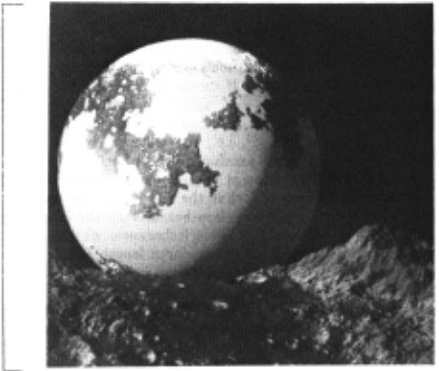
Even ~bapc-from-shading and surface-interpolation methods are limited by the lack of a 3-D model of natural surfaces. Currently all such methods employ the heuri~tic of "smoothness" to relate neighboring points on the surface. Such heuristics are applicable to many man-made surfaces, of course, but are demonstrably untrue of most natural surfaces. In order to apply such techniques to natural surfaces, therefore, we must find a heuristic that is true of natural surfaces. Finding such a heuristic requires recourse to a 3-D model of natural surfaces.
Fractal function~ seem to provide such a model of natural surface shapes. Fractals are a novel class of naturally arising functions, discovered primarily by Benoit Mandelbrot. Mandelbrot and ot.hers [I ,2,4] have shown that fractals are found widely in nature and that a number of basic physical processes, such as erosion and aggregation, produce Cract.al sur faces. Because fractals look natural to human beings, much recent computer graphics research has focused on using fractal processes to simulate natural shapes and textures (see Figure I), including mountains, clouds, water, plants, trees, and primitive animals [3,4,5,6,7] . Additionally, we have recently conducted a survey of natural imagery and found that a fractal model of imaged 3-D surfaces furnishes an accurate description of both textured and shaded image regions, thus providing validation of this physics-derived model for both image texture and shading.
IT FRACTALS AND THE FRACTAL MODEL
During the last twenty years, Benoit B. Mandelbrot has de veloped and popularized a relatively novel class of mathematical functions known as fracta/8 (1,4). Fractals are found widely in nature [I ,2,4]. Mandelbrot shows that a number of basic physi cal processes, ranging from the aggregation of galaxies to the curdling of cheese, produce fractal surfaces. One general charac terization is that. any process that acts locally to produce a per manent. change in shape will, after innumerable repetitions, result in a fractal ~urface. Examples are erosion, turbulent flow (e.g., of rivers or lava) and aggregat.ion (e.g. , galaxy formation, meteorite accretion, and snowflake growth). Fractals have also been widely and successfully used to generate realistic scenes (see Figure 1 ), including mountains, clouds, water, plants, trees, and primitive animals [3,4,5,6,7].
Perhaps the most familiar examples of naturally occurring fract.al curves are coast.lines. When we examine a coastline (as in Figure I), we see a familiar scalloped curve formed by in numerable bays and peninsulas. If we then examine a finer-scale map of the same region, we shall again see the same type of curve. It turns out that this characteristic scalloping is present at all scales of examination [2], i.e., the statistics of the curve are invariant with respect to transformations of scale. This fact cause~ problems when we attempt to measure the length of the coastline, because it turns out that the length we are meru~ur ing depends not only on the coru~tline but also on the length of the measurement tool itself [2]! This is because, whatever the ~ize measuring tool selected, all of the curve length attributable to features smaller than the size of the measuring tool will be missed. Mandelbrot pointed out that, if we generalize the notion of dimension to include fractional dimensions (from which we get the word "fractal"), we can obtain a consistent measurement of the coastline's length.
The definition. A fractal is defined as a set for which the Hausdorff-Besicovich dimension is strictly larger than the topological dimension. Topological dimension corresponds to t.he standard, int.uit.ive definition of "dimension." Hausdorff Besicovich dimension D, also referred to as the fractal dimen sion, may be illustrated (and roughly defined) by the examples (1) of measuring the length of an island's coastline, and (2) measuring the area of the island.
To measure the length of the coastline we might select a measuring stick of length >.and determine that n such measuring sticks could be placed end to end along the coastline. The length of the coastline is then intuitively n>.. If we were measuring the area of the island, we could use a square of area >. 2 to derive an area of m>. 2 , where m is the number of squares it takes to cover the island. If we actually did this, we would find that both of these measurements vary with >., the length of the measuring instrument - an undesirable result.
In these t.wo examples the length >. is raised to a particular power: the power of one to measure length, the power of two to measure area. These are two examples of the general rule of raising >. to a power that is the dimension of the object being measured. In the case of the island, raising >. to the topological dimension doe~ not yield consistent results. IC, however, we were to use the power 1.2 instead of 1.0 to measure the length, and 2.1 instead of 2.0 to measure the area, we would find that the measured length and area remained constant regardless of the size of the measuring instrument chosen." The positive real num ber D that yields such a consistent measurement is the fractal dimwsion. D is always greater than or equal to the topological dimension.
·This example is discussed at greater length in Mandelbrot's book, "Fractals: Form, Chance and Dimension." The empirical data are from Richardson 1961.
The most. important lesson the work of Mandelbrot and others teaches us is the following:
Standard notions or length and area do not produce consistent measurements for many natural shapes: the basic metric properties or these shapes vary &II a function or the fractal dimension. Fractal dimension, therefore, is a nece8sarll part or any consistent description or such shapes.
This result, which could almost be stated as a theorem, demonstrates the fundamental importance of knowing the frac tal dimension of a surface. It implies that an11 description of a natural shape that does not include the fractal dimension cannot be relied upon to be correct at more than one scale of examina tion.
Fractal Brownian functions. Virtually all the fractals encountered in physical models have two additional properties: (1) each segment is statistically similar to all others; (2) they are stati~tieally invariant over wide transformations of scale. Motion of a particle undergoing Brownian motion is the canonical ex ample of this type of fractal. The discussion that follows will be devoted exclusively to fractal Brownian functions, a generaliza tion of Brownian motion.
A random function B(x) is a fractal Brownian function if for all x and t:.x
where F(!l) is a cumulative distribution function (1). The fractal dimension D of the graph described by B(x) is
If 1/ = 1/2 and F(!l) is a zero-mean Gaussian with unit variance, then B(z) is the classical Brownian function. This definition has obvious extensions to two or more topological dimensions. The fractal dimension of a fractal Brownian function can also be measured from its Fourier power spectrum, as the spectral density of a fractal Brownian function is proportional to f- 2 H -I. Discussion of the rather technical proof of this fact may be found in [1].
The fractal dimension of a surface corresponds roughly to our intuitive notion of jaggedness. Thus, if we were to generate a series of scenes with the same 3-D relief but increasing fractal dimension D, we would obtain the following sequence: first, a Bat plane (D = 2), then rolling countryside (D = 2.1), a worn, old mountain range (D = 2.3), a young, rugged mountain range (D "'=. 2.5), and finally a stalagmite-covered plane (D = 2.8).
The fractal dimension of a surface is invariant with respect to transformations of scale, as 6.z is independent of H and F(v). The frartal dimension is also invariant with respect to linear transformations of the data and thus it remains stable over smooth, monotonic transformations.
A. Fractals And The Imaging Process
Berore we can usc a fractal model of natural ~urfaces to help us understand images, however, we must determine how the im aging process maps a fractal surface shape into an image intensity surface. The mathematics of this problem is difficult and no com plete solut.ion has as yet been achieved. Nonetheless, simulation of the imaging process with a variety of fractal surfaee models can provide us with an empirical answer- i.e., that images of fractal surfaces are thl'mselves fractal as long as the fractal-generating function is spatially isotropic. It is worth noting that practi cal fractal-generation techniques, such as those used in computer graphics, have had to constrain the fractal generating function to be isotropic so that realistic imagery could be obtained (3].
Real images do not, of course, appear fractal over all possible scales of examination. The overall size of the imaged surface places an upper limit on the range of scales for which the surface shape appears to be fractal, and a lower limit is set by the size of the surface's constituent particles. In between these limits, however, we may use Equation (1) to obtain a useful description of the surface.
Simulation shows that the fractal dimension of the physi cal surface dictates the fractal dimension of the image intensity surface; it appears that the fractal dimension of the image is a logarithmic function of the fractal dimension of the surface. If we assume that the surface is homogeneous, therefore, we can estimate the fractal dimension of the surface by measuring the fractal dimension of the image data. Even if the surface is not homogeneous, we can still infer the fractal dimension of the sur face from imaged surface contours and bounding contours, by use of Mandelbrot's results.
What we have developed, then, is a method for inferring a basic property of the 3-D surface (its fractal dimension) from the image data. The fact that the fractal dimension corresponds closely to our intuitive notion of roughness shows the impor tance of the measurement: we can now discover from the image data whether the 3-D surface is rough or smooth, isotropic or anisotropic. We can know, in effect, what kind of cloth the surface was cut from. The fact that the fractal dimension also describes the basic metric properties of the imaged surface is further indica tion that i.t is a critical element in any consistent representation of natural surfaces.
B. Applicability or The Fractal Model
An implication of the fractal surface model is that the image intensity surface is itself fractal - and vice verBa. This is because image intensity is primarily a function of the angle between the surface normal and the incident illumination; thus, if the image intensities satisfy Equation (1), then (for a homogeneous surface) the angle between surface normal and illuminant must also and, integrating, we find that the 3-D surface is a spatially isotropic fractal.
A method of evaluating the usefulness of the fractal surface model, therefore, is to determine whether or not images of natural surfaces are well described by a fractal function. To evaluate the applicability of the fractal model, we first rewrite Equation (1) to obtain the following description of the manner in which the second-order statistics of the image change with scale:
where E( ldhz I) is the expected value of the absolute value of the change in intensity over distance Ax. Equation (3) is a hypothesized relation among the image intensities; a hypothesis that we may test statistically. If we find that Equation (3) is true of the image intensity surface and the viewed surface is homogeneous and continuous then we may conclude that the 3D surface is itself fractal. It is an important characteristic of the fractal model that we can determine its appropriateness for particular image data because it means that we can know when, and when not, to use the model.
To evaluate the suitability of a fractal model for natural textures, the homogeneous regions from each of six images of natural scenes were densely sampled. In addition, twelve textures taken from Brodatz [8] were digitized and examined (see Figure 6). The intensity values within each of these regions were then approximated by a fractal Brownian function and the approxima tion error observed.
Figure 2 shows the results for a typical textured patch. The graphs (a) to (e) show the distribution of intensity differences (i.e., the second-order difference statistics) at one, two, three, five and ten pixel distances; the distributions are approximately Gaussian.
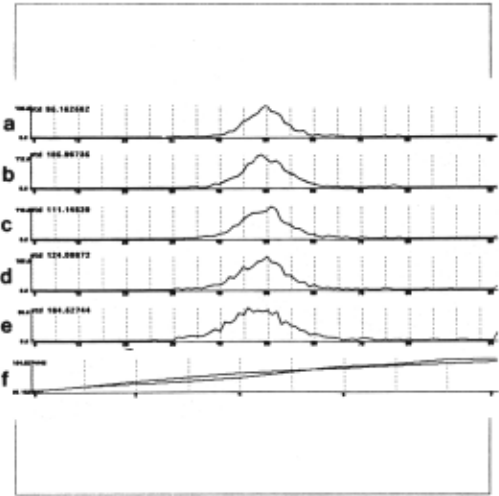
Figure 2(f) shows a plot of the variance of the transition distribu tion as a function of distance between the pixels. Overlaid on this graph is a least-squares fit of a fractal rule. As can be seen, the fit is quite good - implying that the intensity surface in this regiou is actually a fractal Brownian function, at least over the 10 : l range of scales mea.,ured.
For the majority of the textures examined (77%), the model described the image data accurately. In 15% of the cases the region was constant except for random, zero-mean perturba tions; ronsrquently, the fractal function correctly approximates tht> image data, although the fractal dimension wa.' equal to the topologi ,·al dimension and thus the data's dimension is techni cally not "fractional." The fit was poor in only 8% of the regions examined and, in many of these cases, it appeared that the image digitization had become saturated.
The fact that the vast majority of the regions examined were quite well approximated by a fractal Brownian function indicates that the fractal model will provide a useful description of natural textures and their images. Further, in the cases where the frac tal descript.ion is appropriate, the only statistical structure that remains unaccounted for by the fractal Brownian function is zero mean unit-variance Gaussian noise - indicating that the fractal description effect.ively "uses up" all of the second-order difference informat.ion.
Fractal Brownian functions do not, of course, account for large-scale spatial structure such as seen in the image of a brick wall or of a tiled floor. Such structure must be accounted for by ot.her means. Similarly, the fact that the fractal Brownian function appears to account for all of the second-order difference information does not mean that there are aren't other texture "dimensions" which contain useful texture information.
C. Texture Edgce
It. is an important characteristic of the fractal model that we can determine its appropriateness for particular image data because it means that we can know when to use the model. Conversely, when we discover an image region which can not be fit using the fractal model, we can infer that the image region was not caused by a homogeneous fractal surface.
Bound<>ries between homogeneous regions are one example of a physical configuration which can not be accounted for by the fr ac tal model. Thus, when we examine points which lie on the boundary between two image regions we find that the fit between tbe fract al model and the image data is normally poor. The fact that boundaries seem to be the most common event giving rise to a non-fractal intensity surface provides a method of detecting image points which are likely to be texture edges.
One simple way to find such points is examination of the computed fract al dimension. lt turns out that when we compute the fract al dimen5ion · for image data covering a boundary be tween two homogeneous areas, we normally calculate a fractal dimension which is less than the topological dimension. This is a physical impossibility, implying that the assumptions of the frac tal model are inappropriate for that specific image data. Thus, a fractal dimension which appears to be less than the topological dimension is a sufficient condition for concluding that the fractal model is inappropriate; it may also be a necessary condition.
ill INFERRING SURFACE PROPERTIES
Fractal functions appear to provide a good description of nat ural surface texture~ and their images; thus, it is natural to usc the fractal model for texture segmentation, classification and shape-from-texture. The first four beadings of this section describe the research that has been performed in this area, and indicate likely directions for further research.
Fractal func t ions with H = 0 can be used to model smooth surfaces and their reflectance properties. For the first time, there fore, we can offer a single model encompassing both image shading and t-exture, with shading as a -limiting case in the spectrum of texture granularity. The fractal model thus allows us to make a reasonable and rigorous definition of the categories "texture" and "shadin~," thus enabling us to discover similarities and differences bctwcPn them. The final heading of this section briefly discusses this result .
A. Some Examples Of Texture Segmentation
In the following examples, the fractal dimension was measured from the Fourier power spectrum by using an 8 X 8 block of pixels, after which the measured fractal dimension was hi stogramed. This histogram of fractal dimension was then broken at. the "\·alleys" between the modes of the histogram, and the imagc segmented into pixel neighborhoods belonging to one mod<' or anothl·r. No attempt was made to incorporate orien tational information into the measurement of the local fractal dimen~ion , i.e., difff'rences in dimension between various image direct ions at a point were collapsed into one average measure ment.
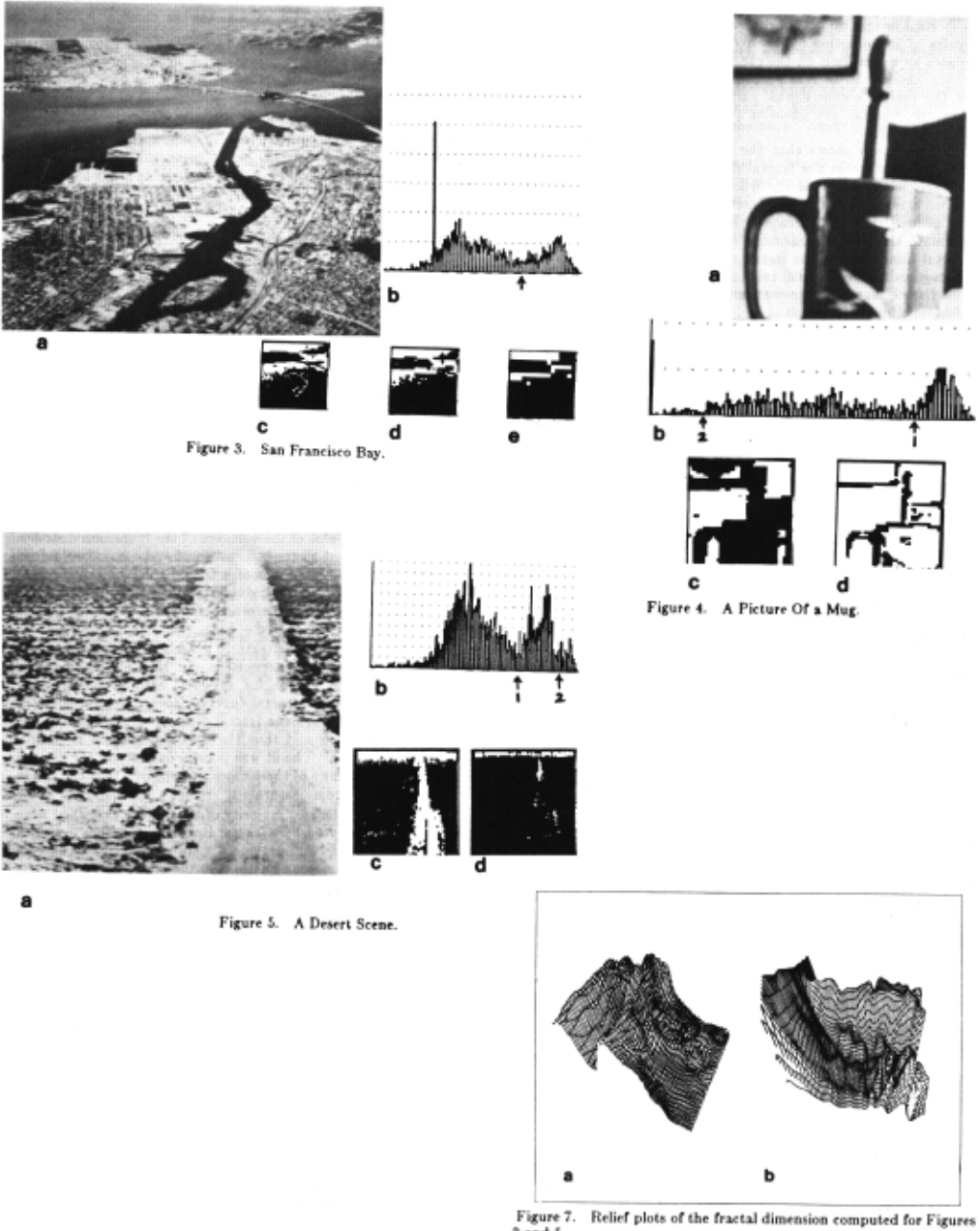
Fignre 3(a) is an aerial view of San Francisco Bay. Figure 3(b) shows a histogram of the fractal dimensions computed over the whole image. Figure 3(c) shows the segmentation obtained by thresholding at the breakpoint indicated by the arrow under (b); earh pixel in (c) corresponds to an 8 X 8 block of pixels in the original image. As can be seen, a good segmentation into water and land was achieved - one that cannot be obtained by thrC'sholding on image intensity. The values to the left of the large spike in (b) have a computed fractal dimension which is less than the topological dimension; these points all occur along the water-land boundary and partially delineate that boundary.
This image was then averaged down, from 512 X 512 pixels into 256 X 256 and 128 X 128 pixel images, and the fractal dimen sion recomput-cd for each of the reduced images. Figures 3(d) and (e) illust rat P the s<'gmentation~ that result from using the &ame cut point. as employed in the original full-resolution segmentation, demonstrating stability across wide ( 4 : 1) variations in scale.
'Using the Fourier technique.
Images of man-made surfaces can also be usefully segmented, as shown in Figure 4. Figure 4(a) shows a picture of a mug and, just behind it, a cbairback. This image was digitized into 256 X 256 pixel~ and the local fractal dimension computed; (b) is a histogram of the fractal dimensions with the two breakpoints indicated by arrows. Figure 4(c) shows the image segmented into two classes at the point indicated by arrow number one. A good partial segmentation results. Figure 4(d) illustrates the points whose comput-ed fractal dimension is less than the topological dimension (the points to the left or arrow number two in (b)); these are ckarly edgt points.
One final example is the desert scene shown in Figure 5(a). This scene was segmented into three classes, based on the his togram shown in (b); the segmentations are shown in (c) (road and sky versus desert) and (d) (road and desert versus sky). As can be seen, there is a good se~mentation into desert, road and sky.
Several other images have been segmented in this manner. In each ca.~e a good segmentation was achieved. The computed fractal dimension, and thus the segmentation, was found to be stable oYer at least 4 : I variations in scale; most were stable ovcr a range of 8 : I . Stability of the fractal description is to be expected, because the fractal dimension of the image is directly related to the frac tal dimension of the viewed surface, which is a property of natural surfaces that has been shown to be invariant with respect to transformations. of scale [2] .
· The fact that the fractal description of texture is stable with respert to scale i~ a critically important property. After all , consider : how can we hope to compute a atable, viewer independent representation of the world it our intorma. tion about the world is not atable with reapect to scale? This example or texture property measurement reiterates what we observed earlier, i.e., the fact that the fractal dimension of the surface is nue3sarv to any consistent description of a natural surface.
B. A Comparison With Other Segmentation Techniques
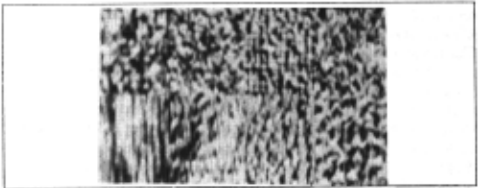
To obtain an objective comparison with previously estab lished texture segmentation techniques, a mosaic or eight natural textures takl'n from Brodatz [8] was redigitized. The digitized texture mosaic , shown in Figure 6, was constructed by Laws [10] for the purpose of comparing various texture segmentation pro cedures. The textures that comprise this data set were chosen to be as visually similar as possible; gross statistical differences were removed by mean-value- and histogram-equalization.
Segmcntation performance for these data exists for several techniques and, although differences in digitization complicate any comparisons we might wish to make, Laws's performance figures newrtheless sene as a useful yardstick for assessing per formance on this data.
For thi~ r. owpari~on simple orientational information was incorporated int.o t.he fractal description; the fractal dimension was calculated separately for the x and If directions. The sample size used to compute the fractal dimension was 16 X 16 pixels, and the dimension was computed directly, using Equation (1). Five subregions were extracted from each of the eight textures and used to establish the parameters of a quadratic classifier. Cla.·sification probabilities were then computed using a Monte Carlo simulation.
The two-parameter fractal segmenter yielded a classification accuracy of 84.4%. This compares quite favorably with correla tion techniques [11,12) reported by Laws as attaining 65% ac curacy, as well as with co-occurrence techniques [13,14) reported to be 72% accurate.* This superior performance was achieved despite the large number of texture features employed by these other methods.
The simple two-parameter fractal segmenter even compares well with Laws' own texture energy statistics; even though Laws' segmentation procedure included more than a dozen texture statistics that were optimized for the test data theoretical seg-. .. ' mentatiOn accuracy was only 3% better. Thus, the results of t~ese ~om_parisons indicate that fractal-based texture segmenta tiOn w1ll hkely prove to be a general and powerful technique.
C. Relationship To Texture Models
The fact that the fractal dimension of the image data can be measured by using either co-occurrence statistics in conjunction with Equation (I), or by means of the Fourier power spectrum suggests one interesting aspect of the fractal model: it highlight~ a formal _link bet~een co-occurrence texture measures [13,14) and Four1er tcchmques [15,16,17). The mathematical results Mandelbrot derives for fractal Brownian functions show that the way interpixel differences change with distance determines the rate at which the Fourier power spectrum falls off as frequency is increased, and vice versa.
Thus, it appears that the fractal model offers potential for unifying and simplifying the co-occurrence and Fourier texture descriptions. If we believe that natural surface textures and their images are fractal (as seems to be indicated by the previous results), then the fractal dimension is the most relevant parameter in differentiating among textures. In this case we would expect both the Fourier and co-occurrence techniques to provide reason able texture segmentations, as both yield sufficient information to determine the fractal dimension. The advantage of the frac tal model would be that it captures a simple physical relationship underlying the texture structure - a relationship lost with either of the other two characterizations of texture.
D. Shape From Texture
There are two ways surface shape is reflected in image tex ture: (I) pr_ojection foreshortening, a function of the angle be tween the newer and the surface normal, and (2) the perspective text.ure gradient that is due to increasing distance between the viewer and the surface. These two phenomena can be indepen dently observed, therefore they can serve to confirm each other i.e., if projection foreshortening is used to estimate surface tilt that estimate is independent/If confirmed if there is a textur~ gradient of the proper magnitude and same direction [17,18). We may be confident our estimate is correct when such independent confirmat.ion is found.
The fractal dimension found in the image appears to be ne~rly independen~ of the orientation of the surface (by virtue o_f mdependence With respect to scale); therefore fractal dimen sion cannot_ be used to measure surface orientation. Projection foreshortemng does, however, affect the variance of the distribution F(y) associated with the fractal dimension (see Equation (1)). Foreshortening affects "V ar(F(11)) in exactly the manner it affects the distribution of tangent direction. Thus, to estimate surface orientation, we might a.~sume that the surface texture is isotropic and estimate surface orientation on the basis of previously derived results [18] .
·Th£'se comparisons are between the actual classification ac curacies of the co-occurrence and correlation techniques and the theoretical accuracy of the fractal segmenter· however Laws results indicate that the theoretical accuracy ciosely refl;cts the accuracies actually obtained.
.. Laws' classification probabilities were achieved using linear classifier; See [10], page 148.
If we apply this technique to the image in Figure 3 we es timate a vertical tilt direction, and a slant of 45°; for the upper half of the image in Figure 5 we obtain a vertical tilt estimate and a slant of 47°. While this technique for estimating surface orien tation often performs well, the necessity of assuming isotropy is a serious shortcoming of the technique. An important .new result, therefore, is that we may in part cure this problem by observing the fractal dimensions in the z and 11 directions. Ir they are un equal we Lave prima facie evidence of anisotropy in the surface texture, because fractal dimension is unaffected by projection. It may even be possible to correct the surface orientation estimate using this information.
However a foreshortening-derived estimate of surface orien tation is produced, we may still seek confirmation of it by measuring the perspective texture gradient; if confirmation is found, we may be confident of our estimate. The images in both Figures 3 and 5 also show a perspective texture gradient: the houses in Figure 3 and the bushes in Figure 5 dwindle in size with increasing distance from the viewer. If this texture gradient can be mea.~ured in these images, then the foreshortening-derived estimates of surface orientation can be confirmed.
Figures 7(a) and (b) show relief plots of the local fractal dimenllion computed from Figures 3(a) and 5(a), respectively. The computed dimensions are viewed from the left-hand side of the original image. In both (a) and (b) there is a gradual rise in the computed fractal dimension with increasing distance, a result of the pixel size becoming large with respect to the largest scale variations in surface texture. Thi~ gradient in the computed fractal dimension confirms the foreshortening-derived estimates of surface tilt in this imagery.* These two examples demonstrate that perspect.i,·e t.exture gradients can be inferred from the locally computed fractal dimension.
This two new results, i.e., the ability to obtain evidence of surface texture anisotropy and the measurement of the perspec tive texture gradient, are extremely important because they offer a way to make shape-from-unfamiliar-texture techniques sufficiently reliable so as to be useful.
E. Shading And Texture
Fractal functions with H = 0 can be used to model smooth surfaces and their reflectance properties accurately. When H = 0, the surface is locally planar, except for small, random varia tions described by the function F(11) in Equation (I). If we assume that incid£'nt light is reflected at the angle of incidence and we make the variance of F(11) small relative to the pixel size, the surface will be mirrorlike. If, on the other hand, the variance of F(y) is large relative to the pixel size, the surface will become more Lambertian .
The fractal model, therefore, is a single model that can ac count for both image shading and texture, with shading cor responding to the limiting value of H. The fractal model thus allows us t.o make a reasonable and rigorous definition of the cat egories "texture" and "shading," in terms that can be measured by using Lhe image data. One important goal of future research will be to discover similarities or differences between these two categories; initial results indicate that local shape-from-shading results [9] can be generalized to include shape-from-texture.
·Note, however, that in Figure 7(b) the portion of the image closest to the viewer does not exhibit. a smooth texture gradient. In this near area the image data used to compute fractal dimen sion are ofteu boundaries between textured areas, and thus do not fit the fractal model. As described previously, the appropriate ness of the fractal model may be determined for the specific image data under consideration. Thus, most of the "texture gradients" in the near portion of Figure 7(b) can be identified as artifacts.
IV COMPUTING A DESCRIPTION
Current methods for representing the three-dimensional world suffer from a certain awkwardness and inflexibility that makes them difficult to envisage as the basis for human performance-level capabilities. They have encountered problems in dealing with partial knowledge or uncertain information, and they become implausibly complex when confronted with the prob lem of representing a crumpled newspaper, a clump of leaves or a puffy cloud . Furthermore, they seem ill-suited to solving the probl<'m of representing a c/a33 of objects, or determining that a particular obj!'ct is a member of that class.
Wh:lt is wrong with conventional shape representations! One major problem is that they make too much information explicit. Experiments in human perception [20] lead one to believe that our representation of a crumpled newspaper (for instance) is not accurate enough to recover every z value; rather, it seems that we remember the general "crumpledness" and a few of the major features , such as the general outline. The rest of the newspaper's detai led structure is ignored; it is unimportant, random.
From fhe poinL of view of constructing a representation, the only important con~traints on shape are the crumpledness and general outline. \Vhat we would like to do is somehow capture the notion of constra.ined cha.nce, that is, the intuition that "a crumpled newspaper ha.s x, 11 and z structural regularities and the rest. is just variable detail," thus allowing us to avoid dealing with inconsequential (random) variations and to reason instead only about the structural regularities.
A. The Process Of Computing A Description
How shall we ro about computing such a "constrained chance" descript ion! Let us con~ider the problem formally and see where that leads us. The process of computing a shape description (given some sensory data) seems best characterized as attempting to confirm or deny such hypotheses as "ehape x is consist.ent wiLh these sense data." Computation of a ehape description, therefore, seems to be a problem in induction [19] .·
If, naively, we try to use an inductive method, we start wit.h the set of all possible shape hypotheses; we then attempt to winnow t he set down to a small number of hypotheses that are confirmed by the sensory data. The "set of all shape hypotheses," however , is much too large to work with. Consequently, we must take a slightly different tack.
Using the notion or constra.ined chance. Rather than aHcmpting to enumt>rate "all shape hypotheses" explicitly, let us instead construct a 8hape generator that uses a random number generator to produce a surface shape description (I ehall shortly describ<' how to do this). If we were to run this shape generator for an infini te period, it would eventually produce instances of every shape within a large class of shapes. If the generator were so constructed that the class of shapes produced was exactly the set of "all hypotheses" about shape, then the program for the shape generator , together with a the program for the random number generator, would comprise a description of the set of all shape hypothe~t>s .
The ~hape generator illustrates how the notion of constrained chance may be us£-d to obtain a compact description of an infinite set. of shapes. By changing the constraints that determine how the output of the random number generator is translated int.o shape, we can change the set of shapes 'described; specifically, we can introduce constraints that rule out some classes of shape and thus restrict the set of shapes that are described. The ability to progressively restrict the set of shapes described allows us to use the constrained-chance shape generator as the basis for induction, rat.her than being forced to use the explicitly equmerated set of all .shape hypotheses .
*The t<'rm "repre~enk1tion" will he used to refer to the scheme for representing shapes, while the term "description" will be reserved for specific instances. Thus, one can compute a descrip tion of some object; it will be a member of the class of shapes that can be account,ed for within the representation.
The process of computing a "constrained chance description" is straightforward. We use image data to infer (using knowledge of t.he physics of image formation) constraints on the shape, and then introduce those constraints into the shape generator. The end result will be a pro~amlike description that is capable of producing all the shapes that are consistent with the image data; i.e., we shall' have a description or the shapes ~onfirmed by the image data. This, then, is the type of description we wanted: a description of shape that contains the important structural regularities that can he inferred from the image (e.g.', crumpled ness, outline), but one .that leaves everything else as variable, random.
Some people a.re already doing this. Something very much like this constrained-chance representation is already being widely ut.ilized in the computer graphics community. Natural looking shapes are produced by a simple fractal program that recursively subdivides the region to he filled, introducing ran dom jaggedness of appropriate magnitude at each step [3,5]. The jaggedness is determined by specifying the fractal dimension. The shapes that can be produced in t.his manner range from planar surfaces to mountainlike shapes, depending on the fractal dimen sion. Current graphics technology often employs fractal shape generators in a more constrained mode; often the overall, general shape or the boundary conditions are specified beforehand. Thus, a scene is often constructed by first specifying initial constraints on the general shape, and then using a fractal shape generator to fill in Lhe surface with appropriately jagged (or smooth) details. The dt>scription employed in such graphics systems, therefore, is exactly a constrained-chance description: important details are ~pccified , and everything else is left unspecified except in a quali t.at.ive manner .
This type of description hears a close relationship to sur face inl·<'rpolation methods. Typically, such schemes fit a emooth surface that. satisfies what.ever boundary conditions are avail able. Tbl' initial boundary conditions, together with the inter polation function , constitute a precise description of the surface shape. Such schemes are limited to smooth surfaces, however, and therefore are incapable of dealing with most natural shapes. In contrast, a fractal-based representation allows either rough or smoot.h surfaces to be fit to the initial boundary conditions, depending upon the fractal dimension. This method of descrip tion, t.bcrefore, is quite capable of describing most natural sur faces - and that. is why the graphics community is turning to the use of fractal-based descriptions for natural surfaces.
In order to make use of this type of description it is necessary to be able to specify the surface shape in a qualitatit>e manner, i.e., how rugged is the topography! This specification of qualit.a tive shape can be accomplished by fixing the fractal dimension. The fact that we have recently develope.d a method of inferring the fr ac tal dimension of the 3-D surface directly from the image data means that we are now able, for the first time, to actually compuLc a fract. l.\1 or constrained-chance description of a real scene from its image.
Not only terrestrial topography has been modeled by use of a constrained-chance representation, but also clouds, ponds, riverbeds, snowflakes, ocean surf and stars, just to name a few examples [1 ,3,4,5,6,i]. Researchers have also used constrained chance generators to produce plant shapes [1,4,6] . A very naturallooking tree can be produced by recursively applying a random number generator and simple constraints on branching geometry. In each case a random number generator plus a surprisingly small number of constraints can be used to produce very good models of apparently complex natural phenomena. Thus, there is hope for extending this approach well beyond the domain of land topog raphy.
B. An Example Of Computing A Description
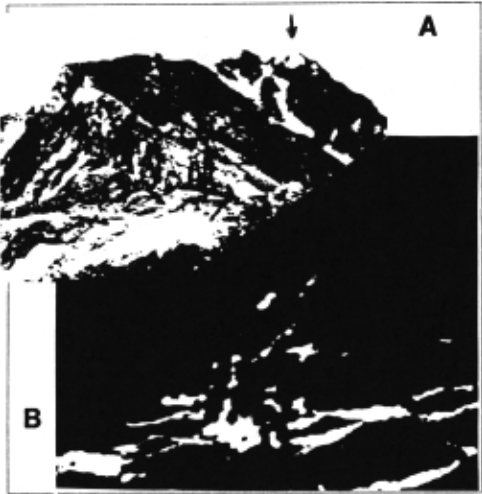
Figure 8 illustrates an actual example of computing such a description. Figure 8(a) is an image of a real mountain. Let us suppose that we wi~hed to use the image data to construct a three dimensional model of the rightmost peak (arrow), perhaps for the purpose of predicting whether or not we could climb it. I will take the standard fractal technology used in the computer graphics community as the unconstrained "primal" shape generator, as it provides an apparently accurate model of a wide range of natural surfaces.
All that is necessary to construct a description of this moun tain peak is to extract shape constraints from the image and in sert them into the primal shape generator. The fractal dimension of the 3-D surface is the principal parameter (constraint) required by our fractal shape generator; roughly speaking, it determines the ruggedness of the surface. The fractal dimension of the 3-D surface in the region near the rightmost peak was inferred from the fractal dimension of the image intensity surface in that area by use of the empirically-derived relationship between surface and image. Constraint on the general outline of this peak was derived from the estimated z-valu~ or distinguished points (those with high curvature) along the boundary between sky and mountain. These two constraints, together with the shape generator, ore a 3-D representation of this peak; the question is: how good a repre sentat.ion! A view of a 3-D model derived from this representation is shown in Figure 8(b). It appears that th~e simple constraints are sufficient for computing a good· 3-D representation of the peak.
·Rather primitive ray tracing, etc., was used to generate this image; better code is being implemented.
C. What Do We Accomplish With This Approach!
Let's consider the problems cited above:
( 1) The problem of representing a complex shape, such as a crumpled newspaper. The problem with a shape-primitive representation such as surface normals, voxcels or generalized cylinders is that the resulting description seems hopelessly com plex. Because the constrained-chance representation allows us to deal only with the structural regularities and to ignore inconse quential details, the problem can become much simpler. Thus, for instance, the graphics community has found that constrained chance fractal descriptions of complex objects (e.g., a mountain) are quite compact and easy to manipulate. It also turns out that many previously simple things, such as d~cribing a smooth plane, remain simple.
How does this representation function when we want to com pute a description of a specific mountain, bush or other entity from its image! Current "shape-from-x" 'research furnishes con straints on shape in a variety of forms: surface orientation (from texture, shading), relative depth (from motion, contour), and ab sQiute depth (from stereo, egomotion). It appears to be fairly straightforward to mix each or the various flavors of constraint into the vanilla-flavor shape generator [3,5), although significant research remains to be done. As more shape constraints are ob tained from the image, the description becomes more and more precise; i.e., there is less and less chance in the description. Eventually, only one shape satisfies all of the constraints.
How complex could such a description become! The constrained-chance representation would ot woret be as complex as a two-dimensional array of z values representing the same sur face, because we could always use it to actually generate such an array of z values. As mentioned previously, experiments in human perception indicate that our representations are usually not accurat.e enough t.o recover every z value. The representation of a particular object, therefore, is likely to be quite a bit simpler than a full depth map.
{2) The problem of representing cloeul! of shapes, such as are referred to by the terms "a mountain," or "a bush." Again, the ability to specify important structural details and leave the rest only qualitatively constrained allows simplification of the prob lem. The definition of "a mountain," for instance, might reason ably consist entirely of a specification of the fractal dimension of the surface and a caveat concerning size. If we are to judge by the results reported in the computer graphics literature, the notion of representation by constrained chance thus allows us, using only a few lines of code, to produce an accurate description of the claBB of shapes we label "mountains," or "bush."
(3) The problem of determining the set of appropriate descriptions when the shape is underconstrained by the sense data. The problem with standard shape-primitive representations is that either we must generate all combinations of shape primi tives consistent with the sense data (a very hard problem), or pick a prototype and specify error bounds. The problem with using prototypes plus error bounds is that we are forced to overcom mit ourselves by, choosing the prototype; e.g., there is something seriously wrong about describing a cube as ·a sphere ±0.4r", even though the cube certainly fits within the specified volume.
Because the constrained-chance repr~ntation allows details to be left. const.rained but unspecified, it allows us to deal with insufficiPnt sensf:' dat.a by simply adding in those constraints that can be deduced from the image data and committing ourselves no further. The result is a programlike description that can be analyzed and manipulated, does not overcommit itself as to object shape, and allows examples of shapes consistent with the image data t.o be generated and examined.
( 4) The problem of determining that a specific descrip tion is a member of a more general class. Here the problem with shape-primitive representations is that there is so much variability among the descriptions of the members of a class such as "mountain" that a description of the class as a whole seems extremely difficult, and determination of class membership even more so.
The problem of establishing class membership by us ing con5trained-chance representations reduces to determining whether the constraints used to specify a particular description arc a subset of those of the more general class. A determination regarding class membership is, therefore, exactly equivalent to determining whether one program's output is a subset of another program's output. While such automatic proof is a difficult problem, it is at le38t tractable and well-defined - unlike the equivalent problem can be when using a shape-primitive rep resentat.ion. Thus, a constrained-chance representation allows a clear and potentially useful definition of what it means to "recognize that X is an 11."
Further, because we need only deal with the structural regularities, t.his problem can become much simpler than it might at first appear . Taking the class "a mountain" to be defined by fractal dimension and overall size (a definition that is actually sufficient to produce realistic mountain shapes) we can, for in stanct·, easily determine that the description computed by us for the mountain peak is in fact a description of part of a mountain - a task that previously seemed to be nearly impossible.
V SUMMARY
Fractal functions seem to provide a good model of natural surface shapes. Many basic physical processes produce fractal surfaces. Fract.al surfaces also look like natural surfaces, and so have come into widespread uses in the computer graphics community. Furthermore, we have conducted a survey of natural imagery and found that a fractal model of imaged 3-D surfaces furni shes an accurate description of both textured and shaded image regions.
Fractal functions, therefore, are useful for addressing the related problems of representing complex natural shapes such a.s mountains , and computing a description of such shapes from image data. The following describes the progress achieved toward t.he solution of these problems.
Computing a description. Characterization of image texture by means of a fractal surface model has shed considerable· light on the physical basis for several of the texture techniques currently in usc, and made it possible to describe image texture in a m:J.nner that is stable over transformations of scale and linear transforms of intensity . These properties of the fractal surface model allow it to serve as the basis for an accurate image seg mentation procedure t.hat is stable over a wide range of scales.
Because fractal dimension is not affected by projection dis tortion, its measurement can significantly enhance our ability to estimate shape from (unfamiliar) texture. Specifically, it seems that measurement of fractal dimen~ion can provide (1) evidence of surface texture anisotropy, and (2) an estimate of the perspec tive texture gradient. Both capabilities are extremely important because they provide a way to obtain independent confirmation of the a.·sumpt.ions on which previously-reported shape-from unfamiliar-texture techniques are based.
Representing natural shapes. A constrained-chance representation modeled after the fractal techniques used by the graphics community seems useful for representing complex natural sh~pc~ , such M a crumpled newspaper or a moun tain. The problem encountered when using conventional shape primitive represent,at.ions to describe natural surfaces is that the resulting description is often hopelessly complex. Because the con~trained-chance representation allows us to deal only with the. structural regularities and to ignore inconsequential details, the problem can become much simpler. Thus, for instance, the graphics community has found that constrained-chance fractal descriptions of complex objects (e.g., a mountain) are quite com pact and easy to manipulate. Similarly, the problem of repre senting cla8sea of shapes, such as are referred to by the terms "a mountain," or "a bush," can also be significantly simplified.
The encouraging progress that has already been achieved on both of these problems augers well for this approach. It appears that a constrained-chance representation incorporating a fractal model of surface shape will provide an elegant solution for some of the most difficult problems encountered when attempting to progrc~s from the image of a natural scene to its description.
@inproceedings{ijcai1983p228,
  title     = {Fractal-Based Description},
  author    = {Pentland, Alex},
  booktitle = {Proceedings of the Eighth International Joint Conference on
               Artificial Intelligence, {IJCAI-83}},
  publisher = {International Joint Conferences on Artificial Intelligence},
  editor    = {Alan Bundy},
  pages     = {973--980},
  year      = {1983},
  note      = {Vision},
  url       = {https://ijcai.org/proceedings/1983/228},
}
TY - CPAPER TI - Fractal-Based Description AU - Pentland, Alex T2 - Proceedings of the Eighth International Joint Conference on Artificial Intelligence, IJCAI-83 PB - International Joint Conferences on Artificial Intelligence PY - 1983 SP - 973 EP - 980 UR - https://ijcai.org/proceedings/1983/228 ER -Copied
Machine-readable versions of this paper, for tools and AI agents:
 Welcome
 Future Conferences
 AI Journal Division
 IJCAI Proceedings
 About IJCAI
 IJCAI Awards