
Equality Reasoning in Clause Graphics
Proceedings of the Eighth International Joint Conference on Artificial Intelligence. Theorem Proving. Pages 936-938.
© 1983 International Joint Conferences on Artificial Intelligence
Abstract
A method to control the application of equalityderivation rules in an automatic theorem proving system is presented . When handling eq uality in the search for a pro o f of a theorem two main problems arise: 1) to obtain a control mechanism for the s ea r ch and application of useful equality derivation steps in order to support global strategies which plan and control the whole proof , thus conducing to an efficient and complete proof procedure. 2) to find proper equations rendering two t e rms unifiable. Thes e pr ob lems are solved by combining th e c laus e graph method and the "paramodulation-if-needed" idea by introducing Morris' E-resolution into th e clause graph proof procedure. The n eces sary equations to form possible E-resolvents are searched for in th e initial graph and are inh e rited afterwards. Th e search space f o r possible E -resolutions will be r ed uced by exploiting constraints using th e information in the clause graph.
Full text extracted automatically from the PDF; figures, tables and equations may differ. The PDF is the version of record.
1. INTEGRATION OF PATHS INTO THE PROOF PROCEDURE
Just like R-links and P-links paths should also be searched for and created at the beginning, when the initial graph is formed, this information should then be inherited during the subsequent search for a proof.
But because of the undecidability of equality of two t e rms not all the necessary ER-paths can be found in the initial graph. For that reason a new link type, PER-link (potential E-resolution link) connecting potentially complementary unifiable literals is introduced into the graph. These PER links provide the top-level information for the proof procedure to search for the corresponding ER-paths, and during this search three cases can occur:
- All possible ER-paths corresponding to a PER-link are found.
- It is detected that no ER-path for a given PER link exists.
- The search for ER-paths is stopped because of space or time limitation.
For each of these cases differ ent operations are performed:
- If all ER-paths are found, then the PER-link is replaced by the ER-paths. All possible ways to r emove the differences between the literals of the PER-link are known and given by the ER-paths. If an ER-path is selected in the proof, then the E-resolution corresponding t o the ER-path is executed.
- Ther e exists no ER-path between the literals of the PER-link, i.e. the differences of the respec tive terms cannot be r emoved completely and therefore the PER-link is del eted.
- If the search is stopped and no (or not all) ER-paths are found, then the PER-link remains in the graph. If a PER-link is selected, then an operation to reduce the differences between the literals of the PER-link i s executed using the information obtained from the incomplete search.
PER-links are treated as a special case and are only used in global strategies as auxiliary links which control the search for paths and enable sen sible operations to r educe differences of potential ly complementary unifiable literals as compensation for the lacking ER-paths (case c above) .
During the search for a proof ER-paths as well as PER-links are inherited and used to compute new ER-paths and new PER-links. Hence each ER-path used in the proof was already present in the initial graph or has been inherited from an initial ER-path.
This method of using ER-paths has three main advan tages:
- (i) ER-paths and PER-links contain important information for global strategies which plan and control the whole search for a proof (see [BESSHW81], (SS81 ], [Oh82 ]). This information is particularly useful because it is already available at the beginning of the proof.
- (ii) An efficient handling of equality is possible, because the search is done in the small ini tial graph only. Furthermore only a few paths have to be searched for; most paths are found by inheritance.
- (iii) Strong additional deletion rules are available which greatly reduce the potential number of paths as well as the size of the graph . For example in case b) above the deletion of a PER-link may lead to a pure clause just as for the usual clause graph proof procedure,
thus causing the we ll-known snowball effect of deletions to start.
2. THE SEARCH FOR PATHS USING CONSTRAINTS
An unsophisticated and exhaustive search for ER-paths is prohibitively expensive because of the very large search space. The size of this essentially depends on the number of equations (ne) in the c lause set, on the average number of subterms (ns) in a literal, and on the ratio (r) of positive to total unifica tion tests for possible equality r eplacements. Finally it also depends on the search depth (sd). A breadth first search procedure, like that of Morris [Mo69 ) must execute ( (2 * ne * ns * r) sd *1 /r) calls of the unification a lgorithm. Also it has to
carry out (2 * ne * ns * r)sd equality r eplacements in order to get all possible E-resolvents for ~ PER-link. For example, if a c lause set has ten equations, an average of five subterms per literal and a unification success rate of 10%, the n a search
depth of t en steps requires 10 11 calls of the unification algorithm and 10 10 replacement operations. To make the situation worse Morris [Mo69 ) observed that in usual clause sets f o r most PER-links the re does not exist an E-resolvent, but since the search must be done completely most of the effort is spent in vain.
In order to obtain a practicable search procedure the enormous sear c h space has t o be reduced. In the following we propose a r eduction of the search space by exploiting constraints. The constraints use the information contained in the P-links.
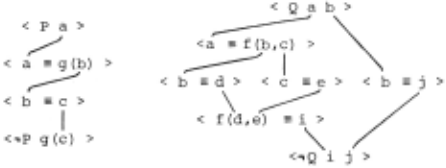
For a clause graph <S> and a PER-link there are usually many P-links connecting the effective equa tions and the two literals . If these P-links are visualized graphically, certain structures emerge, e .g . an equality-chain in the simple example 1. But in most cases the structure is a more complex equa lity-net as example 2 demonstrates:
Example 2
An equality-net (EN) and the compatibility of an equality-net are defined in [Bl83] as a special graph structure of P-links. Each compatible equality net builds an ER-path and represents a possible E-resolution step. Conversely there exists for each possible E-resolution a compatible EN in the graph which builds the appropriate ER-path. These condi tions are ensured because the PeG-Procedure is complete [SW79 ). In order to find the ER-paths the compatible equality-nets must now be searched for.
To this end several conditions can be stated which are necessary but not sufficient f o r the compatibi lity of an EN. Such constraints are checked step by step the reby drastically r educing the search space.
Two examples will show possible r easons for the in compatibility of equality-ne ts.
Exampl e 4
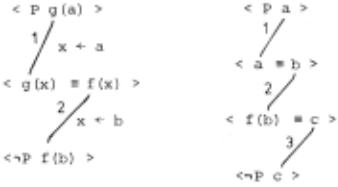
In Example 3 the combination of the P-links 1 and 2 is imposs ible because their unifiers [x + a) and [x + b) are incompatibl e . . In example 4 the P-links 1 and 2 are incompatible, because after paramodula tion on link 1, link 2 cannot be inherited t o the paramodulant < Pb > since the access depth does not coincide .
Some of the constraints to be used are:
- In a compatible EN all unifie rs of the p-links concerned must merge to one mgu (i.e. the uni fi ers must be compatible, provided a proper variable r enaming has been carried out) .
- 2 ) In a compatible EN : for each maximal equality chain in the EN the s um of all access depths must be equal to z e r o and each partia l sum must be l ess than or equal to zero.
- In a compatible EN, no chain of two links in the EN is incompatible, i.e. if an equality-chain of length 2 is incompatible, then each EN which contains this equality-chain i s also incompatib - le. (Note: incompatible is defined in [ Bl83 ) and is diffe rent from not compatibl e .)
The searc h procedure can be improved by introducing additional constraints.
Although suc h constraints are powerful it is not expensive to test them, for exampl e only some inte ge rs must be added to detect the incompatibility of an EN caused by condition 2.
After reduction of the search space the most promi sing ENs are selected for a _full compatibility test and the surviving candidates are used to build the ER-paths.
The method outlined here of handling equality is described in [Bl83) whe re the formal notions are developed and additional results are presented. This me thod is presently b e ing impleme nte d and evaluated as part of the Markgraf Karl Refutation Procedure [BESSHW81), [Oh82).
LITERATUR
[sS81]
[An70 ]
R. Anderson: Completeness results for E-Resolution. Proc. Spring Joint Conf., 1970,653-656
[BESSHW81] K.H. Blasius, N. Eisinger, J. Siekmann, G. Smolka, A. Herold, C. Walther: The Markgraf Karl Refutation Procedure. Proc. IJCAI, 1981, 511-518
[Bl 83 )
K.H. Blasius: Equality-Reasoning in clause graphs. Universitat Karlsruhe, Interner Bericht (to appear)
[Br75 ] D. Brand: Proving Theorems with the Modification Me thod. SIAM Journal of Comp., vol 4, no. 4, 1975
(Di79 ) V.J. Digricoli: Resolution by Unification and Equality. Proc. 4th Workshop on Automated Deduction, 1979, Texas
(HR78) M.C. Harrison, N. Rubin: Another Generalization of Resolution. JACM, vol 25, no. 3, July 1978
[Ko75 ] R. Kowalski: A Proof Procedure Using Connection Graphs.
JACM 22, 4, 1975
[Lo78] D. Loveland: Automated Theorem Proving: A logical Basis. North Holland, 1978
[Mo69] J.B. Morris: E-Re solution: An Extension of Resolution to include the Equality Relation.
Proc. IJCAI, 1969, 287-294
[Oh82) H.J. Ohlbach: The Markgraf Karl Refutation Procedure, the Logic Engine. Universitat Karlsruhe, Interner Bericht,
1982
(RW69) G. Robinson, L . Wos: Paramodulation and TP in first order theories with equality.
Machine Intelligence 4, 135-150
[Sh78 ] R.E. Shostak: An Algorithm for Reasoning About Equality. CACM, July 1978, vol 21, no. 7
E.E. Sibert: A machine-oriented Logic incorporating the Equality Axiom. Machine Intelligence, vol 4, 1969,
[Si69) 103-133
(SW79)
J. Siekmann, G. Smolka: Selection Heuristics, Deletion Strategies and N-Level Terminator Configurations for the Connection Graph Proof Procedure. Universitat Karlsruhe, Research Report, 1981
J. Siekmann, G. Wrightson: Paramodulated Connectiongraphs. Acta Informatica, 1979
@inproceedings{ijcai1983p221,
  title     = {Equality Reasoning in Clause Graphics},
  author    = {Bläsius, Karl-Hans},
  booktitle = {Proceedings of the Eighth International Joint Conference on
               Artificial Intelligence, {IJCAI-83}},
  publisher = {International Joint Conferences on Artificial Intelligence},
  editor    = {Alan Bundy},
  pages     = {936--938},
  year      = {1983},
  note      = {Theorem Proving},
  url       = {https://ijcai.org/proceedings/1983/221},
}
TY - CPAPER TI - Equality Reasoning in Clause Graphics AU - Bläsius, Karl-Hans T2 - Proceedings of the Eighth International Joint Conference on Artificial Intelligence, IJCAI-83 PB - International Joint Conferences on Artificial Intelligence PY - 1983 SP - 936 EP - 938 UR - https://ijcai.org/proceedings/1983/221 ER -Copied
Machine-readable versions of this paper, for tools and AI agents:





