
STROBE: Support for Structured Object Knowledge Representation
Proceedings of the Eighth International Joint Conference on Artificial Intelligence. Systems Support. Pages 855-857.
Abstract
STROBE is a system that provides object-oriented programming support tools for INTERLISP. It offers a primitive foundation with which more complex structured object representation schemes can be constructed. STROBE implements multiple resident knowledge bases, tangled generalization hierarchies, flexible inheritance of properties, procedural attachment, and event-sensitive procedure invocation.
- D . G . Bobrow and M. J. Stefik, A Virtual Machine for Experiments in Knowledge Representation. Unpublished Memorandum, Xerox Palo Alto Research Center, April 1982.
- R. Greiner and D . B. Lenat, A Representation Language Language. Proceedings of the National Conference on Artificial Intelligence, August 1980, pp. 165-169.
- G. S. Novak, GLISP: A High-Level Language For A.I. Programming. Proceedings of the National Conference on Artificial Intelligence, August, 1982, pp. 238-241.
- M. J. Stefik, An Examination Of A Frame-Structured Representation System. Proceedings of the Sixth International Joint Conference On Artificial Intelligence, August 1979, pp. 845-852. IJCAI
References were extracted automatically from the PDF and may contain errors.
Full text extracted automatically from the PDF; figures, tables and equations may differ. The PDF is the version of record.
1. INTRODUCTION
The goal of designing second generation expert systems that are able to reason from causal models as well as the familiar compiled expertise encoded in rules is dependent on flexible tools for representing knowledge. In recent years there has been considerable interest in structured object representation. Within this framework, a programmer can encapsulate packets of knowledge and link them together via a variety of relationships to form knowledge bases. Inheritance of properties through generalization hierarchies is standard.
A problem facing the representation system designer is that many decisions he might make are implicitly biased toward a particular problem domain. The result is a system that may be too brittle to be easily applied to other domains. One approach to the problem is a low-level system that imposes a flexible structure and provides tools that allow a user to adjust the operation of the system and to embed it in higher-level systems that offer increased structure.
This is the motivation for STROBE, a low-level system for support of structured objects in INTERLISP. It is to be viewed more as an augmentation to INTERLISP that simplifies programming with structured objects than as a powerful representation system. In this light, major concerns in its design have been flexibility and efficiency. Mechanisms are provided through which a user can encode in his knowledge bases explicit information to adjust the skeletal STROBE structure in a manner specific to particular applications. 1
2. STROBE: OVERVIEW
A STROBE kn<iwledge base is a collection of objects whose characteristics ·are elucidated through a number of slots. Alternatively it can be viewed as a semantic network of nodes and unidirectional links.
I. RLL [Greiner, 1980) has a similar flavor but emphasizes self description over efficiency. GLISP [Novak, 1982) places more emphasis on efficiency and less on flexibility.
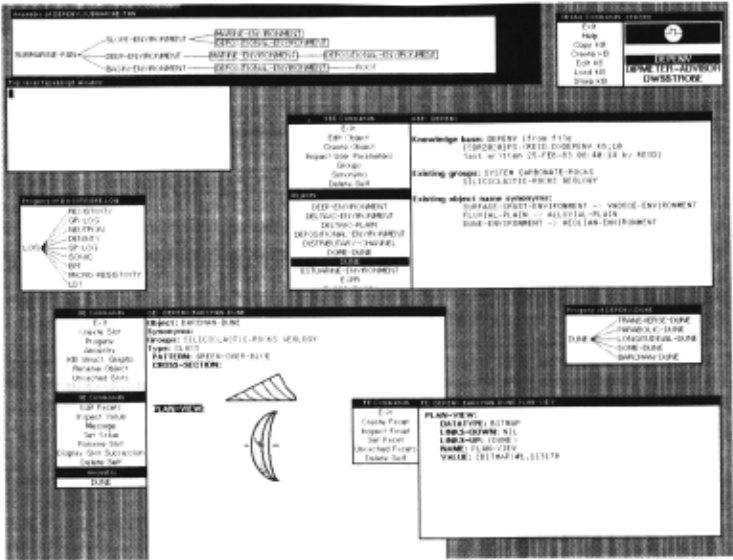
Figure I shows the screen of the Xerox II 00 running the STROBE editor. 3 BARCHAN-DUNE, a specialization of DUNE, is shown. It has inherited the slots of DUNE and the value facets of the CROSS-SECTION and PLAN- VIEW slots have been filled with bitmaps.
3. INHERITANCE
If necessary, STROBE performs a run-time breadth-first search through the ancestors of an object to find the contents of a facet of a slot in that object. 4 The ancestors actually only provide a default for inheritance. Every STROBE slot access function allows the user to specify a partial path of objects to use as starting points for a search for inherited properties. This generality enables construction of objects that inherit slots from objects that are linked to them by relationships other than generalization (e.g., parts).
4. PROCEDURAL ATTACHMENT AND INDIRECT PROCEDURE INVOCATION
A procedure may be associated with a slot facet and invoked indirectly by sending a STROBE message to that facet. For example, a message sent to the value facet of the BUILD slot of a BOX object will cause the BUILDBOX procedure to be invoked. Many other objects may have BUILD slots--filled with procedures specific to the objects themselves.
(DEFOBJECT BOX CLASS (GEOMETRIC-STRUCTURE ICON) NIL ((BUILD (DATA TYPE . LISP)
(VALUE (LAMBDA (OBJECT SLOT FACET WIDTH HEIGHT) (BUILDBOX WIDTH HEIGHT))))))
3. The editor was written by Eric Schoen.
4. STROBE provides mechanisms that can be used to increase efficiency (e.g. caching slot pointers) .
If the facet to which the message is addressed is not found in the slot of the object (even after an inheritance· search), then STROBE reroutes the message to the object that is the datatype for the slot. This indirection enables a programmer to encapsulate information about how to deal with actions that are generic to a datum of a particular datatype.
5. EVENT-SENSITIVE PROCEDURE INVOCATION
STROBE checks for procedures to be invoked whenever one of a number of significant events occurs. This gives a user considerable freedom to adjust the basic mechanisms of the system in ways that are specific to particular objects or classes of object.
Object Creation/Deletion Procedures: Invoked after an object has been created or before an object is deleted. They can be used to perform specialized initialization or cleanup. For example, when an instance of TEST is created, FiiiTESTSiots is invoked to initialize its slots. Upon deletion, SummarizeTESTSiots is invoked to summarize information contained in the slots before it is lost.
(DEFOBJECT TEST CLASS ROOT NIL ((OBJECT-CREATION-PROCEDURES (DATA TYPE . LISP) (VALUE Fii/TESTS/ots)) (OBJECT-DELETION-PROCEDURES (DATA TYPE . LISP) (VALUE SummarizeTESTS/ots))))
Slot Creation/Deletion Procedures: Invoked after a slot has been created or before a slot is deleted. In the following example, the functions AddObjectToS/ot and RemoveObjectFromS/ot maintain an association list that indexes a knowledge base by slot name. (STROBE provides a mechanism that enables a user to store such a data structure with a knowledge base.)
(DEFOBJECT INDEX CLASS ROOT NIL ((SLOT-CREATION-PROCEDURES (DATA TYPE . LISP) (VALUE AddObjectToS/ot)) (SLOT-DELETION-PROCEDURES (DATA TYPE . LISP) (VALUE RemoveObjectFromS/ot))))
Slot Access/Alteration Procedures: Invoked before and after every attempt to access or alter the value of a slot. In the following example, the value of the AREA slot is computed from the WIDTH and LENGTH slots via the procedure found in the ACCESS-PROCEDURES facet. The keyword AFTER indicates that the procedure should be fired after the value has been retrieved via lookup. SOURCE OBJECT is the object in which the slot was found (perhaps via inheritance), and VAL is the value retrieved via lookup (ignored in this example). GETVALUE is a STROBE function for accessing the value of a slot. 5
(DEFOBJECT COMPOSITE CLASS ROOT NIL ((WIDTH (DATA TYPE . EXPR) (VALUE. 3)) (LENGTH (DATA TYPE . EXPR) (VALUE . 2)) (AREA (DATA TYPE . EXPR) (ACCESS-PROCEDURES AFTER (LAMBDA (OBJECT SOURCE-OBJECT SLOT VAL) (/TIMES (GETVALUE OBJECT 'WIDTH) (GETVALUE OBJECT 'LENGTH)))))))
In the following example, the value of the Sf slot can only be filled with BITMAP or EXPR. This is accomplished with a RESTRICTIONS facet and an alteration procedure that enforces the restriction. ·or a procedure fired before the new value is placed returns *FAIL ·, then placement of the new value is prevented.) VAL is the new value to be placed. GETFACET? is a STROBE function for accessing a facet.
(DEFOBJECT Rl CLASS ROOT NIL
((Sl (DATA TYPE. OBJECT) (RESTRICTIONS BITMAP EXPR) (ALTERATION-PROCEDURES
(LAMBDA (OBJECT SOURCE-OBJECT SLOT VAL) (COND ((FMEMB VAL
(GETFACET? OBJECT SLOT 'RESTRICTIONS))
BEFORE VAL)(T '*FAIL ·)))))))
In the following example, the before procedure associated with the PARTS and PARTOF slots of Tl redefines the operation of placing a value in those slots. The new operation adds an object without duplication to a list of objects. It also sets a variable (NewVa/ue) for use by the after procedure.
5. In general, a list of procedures may be invoked on slot access or alteration.
That procedure sets up a back pointer. If object Partl is added to the PARTS slot of object Tl , then Tl is added to the PARTOF slot of Partl. Note that this kind of symmetric operation must be carried out after the new value has been placed to avoid infinite regress. It demonstrates the utility of both before and after procedures. 6
(DEFOBJECT Tl CLASS ROOT NIL ((PARTS (DATA TYPE . OBJECT) (ALTERATION-PROCEDURES (BEFORE (LAMBDA (OBJECT SOURCE-OBJECT SLOT VAL) (COND ((NULL (SLOTVALUEP OBJECT SLOT)) (SETQ New Value VAL) (LIST VAL)) ((FMEMB VAL (GETVALUE OBJECT SLOT)) (SETQ NewVa/ue '*FAIL*)) (T (SETQ New Value VAL) (CONS VAL (GETVALUE OBJECT SLOT)))))) (AFTER (LAMBDA (OBJECT SOURCE-OBJECT SLOT VAL) (COND ((NEQ New Value '*FAIL*) (PUTVALUE New Value 'PARTOF OBJECT))))))) (PARTOF (DATA TYPE . OBJECT) (ALTERATION-PROCEDURES (BEFORE ... <identical to PARTS procedure> ... ) (AFTER (LAMBDA (OBJECT SOURCE-OBJECT SLOT VAL) (COND ((NEQ New Value '*FAIL ·)
(PUTVALUE New Value 'PARTS OBJECT)))))))))
SLOTVALUEP returns NIL if no value has been set for a slot. PUTVALUE is a STROBE function for setting the value of a 'slot.
6. OTHER STROBE FEATURES
- Multiple Resident Knowledge Bases: A user may have several knowledge bases in memory at the same time.
- Synonyms: All STROBE functions resolve references to synonyms for objects and slots.
- Instantiation from Complex Descriptions: STROBE uses the description object type to specify templates for instantiating class objects. When an object whose slots contain descriptions is instantiated, STROBE creates new objects for each of the descriptions and resolves inter object references.
- Standard INTERLISP Source Files: STROBE is integrated with the INTERLISP file package and constructs knowledge base files in standard source file format.
- Object-Centered Memory Management: A user can selectively page objects to secondary storage. 7
6. The LOOPS [Bobrow, 1982) active value effectively corresponds to the STROBE before alteration procedure. There is no direct correspondence to the after procedure.
7. This is useful on a limited address machine like the DEC-20. It has not yet been needed on the Xerox 1100.
7. APPLICATIONS
STROBE has been used to structure information about data and control flow for two large well-log interpretation programs. The system has also been used to construct a two-dimensional equation prettyprinter as part of the interface to an automatic programming system for well-log interpretation software. In future it will be used to represent the domain knowledge, software knowledge, and intermediate stages of program development.
STROBE has been used as a rapid prototyping tool in the development of graphics facilities by Schlumberger's Houston Interpretation Engineering staff. These facilities are intended to generate the graphics for all commercial Schlumberger products.
Finally, as an experiment in adjusting the STROBE skeleton in the manner shown in this paper, a basic implementation of the class and inheritance structures of Smalltalk-80 was developed. It required the definition of a small number of objects, slots, and attached procedures and was completed in a few days. 8
Acknowledgements: The design of STROBE has benefited greatly from its use by Stephen Smoliar, Eric Schoen, David Barstow, Roger Duffey, and Scott Marks. Gilles Lafue provided a number of helpful comments on this paper. The local network support provided by Stanley Vestal, Eric Schoen, and Ed Dolph has simplified the workstation implementation. The intellectual stimulation of object-oriented programming discussion group and the managerial support of James Baker are also appreciated.
@inproceedings{ijcai1983p206,
  title     = {STROBE: Support for Structured Object Knowledge Representation},
  author    = {Smith, Reid G.},
  booktitle = {Proceedings of the Eighth International Joint Conference on
               Artificial Intelligence, {IJCAI-83}},
  publisher = {International Joint Conferences on Artificial Intelligence},
  editor    = {Alan Bundy},
  pages     = {855--857},
  year      = {1983},
  note      = {Systems Support},
  url       = {https://ijcai.org/proceedings/1983/206},
}
TY - CPAPER TI - STROBE: Support for Structured Object Knowledge Representation AU - Smith, Reid G. T2 - Proceedings of the Eighth International Joint Conference on Artificial Intelligence, IJCAI-83 PB - International Joint Conferences on Artificial Intelligence PY - 1983 SP - 855 EP - 857 UR - https://ijcai.org/proceedings/1983/206 ER -Copied
Machine-readable versions of this paper, for tools and AI agents:





