
A Distributed Control System for the CMU Rover
Proceedings of the Eighth International Joint Conference on Artificial Intelligence. Robotics. Pages 830-832.
© 1983 International Joint Conferences on Artificial Intelligence
Abstract
This papa describes a distributed software control structure developed for the C/1/U Rover. an advanced mobile robot equipped with a variety of semors. Fxpert modules are used to comro/ the operation of the sensors and actuators. interpret sen sol)' and feedback data. build an intema/model of the rob ot's environme11t. de1 •ise strategies to accomplish proposed tasks and execute these strategies. Fach expert module is composed of a master process and a sla1•e proce ss. where the master process controls the scheduling and working of the slave proces s. Communication among expert modules occurs asynchronously over a blackboard structure. lnfonnation specific to the execution of a gi1 • cn task is provided through a control plan The system is distributed over a network of processors. Realtime operating system kernels local to each processor and an interprocess message communication mechanism ensure transparency of the underlying network structure. The various parts of the system are presented in this paper and future work to be perfonned is mentioned.
- Moravec, H.P. "'!be CMU Rover." Proceedings of the AAAI-82, August 1982.
- Moravec, H.P. "The Stanford Cart and The CMU Rover." Proceedings of the lEE F. to appear, 1983.
- Raibcrt, M. H. and Sutherland. f. E. "Walking Machines." Scil'ntific American, January 1983.
- Moravec, H.P. Obstacle Avoidancr and Nuvigation in the Real World by a Seeing Robot Rover, PhD diss~rtation, Stanford University, September 1980. Published as Robot Rover Visual Navigation by UMI Research Press, Ann Arbor, Michigan, 1981.
- Julliere, M. and Marcc, L. Contribution a I'Autonomie des Robots Mobiles. l..aboratoirc d't\pplications des Techniques Electroniques Avancccs, lnstitut National des Sciences Appliquces, Rcnncs, 1982.
- NASA Machine Intelligence and Robotics: Rtport of the NASA Study Group. Final Report, N81-21769, March 1980.
- Ayres, R. and Miller, S. The Impacts of Industrial Robots, CMU Robotics Institute TR-81-7, November 1981.
- Erman. L.D. et al. "'l11e II Ft\ RSA Y -II speech-understanding system : Integrating knowledge to resolve uncertainty." Computing Survrys 12:2. June 1980.
- Feldman, J. A. "High l.cvcl Programming for Distributed Computing." CACM 22:6, June 1979.
- Donner. M.D. "The Design of OWL: A l..anguage for Walking." Proceedings of 1983 Sigplan Symposium, ACM, June 1983.
- Talukdar, S.N .. Pyo, S.S. and Giras, T.G, "/\synchronous Procedures for Parallel Processing", Proceedings of Power Industry Computer Applications Conference, 1983. To appear in 1/:'I:'F: Trans. on PAS.
- Hanson, A.R. and Riscman, E.M. "Visions: A computer system for interpreting scenes." In: Hanson, A.R. & Riscman, E.M. (eds.). Computer Vision Systems. Academic Press, NY, 1978.
- Corkill. D.D., Lesser, V.R. and Hudlicka,E. "Unifying Data- Directed and Goal-Directed Control: t\n Example and Experiments." Proceedings of the AAAI-82, August 1982.
References were extracted automatically from the PDF and may contain errors.
Full text extracted automatically from the PDF; figures, tables and equations may differ. The PDF is the version of record.
1 Introduction
This paper is a progress report on the CMU Rover Project." The CMU Rover (1.2) is an advanced mobile robot. equipped with several different sensors. being developed at the CM U Robotics Institute.
Research in the area of mobile robots can be divided into two broad categories. One major line of investigation studies the problems of balance and locomotion [3). Another line. exemplified by projects such as the Stanford Cart [4). Hilaire, VESA and others [5). as well as the CMU Rover, concentrates on the problems of developing autonomous or semi-autonomous vehicles which usc different kinds of sensors to obtain data about the real world.
From the point of view of application, the latter kind of research paves the way for the development of intelligent autonomous vehicles which could be used for space or sea exploration, or for work in hazardous environments, such as undersea mining and reactor maintenance [6,7). Additionally, research in mobile robot systems is an important challenge in Artificial lntclligcncc research [2). The need to cope with dynamically changing. unpredictable, real-world environments in which processing has to be done in real-time, can lead to the development of more robust and general AI tools.
In this paper. we will give a brief overview of the robot's hardware,
. This research is being supponcd by the Office of Naval Research under Contract NOOOI4·81·K·0503. The firsl author is supponed in pan by the Conselho Nacional de Dcsenvolvimenlo Cientilico c Tecnoldgico · CNPq. Bra1.il, under Grant 200.986·80: in part by the lnstitulo Tecnol6gico de Aeronautica · IT A, Brazil: and in pan by The Robotics Institute, Carnegie-Mellon University.
The views and conclusions contained in this document are those of the authors and should not be interpreted as representing the official policies, either expressed or implied, of the funding agencies.
A Distributed Control System for the CMU Rover
Alberto Elfes Sarosh N. Talukdar
The Robotics Institute Carncgic·Mellon University Pittsburgh, PA 15213 USA
describe a Distributed Control System designed for the Rover, and present one control configuration. which is being developed for obstacle· avoidance tasks.
2 Hardware Structure
The CMU Rover Project is a continuation of research begun with the Stanford Cart [2.4). a minimal computer controlled mobile camera platfonn. 'Inc Rover [I) is intended to support a variety of AI research in the areas of perception (sensory data processing and understanding), control. real-world modelling, problem-solving. planning and related issues. For this reason, the system is being designed along the following guidelines:
- mechanical, sensor and controller flexibility;
- enough onboard processing capabilities to enable it to function autonomously. but with connections to a remote mainframe system for heavy processing. such as is needed in vision or in long-tcnn planning;
- several different sensor systems which substitute and complement one another.
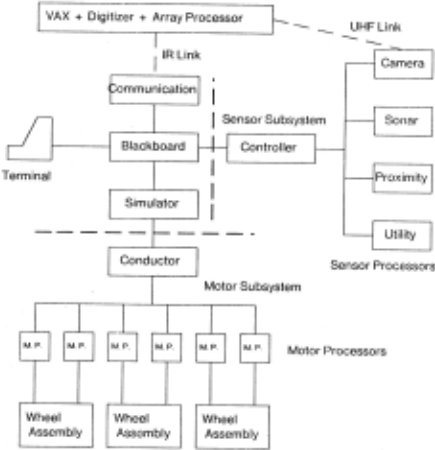
The Rover is cylindrical. approximately I meter tall and 50 em in diameter. and is equipped with three individually stccrablc wheel assemblies. Each has two wheels, and is powered by two brushless samarium-cobalt motors. 'Inc whole system is powered by six scaled lead-acid baucrics. Each motor is controlled by a 11/otor Processor (a dedicated MC6805). The Conductor (an MC68000) orchestrates the individual Motor Processors to follow a given path. The Simulator (another MC68000) uses feedback infonnation from the motors to maintain a dead-reckoning estimate of the robot's position.
The sensors available include a TV camera, a set of sonar ranging devices and an array of proximity sensors. Each is controlled by a dedicated MC6805 (respectively the Camera. Sonar and Proximity Processors). The Utility Processor (also an MCii805) monitors internal conditions of the Rover. such as motor temperature or battery voltage. Additional processors (all MC68000s) arc the Controller, responsible for the sensor subsystem; the IJ/ackboard Processor, where infonnation relevant to several processes is shared; and the Communications Processor, which controls a remote link to a mainframe system (a VAX 111780 with a high-speed digitizer and an array processor). 'Inc processor network is shown in Fig. 1.
3 Software Structure
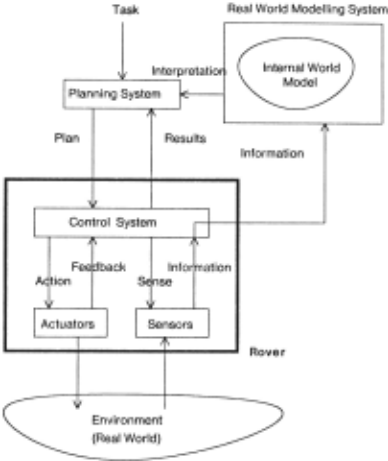
To pennit high-level control, case of programming and usc, and flexibility to pcrfonn different kinds of experiments with the Rover, an integrated Planning and Control System is being designed, composed of the following modules (Fig. 2):
- a Real- World Ill ode/ling Sysfem, which interprets and integrates the qualiwtively different. partial and sometimes cc:-~nicting sensory information. and constructs an Internal Model of the real world environment in which the Rover is operating:
- a high-level Planning and Simulafion Sysfem, which uses general problem-solving techniques. as well as specific information obtained from the Internal World Model, to develop and monitor the execution of plans to solve a given task:
- a DisfribUied Conlrol Sys/em, which is responsible for the execution of a Confrol Plan. through parallel and coordinated control of the different sensors and actuators.
Of the three modules, the Distributed Control System was developed first . and is described in the following material.
3.1 The Distributed Control System
3.1.1 Design Considerations
The design of the Distributed Control System was guided by the following goals:
- effective usc of the large parallel processing potential existing in the system;
- nexibility of interaction with the different sensors and actuators;
- disuibuted hierarchical decision-making capabilities;
- ncxibility and case of expansion and change of the system;
- graceful integration of a task-specific Control Plan with the several processes which control and operate the Rover, and with sensory and feedback information.
:>.1.2 Overview
With the previously mentioned functions and design considerations in mind. the Distributed Control System was designed and a first version was implemented. The syst..:m consists of an expandable community of I :Xperf Modules, which communicate asynchronously among themselves over a Blackboard and perform a given task under the direction of a Confrol Plan. Each Expert Module is dedicated to a particular type of subtask, such as the monitoring of sensors or actuators, problem-solving, or system management. The Control Plan breaks the overall task set to the Rover into a set of subtasks and a set of constraints (the order in which these subtasks must be executed). One Expert Module, the Supervisor, dynamically extracts scheduling information on the subtasks from the Control Plan. The Blackboard is a data structure [8) where infonnation rcl"vant to the different Expert Modules is posted. This includes information on the robot's st;ttus. relevant sensory and feedback data. scheduling inforonation abstracted from the Control Plan and the degree of progress made towards completing this plan.
The Expert Modules reside in the various processors that make up the network. l .ocal to each processor we have a small real -time operating system kernel that handles physical 1/0, schedules processes and manages interprocess and interprocessor communication. A general message-based communication mechanism is used for local as well as remote interproccss communication.
A high level diagram of the Distributed Control System is shown is Fig. 3.
3.1.3 Details
Each expert module is composed of a pair of closely coupled processes: a "masfer" process and a "sla1·e" process. The master process keeps track of relevant information on the Blackboard, changing when necessary the status (run/slop/abort/collfinue) of its associated slave process. The master also retrieves needed data from the Blackboard, hands it as input to the slave module. and posts relevant information generated by the slave process on the blackboard. The slave process is the one actually responsible for expert work. such as monitoring sensors, handling events, controlling actuators. interpreting sensory infonnation, doing problem-solving. etc. In the typical case. the master process resides in the Blackboard processor (for access efficiency reasons). and the slave process actually resides in a different processor of the network. Communication between them is maintained through the usc of a symbolic message passing mechanism, similar to the system proposed in (9). A message is composed of a set of (<name>. <value>) pairs, and has a priority associated to it. Each of the Expert Modules, working asynchronously, maintains an input processing stream and an output processing stream.
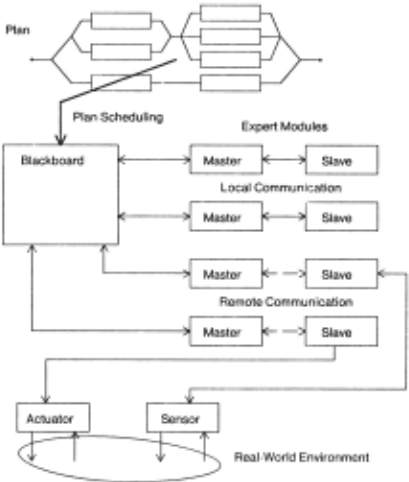
The infonnation posted on the lllackboard has a structure in some aspects similar to the structure of messages. being also composed of (<name>. <value>) pairs. For efficiency and logical structuring reasons, the Blackboard is subdivided into different areas. with scvcrallcvcls of abstraction possible within each. In each area related types of infonnation arc posted. e.g .. data relating to "movement", "proximity sensors" , etc. Actual access to the Blackboard is done only by the Blackboard Monitor, to insure the integrity of the posted data. A Blackboard Scheduler schedules the master processes to interact with the Blackboard, according to their own priorities and the priorities of data and events being recorded there.
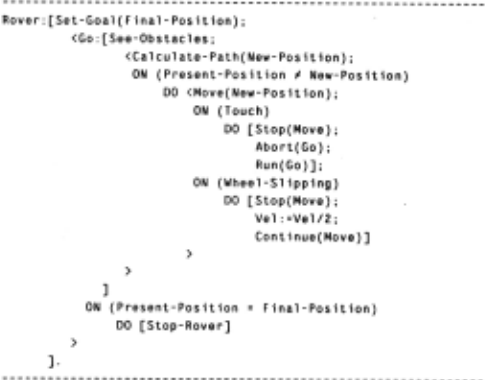
Integrated into the overall control structure of the Rover is the Control Plan. A simplified example is shown in Fig.4. The syntax is partially based on [10]. Processes can be specified to execute in parallel (those wiLbin <>brackets) or sequentially (those within [)brackets). Responses to events arc defined by the tt~c of "ON <event> DO <action)" rules. From the Plan. information about parallel and sequential execution of processes. as well as rc;tctions to events. is abstracted, and posted dynamically on the blackboard as the Plan is executed.
Transparency of the physical structure of the network itself is obtained through the underlying support software residing in each processor. Local to each processor we have a real-time operating system kernel , which handles interproccss and interproccssor commu11icatioll. takes care of the internal scheduling of the resident processes. and handles low-level 110. 1/0 ha11dlers intc.·face with the actuators and sensors in the system: other routines arc responsible for the tra11slatio11 of specific low-level actuator and sensor commands to control signals (logical -> physical translation) and of feedback and sensory data to higher abstraction level descriptions (physical -> logical translation). The mailing routine constructs messages to be sent to other processors. and handles incoming messages. Messages have headers with routing infonnation (source and destination) and information contents. The specialized modules residing in each processor can either perform only local functions (in which case they don't interact with the blackboard), or can belong to the set of master-and-slave expert modules. The scheduling of local (in-processor) modules for execution/suspension/abortion/continuation is done on the basis of: a)thc inherent priority of the module: b)thc priority of internal events, generated either by software or by hardware: c)the priority of related incoming messages. The resident kernel also takes care of flow control, buffering, message fragmentation. broadcasting,etc.
3.2 Discussion
The system presented reflects the structure of a community of coopcrati11g exprrts. These experts communicate lsynchronously over the processor network, generating and absorbing streams of data. Concomitantly, the system embodies a hicrarchi<:nl model of distributed computation. where the arrangement of the processors can be seen as a tree. This reflects the fact that the decision-making model is partially hierarchical : control decisions arc, whenever possible, made locally in the processor which is confronted with a problem. Otherwise, the problem or data is broadcast recursively to the next higher level of decision (processors on the path up the tree). Another result from this model. is that commands and data can exist within the system at several levels of abstraction. At each level only the necessary degree of detail is present Higher levels arc able to deal with the same infonnation in a more abstract fonn and do not become cluttered with unnecessary details.
The system described is loosely coupled , since the rate of communication between machines. spcciall> from the motor and sensor subsystem levels on upwards. is relatively small. This results from the usc of asynchronous processes and the blackboard. This approach can lead to higher performance and better adaptability to dynamically changing conditions [11].
The blackboard mechanism has been used by several researchers. e.g. in speech understanding [8]. image understanding [12], and tracking of objects [13]. In our case, due to the multiprocessing network and the need to dynamically respond to the changing conditions of the real-world environment, the role of the "condition part" of the Hcarsay-II Knowledge Sources [8] was expanded to a more general master/slave relation. In this way. unnecessary or even dangerous actions can be discontinued when necessary. Furthermore. a separate control plan, integrated into ·the overall structure, and which Hearsay- II lacked, was considered essential in our case. Other researchers have also felt the need to usc separate focusing and goal-proposing mechanisms [12,13].
4 Implementation Status
The several physical subsystems of the Rover have been tested and are operational. Final assembly, integration and testing arc now being undertaken. Concomitantly, one specific control configuration, consisting of a set of Expert Modules and the underlying support software. is being developed. This set of modules includes tht Controller, ·Communication, Sonar, Proximity-Sensor, .Camera, Simulation, Blackboard and Utility modules. which implement the corresponding functions mentioned in Section 2; the Movement module accomplishes a trajectory along a path provided by the Path-Planner, the Vision-Processing module extracts visual information about obstacles; the Real-World-Model/er uses information from the Obstacle-Detection module to construct an Internal Model of the environment; the Supervisor dynamically extracts the necessary information from the Control Plan, while the Defaulter fills in the details; the Guardian watches over certain key parameters in the lllackboarr' to prevent dangerous situations from happening. and the User-Interaction module permits communication with a human user. Most of these modul~s have been implemented and tested in a simulated environment. The Distributed Control System has proven to be very ncxiblc and ddcquatc. It is now awaiting in silo testing, running the Rover.
5 Conclusion
Although the development of such complex pieces of hardware and software is fraught with difficulty, there arc considerable benefits. Among them. many insights were gained into the problems of control, planning. interaction with the real-world environment and usc of a processor network.
The Distributed Control Structure described in this paper fulfills the initial design goals. Future work includes the integration of the information coming from the sensors into a more sophisticated Internal Model. the development of a more elaborate planning system, and research into the problems of automatic knowledge acquisition and learning.
6 Acknowledgments
'Inc authors would like to thank Hans Moravec, Marc Donner, 7..ary Segall, Dave McKeown and Peter Hibbard for their suggestions and for interesting discussions.
7 References
- Moravec, H.P. "'!be CMU Rover." Proceedings of the AAAI-82, August 1982.
- Moravec, H.P. "The Stanford Cart and The CMU Rover." Proceedings of the lEE F. to appear, 1983.
- Raibcrt, M. H. and Sutherland. f. E. "Walking Machines." Scil'ntific American, January 1983.
- Moravec, H.P. Obstacle Avoidancr and Nuvigation in the Real World by a Seeing Robot Rover, PhD diss~rtation, Stanford University, September 1980. Published as Robot Rover Visual Navigation by UMI Research Press, Ann Arbor, Michigan, 1981.
- Julliere, M. and Marcc, L. Contribution a I'Autonomie des Robots Mobiles. l..aboratoirc d't\pplications des Techniques Electroniques Avancccs, lnstitut National des Sciences Appliquces, Rcnncs, 1982.
- NASA Machine Intelligence and Robotics: Rtport of the NASA Study Group. Final Report, N81-21769, March 1980.
- Ayres, R. and Miller, S. The Impacts of Industrial Robots, CMU Robotics Institute TR-81-7, November 1981.
- Erman. L.D. et al. "'l11e II Ft\ RSA Y -II speech-understanding system: Integrating knowledge to resolve uncertainty." Computing Survrys 12:2. June 1980.
- Feldman, J. A. "High l.cvcl Programming for Distributed Computing." CACM 22:6, June 1979.
- Donner. M.D. "The Design of OWL: A l..anguage for Walking." Proceedings of 1983 Sigplan Symposium, ACM, June 1983.
- Talukdar, S.N .. Pyo, S.S. and Giras, T.G, "/\synchronous Procedures for Parallel Processing", Proceedings of Power Industry Computer Applications Conference, 1983. To appear in 1/:'I:'F: Trans. on PAS.
- Hanson, A.R. and Riscman, E.M. "Visions: A computer system for interpreting scenes." In: Hanson, A.R. & Riscman, E.M. (eds.). Computer Vision Systems. Academic Press, NY, 1978.
- Corkill. D.D., Lesser, V.R. and Hudlicka,E. "Unifying Data Directed and Goal-Directed Control: t\n Example and Experiments." Proceedings of the AAAI-82, August 1982.
@inproceedings{ijcai1983p200,
  title     = {A Distributed Control System for the CMU Rover},
  author    = {Elfes, Alberto and Talukdar, Sarosh},
  booktitle = {Proceedings of the Eighth International Joint Conference on
               Artificial Intelligence, {IJCAI-83}},
  publisher = {International Joint Conferences on Artificial Intelligence},
  editor    = {Alan Bundy},
  pages     = {830--832},
  year      = {1983},
  note      = {Robotics},
  url       = {https://ijcai.org/proceedings/1983/200},
}
TY - CPAPER TI - A Distributed Control System for the CMU Rover AU - Elfes, Alberto AU - Talukdar, Sarosh T2 - Proceedings of the Eighth International Joint Conference on Artificial Intelligence, IJCAI-83 PB - International Joint Conferences on Artificial Intelligence PY - 1983 SP - 830 EP - 832 UR - https://ijcai.org/proceedings/1983/200 ER -Copied
Machine-readable versions of this paper, for tools and AI agents:





