
Activation-Based Parsing
Proceedings of the Eighth International Joint Conference on Artificial Intelligence. Natural Language. Pages 678-681.
© 1983 International Joint Conferences on Artificial Intelligence
Abstract
A model is presented that desc ribes natural language parsing in terms of a uniform activation algorithm which operates over an interco nn ected, dcchrative st ructure of nodes and node instances. The :>lg o rithm directs the flow of activation and expectation using only lo ca l inform:>tion a nd, hen ce, su pports substantial concurrency. A rep rese ntation is introdu ced to express nod e relationships and activat.ion agreement. Examples of several linguistic processes and their intrrr ebtin nships are desc ribed.
- Burton, R. Semantic Grammar: An Engineering Technique for Constructing Natural Language Understanding Systems, BBN Report No. 3453, Bolt, Beranek and Newman Inc., Cambridge, MA, 1976.
- Dyer, M. Jn-Depth Understanding , Research Report #219 (doctoral dissertation) , Dept. of Computer Science, Yale University, New Haven , CT, 1982.
- Fahlman, S. NETL: A System for Representing and Using R eal-World Knowledge, MIT Press, Cambridge, 1979.
- Gazdar , G. A Phrase Structure Syntax for Comparative Clauses, Lexical Grammar (ed. Teun Hoekstra), Faris Publica- tions , Dordrecht, 1980, 165-179.
- MacDonald, D.B. Understanding Noun Compounds, doctoral dissertation, Carnegie-Mellon University, Pittsburgh, 1982.
- Ricsbeck, C. and Schank , R. Comprehension by Computer: Expectation-Based Analysis of Sentences in Context, Research Report #78, Dept. of Computer Science, Yale University, New Haven, CT, 1976.
- Small, S. Word Expert Parsing: A Theory of Distributed Word-Based Natural Language Understanding, TR-954 (doc- toral dissertation) , University of Maryland, College Park, MD, 1980.
- Small, S., Cottrell, G. and Shastri, L. Toward Connectionist Parsing, AAAl-82 Proceedings, Pittsburgh, 1982, 247-250.
- Tarnawsky , G.O. Knowledge Semantics, doctoral dissertation, Dept. of Linguistics, New York University, 1982.
- Woods, W.A. Taxonomic Lattice Structures for Situation Recognition , TINLAP-2, Theoretical Issues in Natural Language 1-'rocessing-2, University of Illinois at Urbana- Champaign, 1978, 33-41.
- Woods, W.A. Cascaded ATN Grammars, American Journal of Computational Linguistics, 6, 1 (1980), 1-12.
References were extracted automatically from the PDF and may contain errors.
Full text extracted automatically from the PDF; figures, tables and equations may differ. The PDF is the version of record.
1. Introduction
The concept of a layered or stratified system has been a central notion in m:>ny linguist ic theories. A system is usually defined in terms of object s at various levels of linguistic description and inter and intra-level m:>pping rules. Traditional levels include phonology, morphology, sy ntax, semantics, and pragmatics. The objects include sy nt:>x trees, deep structure trees, lambda calculus formulas, predi cate calcu lus formulas, and frame (slot-filler) representations. The correspondin .g rule formalisms include tree transformations, lambda application and reduction, logical implication, and frame composi tion. The rules , particularly in computational theories, are often context-free in appearance, but occasionally possess augmentations to rest rict their application , to build new objects, and/or coordinate the application of other rules.
As the role of pragmatic knowledge has grown in AI systems for tasks such as story understanding, a broad new spectrum of "knowledge structures" has been introduced.** The conceptual status of these proposed objects and the nature of the indexing or mapping rules are still the subjects of inquiry and debate in cognitive sc ience. The interplay of the processing components of the programs and the indexing properties of the objects sometimes makes it difficu It to ex t r:>ct the exact character of the mapping rules , but they appear to be similar to other rule-oriented formalisms.
The current work attempts to unify the insights from linguistic and conceptual analysis into a computational theory based on activa tion. Activation-based computational methods are defined here to mean computational methods in which the interconnection structure of a body of declarative knowledge plays an active role in the pro cessing of information. Our concern here is with models in which the interconnected memory structure is as active as possible, and our focus is particularly on the task of natural language parsing. The term activation-based parsing refers to the processing of an input string by the initial (sequential) stimulation of memory nodes corresponding to the constituent substrings (generally words) and by the subsequent activation of other nodes by these. The parse is represented by activation traces derived from the interconnection of existing nodes. A parser, named ABP, is implemented in Franz Lisp to simulate the model that is presented.
·This paper is based upon work supported by the National Science Foundation under grant #IST-8208113 and by the University Awards Pro gram of the Research Foundation of the State University of New York , fel lowship #0271-03-431-81-0.
**One recent dissertation J2J offered 17 different knowledge structures and 28 types of interactions among them.
ACTIVATION-BASED PARSING
Mark A. Jones·
State University of New York at Stony Brook Long Island, New York 11704
Particular attention has been given to the problems of representing and effectively using generalizations about language and the underlying concepts that language attempts to convey. Specifically, sy ntactic generalizations have not been distributed into the detailed semantics as in semantic grammars ]1] or embedded in the lexicon as in word-based parsing approaches (d. ]7, 6 and its des cendantsJ). The phenomena of metaphor processing (where semantic selectional restrictions may he violated), of sensitivity to the phrasing of an utterance, of sensitivity to agreement violations, of novel bnguage use, and especially of language learning attest to human abilities to exploit sy ntactic generalizations profitably. Our view is that generalization is central to the classification and use of concepts in memory and accounts for much of the flexibility in human infor mation proce'5ing. This does not imply that lexically activated (word-based) expectations for the idiosyncratic tendencies of language do not exist, nor that utterances must be completely "gr:>mmatical" to be understood ]the model can account for both of these observations]. The point here is simply that generalizations (e.g., sy ntactic generalizations) do exist and should be helpful in pro cessing ac tivities. This emphasis on generalization anticipates future work on language learning and serves as an inspiration for many of the representational issues that we have faced.
2. The Parsing Model
Previous work in natural language understanding in AI has underscored the need for applying a wide range of comprehension activities into the parsing process. These activities involve syntactic processing and a wide variety of semantic processing including con textual integration, word sense disambiguation , anaphora resolution, metaphor processing etc. The bandwidth among these processing activities in traditional implementations has been low, and as Small points out. ".. it seems that any strict serial decoupling of associated tasks ... docs not permit enough interdependence of function to explain adequately reasoning tasks that people find quite easy and natural to prrform. " [8]
Our parsing model is defined in terms of a set of .semi-distinct levels that represent various types of concepts and processes. Each level has a generally hierarchical infrastructure of nodes and, addi tionally, possesses connections to other levels. The inter-level connec tions permit concurrent recognition behaviors at various levels. Strictly speaking, the nodes in the various levels are not activated themselves, but rather instances of them, and there may be more than one . instance of ~ particular node active at any time. Each node can be viewed as a type of production rule which is described in terms of other node activations. A uniform activation algorithm directs the creation and interpretation of node instances. The algo rithm is sensitive to the current state of active instances and the recency of expectations placed upon the node by other instances. Beyond the activation algorithm, the "process" component of natural language understanding is embodied in the declarative interconnec tion structure. This distinguishes the approach here from production systems or semantic network schemes in which a substantial amount of the processing behavior is still embodied in program code.
The primary aspects of the parsing model are (a) the specification of the recognition processes and node interconnections that define the levels and (b) the design of the production language and the act ivation algorithm. The initi al level definitions are given below. Most of our attention thus far has focused on the form and interplay of the levels 0-4.
Level 0 - the token level, consists of words and a small set of affixes which have a clear productive or agreement function. The model shou ld be relevant to underlying phonemic and morphemic levels as well but we begin at t.he token level for simplicity and assume that nodes at this level are exogenously stimulated. Except for grouping conj ugated verb forms such as seef sawfseen as see+ and noun forms with irregubr plurals manfmen as man+, there is no internal struc ture to level 0.
Level 1 - the syntactic level, consists of syntactic classifications of tokens, phrasal patterns and their classifications, idioms and syntac tic agreement patterns. Syntactic word classes form the primary links to level 0, although some syntactic patterns require particular word forms such as do+ .
Level 2 - the conceptual classification level , provides semantic class ificat ions of objects from levels 0 (words), and 1 (idioms and modifiPrs such as adverbial phrases and prepositional phrases). These classi fi cations are used by higher levels to sort nominal and event desc riptions.
Level 3 - the NP role level, uses activat ion from levels 1 and 2 to sort the NP concepts according to their (syntactic and semantic) roles in the sentence. The subj ect NP concept will be classified as a subject and either an agent or an object depending on the voice of the ve rb phrase . Based on the level 2 classificat ions, it may also be refin ed from agent into actor or instrument. Note that certain syn tactic phenomena such as tag quest ions require distinctions such as subject that are intermed iate to full conceptual resolu tion of roles.
Level 4 - the case frame level, is responsible for word sense disambi guation. Here are the detailed expectations of certain verb senses for particular prepositions and particles. The case fr ames are organized hierarchically for the purposes of shared inferences. For example, the senses of th row, roll , and go which indicate physical transfer will be assembled under a ptrans node.
Levels 5 and higher - the contextual levels, identify sequences of level 4 nodes which relate to temporal ordering, causality and plan recognition.
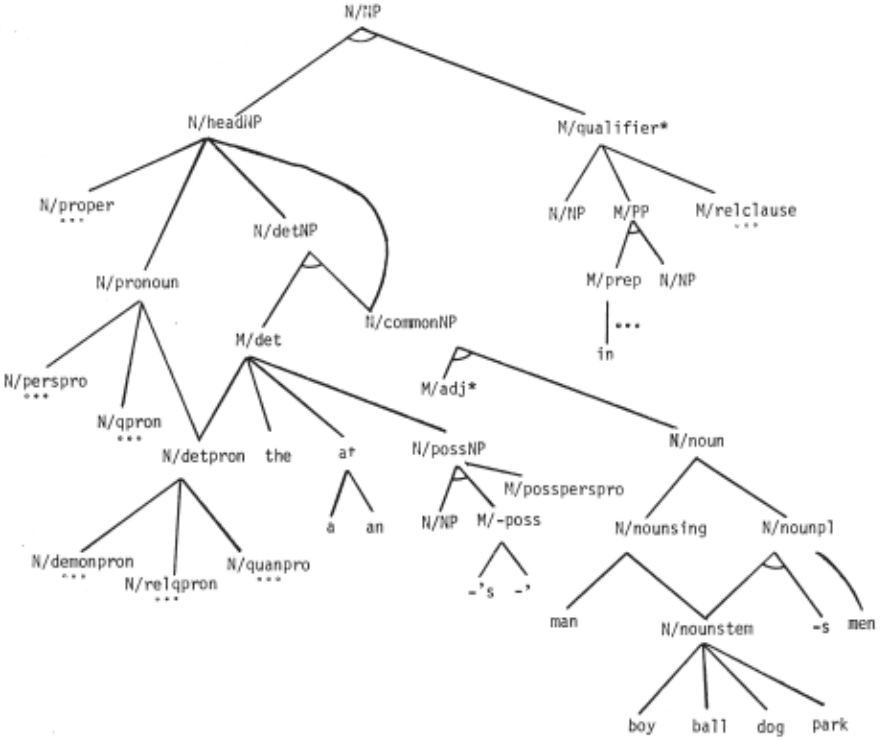
Figure 1 illust~ates a fragment of a simple syntactic level struc ture. Each node may be viewed as a type of production rule which has been divided into a pattern (pat) and an optional test (t est) . Fig ure 2 lists the definitions for several of the nodes in Figure 1. The tests are listed only in Figure 2. The production language allows sequential ion (seq), alternation (or), a case construct, and a repeti tion operator (* ). The case construct contains antecedent-consequent pairs; if an antecedent activation is seen then a consequent activation must also be seen or the construct is blocked.
N/NP pat: (seq (nl . NjheadNP) (ml . M/qualifier)*) NjheadNP pat: (nl . (or Nfproper Nfpronoun N/detNP N/commonNP)) M/PP pat: (seq (ml . M/prep) (nl . N/NP)) test : (case ((nl. Njperspro) (nl. N/objperspro))) NjdetNP pat: (seq (ml . M/det) (nl . NjcommonNP)) test: (or (seq (ml . m/singdet) (nl . N/nounsing)) (seq (ml . M/plurdet) (nl . N/nounpl)))Figure 2: Examples of Node Definitions
The production rules (nodes) explicitly index one another via the interconnections among them. An instance is active if its pat tern or test has been partially satisfied. An instance is triggered (or fired) when no longer inhibited by its pattern or test. For syntactic level nodes, the pattern typically represents the context free base component of language, and the test implements context sensitive aspects such as subject-Hrb agreement, use of the objective case, and determiner-noun agreement. The pattern can alternatively be viewed as a generalization and the test as a specialization of it.
Although node names are completely uninterpreted and arbi trary , naming conventions help to distinguish the levels.* Token node names in level 0 are not prefixed. Syntactic node names prefixed by Nj, E/, and M/ represent syntactic nominal, event and modifier con cepts , respect ively in level I. Node names at levels greater than I are prefix ed by n/ . ef, and m/ in this paper. The terminal nodes (English morphemes) in Figure 1 are from the token level. Just above these nodes are the terminal syntactic level nodes which include lexical categories. The interior nodes in the syntactic hierar chy provide phrase patterns and phrasal combinations.
3. Non-determinism
A purely bottom-up activation-based parser encounters trouble due to the fact that the connection structure is not exclusively tree like. Figure I contains several nodes leading upward to competing alternatives -- N/nounstem, NjcommonNP, N/detpron, and N/NP. Competing alternatives for node activation cause purely bottom-up schemes to be highly non-deterministic.
A shared structure may be lin ked to independent sets of alter natives , termed dimensions. Alternatives in different dimensions are non-competing. For example, pronouns activate features in dimension of gender, number, person and case in addition to partici pating in NP recognition. Activation from a node to non-competing alternatives is deterministic with respect to the activation in each dimension. The figure below shows an example of competing (cir cled) and non-competing alternatives.
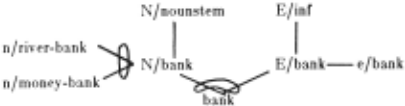
Competing alternatives can be further distinguished into several cases:
- (a) Fir1al epsilon-transitior1s: Natural language syntax commonly involves productions in which optional elements may appear
·The level distinction itself is, of course, somewhat arbitrary and pri n1arily exists to emphasize the general processing behavior characterized by the nodes in a given level.
following an obligatory element. For example, a (regular) noun stem can be optionally followed by -s to form the plural. Present tense verb forms are another similar example. The situation is not confined to suffixes. A pronominal determiner (that , which. some) can serve as an NP when used pronomi nally or can serve as a determiner for a common noun NP. The head of an NP can be optionally followed by qualifiers. Many verbs can be used transitively and intransitively , which caus~s premature VP firing. Furthermore, the VP may have trailing PP modifiers. The sentence You walk -ed her dog -s in th e park contains contains several initial subsequences:
- (i) You walk.
- (ii) You walk -ed.
- (iii) You walk-ed her.
- (iv) You walk-ed her dog.
- (v) You walk-ed her dog-s.
- (vi) You walk-ed her dog-s in the park.
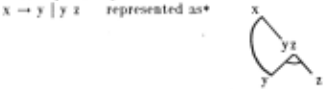
Two subclasses of optional elements can be distinguished: (a.l) Final Optionality:
- (b) Initial P-psilon-t ransitions: These cases are similar to (a.l) and (a.2) except that the optional element precedes the obligatory one. Optional determiners and adjectives are examples of ini tial optional elements.
- (b.!) Initial Optionality:
- (c) Shared sub-st ructures: The epsilon-transition cases (a) and (b) above appear to occur primarily in endocentric constructions in which the optional element does not affect the "type" of the recognized phrase in natural language syntax. The type is esta blished by the head of the phrase which is the obligatory ele ment -- for example, the noun in a noun phrase or the verb se quence in a verb phrase. The same syntactic interpretation survives in these cases and the trailing constituents serve for purposes of agreement or qualification. In other cases, however , competing alternatives may play fundamentally different roles in the interpretive process. Structures such as NP or PP may be shared by many different constituents. For example, an NP can appear as the subject of a sentence, the first or second ob ject , the object of a preposition , etc. Token level words may give rise to multiple syntactic categories. Polysemic words ac tivate multiple nodes at the semantic levels.
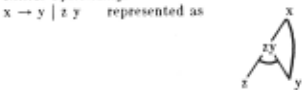
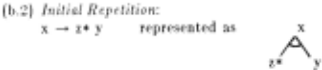
·This representation was chosen in lieu oC a notation Cor optionality, because the resulting cases (x - y) and (x - y z) often need to be explicitly referenced elsewhere {e.g., for context~sensitive restrictions). The new node, yz, conveniently allows this reference.
- (d) Recursion: Recursion introduces cycles into the node structure. Figure l includes two cases or right recursion (the NPs appear ing in the appos itive and the PP) and one case or left-recursion (in M/possNP). Recursion can also involve center embedding as with relative clauses.
4. The Activation Algorithm
This sect ion describes an activation algorithm which uses a breadth-first, parallel expansion or activation. The algorithm attempts to curb non-determinism up to ·genuine ambiguity by aug menting the bottom-up activation with a complementary operation or top-down expectation to provide a biasing affect on alternatives within a dimension. The expectation-driven interpretation of node activ ation is a powerful principle for controlling the integration or knowledge st ructures that have been recognized bottom-up. The characteristic pattern or the system is a rippling or activations "upward" and or expectations "downward" botll ·.vithin and among levels. Under this principle, the non-determinism represented by parallel, competing alternatives is restricted by the context.
The phrase th e man illustrates the principle as it applies to case (b.l) in section 3. The following sequence of actions takes place:
- (i) theO is exogenously created and triggered.
- (ii) M/detO is activated, followed by N/detNPO which is blocked .
- (iii) manO is then created, triggered and followed by N/nounsingO, N/nounO and NJcommonNPO.
The node structure reveals two competing alternatives for NJcommonNP: N/detNP and N/headNP. The alternative N/detNP is biased, however, because NJdetNPO posted an expectation for N/ commonNP as it became blocked in (ii).
- (iv) The remaining instance activations and firings are: N/detNPO, N/headNPO, N/NPO, ...
The following rule summarizes the constraint:
Rule 1:
fora// dimensions stemming from a node (e.g. , N/commonNP)
- if any active instances (N/detNPO) expect an instance (N/ commonNPO) of the node,
- th en the most recent expecting instances are activated and other expecting instances are inhibited.
As it has been developed thus far , the model seeks to rely on a discrete view or activation and inhibition instead or using more con tinuous notions or activation levels, thresholds, and decay . In our implementation, the recency effect needed for Rule 1 is modeled by hav ing active instances "post down" their expectations for consti tuents on LIFO lists that are associated with the nodes. The imple mentation treats each expectation that arises from the same exo genous activation as having the same age. The activation and expec tation processes are currently assumed to complete before the next input. Recency could alternatively be implemented by comparing continuous activation time stamps on instances or by using decaying activation levels to emulate the time stamps.
The phrase the boy -s demonstrates the type of non determinism described in case (a.l). The initial substring the boy is itself a noun phrase. At node N/nounstem there is an upward split lead ing to nodes NJnounsing and NJnounpl. The paths rejoin at N/noun, and any top-down expectatimts posted through N/noun will fail to distinguish a competing alternative. The following sequence of activations tales place:
- (i) theO, M/detO, N/detNPO (blocked)
- (ii) boyO, N/nounstemO, N/nounpiO (blocked) and N/nounsingO, N/nounO, .N/commonNPO, N/detNPO, N/headNPO, N/NPO, ...
When -sO and NfnounpiO are activated next, we are faced with a dilemma at node N/noun. Should we create a new instance N/nounl (for boy -s) or modify our previous instance, N/nounO, that now represents boy? N/nounl cannot be generated, because the prior expectation environment has been altered by the sequence in (ii) and it would lead to a new NP instance. The solution is to link posted expec tations together in such a way that the bottom-up activation retraces the expectation structure. At junctures in the expectation structure (e.g., N/nounO) in which an instance (NJnounsingO) has already satisfied the expectation, new instance activations of the juncture node are suppressed. The old activation links from NfnounsingO to NfnounO can be severed and a new link from N/nounpiO to N/nounO can be established. The general rule is:
Rule 2:
fora// dimensions stemming from a node (e.g., N/nounpl)
- if any inst ance (NfnounsingO) has already satisfied the same expectation (in N/nounO) that an instance of the node (NJnounplO) wants to satisfy
- then the las t binding (from N/nounO) is redirec ted (to NfnounpiO instead of N / nounsingO)
Due to the semantic penetrance of activation from the initial words in a sequence, language has evolved certain relationships across levels in the form of constraints on number, person and gender. In the prev ious examples, the determiner the failed to bias the Njnounsing and Nfnounpl alternatives of N/noun; however, deter miners such as a, every, that , and these can express a preference. In our model these determiners activate feature concepts such as n/singde t and n/plurdet in a number dimension in addition to syn tactic level ac tivations. The agreement restriction is defined at the coordinating node (N/detNP) and is taken into account when post ing expectat ions. For the phrase, a boy, expectations will only be posted in the N/nounsing branch below N/noun. This will cause the bottom-up act ivation at N/nounstem to direct itself only toward N/nounsing.
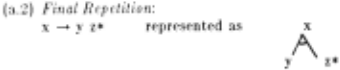
The repet ition cases, which only involve a single production, are easier to handle. Case (b.2), initial repetition, is similar to nor mal sequential pattern activation. In case (a.2), final repetition , the production fires arter the obligatory elements, and the optional , repeated elements simply attach in the trace. Expectations are regenerated after the attachment.
Space does not permit full examples or the recursion cases, so we will only highlight them. The existing rules handle the case of right recursion wi th no diffi culty . Center-embedded structures sim ply require that the LIFO lists (stacks) of node expectations are popped as instances are created. The algorithm does this anyway since a node expectation is "transferred" or an instance when the instance is created .*
Left-recursion poses the greatest difficulty for the expectation (top-down) mechanism due to the possibility or expectation cycles. The two options are to eliminate left-recursion by rewriting the grammar or to define additional rules to handle it . To eliminate the left-recursion in Figure 1, the MfpossNP node can be deleted as a determiner (leave Mfpossperspro) and the top or the NP structure
can be changed as follows :
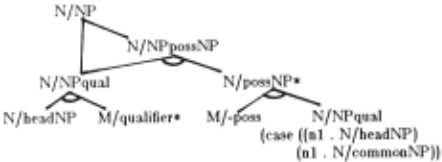
The objection to modifying the grammar is primarily that the syntactic trace structure does not mirror semantic intuitions as closely as the left-recursive trace. To handle left-recursion, the expectation process must be modified to eliminate cycling by having a node realize when it receives an expectation that it has already sent (i.e., that the expectations are in the same expectation struc ture). The recursively called node non-deterministically activates the left-recursive instance and the calling instance. Expectations below the recursive node are spawned again when the left-recursive instance fires and the calling instance is rebound to the new recursive instance.
·An equivalent way or thinking about expectations is to consider them to be prot o- inet ancee created by top-down "activation" which survive in the t race only if reinforced by bottom-up activation.
An English grammar subset of 110 syntactic level nodes has been encoded to explore various interesting recognition issues. The subset includes the verb tense system for declarative sentences, rela tive clause canst ructions and active/passive voices. The syntactic level algorithm desnibed above has been implemented and handles the subset.
5. Related Work
Fahlman 's NETL system [3] is an example of a marker-passing scheme. An interesting use of NETL to determine noun-noun modi fying rel::ttionships is described in [5]. Woods [10] discusses schemes using marker propagation in taxonomic lattices that might be used in conjunction with an ATN (augmented transition network) grammar.
ATN implementations and , in particular, Woods' notion of cas caded A TN grammars [ 11] are related to the work presented here. .Many A TN implementations have used techniques such as backtrack ing, arc-ordering, bounded lookahead and well-formed substring tables which are designed for efficient execution on sequential machines. It is possible, however, to define parallel ATN implemen tations which do not need these techniques. ATN registers are used for feature information extracted from the lexicon, for constituent structures such as subject and object , and for dislocated constituents. Pop arcs return structures that are assembled from the registers. Our view has been not to explicitly build and pass syntactic or semantic representations (data structures), but to allow the "mean ing" of an input to be represented by the impact that it makes upon the instance and expectation structure.*
Cascaded ATNs include the concept of concurrent operation of multiple ATNs at different levels. The emphasis is still on the pass ing of structures that are created and held at one level until an opportune time to transmit them. In our work there is a less rigid distinction of levels in terms of global and immediate availability of node activations and there is a greater assumed bandwidth among recognition processes. Our architecture allows a greater penetration of both activations and expectations to reduce non-determinism. The uniform architecture also is desirable for future considerations of learn ability.
A detailed comparison of the standard A TN grammars and the type encouraged by the activation-based formalism is beyond the scope of this paper, but one example from [11] will be discussed. An interrogative sentence can begin with an auxiliary verb (a form of do, be, have, or a modal) followed by the subject; whereas, the order is reversed in a declarative sentence. Woods discusses the awkwardness of ordinary PSGs (phrase structure grammars) to account for this. In our grammar, the pattern for one of the sentence nodes, E/Qaux, is of the form:
(seq (m1 . (or do+ be+ have+ M/futmodal)) (e1 . E/declS))
This behaves similarly to Gazdar's holes [4]. If the auxiliary is seen, then E/Qaux posts an expectation for a declarative sentence. Note that some verb sequence instances have already been created in the prior activation of the auxiliary. Now the sentence is recognized as usual and the verb sequence activations are completed. NP holes in relative clauses can be treated similarly.
6. Future Work
We have begun expanding the model to deal with levels 2-5. Level 2 contains a conceptual recognition structure similar to stan dard isa-hierarchies, but with a rich categorization structure. The interior nodes in the level 2 structure serve largely to facilitate the conceptual expectations of higher level structures.
·See 19] for a linguistic theory of a similar notion of meaning.
Level 3 uses the semantic information in syntactic order from level 1 and the conceptual categorizations to sort th.e NP concepts into case role relationships for level 4. We are designing a descrip t.ion language to aid in ex pressing compositional relationships that can be used to "compile" new node descriptions. Let us assume that a declarative sentence pattern , EjdeclS, looks like: (seq (n1 . N/NP) (e1 . E/VP)).
We can express our semantic intuitions about the level 3 and 4 map pings in the following (head modifier*) structure:
((e1 . efevent) (if ((e1 . efactive) (m/agent (n1 . n/nominal)))
((el . efpassive) (mfobject (n1 . n/nominal)))))
Using the compositional relationship and the pattern results, for example. in a compiled node pattern for mfagent of: (seq (n1 n/nominal) (e1 . efactive)).
7. Conclusions
An activation-based model for natural language processing has been outlined. An activation algorithm that uses local information regarding the current state of active instances and expectation struc tures has been applied to syntactic processing and is now being extended to other processes. The algorithm uniformly uses expecta tions to bias the activation spread at non-determininstic points in the declarative node structure.
The model should have inte.resting applications to difficu It problems such as ellipsis, deletion , conjunction and anaphora which depend highly on the recency and type of node activity. The con currency in the model suggests ways of using the redundancies in natural language communication to proceed with an interpretation in spite of ill-formed or incomplete input. The model also offers advan tages in extensibility including (1) the properties of additivity and continuity in the integration of new knowledge, and (2) the fact that system performance should not seriously degrade with additional knowledge.
@inproceedings{ijcai1983p163,
  title     = {Activation-Based Parsing},
  author    = {Jones, Mark A.},
  booktitle = {Proceedings of the Eighth International Joint Conference on
               Artificial Intelligence, {IJCAI-83}},
  publisher = {International Joint Conferences on Artificial Intelligence},
  editor    = {Alan Bundy},
  pages     = {678--681},
  year      = {1983},
  note      = {Natural Language},
  url       = {https://ijcai.org/proceedings/1983/163},
}
TY - CPAPER TI - Activation-Based Parsing AU - Jones, Mark A. T2 - Proceedings of the Eighth International Joint Conference on Artificial Intelligence, IJCAI-83 PB - International Joint Conferences on Artificial Intelligence PY - 1983 SP - 678 EP - 681 UR - https://ijcai.org/proceedings/1983/163 ER -Copied
Machine-readable versions of this paper, for tools and AI agents:





