
Towards a Computable Model of Meaning-Text Relations Within a Natural Sublanguage
Proceedings of the Eighth International Joint Conference on Artificial Intelligence. Natural Language. Pages 657-658.
© 1983 International Joint Conferences on Artificial Intelligence
Abstract
A computable linguistic model is proposed for relating texts to their meanings within a natural sublanguage of English (stock market reports), Oriented networks are used to represent meanings which are first established by a linguistic analysis of the paraphrase sets found in the sublanguage, Several types of correspondence rules map fragments of the semantic network onto portions of deep syntactic dependency trees in a recursive process which does not "consume" the network, but rather uses it as a kind of blueprint, Additional representation levels (not illustrated) are required to relat e these trees to final texts through surface syntactic and morphological stages, Important features of this model are (1) its capacity to represent the full paraphrastic power of language within an interesting natural sublanguage, and ("2) its bidirectionality, allowing the modelling of both analysis and synthesis of texts, Implementation is planned first as a device for synthesizing stock market reports (SMRAD system), but later possible applications include translation or paraphrasing of texts from this natural domain.
- Mel'~uk,I, "Meaning-Text Models" Ann,Rev,Anthro- £21,' 10 (1981) pp, 27-62,
- Kittredge,R, "Variation and Homogeneity of Sub- languages" Sublanguage (Kittredge & Lehrberger, eds,) de Gruyter, 1982a,
- Kukich,K, "Design of a Knowledge .. Based Report Generator" Proceedings of the 21st ACL meeting, 1983,
- Kittredge,R, "Semantic Processing of Texts in Restricted Sublanguages" Computers and Mathemat, with Applications 8, 1982b,
- Mel'~uk,I, "Lexical Functions in Lexicographic Description" Proceedings of the 8th Annual Meeting of the Berkeley Linguistic Society,l982.
References were extracted automatically from the PDF and may contain errors.
Full text extracted automatically from the PDF; figures, tables and equations may differ. The PDF is the version of record.
TOWARDS A COMPUTABLE ~ODEL OF ~EANIN�~TEXT RELATIONS
NITHIN A NATURAL SUBLANGUAGE
Richard Kittredge and Igor Mel'~uk
Department of Linguistics University of Montreal Montreal H3C 3J7, Canada
constrained texts, The full paraphrastic possibil ities of natural language are so rich that even in a_narrow technical domain, only a powerful linguis t1c mode l can cope wi.th the astronomicall')\ large variety of semantically equivalent forms.
II CHOICE OF NATURAL SUBLANGUAGE
Our work here has two goals. First, we are constructing an experimental device to test the general Meaning<=> Text Theory -with special empha sis on verifying its consistency, filling in miss ing details in the rule mechanisms, etc . Second, we are orienting our model towards practical appli cations, intending to make it operational within a reasonable time. In order to reconcile these two goals, we have chosen to develop our model in a fragment of natural language which is simultaneous ly small enough to me manageable, yet rich enough to represent the language as a whole, This forces us to choose a natural sublanguage used in a very restricted semantic domain, One such sublanguage. already described linguistically, is that of English stock rna rket reports (Kittredge, ( 2] ) , Sali ent features of this sublanguage are: (1) 1 imi ted vocabulary, (2) restricted syntax, (3) very narrow and well-defined semantic domain, yet (4)nearly the full paraphrasing power of gener al English, Natural constraints on the domain are such that we can envisage making a semantic clll· culus of all admissable s-emantic patterns found in the texts under study,
III PERFORMANCE GOALS OF THE SYSTEM
The system (called SMRAD -- Stock Market Report Automation Device) is being designed to carry out the following two operations: (1) given a formally correct semantic representation of a mess age possible within the stock market report domain, SMRAD produces for it (ideally) all synonymous text segments likely to be found in actual stock market reports; (2) conversely; given a text segment from a natural stock market report, it produces for it all the appropriate semantic representations, How ever, it should be emphasized that the severe re strictions on our domain eliminate almost all cases of ambiguity which complicate the task of recogniz ing meanings in texts from less restricted domains.
In the short term, we plan to run our model as a device for generating paraphrastic sets from
meaning representations, a completely deterministic
ABSTRACT
A computable linguistic model is proposed for relating texts to their meanings within a natural sublanguage of English (stock market reports), Ori ented networks are used to represent meanings which are first established by a linguistic analysis of the paraphrase sets found in the sublanguage, Sev eral types of correspondence rules map fragments of the semantic network onto portions of deep syntac tic dependency trees in a recursive process which does not "consume" the network, but rather uses it as a kind of blueprint, Additional representation levels (not illustrated) are required to relat e these trees to final texts through surface syntac tic and morphological stages, Important features of this model are (1) its capacity to represent the full paraphrastic power of language within an inter esting natural sublanguage, and ("2) its bidirection ality, allowing the modelling of both analysis and synthesis of texts, Implementation is planned first as a device for synthesizing stock market reports (SMRAD system), but later possible applications in clude translation or paraphrasing of texts from this natural domain,
I GENERAL FRAMEWORK
The mastery of a natural language is consid ered to amount to the ability of speakers to ~ress a given semantic content (meaning) by a set of syn~ onomous utterances (texts), and conversely , to ex tract from a given text its possible meanings, An important goal of linguistic research is therefore to develop formal models to represent the two-way passage between meaning representations and text representations, The notorious complexity of the meaning-text relation has led many researchers to introduce intermediate levels of representation in order to simplify the rule types and actualrules for this passage. Out of these cons-iderations a particular linguistic approach has emerged, the Meaning<=>Text Model Theory (Mel' ~uk, [ 1] ) , which will serve as the general theoretical framework in what follows,
A full-fledged model of the meaning-text rela tion is required in the general solution of several practical problems in the area of language process ing such as automatic translation, question answer ing, text synthesis and man-machine communication·, This is particularly the case when our goal is to deal with natural texts as opposed to artificially process. In the longer term, we plan to invert our model, using it for text analysis as well in this sublanguage. Hhen bi-directional. SMRAD can be us"' ed as the basis for such applied tasks as automatic translation, abstracting, paraphrasing, creative writing, etc. Experimental implementation of S.J-'RAD as a synthesizer for short segments of English stock market reports is planned for late summer 1983 , us ing PROLOG. In contrast to other recent research on text synthesis for this limi t ·ed subLmguage [ 3 ] , we are not concerned with mode~ling the pro cess by which semantic repres;:,ntations of 'messages" are extracted from raw numerical data, since this is a non-linguistic problem. Instead, we expect to provide a much more powerful and transportable ~od el than heretofore of the paraphrase mechanism re quired for synthesizing stylistically interesting texts.
IV ORGANIZATION OF TRF. RESEARCH
In accordance with the above, our research is divided into three tasks: (1) developing a f o r~a 1 language for semantic representations, (2) develop ing forma 1 1 a nguag e s for intermediate levels, (3) writing the system's rules (which function to carry out the mappings between the above represen tations).
A. Semantic Representation
'·1e illustrate our approach with a few represen., tative examples. Consider the following five sen tences, which are typical for natural stock market reports:
- Bow Valley jumped 2~ to 25,
- Rio Algom eased ~ to close at 39~.
- Abitibi was up sharply, gaining 5 to 49f.,
- IBM chalked up a 5-point gain, closing at 64.
- Bank of Montreal moved up smartly , adding 21; to 34.
To describe the meanings of these sentences (and all similar sentences) we propose an oriented sem antic network in which nodes are labelled with the primitive semantic elements of our universe and arcs are labelled with numbers indicating the argu ment slots. Semantic elements are of two basic ty pes: (a) predicates (in a broad sense) which in our sublanguage have from one to four arguments; (b) (names of) entities such as stocks, companies, sums of money, etc.; these may include variables for entities. Our network representation is basic ally equivalent to a formula of predicate logic . but has the advantage of perspicuity primarily be cause our network is free of linear order. Since sentences (1) - (5) all concern changes in the price of stocks, we introduce a 4-place predicate named CHANGE(1ol,X,Y,Z) whose arguments are limited in our domain to the following types:
- H: the price of a stock or index manifested in the text by the name of the corresponding company
- X: an initial value in dollars (for North American stocks)
- Y: a final value in dollars
- Z: a signed value equal to the difference Y-X.
Although the x.,.value is rarely expressed in stock market reports, it has been retained here (at the risk of introducing redundancy) in order to show how very general semantic primitives may be usedin particular domains, The Z-value indicates the di rection of change explicitly, although this direc tional component may be incorporated in the lexical meaning of a verb expressing change (e,g.,jump and move ·up mean O<Z; plunge,sag mean Z<O), Verbs may also be lexically marked for degree of change (i,e. ,subjective size of Z), For example, .~. plunge signify large changes; creep '::!.£_, edge up indicate small changes, Figures 1 and 2 give pre liminary representations for sentences (1) and (2) respectively,
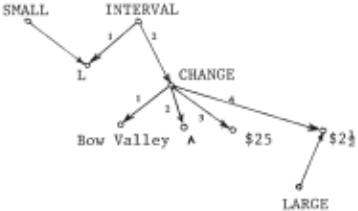
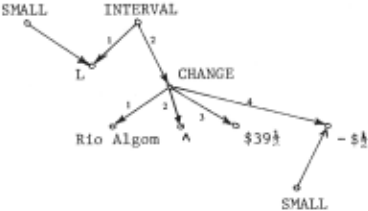
Two comments may be in order, First, we wee that in both Figs 1 and 2 the Z-values of CHANGE have subjective qualifications of amount (e.g., LARGE, SMALL), Moreover, the time INTERVAL over which the change takes place (i,e,, the unknown quantity L) is considered SMALL. No value is given to the second argument of CHANGE (indicated by "-" ) since no initial value is expressed linguistically in either example, Second, in stock market reports, company names show a systematic 4-way ambiguity. Bow Valley can refer to a company, or its spokes man, or its stock, or the price of the stock.
Our semantic representations are postulated on the basis of a systematic comparison of observable paraphrases within this sublanguage of English. \ole select as most "semantically transparant" that pa raphrase which satisfies two conditions: (a) all relevant meanings are expressed analytically, i.e. by separate words; (b) its words have the freest occurrence in the sublanguage, i.e., they are the least idiomatic, This semantically transparant paraphrase is converted into a semantic represen .. tation by replacing the English surface syntactic means by the labelled arcs of our network. The resulting representation must meet a number of gen eral formal requirements: (1) the formal repre sentation language must be rich enough to allow assigning two different representations to two sen tences which are felt intuitively to have different meanings; (2) representations must reflect the add itivity and compositionality of meanings, etc, Our use of paraphrase as an approach to deriving sem antic representations is ba sed on work by Kittredge [ 4 J.
B. Intermediate Levels of Representation
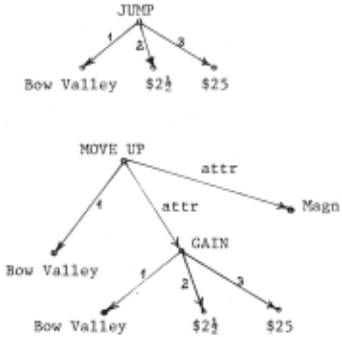
We restrict ourselves here to the deep syntac .. tic level, which we will not attempt to justify, Surface syntactic and morphological levels are even less debatable and farther from the semantic prob .. !ems which are our main concern. Figures 3 and 4 give two possible deep syntactic realizations for sentenc-es whose content is represented by the net,.. work of Figure 1,
Fig.3
Fig.4
We use unordered dependency trees in which arcs are labelled with syntactic relations of two different types. First, we use a predicative relation between a term and its subject and objects or complements. Second, we use an attributive relation, which covers all kinds of attributes, modifiers and adverbials. This labelling is used to constrain the ordering and inflecting of lexical items at the superficial syntactic level (not shown here), Nodes of trees are marked with English lexical expressions or lex ical functions such as Magn in Fig,4 (see Mel' ~uk [ 5 J ) ·
c. Correspondence Rules
The SMRAD system uses a variety of rules for relating semantic networks to deep syntactic depen dency trees·. These are organized into two main com ponents: (1) lexical rules, and (2) syntactic rules,
Lexical rules are of two types: (I) a lexical correspondence rule associates an English lexeme, along with its syntactic govern-ment pattern and some semantic labels, with a subnetwork of a seman tic network representing the sentence meaning. Fig. 5 r epresents the lexical corresponJ.ence rule for jump, Within the boxes on the right we give any restric tions on the syntactic form of the arguments in the syntactic dependency tree, Any semantic constraint (e.g., reference to semantic word classes) is given under the boxes; (II) a lexical function rule intro duces a lexical function, such as the intensif:ler function, as the syntactic correlate of a semantic subne twork.
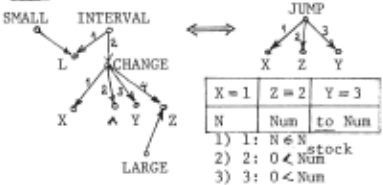
The syntactic rules specify how to put the whole syntactic structure of the sentence togethe~. They are also of two types: (I) general rules give global principles for encoding meanings in the deep syntac tic structure (e.g,, "if one verb is used to express an argument of a second verb, the first becomes a syntactic attribute of the second" ). (II)meta-rules give general principles for constructing a syntactic tree for the English sentence on the basis of its: se mantic network. It is important to state here that the network is not "consumed" in the process. In stead, it is used as a "blueprint" for the rules which construct the tree. Items already "'used" in the network are checked off in a recursive process until all parts of the network have been encoded in the syntactic tree, Logically speaking, the rules which do this are not ordered.
@inproceedings{ijcai1983p157,
  title     = {Towards a Computable Model of Meaning-Text Relations Within a Natural Sublanguage},
  author    = {Kittredge, Richard I. and Mel'cuk, Igor},
  booktitle = {Proceedings of the Eighth International Joint Conference on
               Artificial Intelligence, {IJCAI-83}},
  publisher = {International Joint Conferences on Artificial Intelligence},
  editor    = {Alan Bundy},
  pages     = {657--658},
  year      = {1983},
  note      = {Natural Language},
  url       = {https://ijcai.org/proceedings/1983/157},
}
TY - CPAPER TI - Towards a Computable Model of Meaning-Text Relations Within a Natural Sublanguage AU - Kittredge, Richard I. AU - Mel'cuk, Igor T2 - Proceedings of the Eighth International Joint Conference on Artificial Intelligence, IJCAI-83 PB - International Joint Conferences on Artificial Intelligence PY - 1983 SP - 657 EP - 658 UR - https://ijcai.org/proceedings/1983/157 ER -Copied
Machine-readable versions of this paper, for tools and AI agents:
 Welcome
 Future Conferences
 AI Journal Division
 IJCAI Proceedings
 About IJCAI
 IJCAI Awards