
Beyond Domain-Independence: Experience With the Development of a German Language Access System to Highly Diverse Background Systems
Proceedings of the Eighth International Joint Conference on Artificial Intelligence. Natural Language. Pages 588-593.
© 1983 International Joint Conferences on Artificial Intelligence
Abstract
For natural language dialog systems, going beyond domain independence means the attempt to create a core system that can serve as a basis for interfaces to var1ous application c lasses that differ not only with respect to the domain of discourse but also with respect to dialog type, user type, 1ntended system behav1or, and background system . In the design and implementation of HAMAN S, which is presently operational as an interface to an expert system, a vision system and a data base system, we have s hown that going beyond domain independence is p ossible. HAM - ANS is a large natural language dialog system with both co nsiderable depth and breadth, which accepts typed 1nput 1n colloqu1al German and produces typed German responses quickly enough to make it practi ca l for real - time interaction. One goal of this paper is to report on the lessons learned during the realization of the s ystem HAM-ANS. This paper introduces the overall structure of the system's processing units and knowledge sources. In addition we describe some of the innovative features concerning the strategy of semantic interpretation.
Full text extracted automatically from the PDF; figures, tables and equations may differ. The PDF is the version of record.
BEYOND DOMAIN-INDEPENDENCE:
Experience with the Development of a German Language Access System To Highly Diverse Background Systems
Wolfgang Hoeppner, Thomas Christall er, He inz Marburger, Katharina Marik Bernhard Nebel, Mike O'Leary, Wolfgang Wahlster
Research Unit for Information Science and Artificial Intel] igence , University of Hamburg Mittelweg 179, D-2000 Hamburg 13, F.R. Germany
ABSTRACT
For natural language dialog systems, going beyond domain independence means the attempt to create a core system that can serve as a basis for interfaces to var1ous application classes that differ not only with respect to the domain of discourse but also with respect to dialog type, user type, 1ntended system behav1or, and background system . In the design and implementation of HAM ANS, which is presently operational as an interface to an expert system, a vision system and a data base system, we have s hown that going beyond domain independence is possible. HAM- ANS is a large natural language dialog system with both considerable depth and breadth, which accepts typed 1nput 1n colloqu1al German and produces typed German responses quickly enough to make it practi ca l for real - time interaction. One goal of this paper is to report on the lessons learned during the realization of the system HAM-ANS. This paper introduces the overall structure of the system's processing units and knowledge sources. In addition we describe some of the innovative features concerning the strategy of semantic interpretation.
I . INTRODUCTION
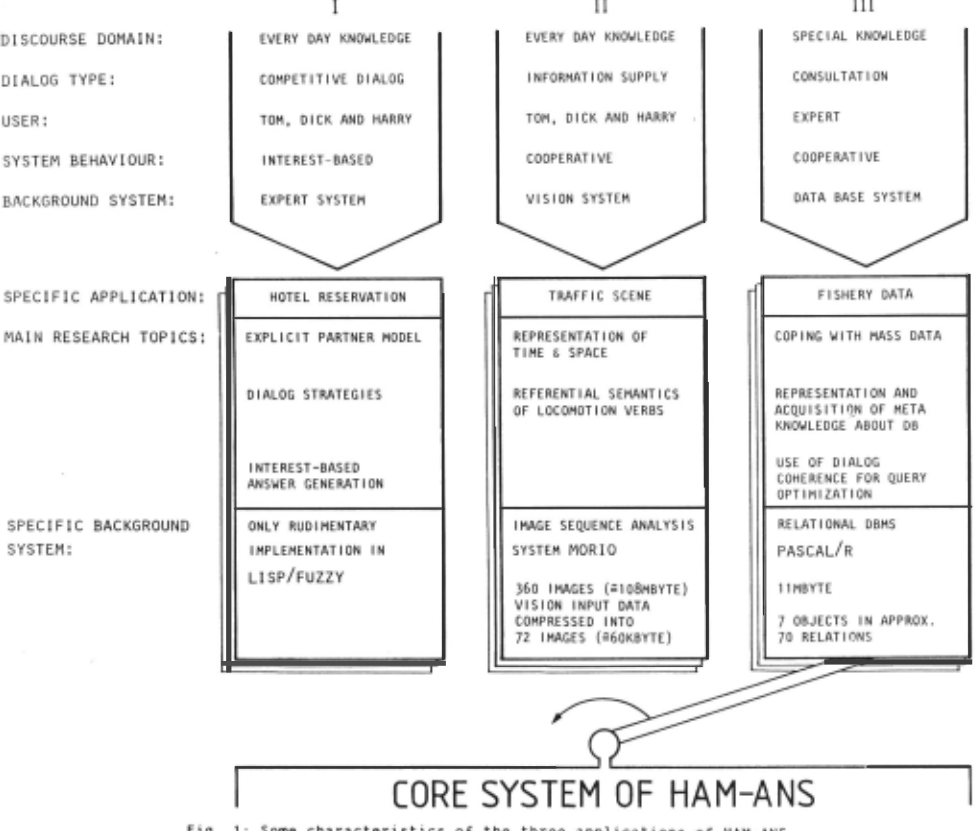
In the past , considerable effort has been devoted to the development of domain-independent natural language (Nll interfaces. As it turns out, doma1n 1ndependence does not mean that such NL interfaces can be adapted for such diverse information processing systems as CAD, simulating, and operating systems (which we will henceforth call ba ckground systems!. Thus going beyond domain independence mean s the attempt to create a core system that can serve as a basis for interfaces to variou s application classes (see fig . 1) that differ not only with respect to the background system but also with respect to dialog type, user type, intended system behaviour, and discourse domain (see upper half of fig . 1). We define the core system of an NL interface as consisting ideally of those knowledge sources (KSs) and processes that are common to all applications. Of course this is a very ambitious goal that does not seem to be attainable in its full generality in the near future according to the current state of the art, but we have shown that it is feasible in a more limited sense in our design and implementation of the system HAM - ANS (HAMburg Application oriented Natural language System) , which is presently operational as an interface to an expert system, a vision system, and a data base system (see lower halfoffig. 1).
HAM- ANS is a large NL dialog sytem of both considerable depth and breadth, whose components have been developed over a 3-year period with an effort of approximately 15 man-years . The system accepts typed input in colloquial German and produces typed German responses quickly enough (5 -2 5 seconds on an unloaded PDP - 10) to make it
Research on HAM-ANS is currently being supported by the German Ministry of Research and Technology (BMFT) under contract 08IT15038
practical for real - time interaction . The project represents a massive approach towards develop1ng and implementing an actual application-independent, easily adaptable system. The design of HAM-ANS draws mainly upon work on CO-OP [14) , PLANES (24), INTELLECT (8) , TEAM [6) and HAM-RPM (7] .
II . HAM-ANS AS AN NL INTERFACE TO HIGHLY DIVERSE BACKGROUND SYSTEMS
Our research strategy has been to build the core system with a set of diverse applications included from the very beginning. As the upper half of figure 1 shows, the three application classes considered 1n HAM- ANS are defined by choosing a different value for each of the dimensions . Before the capabilities of the working system are demonstrated, let us briefly characterize the communicative situations that we have focused on in the variou s appli ca tion classes listed in figure 1.
In the hotel reservation situation the system takes the role of a hotel manager, who trie s to persuade the user to book a room (see fig. 2). The caller is assumed to have the overall goal of determining whether the room offered meet s his requirements . The system must attempt to recognize the user's specific desires concerning the room as they are revealed usually indirectly - in his utterances and to make use of the various devices available in natural language that permit the room in question to be presented in a particularly favorable light (e.g . the generation of tendentious descriptions using hedged relative adjectives).
In the traffic domain we presuppose the following situational context : The system is observing a street intersection and supplies the user, who is familiar with the scene but cannot see from his remote location, with information about the traffic at that intersection on the phone (cf. [16]) . A geometrical description of the observed scene is provided by the image sequen ce analysis system NAOS/MORIO (5](19] . In this application , in contrast to the hotel domain , where at the beginning of the dialog the user must be assumed to have no definite knowledge about the interior of the room being offered, both partners are assumed to have shared knowledge about details of the domain discussed. This difference has strongly motivated our design of parameterized components for the generation and resolution of definite descriptions and anaphora .
In the database application (18] HAM-ANS provides marine scientists with NL access to a fishery database, which contains data collected during international expeditions in the South Atlantic and the Indian Ocean . The complex structured data sets, which consist of cruise data concerning the vessels' voyages, krill biology data, relevant net hauls and oceanographic data , are stored in a relational database w1th a PASCAL/R data base management system . PASCAL/R is an extension of the well - known programming ~anguage PASCAL, hav1ng the data structure relat1on and a general content-based selection mechanism for relations (21). In contrast to the hotel reservation situation , where the system tries to sell a particular room, in accessing the vision system and the database system HAM- ANS has no interest beyond helping the user by responding in a cooperative way.
We believe it to be very important that each new or modified process be testable in an existing and running program, so that each extension of the system takes place under comparable conditions. Only then it is possible to identify early enough in the design process the application-independent components, the interfaces needed between them and application-dependent ones, and the tools that make it feasible to build an NL interface based on the core system. We have attempted to develop the different linguistic, communicative, and cognitive abilities of the core system as evenly as possible .
Often we started with highly non-deterministic but easy to handle control structures for the rapid development of new components . In later stages of development, after careful evaluation of the actual flow of control in these components, optimizations were performed which often produced sequential and simple control structures.
Even in the simplest settings it seems illusory to develop an application-oriented NL interface merely by radically cutting away advanced features from relatively complete, but inefficient NL systems that are used as vehicles for basic research (cf . [3] [22]) . Therefore, in the design and implementation of HAM-ANS we have dealt from the beginning with phenomena like anaphora resolut1on, user modelling, the generation of extended responses, and focus shifting, always looking for simple and efficient solutions that provide the user with an adequate functionality in limited domains without trying to simulate human performance .
The technical question of communication between HAM-ANS and the background system is not adre ss ed in figure 1. We have implemented a module in HAM ANS for communicating with interactive background systems according to the ISO reference model for ·open System Interconnection ' [26] . The session control level is realized as an asymmetric interprocess communication; i.e . HAM-ANS controls, for example, the PASCAL/R interpreter as a slave process. This allows the NL interface to proceed with a dialog with the user while PASCAL/R is performing an assigned task. At the presentation level, the background system is expected to be able to transform from external to internal representations and vice versa . This approach seems to contribute to application independence . However , an equivalent module must be defined in the NL interface for each application .
Ill . AN OVERVIEW OF THE CORE SYSTEM
In HAM-ANSa user's utterance is processed in a multi-level fashion (cf . [9]) : Initial and final dialog sections in the hotel reservation application ( cf . fig. 2) are handled by a surface · level model which is realized by a script-like dialog - grammar, since these sections of a telephone call consist largely of standard phrases. The user's more specific questions about the hotel
APPLICATION CLASSES
I I I
room, however, are analyzed in a linguistically deep manner . In this section, only the second level of processing is considered .
HAM-ANS: HOTEL LORELEY, GOOD EVENINGI USER: Good evening, this is Schmidt, University of Hamburg.
HAM-ANS: WHAT CAN I DO FOR YOU?
USER:
I would like a three - bed room for two days.
HAM- ANS: SURE, I JUST HAVE A LOOK UP . .. A ROOM WITH THREE BEDS UNTIL JANUARY 2GTH?
USER : That's right.
HAM-ANS: YES, THERE ARE STILL SOME
VACANCIES .
IS THERE ANYTHING ELSE YOU WOULD LIKE TO KNOW ABOUT YOUR ROOM?
USER:
HAM- ANS:
USER:
HAM- ANS:
USER:
HAM-ANS:
USER:
HAM- ANS:
USER :
HAM- ANS:
USER:
HAM - ANS:
USER:
HAM-ANS:
USER:
Does the room come with a TV or radio?
YES, THERE IS A RADIO, BUT
THE ROOM DOESN'T HAVE A TV.
A telephone'~
YES.
Perhap s there's a desk in the room?
YES, THERE IS IN FACT A DESK .
I s it a well - lit room?
YES.
Indeed ?
IT HAS GOT A BIG WINDOW.
Fine.
MAY I RESERVE THE ROOM FOR YOU?
Yes, please.
A ROOM WITH THREE BEDS IS BOOKED UNDER THE NAME SCHMIDT FROM JANUARY 24TH UNTIL 26TH. THANK YOU VERY MUCH . GOOD BYE.
Good bye.
Fig . 2: A translated example of a dialog with HAM- ANS in the hotel domain
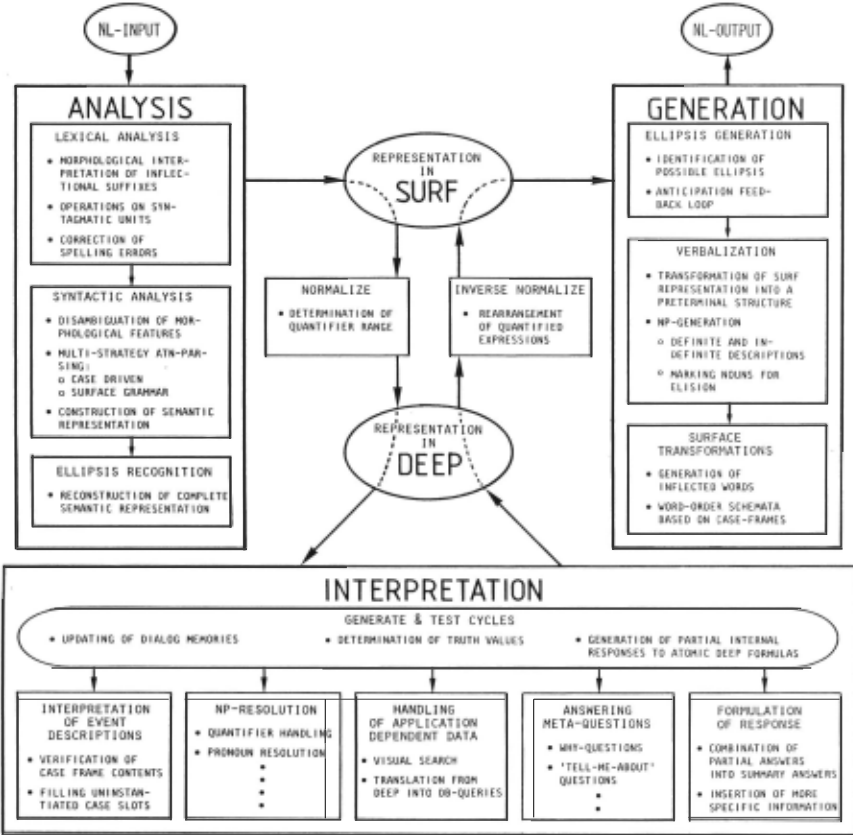
Figure 3 gives an overview of the most important components in HAM-ANS . Arrows between components and the three major processing units indicate the sequence of control usually followed by the system. As it is impossible to give a detailed description of each processing unit of HAM- ANS in this paper we will focus on the way the system interprets the internal representation of a user's input. The analysis and generation components will only be sketched .
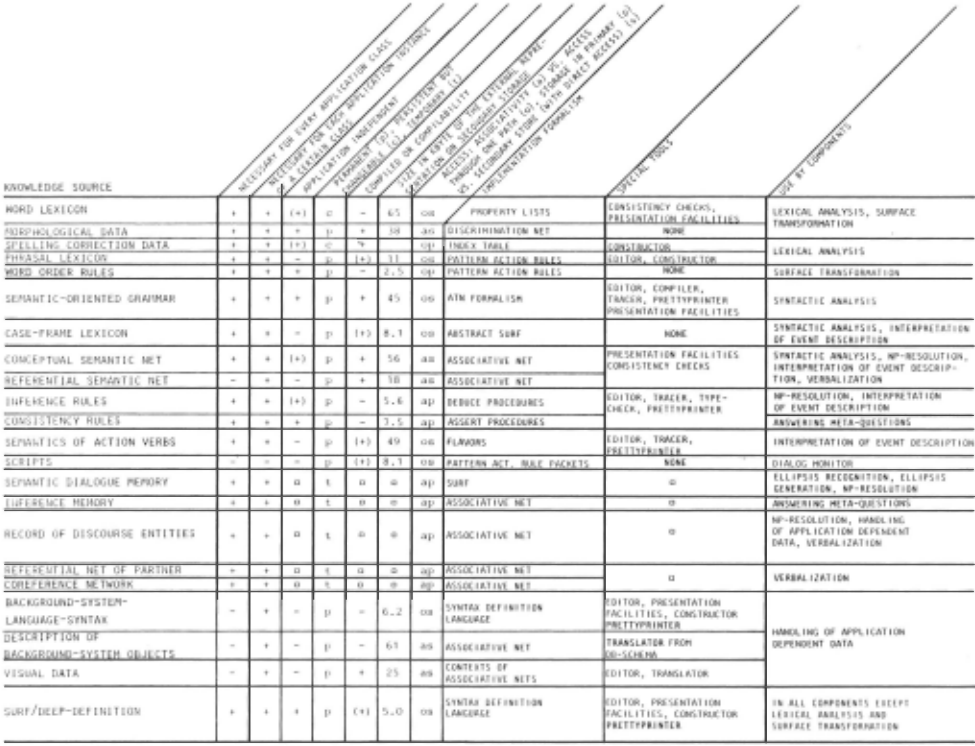
The central representation formalisms of HAM- ANS are the logic-oriented semantic representation languages SURF and DEEP. Although for reasons of efficiency we use a wide range of specialized representation formalisms for the many kinds of knowledge sources needed in HAM- ANS (see fig. 4) , it has been very important to have one central meaning representation formalism to facilitate collaboration in the production of such a large scale NL system, so that code portions generated by all team members work properly together.
SURF and DEEP are designed to be declarative,equivalent to a logic of a higher order, and, because their definition itself is de c larative, easily extendable. The difference between the two 1s that SURF is structurally as close as po ss ible to NL utterances, whereas DEEP is better suited for the evaluation of utterances on the basis of the system's domain specific knowledge. For example, quantifier scope is not yet explicit in SURF representations - quantif1ed substructures are ordered according to their intrinsic scope. This approach is modelled after that of Hendrix [10]. modified for the German quantifier system. SURF is the target language for the parser and the source language for the generator . The components NORMALIZE and INVERSE NORMALIZE transform expressions in SURF into DEEP and DEEP into SURF, respectively .
Some of the salient features of SURF/DEEP are the inclusion of question operators and logical operators for expectability and value-judgement particles such as 'of course · and 'unfortunately ' and the representation of vague quantifiers suc h as 'almost every' and hedged predicates like 'reasonably comfortable' . Moreover SURF/DEEP include constructions for conjoined terms (e.g . 'one bed and several chairs'), noun-phrases with 'of the .... ' (e . g . ' three to five of these rooms· I and complex coordinative conjunctions (e . g . 'but ' ) . SURF and DEEP also use lambda abstraction and meta predicates for marking deep cases, tense and voice.
Di s similar applications require that diver se concepts be expressable in the representation languages. For instance , the semanti cs of locomotion verbs mainly studied in the traffi c domain can be adequately represented by case frames instead of term and predicate structures, which serve as a representation formalism for state descriptions occuring typically in the hotel reservation situation. The SURF/DEEP languages are easily complemented by constructs for new concept s and even a complete reformulation of the case system and its integration into the processing components affected by it took less than 5 man weeks . Thus the design of these central representation languages supports our approach to build a core system for diverse domains .
The processing of a user's NL input starts with a rather elaborate lexical and morphol ogical analysis which reflects the more synthetic character of German as opposed to English . The syntactic analysis comprises two different strategies, both of which use the same ATN definitions of syntactic categories, e . g. for noun phrases and prepositional phrases . The difference between these strategies lies in the amount of domain knowledge guiding the parsing process . The case -driven analysis strategy [12] contains more specific restrictions for possible case slot fillers than the other strategy, which uses a surface-grammar to cope with word -order variations . The ATN-interpreter incorporates a mechanism to save complete substructures of an utterance as SURF representations, thus enabling the ellips is recognition component to handle several types of contextual ellipsis by inserting the partial semantic representation into the complete representation of the previous utterance .
The grammar of the core system currently includes rules for complex noun phrases, all common sentence types in various tenses , conjunction (including the most common forms of gapping) , replacement ellipsis, all common quantifiers , relative clauses, sentences with sentential complements, and adverbial modifiers . It does not include comparative and superlative constructions , expansion ellipsis, counterfactual sentences or other complex types of subordinate sentences. Before giving a more detailed description of the interpretation unit in the next section, we will sketch the generation of natural language responses (for a detailed description see [23]).
The input to the generation unit is a SURFrepresentation of a complete utterance . The ellipsis generation component compares thi s structure to the one constructed by the analysis and identifies the relevant , i . e . new or questioned parts to be passed on to the verbalization component. Possible relevant substructures are rated by applying the system's reconstruction ca pabilit1es in an anticipat1on feedback loop [13] .
The task of the verbalization component is to produce a string of canonical words and their grammatical features. This process uses a set of translation rules attached to each category of SURF expressions and is guided by the message to be expressed rather than by the hierarchical structure of the grammar . A special subcomponent provides for the generation of noun phrases as descriptions of domain individuals, which may be part of the SURF expression to be verbalized . Finally the ' surface transformations' component yields a standard word order schema of the utterance and the correctly inflected forms of the canonical words .
Although, in general, uniformity of repre - sentation is one of the architectural principles of AI - systems [20] [25], Davis [4] has pointed out with an example of two larger expert - systems that while a uniform representation is useful for communication between components, the attempt to enforce the same uniformity on all components either fails completely or causes intolerable performance degration. Our experience gained during t he development of HAM-ANS also provides evidence against a strong uniformity principle . In an application-oriented NL dialog system there are so many kinds of processes (cf . fig . 3) that require s pecial kinds of knowledge (cf . fig . 4) that a uniform repre sentation schema is unfeasible . There i s hardly any common knowledge representation formalism adequate for e . g . the morphological data, conceptual semantic data and case - frame lexicon . Natu r ally non - uniformity per se is not a design goa l in our approach : Wherever possible we have us ed uniform formalisms (cf . fig . 4, 'implementation formalisms ' and [2]) .
During the process of developing the lexical analysis component, we tested several representation formalisms . First we used an associative net for representing the word lexicon and DEDUCE procedures (similar to PLANNER ' s THCONSE theorems) for carrying out morphological analysis
[7] . These mechani sms wer e the same as tho se used in the evaluation component . The disadvantages we re that a blind sear ch wa s performed by the cont r ol regime of the DEDUCE procedures and memory requirements of the associative ne t wer e relatively high . We used assoc iativity although it wa s not needed because of it s ease of extendibility . After discovering which operations must be applied in which order the DEDUCE procedures were sub s tituted by a discrimination tree for suffi xe s and LI SP functions to interpret it, freezing the morphological analy s is as a stri ctly sequential deterministic process . Because the lexical analy s is component ac ces s es the lexi con only by words, we replaced the associative net by a random acces s flle conta1n1ng lex1cal knowledge 1ndexed by words .
Similar experience was gained by us ing ATN s in the verbalization component (cf . fig . 3 ) . It seems conceptually elegant to us e the s ame repre sentation formalism for generation as for syntacti c analysis. Becau s e ATNs only recognize linear s tructures and not tree struc ture s s uch as SURF expres s ions , an ATN must analyze the SURF expression in linear form, thereby 1mplicitly building the structure that is already present in the SURF expres s ion. Having experimented with ATNs we now use the recognizer function s for SURF expressions which are more appropriate in this appli cation .
| KNOWLEDGE SOURCE | (+) | c | - | 6 5 | |||||
|---|---|---|---|---|---|---|---|---|---|
| WORD LEX I CON | -+ | os / PROPERTY LISTS | CONSI STENCY CHECKS , | LEXICAL ANALYSI S, SURFACE | |||||
| C: fl70R:CP:CHC:O:c-L-::0-:G-:Ic:-CA :CLc-:D:-:A-::T:-:A------t-,,-1f--: SPELLI NG CORRECTION DATA | + | , | +-,-,t-l-: | , | -t-c, | -t....,-, 3B.,-1f-: | a-: s"'O;-;I-;-S;c | PRESENTATION FACI i TifS CR;-;I-::H-:;IN-;:A-;-T-:;IO::CN"C"N:::E::T----f=-'-"'.!.!l!-',Nc;OC:;N.;.E""-'-'J..Lll>----i | TRANSFORMATI ON |
| PHRASAL LEX ICON | -t | + -t | (+) - | c o | '+ + | 11 | op INDE X TABLE os PATTERN r.r:T I ON Rill | ED ITOR CONSTRUCTOR | LE XI CAL ANALYS I S |
| WORD ORDER RULES | + | + | + | p | 2 . 5 | op PATTERN ACT I ON RULE S | NONE | SURFACE 1 RANSFORHAT I ON | |
| SEflANT I C-OR I ENTED GRAt·lMAR | 4 5 | os ATN FORMALI SH | ED ITOR, COMPILER, TRACER, PRETTYPR I NTER PRESENTATION FAC ILITIES | SYNTACT I C ANALYSI S | |||||
| CASE -FRM1E LEX I CON | ( +) | 8. 1 | OS ABSTRACT SURF | NONE | SYNTACTIC ANALYSI S, INTERPRETAT ION OF EVENT DESCR I PTION | ||||
| CmKEPTUAL SEHANTIC NET | • | + ~N:;:E;:;T;---+-_-1f-,-:-t-_-t-~:-t-:-:+-t-;;1 | (+) | p | + | 56 | as ASSOC IATIVE NET | PRESENTATI ON FACILITIES | SYNTACTIC ANALYSIS, NP- RESOLUT I ON, INTERPRETATION OF EVENT OESCRIP- |
| ;::R;:- E F~E:;R;;E:;- N:;T-; 1 -; A ;- L ~S;:;E::~;-;lA-;:N:;T-;-1 ;- C | srlf-:: | a-: s+ A:::Sc:- SO;:;C:c-1-: AT:CI-:Vc:- E -:N-::E-::-T | ------i CONS I S TE NC y CHECKS | T I ON, VERBALI ZATION | |||||
| IIJFI: kE IKE RULES | + | + | (+) | P | - | 5 . 6 | ap DEDUCE PROCEDURES | ED ITOR, TRACER, TYPE | NP-RESOLUTI ON, INTERPRETATION OF EVENT DE SCRIPT ION |
| ;:- C;:: ON"'S"'I'"'S"T"'E""N7 C""Y-,R"'u"L""'E""'S-------t--,-1'-- | , | +-,-t--p-.J--_-t-::7-.-:- | S+-a-~ f-A:-:S:::S:-, E R:-:T:-:::PR'"'o"'c"'Eo'""u"RE"'S:----lCHECK, | PRETTYPR INTER | ANSWER ING META-QUEST IONS | ||||
| SE1·1AI. TI CS OF ACT I ON VERBS | p | (+) | 49 | os FLAVORS | EDITOR, TRACER , PRE TTYPR I NTEI | INTERPRETATI ON OF EVENT DESCRIPT ION | |||
| SCR I PTS | ( +) | 8 . 1 | O S PATTERN ACT. RULE PACKETS | NONE | 0 I ALOG HON I TOR | ||||
| SE1·1ANT I C D IALOGUE MEHORY | ap SURF | Elll PS I S R£COGN IT I ON, Elll PSI S GENE RAT I ON, NP-RESOLUT ION | |||||||
| I IJFEREIKE ME1·lORY | o | o | ap ASSOCIATIVE NET | ANSWERING META-QUEST I ONS | |||||
| RECORD OF DISCOURSE ENT ITI ES | o | a | ap ASSOC IATI VE NET | NP-RESOLUT ION, HANOLI NG OF APPLI CATION DEPENDENT DATA, VERBALIZAT I ON | |||||
| REFERErH I AL NET OF PARTNER | o | a | ap ASSOCIATIVE NET | VERBALIZATION | |||||
| COREFERENCE NETWORK BACKGRO UND-SYSTEM- | a | a | ap ASSOC I AT I VE NET | EDITOR , PRESENTATION ~~~~~~~~~~-fE;ONSTRUCTOR | ~:~~~~~~T O~A~:PL I CAT I ON | ||||
| LANGUAGE -SYNTAX | - | + | - | p | - | 6 . 2 | os ~!~~~~�~H IN I T I ON | ||
| "D""E"SC"'R"I"P"T"I"O'-N-Oo;Fr----------1-_-f---, BACKGROUND- SYSTEM OBJ ECTS | +-_-t--- | p-t-_-t-6 | -~ | +-a-5--j-A-S-SO_C_I-AT_I_V_E_N_E_T | -----fT.!OR.C. AN!..!S-'.l!..!AT'-'0-"R-'-'F'-'R'-OH-------i DB-SCHEMA | ||||
| VISUAL DATA | - | + | - | P | 1 | 25 | as ~~~~~~~~ ~ ~~ NETS | ED ITOR, TRANSLATOR | |
| SURF/DEEP-DEF INITION | p | (+) | 5 . 0 | SYNTAX DEF INITI ON OS LANGUAGE | EO I TOR, PRESENTATI ON FAC ILITI ES, CONSTRUCTOR PRETTYPRINTER | IN All COMPONENTS EXCEPT LE XI CAL ANALYSI S AND SURFACE TRANSFORIIAT I ON |
not app l 1cab le
Fig. 4 : An overview of the knowledge sources of HAM-ANS
IV . AN EXAMPLE OF SEMANTIC INTERPRETATION
The interpretation of DEEP expressions may be illustrated by an example taken from a dialog in the hotel - reservation situation. We assume a Slt uation s imilar to that of the example in figure 2 :
User: HAM-ANS : Is there a lamp next to every bed? Ye s , next to almost every one.
Several features are worth noting in the way the system answers this question. First, the system does not merely answer negatively, when a universally quantified expression cannot be verified 1n a strict sense, but rather tries to modify the quantifier. Second, the system answers yes-no questions in an extended and cooperative way. This is one of the reasons for constructing a system capable of producing complete responses . Third, the system·s utterances contain only those parts which bring in new information . In the example above this is particularly notable, since the noun phrase has been reduced down to its quantifier part. We may now take a closer look at the way the example is interpreted and the response is formulated.
The analysis unit constructs a SURF representation reflecting the question of whether the relation NEXT/ TO holds between the subject NP ·a lamp · and the NP ·every bed· . NORMALIZE transforms this SURF formula into a DEEP formula and embeds the first noun phrase into the second one, since the quantifier "every is stronger than the indefinite article ·a· (cf. the argument of the first TEST in fig. 5). This DEEP representation excludes the interpretation : ·Does a single lamp exist such that it is next to each bed? "
The task of interpreting a DEEP formula 1s governed by a generate and test strategy . Generate and test procedures can be viewed as being activated by pattern- directed invocation and differ from each other in that the generate procedures assign internal object identifiers to variables in DEEP formulas, while the test procedures yield two values, the first of which is either a fully instantiated formula equivalent to the input formula or a modified one dependin~ on the state of affairs, and the second of whlch indicates the truth value of the input formula in the range (0,1] . In the interpretation phase these two processes interact in such a way that a test attempt activates generate procedures which again call test procedures and so on.
We may now take a closer look at the way the DEEP formula in our example is treated in HAM- ANS . NORMALIZE has ordered the quantified terms for the NPs ·a lamp' and "every bed" such that the interpretation can proceed from left to right, resolving the NP with the stronger quantifier 'every· before searching for referents for the second NP. This DEEP-formula is shown at the top of figure 5 as the argument of the first TEST. The interpretation process now attempts to verify the complete formula in a top-down manner using the system's inferential capacity and other domain specific knowledge sources (e . g . semantic networks and visual data) .
As soon as this process of decompos1ng the complete formula discovers a structure conta1n1ng variables, a set of generate procedures 1s activated and produces the set of object identifiers in the hotel room being considered . Since the client in the initial dialog has asked for a three - bed room, this set is instantiated by (BED 1, BED2, BED3). The rest of the formula is then recursively sent to a test process with variables substituted by elements of the reference set for beds one after the other . Being aware that the relation to be verif1ed is a spatial one, a special s ub set of procedures produces the identifier of the most sal1ent object that is in the relation NEXT/ TO with the specific bed.
A subsequent test phase determines whether the generated object belongs to the class of lamps. If this cannot be shown, as in the example of the deepest TEST attempt, a further obJect in the ne1ghbourhood of the specific bed is generated and tested until either the conditions are satisfied or no more objects in the relation NEXT/ TO can be generated. Success or failure of the test phases are noted in local memory-registers (HITS and HISSES) which form the basis for composing a complete DEEP formula that comprises the result of the entire interpretation process .
With the quantifier between generate and test every ' , processes the interaction is performed
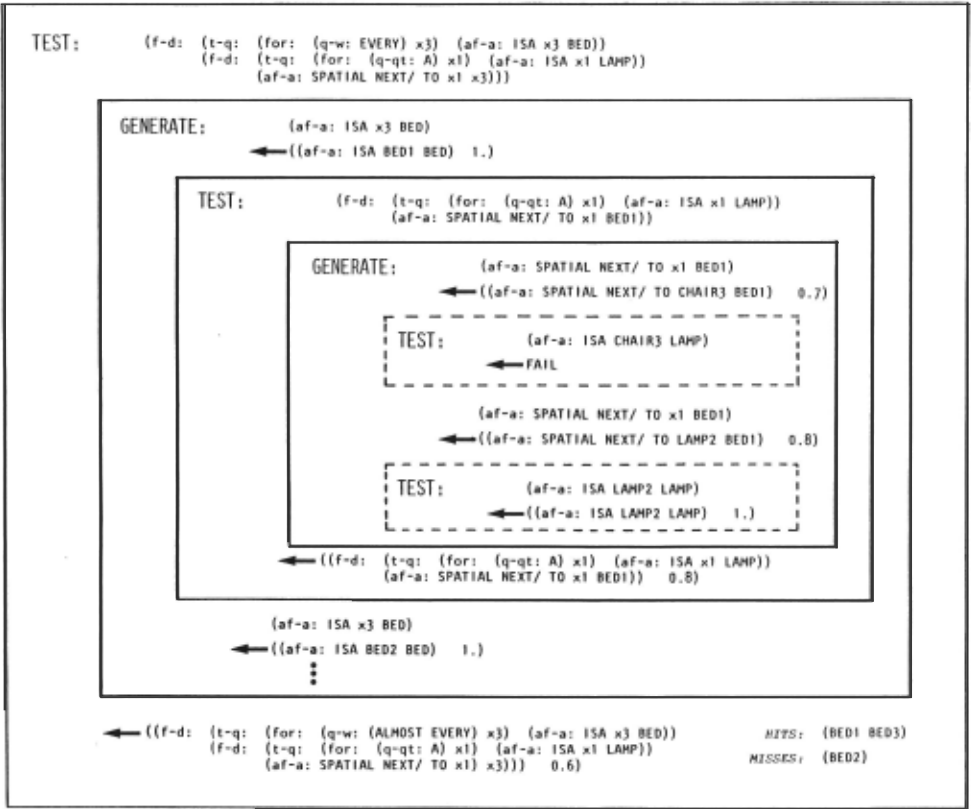
unt1l all of the extensional entities of the concept 'bed' have been inspected . In our example the spatial relation between two of the beds (BEDI and BED3) and a lamp could be established while no object of the class 'lamp' could be generated that met the restriction of NEXT/ TO with respect to BED2 . This bulk of spec1fic knowledge could be transferred to the client, but the natural language descr1ptions necessary to be produced for each of the ObJects would only be understood by someone w1th 1nt1mate knowledge of the specific hotel room. Therefore the information saved in the local memories is summarized: Similar partial assertions are merged into a single expression, whose quantif1er-part indicates the number of successes (or failures).
In addition, the interpretation process uses linguistic hedges to express the relation between successful and unsuccessful partial results. In the example of the three-bed room, only two beds with a lamp next to them are identified and the resulting DEEP quant1f1er 1s replaced by the single hedged quantifier 'almost every'. Although the generate and test strategy rema1ns the same in each application class access to external data bases must be able to handle the expressive power of the DB query language.
V. CONCLUSION
A version of HAM-ANS written in UCI - LISP/FUZZY [17] [15] is presently running under the TOPS10 operating system on a DECsystem 1070 (KI - 10). Comprising approximately 900 procedures. the current ver sion requires 200K of 36-bit words .
Building an actual application-independent, easily adaptable system is the research topic in our project HAM - ANS . To meet this demand our research strategy has been to build the core system taking into account a set of highly diverse appli ca tions, so that each modification (e . g . extensions to the linguistic, communicative and cognitve capabilities) is testable under varying conditions.
We have provided a detailed presentation of the interpretation proce ss, whereas some of the other distinguishing features of our system, e.g. multi level processing of user utterances, multi strategy parsing and generation of complete system utterances, were only introduced briefly .
Further work will concentrate on broadening the system"s capab ilitie s with a more elaborate partner model, the handling of NL DB updates, facilities for explanation of the systems speech acts, for the treatment of word formation [11] , and for NL knowledge acquistion. Although the HAM-ANS core system described is operational, setting our work in relation to the software life cycle, we are still at the system development stage and it will be a long time before the system i s ready for distribution to a user community.
@inproceedings{ijcai1983p138,
  title     = {Beyond Domain-Independence: Experience With the Development of a German Language Access System to Highly Diverse Background Systems},
  author    = {Hoeppner, Wolfgang and Christaller, Thomas and Marburger, Heinz and Morik, Katharina and Nebel, Bernhard and O'Leary, Mike and Wahlster, Wolfgang},
  booktitle = {Proceedings of the Eighth International Joint Conference on
               Artificial Intelligence, {IJCAI-83}},
  publisher = {International Joint Conferences on Artificial Intelligence},
  editor    = {Alan Bundy},
  pages     = {588--593},
  year      = {1983},
  note      = {Natural Language},
  url       = {https://ijcai.org/proceedings/1983/138},
}
TY - CPAPER TI - Beyond Domain-Independence: Experience With the Development of a German Language Access System to Highly Diverse Background Systems AU - Hoeppner, Wolfgang AU - Christaller, Thomas AU - Marburger, Heinz AU - Morik, Katharina AU - Nebel, Bernhard AU - O'Leary, Mike AU - Wahlster, Wolfgang T2 - Proceedings of the Eighth International Joint Conference on Artificial Intelligence, IJCAI-83 PB - International Joint Conferences on Artificial Intelligence PY - 1983 SP - 588 EP - 593 UR - https://ijcai.org/proceedings/1983/138 ER -Copied
Machine-readable versions of this paper, for tools and AI agents:
 Welcome
 Future Conferences
 AI Journal Division
 IJCAI Proceedings
 About IJCAI
 IJCAI Awards