
AND Parallelism in Logic Programs
Proceedings of the Eighth International Joint Conference on Artificial Intelligence. Logic Programming. Pages 539-542.
© 1983 International Joint Conferences on Artificial Intelligence
Abstract
An interpreter for logic programs is defined which executes some goals in parallel. OR parallelism exploits the parallelism defined from nondeterministic choices, and is essentially a replacement for backtracking. AND parallel ism comes from solving goals in the body of a single clause in parallel, and is the only way to exploit parallelism in deterministic functions written as logic programs. A unique feature of our model is that it allows both forms of parallelism for the same computation.
- Arvind. K. P. Gostelow. and W. E. Plouffe. An Asynchronous Programming Language and Computing Machine. Tech. Rep. 114a. Dept. of Info. and Computer Sci •• UC Irvine. December. 1978.
- Clark. K. L •• and F. McCabe. The Control Facilities of IC-Prolog. In D. Michie. Ed •• ~ Systems in ~ ~ Electronic ~. Edinburgh Univ. Press. 1979.
- Conery. J. s .• P. H. Morris. and D. F. Kibler. Efficient Logic Programs: A Research Proposal. Tech. Rep. 166. Dept. of Info. and Computer Sci •• UC Irvine. April. 1981.
- Conery. J. S. and D. F. Kibler. Parallel Interpretation of Logic Programs. Proc. of the Conf. on Functional Programming Languages and Computer Architecture. October. 1981. pp. 163-170.
- Conery. J. S. In& AHU/~ ~ ~ Parallel Interpretation Qf ~ Prozrams. Ph.D. Th •• Dept. of Info. and Computer Sci •• UC Irvine. 1983.
- van Emden. M. H. An Interpreting Algorithm for Prolog Programs. Proc. of the First International Con£. on Logic Programming. Faculte des Sciences de Luminy. Marseille. Sept. 1982. pp. 56-64.
- Furukawa. K •• K. Nitta. andY. Matsumoto. Prolog Interpreter Based on Concurrent Programming. Proc. of the First International Conf. on Logic Programming. Faculte des Sciences de Luminy. Marseille. Sept. 1982. pp. 38-44.
- Kowalski. R. A. Predicate Logic as a Programming Language. Proc. IFIPS 74. 1974.
- Pereira. L. M •• F. C. N. Pereira. and D. H. D. Warren. Users Guide to DECsystem-10 Prolog. Dept. of Artificial Intelligence. Univ. of Edinburgh. September. 1978.
- Pereira. L. P. and A. Porto. Intelligent Backtracking and Sidetracking in Horn Clause Programs -the Theory. Report 2/79. Departamento de Informatica. Universidade Nova de Lisboa. October. 1979.
- Warren. D. H. D. Efficient Processing of Interactive Relational Database Queries Expressed in Logic. Paper 156. Dept. of Artificial Intelligence. Univ. of Edinburgh. September. 1981.
References were extracted automatically from the PDF and may contain errors.
Full text extracted automatically from the PDF; figures, tables and equations may differ. The PDF is the version of record.
1. Introduction
In this paper we present a method for exploiting AND parallelism within the context of the AND/OR Process Model [4]. This paper focuses on the division of a that can be executed concerned with the logic program into pieces in parallel. We are management of abstract processes their creation, termination, and communication. We postpone dealing with the significant problems of effective distribution of processes to processing elements (PEs) and the physical structure of the interconnection of PEs and the resulting communication times. At this point, we assume only that each PE will have a large amount of local memory, sufficient to store some number of processes and its own (unchanging) copy of the entire program. A more complete description of the AND/OR Process Model and AND parallelism can be found
in Conery's dissertation [5].
1 This research was supported by the Naval Ocean Systems Center under Contract N00123-81-C-1165.
AND Parallelism in Logic Programs
John s. Conery Dennis F. Kibler
Department of Information and Computer Science University of California, Irvine Irvine, Ca. 927171
2. Sources of Parallelism
A logic program is a set of clauses of the form Po + Pl A ··· A Pn· where each Pi is a literal. The literals Pi· i > O, form the ~ of the clause and the literal Po is the .heJili of the clause. A computation in a resolution based logic programming system is a sequence g 0 · · gm of ~ statements, each of which 1s a set of literals. The derivation of statement gi+l from a literal head that gi requires two choices: first, select Pg in gi' then find a clause which has a can be unified with Pg using unifier 9. gi+l is the resolvent of gi and the clause, and contains all literals (except gi· plus the literals from the body Statement selected Pg) from of the
selected clause [8].
Normally, the choice of Pg is fixed . For the second choice, if there is more than one clause with a head that unifies with p , then the current g statement is a ~ .llQinr., and a tree of goal statements is defined. The typical sequential control in logic programming systems (e.g. [6]) is a depth first search for an occurrence of the null
clause in this tree.
One parallel point, possible parallel search of the distribute the control method 1s a tree: goal at each choice statements at descendant nodes to interpreters running on independent computers. The expected speedup in execution will be obtained if one of these interpreters derives the null clause more quickly than an interpreter that performs a simple depth first search. The amount of time required (ignoring inter-computer communication times) will be directly proportional to the length of the shortest path in the search tree from the root to a null clause. The amount of time required by a depth first interpreter is proportional to the sum of path lengths in all branches to the left of the
first branch that contains the null clause.
The search tree for a deterministic program has exactly one null clause. which is typically at the end of the leftmost branch. Parallel search cannot speed up the execution of one of these programs. An interpreter based on AND parallelism is able to effectively shorten the length of this chain of derivations. and as a result obtains the same sort of parallelism for deterministic logic programs that is seen in other functional programming languages [1]. The outline of one such interpreter is presented here. in the context of the AND/OR process model.
3. The AND/OR Process Model
Our parallel model is based on the notion of independent processes which communicate via messa~es. An i2R process is basically an independent interpreter. created to solve a goal statement that contains exactly one literal. When solutions are obtained. they are communicated to the process that created the OR process in a success message. For example. if the literal to be solved is 1 sum(3 .4 .X) 1 · the response will be 'success(sumC3.4.7))'. If no solutions are possible. or after all solutions have been sent. the OR process sends a fail message.
An AND process is created to solve a conjunction of goals PI A ·· A Pn· where n ~ 1. When all of the goals in the conjunction have been solved. the AND process sends its creator a success message; if one of the goals cannot be solved then a fail message is sent.
An AND process solves the individual goals in its conjunction by creating OR processes for each one. An OR process solves its literal L by (1) creating AND processes to solve the bodies of nonunit clauses with heads that are unifiable with L. or (2) sending 1 success(C9) 1 when L unifies
with a unit clause c.
The relationship between processes defines an AND/OR tree. The user's original goal statement LS an AND process at the root of the tree. Success and fail messages pass only upward in the tree. from a process to its parent. Messages that can be sent from a process to one of its offspring are ~. ~. and ~. A redo message instructs the descendant to re-solve its problem. If there is another solution. a success message (presumably with a different set of bindings for variables) will be sent. If there is not another solution. a fail message is returned. A reset message sent by an AND process to an OR descendant tells the OR process to start over; the OR process will retransmit all previous answers in response A cancel message indicates that no longer needed. and that it to redo messages. the descendant is should terminate.
By QR execution parallelism of one or we more mean the children parallel of an OR process. i.e. OR parallelism is the simultaneous execution of several clause bodies where the heads match a single goal. A straightforward (sequential) implementation of an AND process just solves the goals left to right: when the OR process for literal Pi sends a success message. then an OR process will be created to solve literal Pi+l; if Pi cannot be solved (i.e. a fail message is received) then the process for literal Pi-1 is sent a redo message. AND parallelism LS the parallel execution of one or more children of an AND process. i.e. a parallel AND process creates more than one OR process simultaneously. The remainder of this paper describes our current implementation of AND parallelism.
Note that our which originally as that used example [7]). definition of OR appeared in [4]. is by some other What they refer parallelism. not the same authors (for to as OR parallelism is the parallel search described in an earlier section and called Goal List parallelism in [3].
4. AND Parallelism
A guiding principle in our work is that the programmer should not be concerned with the details of parallel interpretation. This implies that the programmer should not be forced to annotate his program with control information. as is done in IC-Prolog [2]. Moreover he LS guaranteed that the answers produced by parallel interpretation include those achieved by depth
first interpretation.
There are three independent components in our implementation: An orderin~ al~oritbm determines which literals must be solved before others. and which can be solved in parallel; the forward execution component that handles success messages. and decides if other literals can be solved as a result; and the backward execution component that handles fail and redo messages. and decides which literal(s) from the body must be re-solved.
4.1. Ordering Algorithm
The only constraint on whether or not two literals can be solved in parallel is the sharing of uninstantiated variables. If a set of literals have an uninstantiated variable V in common, one of the literals is designated as the ienerator of values for V, and is solved first. Its solution is expected to instantiate V. When the generator has been solved, the other literals, the consumers, may be scheduled for solution. If a generator instantiates a variable to a non-ground term (one that contains new variables), then the ordering algorithm must be applied again in order to find generators for the new variables.
The execution order of the literals, as determined by the ordering algorithm, can be expressed as a dataflow graph [1], There is a node in the graph for every literal, including the head. An arc, labeled with a variable name, is drawn from every generator to literals that consume the variable.
The ordering algorithm uses three rules when deciding which literal should be designated as the generator of a variable. .t1Qs1.e declarations may indicate that a certain literal must be or cannot be a generator. For example, using the syntax of the DEC-lO Prolog compiler [9], the predicate 1 mode(sum(+,+,-)) 1 means that the first two arguments to a call to 1 sum 1 must be terms or instantiated variables, and that the third argument must be an uninstantiated variable. Thus, when the ordering algorithm encounters a literal 1 sum(3,X,Y) 1 , for · example, it infers that this literal cannot be the generator of X and must be the generator of Y. The interpreter has mode declarations built in for some of the known evaluable predicates (primitive procedures) and the user can add mode declarations to his program if he wishes.
The connection .I.ll.l..e. states that if there is a literal p(X, Y) in the body, and a generator has already been found for the variable X, then p(X,Y) 1.s a good candidate to be the generator of Y. This is just one of many possible heuristics, or general policies, that can be used to select generators. Other heuristics are described in [11] and [10].
The last rule is that the leftmost literal that contains an uninstantiated variable should be the generator of that variable; this rule is used if the other two fail to identify a generator.
An implementation of this algorithm produced the dataflow graphs shown in Figures S-2 and S-4. Note that except for evaluable predicates or user predicates with mode declarations, any literal can be a generator. The ordering algorithm is used primarily to ensure that mode constraints are not violated, and secondarily to produce an efficient ordering.
4.2. Forward Execution
After the ordering algorithm creates an ordering of literals, an AND process enters the forward execution phase. Forward execution is a graph reduction algorithm: when a literal is resolved away from the body of a clause (i.e. when the AND process receives a success message from the OR process created to solve the literal), the corresponding node and all of the arcs leaving it are removed from the dataflow graph.
Recall that the only arcs in the graph are those that connect generators to consumers. An OR process will be created for a literal only when there are no arcs leading in to the corresponding node in the graph, i.e. when all preceding generators have been solved. Finally, when a generator creates a non-ground term (containing a new variable V 1 ), the ordering algorithm must be invoked again, so that a generator is determined for V 1 · Note that this will add arcs to the graph, and may delay solution of some literals
that contained the original variable V.
4.3. Backward Execution
When an AND process receives a fail message from an OR process, it must re-solve some previously solved 1 iteral. The last parent (as defined by a linear ordering of literals, obtained by a depth first traversal of the dataflow graph) for the failed process is sent a redo message. If an OR process with no parents fails, the AND process itself fails.
To be more specific, consider the clause body gl(X) A g2(Y,Z) A p(X,Y) A q(Y)
where gl(X) is the generator of X and g2(Y,Z) is the generator of Y. When p(X, Y) fails, the OR process for g2(Y,Z) is sent a redo message.
In a simple case, that process will return another success message, with a different value for Y, and the AND process can resume forward execution. Note that the process for q(Y) must be canceled when p(X,Y) fails, and replaced when the new value of Y is generated.
A more complicated case arises when the OR
process for g2(Y, Z) fails, signaling that there are no more ways to instantiate Y. At first it would appear that the AND process should fail, since there are no predecessors for g2(Y,Z) in the dataflow graph. However, since p(X,Y) may succeed with a different value for z, the appropriate action is to send a redo to the process for gl(X) and to reuse all values of Y by sending a reset message to g2(Y,Z). In other words, p(X,Y) has to be tested with all possible combinations of X and Y.
The method for deciding which generatbr(s) must be redone, and in complicated. The AND literal a list, called what order, is quite process maintains for each a ~ ~. containing all of the literal's ancestors in the dataflow graph. A failure context is used to determine which of the ancestors in a redo list have in fact been sent redo messages. The AND process must keep multiple failure contexts, for those situations when a number of literals fail, and redo messages have to be sent to ancestors of each failed literal [5].
5. Example Computations
We illustrate AND parallelism by describing the execution trace printed by our interpreter as it solved two sample problems.
Fast factorial is an example of a deterministic function, where the subgoals will not fail, and the backward execution component is not required. The map coloring problem, used by Pereira and Porto to illustrate intelligent backtracking [10], 1s a problem that does require backward execution.
5.1. Fast Factorial
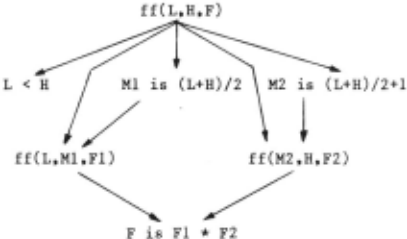
The Fast Factorial program (Figure 5-l) typifies the divide and conquer approach to solving large problems. The procedure is called with two integers (named H and L) as inputs, and instantiates F to the result. Note that the head of the clause is the generator of H and L and the consumer of F. The divide and conquer version of this function is to compute the midrange between H and L, find the products F 1 and F 2 of all integers in these smaller ranges, and then multiply the results. As the graph shows, the computation of Fl and F2 can proceed independently, as soon as the midpoints are computed.
A depth first interpreter must solve the subproblems sequentially. This is an example of a deterministic function for which the only answer is found at the end of the leftmost branch in the mode(ff,[+,+,-]). mode(is,[-,+]).
fact(N,F) + ff(1,N,F).
ff(N,N,N).
ff(L,H,F) +
L < H A
M1 is (L + H)/2 A
M2 is (L + H)/2 + 1 A
ff(L,M1,F1) A
ff(M2,H,F2) A
F is Fl*F2.
F is Fl * F2
Figure 5-2: Dataflow Graph for Fast Factorial
search tree, and thus an example of a program for which a parallel search will not gain any speedup over a depth first search. In our interpreter, however, the recursive calls are solved by independent interpreters (OR processes), and the time complexity on a multiprocessor, under the right circumstances, could be reduced to O(log 2 T) from O(T), where T is the number of steps taken by a sequential interpreter.
5.2. Map Coloring
A map coloring problem, its representation as a logic program, and the dataflow graph produced for it are shown in Figure 5-3. The forward execution phase of the computation was: 1 next(A,B)' is the only node without incoming arcs, so it was the only one for which an ,OR process was created in the first step. As soon as 1 next(A,B)' was solved, processes to solve 'next(A,C)', 1 next{A,D) 1 , and 'next(B,E) 1 were created. When 1 next(A,C) 1 succeeded (instantiating C to a color), a process for 1 next(B,C) 1 was created to verify the values of B and C. Similarly, after 'next(A,D)' and 1 next(B,E) 1 were solved, processes for the remaining three literals were created.
The generators for B and C instantiated those variables to the same color. so the process for 1 next(B.C) 1 failed. thus triggering backward execution. The redo list (sorted 1 is t of ancestors) for this literal is [next(A.C) .next(A.B)]. so the process for 1 next(A.C) 1 was sent a redo message. in order to get a different value for C. Since the literals 1 next(C.D) 1 and 1 next(C.E) 1 also consume c. the corresponding processes were canceled. When the process for 1 next(A.C) 1 sent the next success message. processes for the three literals that consume C were started (using this new value). and all four literals at the bottom of the graph were solved successfully.
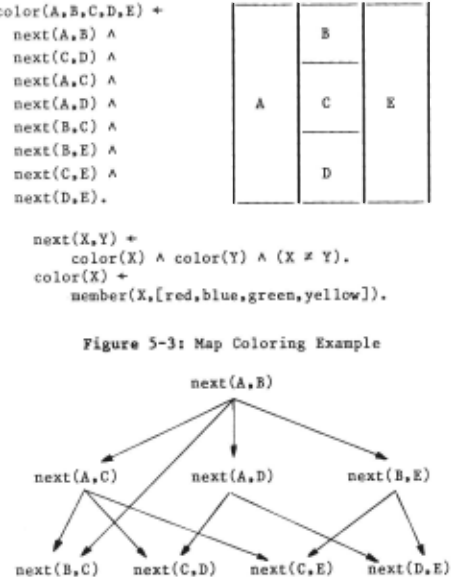
In this example the AND process behaved very much like the intelligent backtracking interpreter of Pereira and Porto. In general. however. our backtracking algorithm will not be as smart as the theirs. since ours must be executed by a number of processes as opposed to a single process with global information. and our fail messages contain no information about m an OR process failed.
6. Conclusion
We have outlined an algorithm for the parallel execution of the body of a clause. The algorithm relies on the use of generators to order the solution of 1 iteral s in a clause body so that a dataflow-like computation l.S performed. The algorithm allows generators to be nondeterministic. meaning they can produce a number of different answers. A major source of complication is in the coordination of these nondeterministic generators [5].
@inproceedings{ijcai1983p129,
  title     = {AND Parallelism in Logic Programs},
  author    = {Conery, John S. and Kibler, Dennis F.},
  booktitle = {Proceedings of the Eighth International Joint Conference on
               Artificial Intelligence, {IJCAI-83}},
  publisher = {International Joint Conferences on Artificial Intelligence},
  editor    = {Alan Bundy},
  pages     = {539--542},
  year      = {1983},
  note      = {Logic Programming},
  url       = {https://ijcai.org/proceedings/1983/129},
}
TY - CPAPER TI - AND Parallelism in Logic Programs AU - Conery, John S. AU - Kibler, Dennis F. T2 - Proceedings of the Eighth International Joint Conference on Artificial Intelligence, IJCAI-83 PB - International Joint Conferences on Artificial Intelligence PY - 1983 SP - 539 EP - 542 UR - https://ijcai.org/proceedings/1983/129 ER -Copied
Machine-readable versions of this paper, for tools and AI agents:





