
Adjusting Bias in Concept Learning
Proceedings of the Eighth International Joint Conference on Artificial Intelligence. Learning and Knowledge Acquisition. Pages 447-448.
© 1983 International Joint Conferences on Artificial Intelligence
Abstract
We approach concept learning as a heuristic search through a space of concepts for a concept that satisfies the learning task at hand . The heuristics represent bias that the conce pt learning program em ploys when forming an inductive generaliz atio n. We present a 1110dcl of bias adjustment and report our experience with un implementation of the model.
- Lenat, D. B., "The Role of Heuristics in Learning by Discovery," Machine Learning, Michalski, Carbonell, Mitchell (eds.), Tioga, Palo Alto, 1983, pp. 243-306.
- Michalski, R. S., "A Theory and Methodology of Inductive Learning," Machine Learning, Michalski, Carbonell, Mitchell (eds.), Tioga, Palo Alto, 1983, pp. 83-134.
- Mitchell, T. M., "Versio.n Spaces: A Candidate Elimination Approach to Rule Learning," Proceedings of the Fifth International Joint Conference on Artificial Intelligence, Cambridge, Mass., 1977, pp. 305-310.
- Mitchell, T. M., Utgoff, P. E., and Banerji, R. B. "Learning by Experimentation: Acquiring and Refining Problem-Solving Heuristics," Machine Learning, Michalski, Carbonell, Mitchell (eds.), Palo Alto, Tioga, 1983, pp. 163-190.
- Utgoff, P. E. and Mitchell, T. M., "Acquisition of Appropriate Bias for Inductive Concept Learning," Proceedings . of the Second National Conference on Artificial Intelligence, Pittsburgh, August 1982, pp. 414-417.
- Vere, S. A. "Multilevel Counterfactuals for Generalizations of Relational Concepts and Productions," Artificial Intelligence, 14:2, September 1980, pp. 138-164.
References were extracted automatically from the PDF and may contain errors.
Full text extracted automatically from the PDF; figures, tables and equations may differ. The PDF is the version of record.
ABSTRACT
We approach concept learning as a heuristic search through a space of concepts for a concept that satisfies the learning task at hand . The heuristics represent bias that the concept learning program employs when forming an inductive generalization. We present a 1110dcl of bias adjustment and report our experience with un implementation of the model.
ROLE OF BIAS
A major objective in research on inductive concept learning is creation of a program that can accept training data, apply knowledge, and form inductive hypotheses of the concept, all without human intervention. The learning program searches a space of hypotheses for those that are consistent with the observed examples, and which classify the unobserved instances as indicated by heuristics. The heuristics, which we call bias, determine the inductive generalizations that the program will form, given some set of training examples. The initial bias may be appropriate for one learning task, yet inappropriate for another. In many concept learning programs to date, e.g. (Michalski 83), (Mitchell 77), the search for appropriate bias is done by hand. We examine an approach to mechanizing that search.
Vere (Vere 80) and Lenat (Lenat 83) have programs that adjust their bias. Vere uses the set difference operator to construct a new description C = A-B when no other consistent description is available. Lenat's EURISKO learns heuristics that lead the program to discover interesting concepts. EURISKO is an advance from Lenat's AM where the search for appropriate bias was done by hand.
II AN APPROACH TO ADJUSTING BIAS
We represent bias as a restricted search space of concepts that we call the concept description language. We use Mitchell's Candidate Elimination Algorithm C:VIitchell 77) to maintain a version space of all concept descriptions in the concept description language that are consistent with the training instances. When the trainer supplies a positive instance, all concept descriptions that exclud-e the instance are refuted and removed from the version space. Similarly, when the trainer supplies a negative instance, all concept descriptions tha t include the instance are refuted and removed from the version space. As shown in Figure 1, as the version space shrinks, the complementary set of refuted hypotheses grows. If the version space becomes empty, then all descriptions in the concept description language have been refuted. A refuted concept description language indicates a refuted bias, and is sufficient justification for adjusting bias. We
· This work was supported by National Science Foundation Grant GMCS80-08889, Rutgers University Laboratory for Computer Science Research, and Siemens Research and Technology Laboratories.
** Current address is Siemens Research and Technology Laboratories, 105 College Road East, Princeton, New Jersey 08540.
ADJUSTING BIAS IN CONCEPT LEARNING ·
Paul E. Utgoff**
Department of Computer Science Rutgers University New Brunswick, New Jersey 08903
do not yet know stronger justifications. The role of bias adjustment is to enlarge the concept description language so that the version space becomes non-empty and search can continue. It may be that certain concepts are not describable within a particular formalism. lfso, shift to a more appropriate formalism: may be necessary.
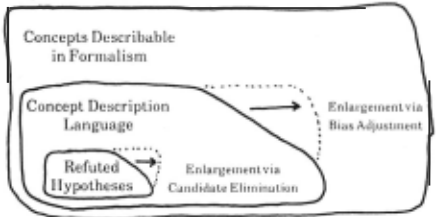
We approach bias adjustment as a three step process:
- Determine a membership specification for the new concept.
- Translate the membership specification into a description that uses the formalism of the concept description language.
- Assimilate the new concept description into the hierarchy of the concept description language.
A membership specification is itself a concept description, but is expressed in an unbiased language so that the heuristics for determining the specification are not compromised by what is expressible. Because the membership specification may be expressed in an alternate formalism, we require the ability to translate the membership specification into a concept description in the formalism of the concept description language. The translation step may require creation of new descriptive terms that correspond to membership specifications that are not describable in the current concept description language. A new concept must then be assimilated into the concept description language by defining its location in ~he hierarchy of descriptions.
III AN EXAMPLE
We have implemented a program that models bias adjustment as part of the LEX program (Mitchell 83) LEX is a concept learning program that learns heuristics that suggest whether a given operator should be applied to a given problem state. -Each operator heuristic IS represented as the concept "set of states to which this operator should be applied."
LEX currently learns heuristics in the domain of integral calculus. The program is initially given a set of problem-solving operators. Each operator has a domain of applicability, a rewrite rule, and a range of producible states. For each operator, the legal domain of applicability describes states to which the operator can be applied. For each operator, the heuristic domain of applicability describes states to which the operator should be applied. -- LEX solves a problem by producing a state that contains no integral. The solution tree is then criticized. Each operator application along the minimum solution path is labelled as a positive instance showing a state to which the given operator should be applied. Each operator application that leads away from the minimum solution path is labelled as a negative instance showing a state to which the given operator should not be applied. The training instances are then used to update the heuristics being learned for the operators. For each operator, Mitchell's Candidate Elimination Algorithm is used to maintain a version spac<: of a ll candidate versions of the heuri stic that have not yet been refuted. If a version space becomes empty, then the bias adjustment module is invoked .
A. A Heuristic for Membership
Deciding the membership of a new concept is the essence of induction. Which instances should be included, and which should be excluded? We employ a heuristic:
The domain of an operator sequence that leads to a soluti'on should be describable in the concept description language.
We choose this heuristic because of our a priori knowledge that the operator heuristic we hope to learn will be the disjunction of all useful sequences that start with that operator. To describe the disjunction, we can start by being able to describe the disjuncts. To compute a specification of the domain of an operator sequence that produces a state in a given range, in this case the set of solved problems, we apply a deduction procedure that we call constraint back-propagation.
Constraint back-propagation is a procedure for deducing the domain of a macrooperator that produces some constrained range of states. Consider an operator sequence of length I that uses operator Opi, as shown in Figure 2. If we constrain. the range of the Op, to some set of states Rc;;;Range(Opil, and then apply the inverse operator Op·li to R, then we deduce a constrained set De;;; Domain(Opi) such that Opi(D) = R. For example, an operator r->[r·2J has the set of real numbers as its domain and also as its range. If the domain is constrained to the set of integers, then the range is constrained to the set of even integers.
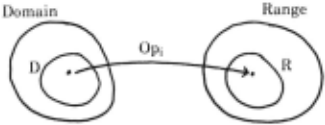
If we know that Opi can produce a state that is a solved problem, we can compute Op·li(lntersect<SolvedProblems, Range(OpJ)) to deduce a constrained set D. D is then the set of states to which application of Opi will produce a solved problem. For operator sequences of length greater than 1, the deduction step is simply applied sequentially to the result of the previous deduction.
B. A Translation Method
A nested expression of intersections and inverse-operator applications, as shown above, is a specification of concept membership, but is not useful as a concept description because operator applications are required to evaluate whether an instance matches the description. The nested expression must be translated from a membership specification into a structural concept description that uses the formalism of the concept description language. Our translation method is to evaluate the membership specification. To let this work, we have defined a descri ption of the set of solved problems, an Inte.rsection function, and inverse operator definitions. New concepts are created and assimilated during evaluation of the membership specification ..
When an operator only restructures a state via a simple rewrite ru le , e.g. a·b->b·a, creation of new concepts is not required because the range of the operator is expressible by a description in the concept description language. When an operator requi res a computation, e.g. multiplication by 2, the range may be describable in the operator language, but not the concept description language. For example, consider an operator r->[r·2]. The [r·21 indicates that the bound value of r should be multiplied by 2, and the result used in the rewritten state. If an operator is to be applied to a set of states, as with constraint back propagation, then correct specification of the operator's domain and range becomes very important. Application of r->[r·2] to the set of integers k produces a description [k·2]. This is a description in the operator language, not the concept description language'
Our method of translating a description implied by a computation y = f(x) to a term in the concept description language is to first create a definition {yl(,\(y)(match f-l(y) x))} and then search for a term with the same definition. If a term with that definit ion is not found, then a new term is created and defined as per the constructed definition .. For example, the definition that corresponds to lk·2] is {yl(,\(y)(match y/2 'k)J}, which we could associate with a new term "even."
C. An Assimilation Method
Assimilation is the process of inserting a new concept description into the hierarchy of description in the concept description language. Assimilation is necessary so that we can use the match predicate to evaluate whether one concept is more specific or equal to another.
Our present method is imprecise. In general, if we are to assimilate z={yl(,\(y)(match f-l(y) x))}, then we make z a specialization of y. This method is correct only in the sense that no false match relation is asserted. For example, our method may assert that "even integers" is a specialization of "real numbers", but fail to assert that "even integers" is a lso a specialization of "integers". At the same time, the method does indicate y as a most general bound on where z should be assimilated. If the set of possible assimilations is small, we wou ld expect that a mechanical procedure could prune these by empirical refutation, but we have not pursued this. Below we show an example of deducing the correct assimilation.
D. Experiments
We present three experiments with the implementation. Several problems came to light.
I. Experiment #1
As in (Utgoff82), LEX found a solution for fcos7(x)·dx similar to that shown in Figure 3. LEX was then given fcos5(x)·dx, for which the same solution sequence, and Jcos6(x)·dx for which the same solution sequence did not work because the polynomial in the integrand was not an integer. Because the concept description language did not contain a description that included fcos7(x) ·dx and fcos5(x)·dx and excluded Jcos6(x) ·dx, the heuristic for Op51 could not be described. Bias adjustment was invoked, and constraint back-propagation was expected to proceed as shown in Figure 3. The implementation was successful for the last three propagation steps through Op·l52, Op·150, and Op·l51. Back propagation through Op·il3 failed because our formalism, a modified context-free grammar, does not permit specifying that whatever matches f' be the derivative of whatever matches f. This example shows that the formalism of the concept description language also implies bias. The ability to identify the kind of bias that is associated with a given formalism is an important open problem.
Back-propagation of the set of integers k through the exponent in Op-150 caused a new description {xi(A(x)(match x12 'klJ} to be constructed; the set of even integers. Because the operator could divide any real exponent by 2, the constructed set description was assimilated as a specialization of the set of real numbers. It would have been better to assimilate the set of even
. .
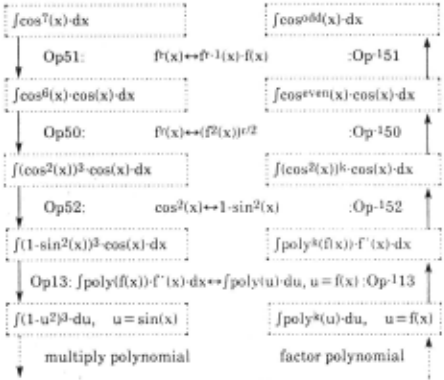
integers as a specialization of the set of integers. Precise assimilation could have been determined with the following reasoning: An alternate definition of even integers is {yl(3xE Integersly = 2·xl}. Because x and 2 are integers, and because we know that integers are closed under multiplication, we prove that every y is also an integer. The critical piece of knowledge for the proof is that integers are closed under multiplication. We have not implemented a mechanism for executing such proofs. Proposing and then proving subset relationships is an open problem of great interest. The backward constraint propagation method is useful for deducing which conjectures are worth proving.
2. Experiment #2
In this experiment, the set of re.al numbers "r" was to be back propagated through Op22 as shown in Figure 4 . The result of the back-propagation step was q·(r3/ql. Because this set was describable by an existing set description, it was not necessary to add any new descriptions to the search space.
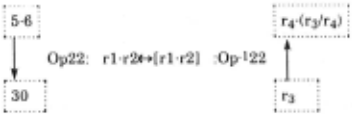
Nevertheless, the back-propagation failed because the deduced set q·(r3/q) did not satisfy a safety check requiring that a deduced set, in this case r4·(r3/r4), match the state that occurred in the original solution sequence, in this case 5·6. Although q matched 5, r3/r4 did not match 6. The concept description language did not include knowledge that r3/f4 is equivalent to the set of rational numbers, and that 6 is an instance of a rational number. The inverse operator had inserted an implicit computation; division!
3. Experiment #3
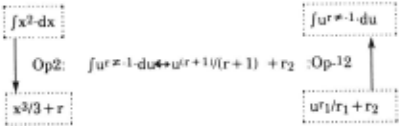
A problem I x2-dx was given to LEX, and was solved by Op2 as shown in Figure 5. Other instances were also provided that caused the bias adjustment module to be invoked. The program needed to back-propagate the set of real numbers "r" through the exponent in Op2-l The code created u description {xi(A(x)(match x +I 'rJl}, and assimilated it us a specialization of r. This produced a description with infinite recursion of the form "xis a real number if x + 1 is a real number". If the program could have applied knowledge that the real numbers are closed under addition, in this case by 1, then it would have proven that adding l to an x will not alter whether that xis a real number.
It is important to consider not only where to assimilate a new description, but whether to assimilate a new description. To circumvent superfluous descriptions, we added an ad hoc procedure for computing closures; if the description Dne" is intended to be a specialization of an existing description Dold. but Dnew is more general or equal to Dold. then Dnew is superfluous.
IV SUMMARY
We suggested that heuristics used for induction should be found by the learning program itself, not by hand. We presented a model of a concept learning program that adjusts its own bias, thereby altering the inductive generalizations it will make. We implemented an example of the model by adding a bias adjustment module to the existing LEX concept learning program. Experience with the implementation uncovered examples where the formalism was weak, or additional knowledge was needed to determine whether or where to assimilate a newly constructed description. Where these problems were not a factor, the program was able to automatically adjust its own bias.
ACKNOWLEDGEMENTS
I thank Tom Mitchell, Rich Keller, and Donna Nagel for discussions of ideas presented here. I thank Jack Mostow and Bruce Ladendorffor helpful comments on a draft.
@inproceedings{ijcai1983p109,
  title     = {Adjusting Bias in Concept Learning},
  author    = {Utgoff, Paul E.},
  booktitle = {Proceedings of the Eighth International Joint Conference on
               Artificial Intelligence, {IJCAI-83}},
  publisher = {International Joint Conferences on Artificial Intelligence},
  editor    = {Alan Bundy},
  pages     = {447--448},
  year      = {1983},
  note      = {Learning and Knowledge Acquisition},
  url       = {https://ijcai.org/proceedings/1983/109},
}
TY - CPAPER TI - Adjusting Bias in Concept Learning AU - Utgoff, Paul E. T2 - Proceedings of the Eighth International Joint Conference on Artificial Intelligence, IJCAI-83 PB - International Joint Conferences on Artificial Intelligence PY - 1983 SP - 447 EP - 448 UR - https://ijcai.org/proceedings/1983/109 ER -Copied
Machine-readable versions of this paper, for tools and AI agents:
 Welcome
 Future Conferences
 AI Journal Division
 IJCAI Proceedings
 About IJCAI
 IJCAI Awards