
Learning by Controlled Transference of Knowledge Between Domains
Proceedings of the Eighth International Joint Conference on Artificial Intelligence. Learning and Knowledge Acquisition. Pages 439-442.
© 1983 International Joint Conferences on Artificial Intelligence
Abstract
A method for Learning by practice, based on the transference of knowledge between doma1ns, is discussed and illustrated in the context of a problem solver functioning in a domain of elementary physics. As an example of the applicat1on of this approach, it is shown how knowledge belonging to the doma1n of "symmetry of figures" can be successfully used to solve problems in the first domain. This controlled transference of knowledge is accomplished in four steps: a) mapping certain components of the physics problem into the domain of figures, b) applying the available knowledge for that domain, c) mapping the results back into the original domain, and d) testing the validity of the transference.
- Anderson,J. "Tuning of Search of the Problem Space for Geometry Proofs" In ~ IJCAI-81, Vancouver, Canada, August 1981. IJCAI
- Carbonell,J. "A Computational Model of Analogical Problem Solving" In ~ IJCAI-81 , Vancouver, Canada, August 19 81 • IJCAI
- Korf,R. "Toward a Model of Representation Changes." Artificial Intelligence 14:1 (1900) 41-78.
- McCarthy, L. and Sri dharan,N.S. "The Representation of an Evolving System of Legal Concepts" In ~ IJCAI-81, Vancouver, Canada, August 1981.
- McOermott,J. and Larkin,J.H. "Re-representi ng Textbook Physics Problems" In ~ 2nd CSCSI, Toronto, Canada, July 1978.
- Novak,G.S. and Araya,A.A. ''Research on Expert Problem Solving in Physics" In~ IJCAI-00, Palo Alto, California, August 1900.
- Winston,P. "Learning by Creating and Justifying Transfer Frames." Artificial Intell1gence 10:2 (1978.) 147-172.
- B. Winston, P. "Learning and Reasoning by Analogy." !&Jrun... ACM 23:12 (1900) 689-702.
- Winston, P. "Learning New Principles From Precedents and Examples." Artificial Intell1gence 19:3 (198:!) 321-350.
References were extracted automatically from the PDF and may contain errors.
Full text extracted automatically from the PDF; figures, tables and equations may differ. The PDF is the version of record.
1 · INTRODUCTION
An "intelllgent" system should have two main components: a problem solver and a Learning agent. The problem solver has the capability of solving problems in e particular domain; the Learning agent is in charge of superv1sing the behavior and modifying the structure of the problem solver. In the case of Learning by practice, the Leerni ng agent analyzes the solutions given by the problem solver to a sequence of problems, and determines appropriate modifications to be made to the probLem soLver.
Several mechanisms have been proposed to perform this type of Learning, some of which have been explored in the context of elementary physics [Novak end Araya, 1900). Here, a
This work was partiaLly done at the Departments of Computer Science of the University of Texas at Austin, and the P.Universidad Cat6Lica de Chi Le. It was supported in part by grant 216/82 of the Oirecci6n de Investigeci6n, ·P.Universidad
Cat6Lica de Chile.
Agustin A. Araya
Departamento de Ciencia de La Computaci6n P.Universidad Cat6Lica de Chile Casilla 114-D, Santiago, Chile
Learning method based on the transference of knowledge between domains, is presented. This process can be viewed as an approach to the discovery of he uri st i cs, in the sense that methods that work for one domain are found to be also appropriate for another domain, provided that the problems satisfy certain conditions. The possibility of discovering these heuristics is particularly important when they Lead to simplified solutions.
2. MAPS: BRIDGES BETWEEN DOMAINS
In soLving a new problem it is often useful to try to apply knowledge that has been successfully employed in the solution of similar problems in the past. More specifically, in problem solving by analogy a problem to be solved is compared to previously solved problems. When a high degree of similarity is found, it is reasonable to expect that knowledge used in the solution of the old problem [or even the solution itself) can be applied to solve the new problem. In generaL some adjustments wilL have to be made in the old solution due to differences between the problems. An important characteristic of this analogical approach is the high degree of similarity that must exist between old and new problems in order for the process to be carried out. Such use of analogy in Learning and problem solving ·has bean discussed by Carbonell,1981, Anderson,1981, Winston,1900, and Winston,19B2.
An alternative approach is to make applicable to the solution of a problem in a given domain, knowledge._ belonging to another domain. In what follows we show how this can be accomplished by means of mappings between concepts pertinent to the respective domains. This allows one to view a problem in the original domain in terms of concepts defined in the new ["external") domain. Since the mappings between the original and external domain are given, this approach does not involve any search for analogous problems as in the analogical m~thods mentioned above. Although the fact that there is a map implies that some kind of "similarity"betwean the two domains exists, this similarity is only implicit, and the transference process is not directly concerned with it. This has two important consequences. On the one hand, it makes it necessary to determine whether the application of a particular piece knowledge from the external domain yields valid results in the original domain. On the other hand, the proposed method has the advantage of bringing more diverse knowledge to bear on the problem under consideration.
The notion of learning by transference of knowledge has been analyzed by Winston,1978. Korf,19Eil has studied the problem of transforming representations to obtain those that yield simplified solutions. McDermott et al,1978 discuss different representations used by experts in solving physics problems. McCarthy et al,1981 have proposed a notion of mapping to be used for representing concepts in terms of deformation of prototypes.
3. AN EXAMPLE
We have developed a problem solver that deals with a domain of elementary physics in which forces are applied to linear rigid bodies. The system knows, for instance, that "if forces satisfy certain conditions, then the rigid body is in equilibrium (in a statics sense)." At some point in the process of solving a given problem, the problem solver produces a diagram, that is, a figure representing forces and objects as lines. (McDermott et al,1978 consider that this is typical of humans when solving problems in elementary physics). Let us assume that the system has knowledge about symmetry of figures in the plane. For instance, the system could know that "if a figure is symmetric with respect to some axis, then the figure is in equilibrium (in a geometric sense)." Thus, if the f i gure obtained from the problem satisfies certain symmetry conditions, this knowledge becomes applicable and may actually produce a solution to the problem. The learning agent may react to this situation by initiating a learning episode as a result of which the system learns that "if forces are symmetric with respect to some axis, and satisfy some additional conditions, then the rigid body is in equilibrium." Let us consider the following problem to illustrate the effects of using knowledge of symmetry:
"Several forces are applied to a lever. Forces F1, F2, F3 and their locations are known; Suppose that the Location of force F4 is also known. If the lever is in equilibrium, find the magnitude and angle of F4."
Solution 1
In order to compute force F4 the problem solver applies a method based on elementary knowledge of physics. It makes use of the notions of equilibrium of forces and equilibrium of moments. The system obtains the information needed to write the corresponding equations, writes them, and solves the equations.
Solution g
In the initial stages of the process system generates the following figure: the
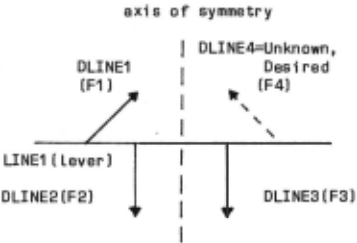
In parenthesis, near the Lines, appear the names of the components of the physics problem that are represented by them. In the original problem, the question was to compute the magnitude and angle of force F4, assuming the lever to be in equilibrium. When the problem is mapped into the figure, the question becomes that of finding the size and angle of DLINE4 so that the figure is in equilibrium [in a geometric sense). Let us assume that the locations of the forces ere such that there is an axis, passing through the center of the line representing the lever, with respect to which directed lines DLINE2 and DLINE3 are symmetric. Furthermore, we assume that the locations [i.e., the coordinates of the respective tails) of DLINE1 and DLINE4 are also symmetric with respect to that axis. By applying knowledge about symmetry, the system can determine the angle end size of DLINE4 so that it is symmetric to DLINE1. Finally, after mapping back DLINE4 into force F4 we obtain a solution to the physics problem.
This solution, however, may not be correct. Even if the figure is symmetric with respect to a given axis, the lever may not be in equilibrium. In fact, in the example the condition of equilibrium of forces in the vertical direction may be violated by the solution. This is determined during the validation stage. In consequence, the heuristic of symmetry works correctly when the problem satisfies the condition of equilibrium of forces in the vertical direction. Other examples given below will further clarify this issue.
4. THE TIIANSFER PROCESS
The example shows how knowledge from one domain can be applied to another domain. The transfer process that makes this possible mey be divided in the following stages:
- Mapping e problem from the original domain to the external domain.
- Applying external knowledge.
- Mapping back to the original domain.
- Validating the application of external knowledge.
To test the feasibility of this approach we are currently developing en experimental system, and explain below how the different stages of the process are to be carried out.
- Mapping~ problem from~ original ~ .!Q_ the external ~
In a problem solving mode, the system uses physics knowledge to solve a problem. In a learning mode the system tries to explore other kinds of knowledge that could be applied to solve a particular problem. This is accomplished by using a mapping mechanism to project a problem into some external domain. In a full fledged system containing knowledge about several problem domains and with a large number of mappings betweEI'l them, the system should have e way of determining, in a givEI'l situation, which of the mappings should be explored. This would help cut down e potentially combinatorial explosion of the number of maps that could be applied at different problem solving steps. In our experimental system, however, we are primarily concerned with understanding more basic issues, such as the utilization of the maps themselves end how the application of external knowledge can be validated.
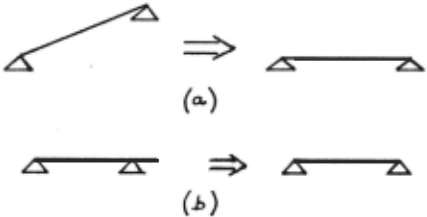
domain of figures
Let us suppose that in the domain of figures there are several pieces of knowledge. For instance, knowledge about symmetry, as indicated above; knowledge about simplifying a figure by projecting it in some direction (Figure 2a); or knowledge about simplifying a figure by eliminating parts of it (Figure 2b). These become applicable once the problem has been appropriately mapped to the domain to which they belong.
In the case of the problem discussed above, several maps are necessary: to map linear rigid bodies into line segments, forces into directed lines, and questions into questions. A map has the following general form:
(MAPxyz : a MAP with sourceclass destinationclass identicalprops transformations <class1 > <class2> [ (prop2i (prop2m = [ (prop2k [prop2l prop1j I prop1n)] proc r I proc s I] lThis map states that an instance of class1, belonging to the original domain, can be mapped into an instance of class2, belonging to the external domain. The "i denti ca lprops" component of the map contains a list of pairs of properties of the destination and source instances that have the same value. The "transformations" component of the map contains a list of pairs, composed of properties of the destination instance and procedures that may be used to compute their values (possibly using properties of the source). Let us illustrate the notion of a map with an example:
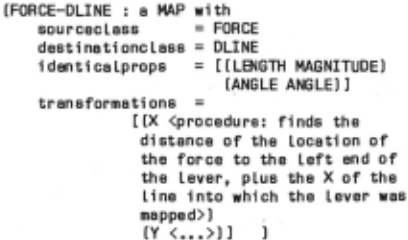
The map indicates how a FORCE can be mapped into a DLINE. For instance, the LENGTH of the DLINE is equal to the MAGNITUDE of the force, and the "X" of the DLINE (i.e., the horizontal component of ita tail) can be found by activating a procedure whose description appears above. The specific form that the mapping process takes depends on how knowledge is represented, and how problems are described. In the hierarchical, schema-based representation that we have used to implement the problem solver, the process consists of performing the mappings of instances in a certain order, and propagating their effects along the way.
4.2 Applying External Knowledge
Up to this point, external knowledge has been useless to the system. It is present, but since it is formulated in terms of concepts different from those in which the problem is represented, it cannot be used in any way. Once the mappings are applied, however, projection of the problem into the external domain becomes available, and the external knowledge can now be
utilized.
4.3 Mapping back to~ Original Domain
To continue with the example given above, let us assume that knowledge about symmetry is applied. After that, it is necessary to map the results obtained to the original domain. This is carried out in a manner similar to the first stage. In the example DLINE4 has to be mapped back to F4.
4.4 Validating ~ Transference Qf External Know ledge
After the first three stages have been completed, the problem solving process continues in the original domain. If the problem has not been completely solved, physics knowledge available there is applied, and a solution is eventually obtained. The system, however, cannot take for granted the correctness of this solution. What it can do is assume that if a problem satisfies certain conditions, the use of external knowledge will produce correct results. In this case the learning agent initiates a process to discover those conditions.
Let us consider now the conditions for the correct application of the three pieces of external knowledge mentioned in 4.1. For symmetry know ledge, the condition is the equilibrium of forces in the vertical direction. (Since the figure was found to be symmetric with respect to e vertical axis, symmetry knowledge is not enough to establish equilibrium in the vertical direction). The heuristic of "projecting a line in a horizontal direction" will work correctly if all the forces applied to the lever are vertical. (If there were oblique or horizontal forces, their horizontal components would produce moments in the inclined laver but not fn its horizontal projection, producing incorrect results). For the heuristic of eliminating parts of a figure, the condition is that the lever have no weight (because if the lever had weight, after removing part of it, that weight would change, leading to i ncar rect
results).
We are currently developing a component of the system that determines those conditions. The basic idea is that the solution obtained by applying only physics knowledge be compared to the solution produced when using knowledge from the external domain. If the solution is correct, the problem being solved is an instance of a "problem type" characterized by the fact that a particular piece of external knowledge can be correctly applied to its problem instances. Then, using appropriate heuristics, the system explores the problem domain in an attempt to arrive at a description of that problem type. This description is precisely the condition of applicability of the specific piece of knowledge used in the solution of the problem, and must be added to the conditions it already had.
5. DISCUSSION AND CONCLUSIONS
We have examined a learning mechanism based on the transference of knowledge between domains. The system learns that knowledge of an external domain can be applied to solve problems in the original domain. It also learns that in order for this application to be successful, the problems have to satisfy certain conditions. We think that the proposed method has wide applicability, and have found that several pieces of knowledge in the domain of "figures" can be transferred to the physics domain. For instance, know ledge about how to "simplify a figure by projecting it in some direction", or how to "simplify a figure by ignoring parts of it", etc, can be successfully used in the
physics domain.
To test the feasibility of this approach, we are developing an experimental system. The problem solver works in the domain of elementary statics, handling problems of equilibrium of ri gi d-bodi es subject to ext erne l forces. The implementation of the first three stages of the transfer process has been completed, and the implementation of the validation stage is under way. After this Last stage is completed, we intend to carry out experiments using more knowledge about the domain of figures, and then apply the method to other external domains.
The process we have presented presupposes the existence of the maps. It seems natural to assume that a physics problem solver should know how to produce a ' diagram corresponding to a physics problem. An important problem, however, is to determine the origin of these maps. This leads to the notion of a "map generating process", in which, concepts in different domains are examined for their degree of "similarity", to determine potentially useful maps. The anaLysis of this "map generating process" is a significant topic for future
research.
ACKNOWLEDGEMENTS
I wish to thank Julian Gevirtz for his valuable comments and his assistance in editing earlier drafts of this paper.
@inproceedings{ijcai1983p107,
  title     = {Learning by Controlled Transference of Knowledge Between Domains},
  author    = {Araya, Agustin A.},
  booktitle = {Proceedings of the Eighth International Joint Conference on
               Artificial Intelligence, {IJCAI-83}},
  publisher = {International Joint Conferences on Artificial Intelligence},
  editor    = {Alan Bundy},
  pages     = {439--442},
  year      = {1983},
  note      = {Learning and Knowledge Acquisition},
  url       = {https://ijcai.org/proceedings/1983/107},
}
TY - CPAPER TI - Learning by Controlled Transference of Knowledge Between Domains AU - Araya, Agustin A. T2 - Proceedings of the Eighth International Joint Conference on Artificial Intelligence, IJCAI-83 PB - International Joint Conferences on Artificial Intelligence PY - 1983 SP - 439 EP - 442 UR - https://ijcai.org/proceedings/1983/107 ER -Copied
Machine-readable versions of this paper, for tools and AI agents:





