
Using Matching in Algebraic Equation Solving
Proceedings of the Seventh International Joint Conference on Artificial Intelligence. Theoretical Foundations. Pages 466-470.
© 1981 International Joint Conferences on Artificial Intelligence
Abstract
This paper describes the use of powerful algebraic matching techniques for applying rewrite rules in equation solving. A matcher is presented that knows about the commutativity and associativity of addition and multiplication, will provide defaults for missing summands and factors, and if necessary will solve algebraically for the value of pattern variables.
- Barnard and Child. Higher Algebra. MacMillan, 1936.
- Borning, A. , and Bundy, A. Using Matching ~ Algebraic Equation Solving. Research Report 158, Dept. of Artificial Intelligence, Edinburgh, 1981. An expanded version of this IJCAI paper. Also available as Technical Report No. 81- 05-01, Computer Science Department, University of \~ashington.
- Bundy, A. Analysing Mathematical Proofs (or reading between the lines). In Proceedings of the 4th IJCAI. Georgia, 1975. An expanded version is available from Edinburgh as DAI Research Report No. 2. IJCAI
- Bundy, A. and Welham, B. Using Meta-level Inference for Selective Application of Multiple Rewrite Rules in Algebraic Manipulation. Artificial Intelligence , 1981. In press. Also available from Edinburgh as DAI Research Report No. 121.
- Fateman, R. J. Essays in Algebraic Simplification. PhD thesis, MIT, 1972. Also available as MAC TR-95.
- Mathlab Group. MACSYMA Reference Manual MIT, 1977.
- Pereira, L., Pereira, F., and Warren, D. User'~ Guide~ DECsystem-..!.Q PROLOG Dept. of Artificial Intelligence, Edinburgh, 1978.
- Raulefs, P., Siekmann, J, Szabo, P., and Unvericht, E. A Short Survey on the State of the Art in Matching and Unification Problems. AISB Quarterly (32):17-21, December, 1978.
- Tranter, C. J. Advanced Level Pure Mathematics. English Universities Press, 1970.
References were extracted automatically from the PDF and may contain errors.
Full text extracted automatically from the PDF; figures, tables and equations may differ. The PDF is the version of record.
1. Introduction
This paper describes the use of powerful matching techniques in algebraic equation solving. This work builds on the PRESS algebra system, a computer program for solving equations and inequalities and for simplifying expressions [4). A powerful matcher, upon which the present work is based, is proposed in [3]; this report also describes many of the ideas in PRESS. PRESS and the matcher extensions are written in PROLOG [7).
The goal of the research described here is to test the search control technique of meta-level inference and the powerful algebraic manipulation methods of PRESS on some hard problems. We consider the problems of solving the general quadratic and cubic equations and a general trigonometric equation. The solutions of these problems given in standard algebra textbooks all have a "magic" element. An expression is drawn out of a hat with a flourish of "Consider the following term ··· ". As a side effect of applying the PRESS equation solving methods, we show how the magic element can be understood. In fact, the program is The PRESS solutions constitute a rational reconstruction of part of the history of algebra: we are not saying that this is how these solutions were first discovered, but that our program does show how they could have been discovered by a rational process of analysis of the problem, in terms of the tools available for its solution.
* Computing resources for this research were Science Research Council grant number A. Berning was supported at the of Edinburgh by a NATO Postdoctoral from the National Science Foundation, provided by GR/ A 57954. University Fellowship
**current address: Computer Science Department, FR-35 University of Washington Seattle, Washington 98195 USA
PRESS uses multiple sets of rewrite rules, employing meta-level reasoning and descriptions to guide that application and hence control search. Some of the important rewrite rule sets are:
isolation
collection
attraction PRESS tries applying isolation rules when there is a single occurrence of the unknown in the equation. Isolation rules are applied to strip away surrounding functions and operators from the unknown, finally resulting in an equation with the unknown on one side by itself, and some expression (free of the unknown) on the other. A typical isolation rule is arcsin x · b -> x · sin b.
Collection rules serve to reduce the number of occurrences of the unknown, so that isolation can be applied. A typical collection rule is
uw + vw -> (u+v)w
which collects relative to w.
Attraction rules move occurrences of the unknown closer together i n the expression tree, so that perhaps a collection rule can be applied. A sample rule is
logbu + logbv -> logbuv,
which attracts u and v.
To apply a rewrite rule to an expression, PRESS uses a matcher that knows about the commutativity and associativity of addition and multiplication. For example, to apply the collection rule
uw + vw -> (u+v)w to the expression xy + z(3x)
in order to collect the two occurrences of x, the PRESS matcher would substitute x for w, y for u, and 3z for v. The result of applying the rule would be
(y+3z)x.
The matcher used the commutativity and associativity the match. of multiplication in accomplishing
An application of collection is the crucial step in the solution of some equations. Reflecting this, human mathematicians will try quite hard to find and apply a collection rule to an expression. For example, the standard solution of the general quadratic equation
ax 2 + bx + c · 0 uses the collection rule
u 2 + 2uv + v 2 -> (u+v) 2 ·
All the other steps of the solution are either preparations for applying the rule, or subsequent i so l ation steps. (However, a different terminology is usually used rather than talking about rewrite rules, mathematicians talk about i dentities. Also, the process of applying the above collection rule is often presented in "compiled form" as the operation of completing the square.) Similarly, the standard solution of the trigonomtric equation
a sin x + b cos x · c
depends critically on the use of the rule
cos u sin v +sin u cos v -> sin(u+v).
(Descriptions of the solutions of these equations may be found in [9].)
However, the application of these rules - ma tching the left hand side of a rule with an expression cannot be accomplished by using simple pattern matching and information about associativity and commutativity. What additional techniques are required? As part of an i nvestigation of this question, an experimental matcher has been embedded in PRESS that can, among other things, solve both ·of the above equations f rom first principles.
2. The Matching Algorithm
The matcher is called with descriptions of the expression and pattern to be matched. If the match i s successful, a transform is returned, consisting of a series of substitutions and arithmetic operations, such that the result of applying the transform to the pattern would be algebraically equal to the expression.
When called, the matcher first checks for simple cases. If the expression and pattern are identical, the match succeeds trivially, and the null trans form is returned. If the pattern cons i sts solely of a pattern variable, the match succeeds again, and a transform consisting of the single substitution "variable -> expr" is returned.
Otherwise, the matcher must try harder. The matcher has two ways of accomplishing a non-trivial match: by recursively matching corresponding parts of the expression and the pattern, or by solving algebraically for the value of a pattern variable.
2.1. Recursively Matching Parts of Expressions
In general, to match two complex expressions, the matcher will first check that the principal operators or functions are the same, and will then match the corresponding arguments. For example, consider matching the expression logea with the pattern logev, where v is a pattern variable. The matcher first checks that the functions log are the same, and then calls itself recursively to match e withe, and a with v.
The matcher knows about the commutativity and associativity of addition and multiplica.tion. When matching two sums or products, the matcher puts all the terms in each sum or product into an unordered bag. It then has available a range of alternatives in matching the two bags, among the more important being:
- If both bags are empty, the match succeeds trivially.
- The matcher can pick a term from each bag and call itself recursively to match the two terms. In using this alternative, the matcher will pick the most complex term from one bag, using a simple complexity metric. Then, it will pick an appropriate term from the other bag by performing a fuzzy match between the term from the first bag and candidate terms from the other bag. (See Section 3 for a description of fuzzy matching.)
- If the term in either the expression or the pattern is free of the unknown, the matcher can permit the match to succeed by adding or multiplying each side of the rule by a term, if applying the operation will not invalidate previously matched parts of the expression and pattern .
- If the pattern contains a pattern variable, the matcher can try to solve for its value algebraically. (See Sect ion 2. 2. )
When matching a sum against any other expression (including a product), the matcher will convert the other expression into a plus bag with just the one element. Matching a product against any other expression (except a sum) is handled analogously.
2.2. Solving Algebraically for the Value of a Pattern Variable
The other principal technique for accomplishing a match is to solve algebraically for the value of a pattern variable. An equation is constructed whose two sides are the expression and pattern to be matched, and presented to the main equation solving routine. Use of this technique increases the power of the matcher considerably, as it puts the full capabilities of the equation solver at the matcher's disposal.
In solving equations of this kind, a particular rather than a general solution is wanted. The equation solver is told about this by adding an appropriate assertion to the data base, so that only a single solution is returned, wi~h alternate solutions being generated only if the program backtracks.
3. Search Control
The matcher has available a considerable range of strategies for accomplishing a match; some of these strategies, such as solving algebraically for the value of a pattern variable, can be expensive to use. Therefore, it is important that the search involved in accomplishing a match be tightly controlled. The main technique for doing this is the use of fuzzy matching as a preliminary check before the full matcher is invoked. (Note that we are using the term "fuzzy" in a different sense than as in "fuzzy logic"). Fuzzy matching is used both for the initial selection of a collection rule, and for the select ion of a pair of terms to match from two bags. Another technique for controlling search is the complexity heuristic for deciding which term in a bag to look at next.
To check for a fuzzy match, the program computes the features te111a of the expression and pattern, and then matches these using the normal PP£SS matcher (which is comparatively inexpensive). The algorithm for extracting a features term gives special status to the unknown, reflecting the fact that the matcher can often deal with miscellaneous expressions that are free of the unknown.
- If the expression is the unknown itself, then its features term is the unknown as well.
- If the expression is free of the unknown, its features term is the expression
- "mumble".
- To compute the features term of a sum, the features term of each term in the sum are found. All "mumbles" are discarded; the features term is then a sum consisting of the remaining features terms. Products are handled analogously.
- Integer exponents of expressions not free
- of the unknown remain themselves.
- The features term of any other complex expression is found by computing the features term of each argument, and returning a new term with each argument replaced by its corresponding features term.
For example, suppose that x is the unknown. Then the features term of a 2 cos y is "mumble", the features term of ax+b is x, and the features term of a sin(x 2 )+cos(y 2 ) is sin(x 2 ).
These techniques have proven to ·be quite powerful: most spurious matches are rejected during fuzzy matching, and little search is done using the full matcher. To handle the search that does occur, the matcher uses the depth-first search provided by the built-in PROLOG backtracking mechanism, along with a memo procedure to save the results of matches in case they are needed again.
The current search control methods are for the most part adequate for matches that are eventually successful, and for matches that can't succeed (and are detected as such by ·the fuzzy matcher). The matcher takes considerably longer on matches that pass the fuzzy matcher, but eventually fail. For example, if one asks the system to find the solution to the general cubic equation
it will (reasonably enough) attempt to apply the collection rule
- u 3 + 3u 2 v +3uv 2 + v 3 -> (u+v) 3 ·
This match eventually fails, but only after considerable backtracking.
4. An Example -- Deriving the Solution for the General Quadratic Equation
The operation of the matcher will now be illustrated by an example. Because of space limitations, a summary is presented here; a complete annotated trace of the matcher's operation on this and other problems, as well as a fuller description of the program, may be found in [2).
To start things off, the user asks PRESS to solve the equation
for x. PRESS decides that isolation is not applicable, since there are two occurrences of the unknown. It therefore tries to collect these two occurrences. In searching for an applicable collection rule, the program first performs a fuzzy match between the expression and the pattern part of each potentially applicable collection rule. The fuzzy matcher extracts a features term from the expression, and searches for a rule with matching features. The features term of the left hand side of the equation is
x 2 + x,
the coefficients and the constant term c having been regarded as relatively unimportant.
a nd
2xva + v 2 a.
respec t i vel y .
Aga in converting to a bag representation, the ma t che r recursively tries to match the two terms cont ai ni ng x, namely bx and 2xva. The two x's are ma t ched trivially. The matcher then makes several unsuccessful attempts to match b with a term from t he pa ttern. (The strategy previously employed of mult i pl ying both sides of the rule by some expr es s i on can no l onger be used, since doing s o would invalidate the already established match of t he x 2 terms.)
Aft e r these failures, the matcher tri e s the othe r princ ipal matching strategy, that of solving a l gebraica ll y , f o r the value of a patt e rn vari able. The equa tio n so lving program is called recursively
One of the collection rules known to PRESS is
wh ich collects relative to u. When the unknown x is substituted for u, the features term of the rule is also
The program therefore selects this rule and tries t o apply i t to the left hand side of the equation. (This is in fact the only collection rule known to PRESS that will pass the fuzzy ma tch.)
The full matcher is now invoked to match the patte rn part of the rule with the quadratic expres s ion. Since the principal operator of both the expression and pattern is +, the matcher converts to a bag representation. As previously de scr i bed, there are a number of ways in which two bags can be rna tched. The rna tcher tries one of these methods: picking a term from each bag and matching those two terms. It selects the term ax 2 f r om the expression (on the grounds that it is the most complex), and then chooses a term with matching features from the rule, in this case x 2 ·
The matcher now calls itself recursively on these two terms. Since the principal operator of ax 2 is times, the matcher again converts both terms t o a bag representation. The x 2 term from the pat tern is converted to a times bag with one e lement . The matcher picks the x 2 terms from each bag, and matches them trivially. After that, howeve r, it must match the expression bag, which st ill has the "a" left in it, with the now empty pa ttern bag. The previously used strategy of pi c king a term from each product is no longer applicable. Instead, the matcher decides that the " a" should be dealt with by multiplying both sides of the rule by "a". This result is returned as a tr ansfo rm.
The two r emaining terms in the pattern bag are mult i plied by "a", and the matcher is called r ecur s i vely on the remaining parts of the expres s ion and rule, which are now
bx + c to solve for v in b·2va. The answer, v·bl2a, is easily obtained by isolation.
With this substitution for v, the terms bx and 2xva now match. This result is returned as a transform
v -> bl2a, which is applied to the remaining term in the pattern bag, namely v 2 a, to yield
b 2 14a.
The last two terms don't match each other. However, the matcher can complete the match by adding c to each side of the rule, and subtracting the b 2 14a term.
The match of the expression ax2 + bx + c and the pattern x 2 + 2xv + v 2 is now complete. The matcher returns the following transform:
The pattern will match the expression if the transform listed is applied to it (multiply each side of the rule by a, then add c to each side, subtract b 2 14a from each side, and substitute bl2a for v). The rule remains a valid collection rule after the transform has been applied to each side of it. So the transform is applied to the replacement part of the rule, and the altered collection rule is applied to the original equation. The result is
Most of the work is now done. The new equation has a single occurrence of x, and is easily solved by isolation to yield the two roots of the quadratic. The program's solution, written in two-dimensional notation, is:
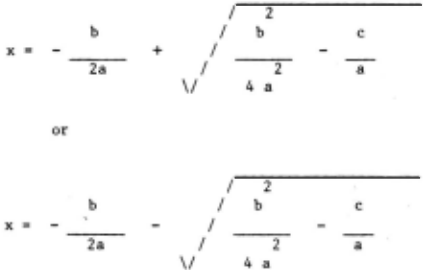
If the demoninator, expressions. fractions are put over a common the answers simplify to the usual (A package for performing this sort of simplification has been been incorporated into PRESS, but after this trace was taken.)
5. Other Problems Solved using the Hatcher
Another equation solved using the matcher is
a sin x + b cos x · c.
The features term of the left hand side of the equation is
sin x + cos x.
One of the trigonometric collection rules is cos u sin v +sin u cos v -> sin(u+v), which collects relative to u. When x is substituted for u, the features term of this rule is
cos x + sin x,
which matches the features term of the left hand side of the equation. (Note that the sin v and cos v factors are dropped, as they are free of the unknown.) The first term of the expression and the second term of the pat tern, namely a sin x and sin x cos v, are matched by multiplying each side of the pattern by a/cos v. The matcher next matches the remaining terms from the expression and pattern, which are now
b COS X
(cos x sin v)a/cos v
respectively. The two cos x factors are matched trivially. To complete the match, the matcher solves algebraically for a value for the pattern variable v. In the process, the (recursively invoked) equation solver employs another collection step to collect the two occurrences of v by using the rule
sin w/cos w -> tan w.
As an application of the augmented PRESS program, a procedure was written that compiles specialized methods for solving certain kinds of equations. The user gives the program the general form of an equation, such as the quadratic or the trigonometic equation. The program solves the equation using the powerful matcher, and then asserts a new PROLOG procedure for solving instances of that equation.
The matcher has also been used to solve equations using a change of unknown, such as the equation
Here, the equation is matched against an equation whose solution is known (in this case the quadratic) to generate the change of unknown
sY -> x.
6. Work in Progress
A milestone in the history of algebra and equation solving was the solution of the general cubic equation. We have recently made progress toward getting PRESS to solve tl)is equation. One solution we are working towards, described in [1),
uses the collection rule
and The program currently will solve the equation with some help. PRESS reduces the general equation to
using a linear substitution. However, at that point it must be explicitly told to try the "magic substitution" z = w cos u. We hope to extend PRESS so that it will be able to solve the cubic and quartic equations from first principles without human intervention, using both this solution path and others.
7. Related Work
To the best of the authors' knowledge, no other algebraic matcher has been implemented that compares in power to the one described here, which builds in the associative, commutative, and distributive laws, and has available the full power of the equation solving system for solving for a value for a pattern variable.
The PRESS program (without the extensions described here) includes a matcher that knows about the commutativity and associativity of addition and multiplication. The matcher in MACSYMA [5), [6) knows about commutativity and associativity. It also provides defaults for missing summands, factors, and exponents, and will distribute products over sums to accomplish a match.
There is considerable literature concerning pattern matching in theorem proving -- see [8) for a survey of the state of the art. None of this work is very relevant to the present research. Most of these algorithms build in only a very few axioms, whereas the matcher described here builds in an indefinite number. On the other hand, these algorithms are usually for two-way matching and come with a completeness proof, which we could not
have.
- Barnard and Child. Higher Algebra. MacMillan, 1936.
- [ 2] Borning, A. , and Bundy, A. Using Matching ~ Algebraic Equation Solving. Research Report 158, Dept. of Artificial Intelligence, Edinburgh, 1981. An expanded version of this IJCAI paper. Also available as Technical Report No. 8105-01, Computer Science Department, University of \~ashington.
- Bundy, A. Analysing Mathematical Proofs (or reading between the lines). In Proceedings of the 4th IJCAI. Georgia,
- 1975.
- An expanded version is available from Edinburgh as DAI Research Report No. 2.
- Bundy, A. and Welham, B. Using Meta-level Inference for Selective Application of Multiple Rewrite Rules in Algebraic Manipulation. Artificial Intelligence , 1981. In press. Also available from Edinburgh as DAI Research Report No. 121.
- Fateman, R. J. Essays in Algebraic Simplification. PhD thesis, MIT, 1972. Also available as MAC TR-95.
- Mathlab Group. MACSYMA Reference Manual MIT, 1977.
- Pereira, L., Pereira, F., and Warren, D. User'~ �uide~ DECsystem-..!.Q PROLOG Dept. of Artificial Intelligence, Edinburgh, 1978.
- Raulefs, P., Siekmann, J, Szabo, P., and Unvericht, E. A Short Survey on the State of the Art in Matching and Unification Problems. AISB Quarterly (32):17-21, December, 1978.
- Tranter, C. J. Advanced Level Pure Mathematics. English Universities Press, 1970.
@inproceedings{ijcai1981p90,
  title     = {Using Matching in Algebraic Equation Solving},
  author    = {Borning, Alan and Bundy, Alan},
  booktitle = {Proceedings of the Seventh International Joint Conference on
               Artificial Intelligence, {IJCAI-81}},
  publisher = {International Joint Conferences on Artificial Intelligence},
  editor    = {Patrick J. Hayes},
  pages     = {466--470},
  year      = {1981},
  month     = {8},
  note      = {Theoretical Foundations},
  url       = {https://ijcai.org/proceedings/1981/90},
}
TY - CPAPER TI - Using Matching in Algebraic Equation Solving AU - Borning, Alan AU - Bundy, Alan T2 - Proceedings of the Seventh International Joint Conference on Artificial Intelligence, IJCAI-81 PB - International Joint Conferences on Artificial Intelligence PY - 1981 SP - 466 EP - 470 UR - https://ijcai.org/proceedings/1981/90 ER -Copied
Machine-readable versions of this paper, for tools and AI agents:





