
A Deterministic Analyzer for the Interpretation of Natural Language Commands
Proceedings of the Seventh International Joint Conference on Artificial Intelligence. Natural Language Applications. Pages 440-441.
© 1981 International Joint Conferences on Artificial Intelligence
Abstract
This paper describes a system which translates a query in Italian language into a representation which can be immediately interpreted as a sequence of algebraic operations on a relational data base. The use of a lookahead buffer allows the system to operate deterministically. Different knowledge sources are used to cope with semantics (associated with the lexicon) and syntax (represented as pa! tern-action rules). These knowledge sources coopeate during the query translation so that independent translation steps and intermediate representations of the command are avoided. Therefore the term "determinism" is used to mean that all the structures built during the process concur to build the final command representation.
- / Marcus, M.P.: A Theory of Synctactic Recognition for Natural Language. MIT Press, Cambridge, Mass., 1980. /
- / Lesmo,L.; Saitta, L.; Torasso, P.: Computer- Aided Evaluation of Liver Functional Assessment, Proc. 4th Symposium on Computer Applications in Medical Care, Washington, D.C., 1980, pp.l81-:-189. /
- / Heidorn, G.E.: Augmented Phrase Structure Gra~ mars, in Schank, R.C. & Nash-Webber, B. (eds. ): Proc. Theoretical Issues in Natural Language Processing, Cambridge, Mass., 1975, pp.l-5. /
- / Lesmo, L.; Magnani, D.; Torasso, P.: Lexical and Pragmatic Knowledge for Natural Language Analysis, 1981 Int. Conf. on Cybernetics and Society, Atlanta, Georgia, Oct.l981.
References were extracted automatically from the PDF and may contain errors.
Full text extracted automatically from the PDF; figures, tables and equations may differ. The PDF is the version of record.
Introduction
One of the most popular new ideas in the field of natural language processing is the "determinism" introduced by Marcus /1/. The system presented in this paper accepts Marcus' proposals for the synta~ tic analysis of the text, but extends that analysis to a real translation of an input query in Italian language by means of a more semantical structure of the actions associated to the pattern-action synta~ tic rules. These actions have the purpose of build ing representations of the constituents with which the syntactic rule is associated, in a form which allows the system to perform semantic checks by u~ ing the semantic information available from the lexi con.
One of the main features of the system is a co operation be tween declarative (lexicon and pattern part of the syntactic rules) and procedural (proc~ dur es to perf orm semantic checks and the action part of the syntactic rules) knowledge sources such that the control flow is automatically transferred from one knowledge source t o another without the inter vention of a central controller.
As a b e~chmark, the system has been specialized t o ac t as an interface to a medical consultation program for the analysis of the liver functional assessment /2/.
A DETERMINISTIC ANALYZER FOR THE INTERPRETATION OF NATURAL LANGUAGE COMMANDS
Leonardo LESMO, Daniela MAGNANI, Piero TORASSO
Istituto di Scienze dell'Informazione- Universita di Torino C.so Massimo D'Azeglio, 42 - 10125 TORINO - ITALY
Command representation
The interpretation process translates the in put command into a set of frame instantiations link ed together. By "frame" we mean a collection of slots, each of which has a name, may contain a val ue and may be associated with a procedure which checks the semantic correctness of the value inser! ed into the slot by the grammar rules.
The system contains a set of prototype frames (currently 4: ACTIONFR, COMMANDFR, RESTRICTIONFR, CONCEPTFR) which are instantiated under request of the grammar rules. Notice that the checks associated with the slot of a given frame F may operate on data not necessarily stored in F, but in other frames con nected to F. The check procedure associated with a frame slot is executed when the slot is filled: it may happen that, at that time, some of the slots (in the same frame or not) needed to perform the checks are still empty. In this case the procedure is suspended and its suspension point is stored in a list together with information which allows the procedures associated with slot filling and frame linking to resume its execution as soon as possible.
Lexicon
The lexicon contains noise words, non-content words (e.g. prepositions) and content words. The latter are used to build the final representati on of the command and the information associated with them concerns their syntactic category and (f or some of them) semantic information stored as links to other content words /3/, so that the lexicon may be considered as a network whi::h allows the system to verify the semantic correctness of the command . A spelling correcti on is performed to detec t and correct possible typing errors.
A more detailed description of the lexical knowledge source is reported in /4/.
Syntax
The syntactic knowledge is represented by means of Syntacti c Rule Packets (SRP) each of which con tains a set of pattern-action rules which specify the different forms a particular constituent may a~ sume. The pattern part of the rules allows the sy~
t ern t o deterministically identify the rule of the Packe t which has t o be applied to analyze the input. The pattern consists in a sequence of syntactic ca! egor i es or constituents which have to be matched on t he l ookahead buffer, which is filled under request of the syntactic knowledge (CAT statements; see be low) with the exact portion of input string needed t o discriminate among the rules of the Packet. For the sake of efficiency, the set of patterns concer~ ing the same SRP have been represented by means of a di scr iminant net which guides the filling of the buffer.
The action part of the rules is a procedure i~ vo lvi ng imperative statements:
- FILL. It fills a slot of a frame and triggers the checks associated with that slot.
- CREATE. It builds a new instantiation of a frame.
- LINK. It connects aframe instantiation to a slot of another one.
- word in - CAT. It checks the category of the current of the lookahead buffer. If all the elements the buffer have already been scanned, a new word is transferred into it from the input string. In cidentally, the categories used in the grammar (and the constituents as well) are not the classi ca l categories (noun, adjective, etc.) but are more semantically biased (concept, property, etc).
- PUSH. It involves the triggering of the SRP ass~ ciated with the embedded constituent that has to be analyzed and the transfer of control to the SRP handler.
- DEL. It deletes a word from the buffer.
When a FILL or LINK operations is executed,the li s t of suspended checks is scanned to decide wheth er some of them may be resumed. After the completion of the action part of a rule, the control is retur~ ed t o the action which activated the SRP containing the rule whose action has been completed.
As an example of Syntactic Rule Packet, consi~ er t he constituent ELEMENT: ·it refers to a group of objects defined by a concept name (e.g. Patient) fo llowed by the conditions selecting the individ ua l s that should belong to the group, or, in case the gr oup is restricted to a s i ngle individual, by its name (Identifier), The structure of the SRP is as fo llows :
ELEMENT
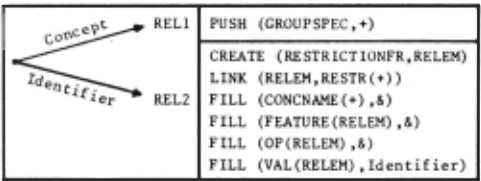
The symbol + refers to the current frame instantia t ion (in this c·ase a copy of CONCEPTFR), whereas t he symbol & means that the filler of the slot is not explicitly present in the input sentence ; in this example all the slots containing & will be filled by the semantic check procedure associated with the slot VAL, by inspecting the semantic info! mation stored in the lexical entry corresponding to the current identifier. As regards RELEM, it is a variable which is filled by the CREATE operation with the actual name of the newly created instanti~ tion.
It may be observed that, in this case, the di~ criminant net is very simple because only one word has to be examined in order to determine which rule has to be applied. In the GROUPSPEC discriminant net it is apparent that two or three lookahead words are needed to deterministically decide what rule has to be applied; for this reason the lookahead buffer size is not fixed, even if our grammar never re quires more than four cells.
GROUP SPEC
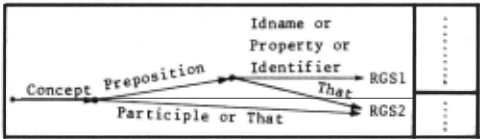
Notice that the trvelling on the discriminant net does not imply that an input word is consumed (for example, the first word in the PUSHed GROUPSPEC is the same Concept tested by ELEMENT).
Examples and comments
One of the most important features of the sy~ tern is its ability to obtain the same represent~ tion for sentences which have the same meaning but completely different surface structures. Consider for example the sentences:
- Sl) Dammi il valore della bilirubina totale per i pazienti con ittero (Give me the value of total bilirubin for the patients with jaundice).
- S2) Per i pazienti che hanno ittero dimmi quanto v~ le la bilirubina totale (For the patients who have jaundice tell me what the total bilirubin is).
- S3) Quante hanno di bilirubina totale i pazienti con ittero presente? (How much total bilirubin have the patients with jaundice present?).
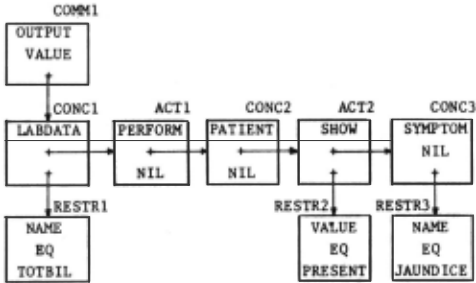
For all of them the final representation is the same and is reported in fig.l.
It should be pointed out that information which is implicit in the input command has been made explicit (e.g. in RESTR3 the fact that "jau~ d i ce" is the "name" of the symptom and in RESTR2 that the "value" of the jaundice used for patient selection should be "present", even if in the sen tences Sl and 52 it is understood).
The resulting representation may seem rather awkward. For example, it may not be apparent why RESTR2 is linked to an action (named SHOW) instead of the concept it qualifies (jaundice). The advan tage of this representation is the one-to-one ma~ ping between the pointers which link the frames and the algebraic operators of the relational approach to database construction. For example, each pointer to a restriction implies ~ SELECT operation on the relation to which the concept (or the action) is associated, each pointer connecting an action and a concept implies a JOIN operation on the two involv ed relations and so on.
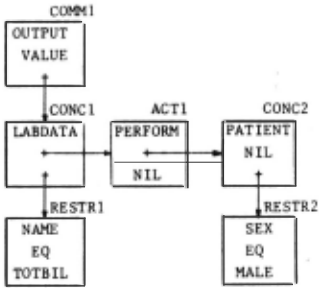
It is worth noticing the difference between the representation of the sentence Sl (fig.l) and the representation (fig.2) of the sentence:
- S4) Dammi il valore della bilirubina totale per i p~ zienti di sesso maschile (Give me the value of total bilirubin for the patients of male sex).
The difference is due to the fact that "sex" is a property of a patient and for this reason it is stored in the data base relation PATIENT, whereas "jaundice" is an identifier of the concept "symptom" (i.e. a key of the data base relation SYMPTOM), so that the value of jaundice for a given patient is stored in the connection relation named SHOW.
In fig.l and 2 the frame structure was heavily simplified for the sake of readibility; let us con sider as an example the actual structure of RESTRIC TIONFR:
RESTRICTIONFR (FEATURE, OP, VAL, FEATURE!, OP!, VAL!, BACK, RESTRCHAIN)
The slots composing the frame are of three kinds: External, Internal, Link; the External slots (e.g. FEATURE, OP, VAL) contain the actual lexical entries appearing in the input sentence; the Internal ones (e.g. FEATURE!, OPI, VAL!) concern the correspon~ ing internal representation, which will be used to access the data stored in the data base relations; the Link slots (e.g. BACK, RESTRCHAIN) contain the pointers to other instantiations.
In RESTRICTIONFR the slot FEATURE contains the name of the attribute used to perform the selection, whereas the slots OP and VAL contain the operator and the linguistic or numeric value involved in the SELECT operation. When the string "di sesso maschi le" in the sentence 54 is analyzed, the slots FEA TURE and VAL are filled with "sesso" and "maschi le" respectively, whereas the slot OP is filled with & (undefined). The semantic checks associated with FEATURE and VAL provide not only the filling of FE~ TURE! and VAL! with the internal representation of "sesso" and "maschile" (i.e. SEX and MALE) ,but also the filling of OP! with EQ (the choice of EQ depends on the information associated with "maschile") thus leading to the situation of RESTR2 shown in fig.2.
The slot BACK contains a backward pointer to the CONCEPTFR (or ACTIONFR) instantiation for which the RESTRICTIONFR instantiation acts as a condition. Finally, the slot RESTRCHAIN may contain a pointer to another instantiation of RESTRICTIONFR which acts as a further condition for the selection (i.e. the two- or more- conditions are ANDed).
The system has been implemented in LISP on a DEC-lO; the lexical and syntactic processes have been tested fully, whereas the procedures associat ed with the semantic checks are currently under debug.
@inproceedings{ijcai1981p85,
  title     = {A Deterministic Analyzer for the Interpretation of Natural Language Commands},
  author    = {Lesmo, Leonardo and Magnani, Daniela and Torasso, Pietro},
  booktitle = {Proceedings of the Seventh International Joint Conference on
               Artificial Intelligence, {IJCAI-81}},
  publisher = {International Joint Conferences on Artificial Intelligence},
  editor    = {Patrick J. Hayes},
  pages     = {440--441},
  year      = {1981},
  month     = {8},
  note      = {Natural Language Applications},
  url       = {https://ijcai.org/proceedings/1981/85},
}
TY - CPAPER TI - A Deterministic Analyzer for the Interpretation of Natural Language Commands AU - Lesmo, Leonardo AU - Magnani, Daniela AU - Torasso, Pietro T2 - Proceedings of the Seventh International Joint Conference on Artificial Intelligence, IJCAI-81 PB - International Joint Conferences on Artificial Intelligence PY - 1981 SP - 440 EP - 441 UR - https://ijcai.org/proceedings/1981/85 ER -Copied
Machine-readable versions of this paper, for tools and AI agents:





