
A Knowledge-Based Approach to Language Processing: A Progress Report
Proceedings of the Seventh International Joint Conference on Artificial Intelligence. Natural Language. Pages 25-29.
© 1981 International Joint Conferences on Artificial Intelligence
Abstract
We present a model of natural langu age use meant to encompass the language-specific aspects of understanding and production. The model is motivated by the pervasiveness of non-generative language, by the desirability of a language analyzer and a language production mechanism to share their knowledge, and the advantages of knowledge engineering features such as ease of extention and modification. This model has been used as the basis for PHRAN, a language analyzer, and PHRED, a language production mechanism. We have implemented both these systems using a common knowledge base; we have produced versions of PHRAN that understand Spanish and Chinese with only changing the knowledge base and not modifying the program; and we have implemented PHRAN using the query language of a conventional relational data base system, and compared the performance of this system to a conventional LISP implementation.
- Becker ~ Joseph D. (1975). The phrasal lexi con. In Theoretical Issues in Natural Lan §ua §e P roce ~s1ng. R. scnanK and B.L. Nash-eb er (eds . • Cambridge , Mass.
- Goldman, Neil ( 1975). Conceptual generation. In R. C. Schank Conceptual Information Processin~. Amer1can E!sev1er Plibl1shing Company, nc., New York. :~]
- Helg , G. D.i Stonebraker, M. R. and Wong, E. ( 1975) . NGRES-A r elational data ba se system. AFIPS Conference Pro cee dings vol. 44, NCC. .
- Hendrix, Gary G. (1977). The Lifer Manual• A Guide to Building Practi cal Natural La~gu age Interfa ces . SRI Internationa l: AI Center Techn1 ca l Note 138 , Feb 1977.
- Kay, Mar~in (1975). Syntactic Process ing and Funct1onal Sentence Perspective. In Theo retical Issues in Natural Language froc e ~s1n~, ~3Cnank and B. Nash-webber eas .• C mbridge, Mass.
- Riesbeck, C. K. (1975). Conceptual analysis. In R. C. Schank Conce~tual Information Pro cess1 n~. America Elsevier Publ1~ing Company, nc., New York.
- Riesbec k, C. K. and Schank, R. C. (1975). Comprehens1on by computer: expectation-based analys1s of sentences in context. Yale Un1versity Research Report 78.
- Schank, R. C. (1975) . Conceptual Information Processin~. American E!sev1er Publ1sh1ng Company, nc., New York.
- Sc ha(n~A R) . C., Lebowitz, M. and Birnbaum, L. 1~? . An Integrated Understander. In Amer1 ca n Journal of Computati onal L1n~u1stics, vol.o no. I, January-March 198 •
- Wilen s ky, R. and Arens, Y. (1980a) . PHRAN: A Knowl e ~ge-Based Approach to Natural Language Analys1s. Berkeley Electronic Research Laboratory Memorandum No. UCB/ERL/MS0/34.
- Wilenskyi R. and Are ns, Y. (1980b). PHRAN-A Phras a Natural Language Onderstander. In ACL 80 : Proceedings of the Eighteenth Annual Meet1ng of the AssocTatTOn for ComputatTOnaT L1ngu1StlcS~1ladelph1a, Pennsylvan 1 a.
References were extracted automatically from the PDF and may contain errors.
Full text extracted automatically from the PDF; figures, tables and equations may differ. The PDF is the version of record.
1 . 0 INTRODUCTION
The need to cope with large quantities of knowledge nas led to the emergence of .. knowledge engineering' issu~ in artificial intelligence. As it is desirable in practice for a system to be robust, modular, extens1ble, and easy to modify 1 a good deal of attention has been paid to the proolem of designing systems that manifest these properties. Much of this research presumes that these goals will require ways of appropriately structuring the knowledge needed by the systemi and thus is concerned with producing useful know edge representations.
Constructing a ~atural language processing system may be v1ewed 1n exactly tnis m~nner. Both natural language analysis programs \those that input sentences and output meaning representations) and natural language production programs \those that leo~ at meaning representations and output sentences) require a large body of knowledge, namely, knowledge about what the utterances of the language mean. However, the tendency has been to res1st this point of view, and treat language knowledge as being somehow special. Thus while existing natural language processing systems vary considerably in the kinds of knowledge about language they possess as well as in how this knowledge is represented, organized and utilized, the knowledge possessed by most of these systems has not been subJected to the sort of knowledge engineering analysis that knowledge of other kinds of knowledge-based systems have undergone.
We propose an alternative a model of language use that is derived from viewing language processing systems as knowledge-based systems. The knowledge that needs to be represented and organized here is the large amount of knowledge about what the utterances of a language mean. In this paper, I describe some of the theoretical underpinnings of the model, and then describe two
*Research sponsored by -the Office of Naval Research under contract N00014-80-C·0732.
2.0 THE ASSUMPTIONS OF THE MODEL
2.1 The Importance Of Non-generative Language
Language user knows a great number of facts about what utterances of their language mean. That is, they know the meanings of a large number of words, and know the rules for relating these meanings to the occurrence of those words in an utterance. Moreover, they know the significance of a set of meaningful linguistic units that are not necessarily understood ~n terms of their components. We call all such units phrases... Included 1n this set are idioms, canned phrases, lexical collocations, cliches, structural formulas, and other non-generative language structures. For example, the language user needs to know the part1cular fact that .. out of the blue., means unexpected!~, and that .,<person1 > bear <person2> a <sentiment> is a way of expressin8 a cont~nued sentiment of one perso~ toward another \as in John bears Mary a grudge .. ), Our conjecture is that such units constitute a very considerable fraction of the language knowledge needed by an intelligent language processor.
In most theories of language, non-generative forms are usually considered to be theoretically uninteresting entities, or irritating special cases that violate the aesthetics of one's theory. However, if such structures do play a central role in language use, then most language processing is actually the application of these special case rules . This is precisely the point of v1ew we take. That is, while our model allows for the more traditional, very general word-to-meaning mappings, these mapp1ngs play no priviledged role. Both generative and non-generative knowledge is represented and applied uniformly - the only difference is in the degree of abstractness of the knowledge encoded.
Once this view is taken, both language analysis and language production become kinds of data base management problems. The knowledge about the mean1ngs of phrases of different shapes and abstractness is the data base. The problem is to represent this knowledge so it can be applied un1formly, and so it can be accessed correctly and efficiently for various language processing tasks.
While we believe that the notion of the primacy of phrase units is psychologically sound, we 1n fact take the data base notion quite seriously. That is, in terms of building practical, efficient language processing systems, the dominating problem may be one of data base management rather than computational complexity of the language processing algorithm. We will discuss the implications of this hypothesis below.
It should also be mentioned that we do not view our acceptance of a theory based on special cases as an abandonment of the hope of finding scientifically interesting generalizat1ons to make about language. In fact, we believe there are principles of language use that can be derived from our approach. They are just not the principles one normally associates with language structure. Rather they are general principles of the application of this language knowledge. Interestingly, they are instances of more general principles that are also applicable to knowledge applicat1on that have no relation to language per se. The nature of some of these principles is discussed in Wilensky and Arens \ 1980a).
2.2 Sharable Knowledge Base
Language analysis and language production are of course very different problems. In language analysis, the task is to identify the meanings of incoming utterances; in production, the goal is to choose a lan~uage form the best encodes one's idea and intenhons. Ho'wever, in spite of these differring natures, it is reasonable to ask what knowledge these tasks share in common. As the language the user speaks and understands is more or less the same, it would not seem unreasonable that knowledge he uses to encode an idea in a sentence and knowledge he uses to understand the meaning of that very same sentence should somehow be related.
In our model, it is assumed that the knowledge used for analysis and for production is by and large the same. That is, there 1s only one data base of knowledge about the meaning of a language's forms. This knowled~e base may be indexed and therefore accessed d1fferently for different tasks, thus accounting for some of the asymmetries between the analysis and production. But the language knowledge used by both tasks is the same knowledge represented the same way.
·There are a number of reasons for believing that this assumption may be true for human language processors. For example, people do not generally use words that they cannot understand, a possibility if their understanding and production knowledge were uncoupled. Also, it is certainly possible to talk about the meaning and use of a word or phrase independently of whether one is understand1n~ or saying it. In fact, in our common understand1ng, separate analysis and production definitions for words are not recognized. That is, we do not normally believe tfiat a word has one meaning when you say it and a separate meaning when you hear it.
However, the knowledge engineering reasons for this decision are more compelling. By having the knowledge of the two components be a shared data base, only one form of representation is needed. Moreover, the addition of new knowledge to this data base extends the capabilities of both systems simultaneously. One need only assert a piece of knowledge about the meaning of a phrase to the data base, and system will be able to understand that phrase when it occurs, as well as be able to use that phrase to express an idea for which the phrase is appropriate. As this requirement forces knowledge to be represented declaratively, the other benefits of such representations are enjoyed as well.
2.3 Benefits Of Declarative Representations
If language knowledge is to consist of one large data base used both for analysis and production, then it is imperative that this knowledge be stored in a highly declarative format. Only in this manner can the same knowledge be used for two quite different tasks. Structuring the knowledge in this fashion entails several traditional knowledge engineering advantages. For example, in this format, knowledge about the language is kept separate from the processing strategies that apply this knowledge to the understanding and production tasks. Thus adding new knowledge requires only adding new assertions to the data base, not writing and debugging new code.
In addition, other knowledge besides the meaning of a phrase can be easily associated with such declaracti ve representations. For exampl~, the context in whi ch a certain phrase is appropr1ate may be stored together with the meaning of that phrase; the analyzer can use such knowledge to help infer the context, the production mechanism to decide whether or not to use that phrase in a particular situation. Such additional information would be more difficult to introduce into a system that did not have phrasal knowledge stored as objects, i. e., that wasn't phrasally oriented and didn't use declarative representations.
3.0 PHRAN AND PHRED
We have been developing this model of language use in two relateq programs, PHRAN (PHRas~l ANalyzer) and PHRED (PHRasal English Diction · PHRAN is a language understanding program written Y Yigal Arens. It reads English sentences a~d produces representations from them that encode th~1r meanin~. PHRED is a natural language product1on mechan1sm developed by Steven Upst1ll. PHRED takes meaning representations as input and expresses them in English sentences.
Both PHRAN and PHRED share a common data base of language knowledge. This data base contains declarative representations about what the phrase of the English language mean. This ~nowledge 1s stor~d in the form of pattern-concept pa1rs. A pattern 1s a phrasal construct oi .varying degrees of spec1ficity. For examile1 1t may be "an . exact l1teral string, such as so SJOur old man; 1t may be a pattern of limited flexibility such as "<nationality> restaurant", or "<person> <kick> the bucket"· or it may be a very general phrase such as "<perso~> <give> <person> <object>".
The concept part of a pattern-concept pai~ is a conceptual template that represents the mean1n~ of the associated phrase. The conceptual ~emplate ~s a piece of meaning representat on ~1th poss1ble references to pieces of the ass~c1ated phrasal pattern. The meaning representat~on we use 1s a variant of Conceptual Dependency Schank, 1975 ) . Together, these pai~s assoc~ate di ferent forms of utterances with the1r mean1ngs. f.or . example, associated with the phrasal pattern <nat1on~l1ty> restaurant" is the conceptual template denot1ng a restaurant that serves <nationality> t~pe . food; associated with the phrasal pattern <personl> <give> <person2> <object>" is the conceptual template that denotes a transfer of possession by <personl> of <object> to <person2> from <personl >.
PHRAN understands by reading the input text and trying to find the phrasal patterns that apply to it. As it reads more of the text 1t may el1m1nate some possible patterns. ~nd suggest new ones. At some point it may recogn1ze the complet1on of one or more patterns in the text. It may then ~ave to chose among possible conflicting patt~rns . F1nally, the conceptual template associated w1th the des1red pattern is used to generate the structure denot1ng the meaning of the utt~ran~e. A deta1l ed qescription of PHRAN 1s found 1n W1lensky an~ Arens (1980a ,b) and in the article by Arens 1n these proceedings.
PHRED produces sentences that encode an idea by examinin~ the same knowledge ba~e. ~owev~r, PHRED starts w1th a meaning representat1on 1t w1shes to express and tries to find conceptual templates that match it. If it finds more than one such template, it may have to chose between them. Then the phrasal pattern associated with the chosen . concep~ual template will be used to express the 1dea. S1nce these patterns may have variable pieces that relate to var1able pieces of the conceptual template, PHRED must now find a way of expressing each s~bpa~t. The knowledge base of pattern-concept .Pa1rs 1s aga1n consulted to find a way to do . so; th1s knowledge .1s then used in a manner described by the 1n~t1al pattern to form the appropriate mode of express1on.
PHRAN and PHRED serve as the front and back end to various natural language processing systems. In general, PHRAN and PHRED perform that part of language processing that requ~res detailed knowledge of the specific language involved; the other components of the system perform reasoning based on more general, n9n-linguist~c world know~edge. For example, PAM \Plan Applier Mechanism) is a story understanding program that can make inferences based
on the goal~ and plans of the story characters. PAM also knows about the relevant saliency of the story components it encounters, so it,can dist~nguish the po·~ts of a story from the story s less ~nterest~ng pa
PAM uses PHRAN to read the initial sentences of the story and produce representations of their meaning. After it has read the story, made the necessary inferences and recognized the story points, PAM uses PHRED to create a summary of that story in English by generating just those parts of the story representation that constitute the story points. The following example i~ meant to demonstrate some of PHRAN and PHRED s language processing capabilities:
Input to PHRAN:
JOHN GRADUATED COLLEGE. JOHN LOOKED FOR A JOB. THE XENON CORPORATION GAVE JOHN A JOB. JOHN WAS WELL LIKED BY THE XENON CORPORATION. JOHN WAS PROMOTED TO AN IMPORTANT POSITION BY THE XENON CORPORATION.
JOHN GOT INTO AN ARGUMENT WITH yOHN'S BOSS. JOHN'S BOSS GAVE JOHN'S JOB TO JOHN S ASSISTANT. JOHN COULDN'T FIND A JOB. JOHN COULDN'T MAKE A PAYMENT ON HIS CAR AND HAD TO GIVE UP HIS CAR. JOHN ALSO COULDN'T MAKE A PAYMENT ON HIS HOUSE AND HAD TO SELL HIS HOUSE, AND MOVE TO A SMALL APARTMENT.
JOHN SAW A HIT AND RUN ACCIDENT. THE MAN WAS HURT. JOHN DIALED 911. THE MAN'S LIFE WAS SAVED. THE MAN WAS EXTREMELY WEALTHY, AND REWARDED JOHN WITH A MILLION DOLLARS. JOHN WAS OVERJOYED. JOHN BOUGHT A HUGE MANSION AND AN EXPENSIVE CAR, AND LIVED HAPPLY EVER AFTER.
After processsing by PAM .·.
Summary generated by PHRED:
JOHN WORKED FOR THE XENON CORPORATION. THE XENON CORPORATION FIRED JOHN. JOHN COULD NOT PAY FOR HIS HOUSE AND HIS CAR. JOHN WAS BROKE. A MAN ·GAVE JOHN SOME MONEY. j8~~ ~~~ ~I~Mw CAR A~D A NEW HOUSE.
In addition, PHRAN has been able to understander utterances of considerably greater complexity. For example, the following are examples of sent9nces PHRAN can understand, taken· from Newsweek \March, 1980):
O~lmen are encouraged by the amount of natural gas d~scovered in the Baltimore Canyon, an undersea trough about 100 miles off the New Jersey coast.
Tenneco, one of 39 companies engaged in drilline 1n the area, thinks its leased tract contains a marketable supply of gas.
As the knowledge base shared by PHRAN and PHRED contains phrasal patterns of various levels of abs traction, each mechanism handles generative as well as non-generative constructs with a single processing strategy. Again, since their knowledge base is in fact shared, adding a single item to both data bases makes that item usable both to the language understanding and language production components.
Both PHRAN and PHRAN are written in UCILISP and run on a KL-10 at Berkeley. Their knowledge base contains over three hundred patterns. PHRAN averages about 1 cpu-sec to analyze a sentence;
PHRED about the same to generate one from an underlying concept. No ~ttempt has been made to optimize these programs, wh~ch are both currently uncompiled code.
3.1 PHRAN And PHRED In A Model Of Language
PHRAN and PHRED represent that part of our language use apparatus that is language specific. As such, they represent separable, but not autonomous, components of the entire ~anguage processing facility. This is a rather d~fferent breakdown than the more traditional view of language that separates it into structural, meaning, and use components; in our model, syntac~~c, semant1c and pragmatic knowledge may all be ~ntertw~ned , both functionally and structurally w~th~n a s~ngle pattern.
Other researchers that eschew these distinctio9s~~ for examp~e, Schank, Lebowitz, and Birnbaum \1~0), emphas~ze the importance of integrated functions to the point where they no longer recognize the existence of a l~nguage specific component. In contrast, we w~sh to preserve a level of language processing ~hat . is distinct from other sorts of knowled~e appl~cat~on. Namely, this is the level of applicat~on of language specific knowledge as embod~ed by the PHRAN-PHRED knowled~e-base. Our work suggests to us that the process~ng involved here is quite different from that required to apply other forms of world knowledge. For example, the kind of processing needed to understand the relation between sentences of a text appears to be unrelated to that needed ~o understand the way in which words of a sentence JO~n together to produce a meaning.
The importance of this distinction is two-fold. First it indicates that wh~le language under~tandin~ is highly integrated with non-linguist~c processing 1 tha~ a separable level of language-speciflc process~ng ~s st1ll ~so~atable. Secondly, since these other processes are v~ewed as being different in nature from PHRAN and PHRED, then we cannot view these programs as models for the entire process. That is, an integrated u~derstander will contain components that are not des~gned al?ng the same lin~s as PHRAN; a general product1on mechanism will contain parts tfiat do not resemble the control structure of PHRED.
4.0 SOME EXPERIENCE WITH THE MODEL
Although it may be too early to make a definitive evaluation of the model, our preliminary, qualitative results are encouraging. For example, the addition of new knowledge to the system is now rather straightforward. The sentences quoted above from Newsweek contain some vocabulary and phrases with which PHRAN was not familiar at the t1me we intended to process them. Getting PHRAN to work on them was accomplished merely by asserting_ the missing ~nowledge into the data base and 1ndex1ng 1t (by hand). No new code had to be written or old code changed. Thus makin~ th9se addition~ took a relatively short period of t1me \a few hours).
In this section I describe some experiences we have had in developing PHRAN and PHRED, as well as some experiments we have made in using the model for other languages, and an alternative implementation of PHRAN using a relational data base system.
4.1 Sharing PHRAN's Knowledge Base
Work on PHRAN began about a year before PHRED. Thus PHRED was essentially des1gned using PHRAN's knowledge base. While their _were some biases in this data base because 1t was somewhat more PHRAN-oriented, these proved to be technical rather t han t heoretical problems. For example, the association be tween a variable part of a pattern and t he part of the concept with which it is associated was kept in the form of a list of correspondences. However, in production, PHRED often needs to know that a particular pattern should be used only when two slots of a concept are filled with the same concept ualization. For example, the pattern "<pe rson> take <object>" is only applicable when the ac t or and recipient of the concept part are the s ame.
The vroblem here is that this equivalence is only impl1cit in the information PHRAN needs to fill slots during understanding. That is, PHRAN only need s to know that the subject goes into the actor s l ot and the subject goes into the recipient slot, but i t need not realize that these slots will t herefore contain the same filler. However, this is exactly the information that PHRED needs to know it should use this pattern. This is a problem because PHRED must make a deduc tion here while PHRAN does not , or alternatively, we could add this derivable fa ct . However, this starts violating the idea that there would be no specialized knowledge for und er standing and production.
The problem 1s not serious in any case. Moreover, it could easily be fixed by using pattern mat ching-type variables to encode the associations; t his would establish a correspondence that is not bi ased more for one program or the other. We have not bothered to do so only because it was easier to mild ly violate one of our principles than to r e-wr1 t e all the patterns. Thus far, all the problems we have encountered with the representation of t he data bas e have been of this sort. While this i s encouraging we probably have not been working on PHRED long enough yet to be able to state categorically that no more significant problems will arise .
4 . 2 Spanish PHRAN
In addition to being easily extended, knowledge-engineered systems should be easily modifiabl e . One way in which someone may want to modify PHRAN is t o make it work on another language. To begin with, we had no a priori feeling about how muc h of PHRAN is dependent upon aspects of the English language and how much could be generalized t o other languages. Also, it seems reasonable that fo r some languages quite d1fferent from English, the pa t tern-based nature of PHRAN might be less well - suited , and for some, perhaps better suited.
Thus while we have we re not in a position to make claims about linguistic universals, it did seem r easonabl e to expect that PHRAN should be easily adaptable to languages fairly close to English. Mor eover, we are interested in how much the basic st ructure of PHRAN should carry over to languages that a r en't quite so similar. To explore out these questions , Mike Morgan, a graduate student, has at tempt t o produce both a Spanish and a Ch1nese version of PHRAN simply by changin~ the patter n-concept data base. Major modificat1on of the program itself was not cons1dered fair play.
The Spanish version proved to be successful in a number of ways . First, we found that it was possible to rewrite most of the patterns into phrases of another language without having the knowledge encoder learn anything about the inner workings of the program. Thus mos t of PHRAN' s knowledge was converted into Spanish language knowl edge in a few weeks of th1s sort of cod1ng. Thi s is particular encouraging since no effort was made to make PHRAN a c c~ssible to the naive user. We feel that t his sugges t s that a system like PHRAN could be designed to allow fairly easy construct i on of a language processor for a new language , or to allow for the additi on of special purpose phrases or jargon by some use r who was not an expert AI programmer.
Thus far, almost all of PHRAN's knowledge base has been converted into Spanish. Actually, the Spanish version contains many patterns that do not occur in English and omits those that do not make sense in Spanish . Thus there is not a one-to-one correspondence between the data bases, but the amount of knowledge they contain is roughly the same. While we have encountered some problems 1n makin~ this conversion, so far, these have all been techn1cal problems with PHRAN per se . That is, these are known deficiencies with the basic mechaniRm of PHRAN that are easily correctable, but which have not yet been fixed. Althoup,h these manifest themselves more in the Spanish version, they do not s eem to represent problems that are particular to Spanish processing. Probably the reason that they have arisen more prominently in.the Spanish version is due to the frequency of the k1nds of constructions involved.
For example, the direct and indirect pronounj in Spanish can com~ . in three types: 1 iQdirect-pronoun verb, 2) d1rect-pronoun verb, an 3! indirect-pronoun d1rect-pronoun verb . S1nce some indirect pronouns and direct pronouns are the same word, care mu~t be taken to differentiate between cases 1 and 2 . This is done by specifying case-like patterns associated with each verb that require some particular kind of object.
The following are some examples of Spanish sentences this version of PHRAN can process . These examples were based on sentences in an elementary Span1sh language textbook . They are cho~en primarily to demonstrate those aspects of Span1sh processing that do not arise in English PHRAN, such as the problems involving pronouns mentioned a~ove . The actual Spanish input is provided, along w1th a literal translation. The representation produced by PHRAN is then shown, followed by some timin~ d~ta (the output has been edited for understandabillty):
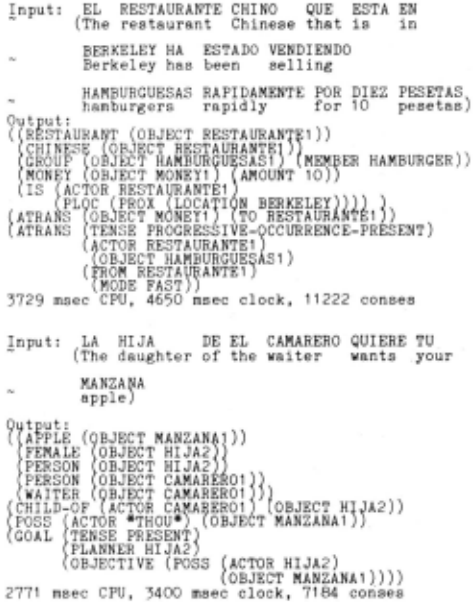
Input: (YO VOY A TENER QUE IR A CHICAGO _ I go t9 hav~ that go to Chicago 1. e., I m go1ng to have to go to Chicago)
Out put: (OBLIGATION ~ TENSE FUTURE) ACTOR *EGO*) OBLIGAND (PTRANS {TENSE FUTURE) (ACTOR *E�O*~ OBJ~CT *EGO*) (FROM *HERE* TO (PROX (LOCATION CHICAGO ))))) 3457 msec CPU, 3950 msec clock, 4921 conses !nput: LA PERSONA QUE (The person that IR A BERKELEY go to Berkeley) ESTA EN CHICAGO QUIERE is in Chicago wants ? ytput · \PERSON (OBJECT PERSONA1))) (GOAL { TENSE PRESENT) PLANNER PERSONA1) OBJECTIVE (PTRANS fTENSE FUTURE) (~CTOR PERSONA1~ OBJECT PERSONA1) (FROM *HER~* TO (PROX (LOCATION BERKELEY)) ))) (IS (ACTOR PERSO~A1) (FLOC (PROX (LOCATION CHICAGO)))) 2999 msec CPU, 3716 msec clock, 6470 conses Input: LAS MANZANAS ROJAS QUE ESTABAN EN LA CAJA (The apples red that are in the box FUERON VENDIDAS FOR JUAN were sold by John) ?u~fL~:(OBJECT JUAN1 )) lPERSON (OBJECT JUAN1J) PHYSOB (OBJECT CAJA1~ (~04 (OBJECT CAJA1) UNSPECtFIED (OBJECT 3)) (GROUP (OBJECT 1 3)) MONEY OBJECT MONEY1 GROUP OBJECT MANZANA 1) (MEMBER ~PPLE)) COLOR OBJECT MANZANAS1) (HUE RED))) (ATHANS jACTOR IT3) (OBJECT MONEY1) TO JUAN1) (fROM IT3)) (A TRANS ACTOR ~U~N1 ) (OBJECT MANZANAS 1 ) ( IS (ACT ~ 0 MHtAN1§Ji9M JUAN 1 )) (FLOC ( INSIDE-OF (OBJECT CAJA1 ))))
4.3 Chinese PHRAN
Chinese is an interesting test of PHRAN because the language consists of a relatively small number of word s , and a ~reat deal of phrasal productivity. A Ch1nese vers1on. of PHRAN is being constructed, aga1 n by only chang1ng the pattern-concept pair data base: The Pin-Yin romanization is used (i. e., Bel Jlng as opposed to Peking) to denote Chinese words , with .suffixed numbers (1-4) denoting tones. Current lyi Ch1nese PHRAN has all 1596 Chinese words 1n 1t, a though 1t only knows the significance of a small percentage of the meaningful patt e rns.
, _For example, concepts often lexicalized in ~ngl 1sh ~an be denoted 1n Chinese by putting words toget ner. Example* il)clud ed ~o far i!) Chinese PHRAr, } re xu~? sheng1 \studPntJ and xian1 sheng1 teacher). Other more complex patt e rns also abound. or exampl e , the pattern "( PLACE> ren2" means "person from that place"; "<PLACE> hua4" -> "the lan§uage spoken 1n that place"i "<COUNTRY-HEAD> suo-" - > "that country"; "<COUNTRr-HEAD> wen2" -> laniluage SJioken in country". Thus "zhon61 guo2 r en2 means a person from ~hina","and both zhong1 guo2 hua4 and zhong1 wen2 mean Chinese".
Other examples inclyde "Chu2 le .·. (yi3 wai4) ... ". Here (yi3 wai4J indicates an option which gives no added meanin~. It corresponds to Except for ... , ···":, "Y1n1 wei1 ... ," suo3 yi3 ... " corresponds to Because ·.· , so
The following are examples of the Chinese sentences PHRAN can handle:
!nput: NI3 PENG2 YOU3 DE1 PENG2 YOU3 YOU3 YI 2 GE4 (Your friend's friend has a FA3 GU02 FAN4 GUAN3 MEI2 YOU3 France restaurant not) have i. e., does he have one
?u~f~I~~D ~ACTOR *YOU*) (O~JECT PERSON3)) FRIEND ACTOR fERSON3) OBJECT fERSON4)) SPECIFI ATION (OBJECT P RSON4) (SPEC SPEC2)) RESTAURANT (OBJECT RESTAURANT1) (TYPE FRENCH) ))
(POSSESS f~8@8RI~t~~~~~tTz~~5EcT RESTAURANT1))
2860 msec CPU, 3650 msec clock, 5960 conses
!nput: 4IAN1 SHENG1 SHI4 ZHONG1 GU02 REN2 ) ( Teacher is China person
?u~~E~~ON TEACHER3)
TEACHER TEACHEE3)
PERSON PERSON3J
OR~�IN (OBJECT PERSQN3) (LOCATION CHINA)))
(IS (SUBJECT TEACHER3) (COMPLEMENT PERSON3))
175 msec CPU, 1084 msec clock, 1429 conses
Input: NEI4 BEN3 SHU1 HEN3 YOU3 YI4 SI1 - (That book very interesting)
?(~8o~:(OBJECT BOOK1)))
(IS (OBJECT BOOK1) (ST~T~-NAME QUALITY) (VALUE INTEREST1NG) (DEGREE VERY)) 1028 msec CPU, 1250 msec clock, 2068 conses
We expect that it would be more difficult t o extend PHRAN to languages that have a great deal of morphological structure. In these cases, our idea of a pattern will probably have to be extended t o allow for the description of components of individual words. It is not clear at this point whether this will present any serious problems for the basic PHRAN processing structure.
5.0 AI AND RELATIONAL DATA BASES
By representing the knowledge about the meaning of a language's utterances declaratively, we claim to have reduced at least part of the natural language processing problem to a problem of data base manipulation. If so, then rather than implementing one's own data base in LISP, conventional data base management systems may be useful when the knowledge to be organized becomes large enough.
We decided to test this idea by actually implementing a version of PHRAN in a conventional data base system. Fred Mueller, a graduate student, essentially re-wrote PHRAN in EQUEL a query language for the INGRES data base system (Held, Stonebraker, and Wong, 1975 ) developed at Berkeley. INGRES is based on the relational model, and runs on a VAX 11 / 780. To get reliable measurements, PHRAN was implemented in FRANZ LISP on this system as well. Test were run to compare the relative performance of the systems on various size data bases.
While the results are somewhat subject to varying interpretations, they can be summarized as follows: First~ it was possible in fact to re-write PHRAN in IN�R~s. although there are some minor difficulties in encoding LISP-based data structures into a language that does not support pointers. Second, the LISP version is considerably faster when the data base of p~ttern-concept pairs is small (about 11 times faster ) . However, when the data base is large (2000 words and 500 patterns), the EQUEL version is about 3 times faster than the LISP version.
These figures are not too surprising in that data bases systems are designed to handle large disk files and therefore should perform better than arbitrary LISP programs access1ng a disk. However, these results are equivocal because (1J loading the data b~s~ was charged to some of the LISP execution timesL \2) little attempt has been made to optimize the ISP version, and \3) the performance of INGRES is actual ly worse than reported, as the figures presume about a factor of four speed-up that should result from very simple changes to INGRES that are in the making .
The details of these numerical results are not so much the point, however. The speed-up figure s are probably conservative in any case. The real point is that a great deal of attention to this sort of performance issue will be paid to general data base systems. If production versions of AI programs can be transferred to these systems to take advantage of this work, then a great deal of duplication of effort may be avoided. By enginee ring PHRAN in the manner that we have, we can take advantage of such technolo~y as it becomes available without having to ent1rely re-design our system fo r a different implementation.
6.0 SUMMARY
We have presented a model of natural language use meant to describe the language-specific aspects of language understanding and product1on. The model is motivated by the pervasiveness of non-generative langua~e , by the desirabity of a language analyzer and a language production mechanism to share their knowledge, and by the need for knowledge engineering advantages such as ease of extent1on and modification .
The basis of the model is a declarative knowledge base of pattern-concept pairs. Thi s knowledge base is shared by PHRAN, a language analyzer , and PHRED, a language production mechanism. PHRAN matches patterns against sentences and uses the associated concepts to represent their meaning; PHRED matches representations for ideas against the concept parts of these patterns, and combines the pattern part to express their mean1ng.
We have experimented with these systems, particularly with PHRAN~ by trying to convert it to other language such as ~panish and Chinese, and by implement1ng PHRAN in a relational data base system. The success we have had so far with these enterprises indicates to us that knowledge engineering principles are useful in the design of flexiblei efficient, and theoretically interesting natural anguage processing systems.
@inproceedings{ijcai1981p6,
  title     = {A Knowledge-Based Approach to Language Processing: A Progress Report},
  author    = {Wilensky, Robert},
  booktitle = {Proceedings of the Seventh International Joint Conference on
               Artificial Intelligence, {IJCAI-81}},
  publisher = {International Joint Conferences on Artificial Intelligence},
  editor    = {Patrick J. Hayes},
  pages     = {25--29},
  year      = {1981},
  month     = {8},
  note      = {Natural Language},
  url       = {https://ijcai.org/proceedings/1981/6},
}
TY - CPAPER TI - A Knowledge-Based Approach to Language Processing: A Progress Report AU - Wilensky, Robert T2 - Proceedings of the Seventh International Joint Conference on Artificial Intelligence, IJCAI-81 PB - International Joint Conferences on Artificial Intelligence PY - 1981 SP - 25 EP - 29 UR - https://ijcai.org/proceedings/1981/6 ER -Copied
Machine-readable versions of this paper, for tools and AI agents:





