
Character Tracking and the Understanding of Narratives
Proceedings of the Seventh International Joint Conference on Artificial Intelligence. Cognitive Science. Pages 209-210.
© 1981 International Joint Conferences on Artificial Intelligence
Abstract
- Abelson, R. P. Does a story understander need a point of view? In R. C. Schank & B. L. Nash-Webber (Eds.), Theoretical issues in natura/language processing. Cambridge, MA , 1975.
- Anderson, R. C. & Picher!, J . W. Recall of previously unrecallable information following a shift in perspective. JVLVB, 1978, 17, 1-12.
- Black , J . B. & Bower, G. H. Story understanding as problem-solving. Poetics, 1980, 9, 223-250.
- Black, J . B., Turner, T. J. & Bower, G. H. Point of view in narrative comprehension, memory and production. JVLVB, 1979, 18, 187-198.
- Carbonell, J. G. Subjective understanding: Computer models of belief systems. Research Report# 150, Dept. of Computer Science, Yale University, 1979.
- Graesser, A. C. Prose comprehension beyond the word. New York : Springer-Verlag, 1981.
- lehnert, W. G. Affect units and narrative summarization. Research Report# 179, Dept. of Computer Science, Yale University. 1980.
- Lehnert, W. G., Black, J . B. and Reiser, B. J. Summarizing narratives. Proceedings of the Seventh International Joint Conference on Artificial Intelligence, 1981 .
- Mandler, J . M. & Johnson, N. S. Remembrance of things parsed : story structure and recall . Cognitive Psychology, 1977, 9, 111-151 .
- Rumelhart, D. E. Notes on a schema for stories. In D. G. Bobrow & A. M. Collins (Eds.), Representation and Understanding . New York: Academic Press, 1975.
- Rumelhart, D. E. & Ortony, A. The representation of knowledge in memory. In R. C. Anderson, R. J . Spiro, & W. E. Montague (Eds.), Schooling and the acquisition of knowledge. Hillsdale, NJ : Erlbaum, 1977.
- Schank, R. C. The structure of episodes in memory. In D. G. Bobrow & A. M. Collins (Eds.), Representation and Understanding . New York : Academic Press, 1975 .
- Schank, R. C. Interestingness: Controlling inferences, Artificial Intelligence, 1979, ll, 273-297.
- Schank. R. C. & Abelson , R. P. Scripts, plans, goals, and understanding. Hillsdale, NJ : Erlbaum, 1980.
- Thorndyke, P. W. Cognit ive structures in comprehension and memory of narrative discourse . Cognitive Psychology. 1977. 9. 77-110.
- Wilensky, R. Understanding goal-based stories. Research Repo rt #140, Dept. of Computer Science. Yale University. 1978.
References were extracted automatically from the PDF and may contain errors.
Full text extracted automatically from the PDF; figures, tables and equations may differ. The PDF is the version of record.
1. Perspective in Understanding
Recent work on the understanding of natural language narratives has emphasized representations composed of goals, plans, and their outcomes. Causal chains [ 12), hierarchical goal / outcome graphs [3] [16], story grammar parse trees [9) [10) [15), and causally linked networks [6) [7] have been proposed as models of the mental representation of a story. A problem that has received little attention however is the influence of perspective in understanding a narrative. Perspective may operate on many levels. Inputs are understood by evaluating them in terms of the system's knowledge, which is often based on subjectively interpreted personal experiences. Thus, understanders having different belief systems may interpret the same story in different ways [5).
Perspective also affects understanding by serving to focus the processing. Attention becomes focused on one key character during the understanding of a narrative. A plausible hypothesis is that we pay most attention to the goals and plans of the character we are focusing on, and are concerned with the goals and plans of other characters only to the extent that they conflict with or further the goals of the tracked character. Although personal factors may certainly influence which character in a narrative one will identify with, the text itself typically is written to focus attention on one of the characters, and the understander usually adopts that perspective. Point of view may be established in a narrative by (I) simple syntactic cues; (2) conveying more information about a character. e.g., more episodes relating his or her experiences; (3) conveying more internal information (i.e., thoughts and feelings) about a character. Once the point of view has been established, more processing work is devoted to that character. More inferences should be made about the character's goals and affective reactions. The other characters are understood only to the extent that their motivations and actions will bear on the main character. The representation will then be built from the main character's perspective, so that recall or summarization will produce more details directly relevant to that character, and will express such details from his point of view. Just as activation of a schema directs processing and causes a number of inferences to fire [II], so does focusing on a character cause more processing to fill out the conceptual picture of the story from that character's point of view.
Consider the following two introductions to a story. An event and goal oriented understander that processed these stories from a neutral 'perspective would presumably build the same
CHARACTER TRACKING
AND THE UNDERSTANDING OF NARRATIVES
Brian J . Reiser
Cognitive Science Program Yale University
New Haven, CT 06520
representation for each story, inferring motivations and reactions for each character whenever possible.
However, it seems likely that in fact the two representations would differ. By the third criteria suggested above, the representation of Story I would be built from David's perspective, while in Story 2, it would be built from Ken's perspective. Processing of the rest of the story should then proceed from the focused character's perspective.
(I) David was still new in town, and felt very lonely. He was just starting to feel comfortable settling into his new high school.
Ken and David met in their Geometry class. Ken always had something to do and had a very active social life at school. Susan was one of the girls that Ken was seeing. David wanted to date Susan and told Ken. David asked Ken to stop dating Susan so he could have a chance with her. Ken laughed and yelled at David, and refused his request.
(2) David was still new in town, and didn't know many people. He was just starting to participate in some activities at his new high school.
Ken and David met in their Geometry class. Ken enjoyed having a very active social life at school. Susan was one of the girls that Ken was seeing. David said to Ken that he would like to date Susan. David asked Ken to stop dating Susan so he could have a chance with her. Ken felt surprised and angry at David and refused his request.
Understanding proceeds as a focused tracking of the fate of a character's goals. When attention is focused on a character in a narrative, each new input is then evaluated from that character's perspective. Such focused character tracking has processing advantages. Schank [ 13] pointed out that if an understander is continually tracking all the goals and plans of all the characters in a narrative, then a combinatorial explosion of inferences would result . Processing the story from one character's perspective is one way that the inferencing process might be constrained . Less relevant inferences need never be made or integrated into the representation.
2. Some Empirical Demonstrations of Perspective
Some recent experiments in the Yale Cognitive Science laboratory provide preliminary support for this notion of understanding. Proponents of story grammars [9) [10] [15] have argued that events more subordinate in the goal hierarchy of the story are less likely to be included in a summary or recall protocol. However. a view of understanding as focused goal tracking suggests that the importance of an event may be influenced not only by its position in a goal hierarchy. but by which of the characters actually achieves the goal. Some support for this prediction is found in data presented by Lehnert, Black, and Reiser [8]. They collected summaries on three slightly altered versions of this base story: 1
Mike and Paul had been close friends ever since their high school days. But now Mike wanted Paul out of town for a few days so he could build a patio in Paul's backyard as a surprise birthday present. He suggested to Paul that he get away for a weekend but Paul said he wasn't interested. On another occasion Mike casually spoke about the joys of fishing or camping trips. But Paul told him he enjoyed puttering around the house much more. Paul was getting very settled in his old age.
Finally, Mike went to Paul's boss and asked him to send Paul on a business trip. But Paul's boss had had a bad day and he wouldn't hear of it. Mike thought a while about what to do next. Then he had an idea.
Mike went to a friend of his who handles the accounting records for Paul's company. He explained the situation to the accountant and told him, "If you tell Paul's boss that there are irregularities in Paul's records and that you would like to examine them for a few days, then Paul will be sent away on some pretense." The accountant replied, "I'd be happy to pull the scam, but I expect a little favor in return. How about an ounce of grass?· Mike felt this was not unreasonable.
So Mike called his connection Joe and asked him for an emergency ounce. But Joe answered, "Sure thing, as soon as you pay up your tab with me." Mike personally delivered a cash payment immediately. When Joe got his money he handed Mike an ounce. Then Mike paid a visit to the accountant and gave him the ounce. As soon as the accountant got the grass. he picked up the phone and called Paul's boss. And within an hour of that phone call, Paul's boss was telling Paul about an emergency situation in Peoria that needed supervision. Paul was on a bus for Peoria that evening.
A strict hierarchical model would predict that the boss sending Paul away is more central in the representation than the event of making the deal with the accountant:
wants to build patio ==>wants Paul out of town ==>wants boss to send Paul out of town ==> wants accountant to trick boss ==>needs grass from Joe the dealer
However, 58% of the summaries mention the role of the accountant, while only 39% of the summaries mention the role of the boss. Indeed, the majority of the summaries say that Paul made arrangements with the accountant to get Paul out of town, deleting explicit mention of the boss at all. This summary is typical of those collected:
Mike tried many ways to get Paul out of town in order to build Paul a patio on his house as a surprise birthday present. He finally managed it by bribing Paul's company's accountant to get
Paul away.
Why should this be so? Lehnert, Black, and Reiser account for this finding in terms of "plot units", a story representation composed of thematic patterns of goal interaction and goal resolution [7]. The unit encompassing both the deal with the accountant and the boss sending Paul away is "nested agencies". This unit represents the situation where X enlists Y who enlists Z as an agent in order to accomplish the goal G. The standard form of expression of this unit is ·x arranged to have Y get G done". thus accounting for the more frequent inclusion of the subordinate event. X (Mike) makes a deal with Y (tht· accountant). than the superordinant event. Y (the accountant) utilizes the aid c>( Z (the baH).
1 The versions varied in the actors of the initial denied requests, and in the inclusion of the goal of building the patio. The differences between the versions are not relevant to the purposes of this paper.
The view I have been proposing would predict that typically in this type of plot relationship, the event achieving the subordinate goal would be encoded as more central in the representation, sine it is executed directly by X, the actor who began the chain, and whose goal G is achieved. The other character important the plot unit is Y, the agent with whom X (the initiating actor) dealt directly, rather than Z, who interacted only withY.
Specifically in this story, the focus has been established on Mike, the actor who began the chain. Mike is established as the main character in the early episodes, since they deal with his attempts to fulfill his goals. Thus, when the accountant and the boss are brought into the story, we are interested in them only insofar as their actions bear on the fate of Mike's goals. The nested agencies plot unit is therefore expressed from Mike's point of view. Thus, although the event of convincing the accountant to help is subordinate to the goal of having the boss send Paul away, Mike is an actor only in this sub-plan, and not in the top-level plan. Consider the goals and events in the story from Mike's point of view: (The percentage of summaries of the above version of the story that mention each proposition is shown m parentheses.)
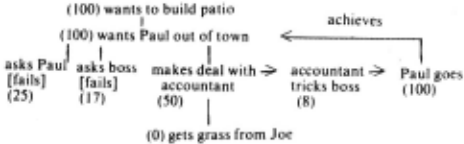
Since we are tracking Mike's goals. although the deal with the accountant works by the accountant tricking the boss, all that concerns the reader is that the deal will result in Paul going out of town. The conversation between the accountant and the boss is seen as an intervening step, and hence the role of the boss is less important than that of the accountant.
Another effect of perspective is evident in the nature of the expression of events in the summaries . For example. the deal with the accountant is a reciprocal arrangement-- Mike pays the accountant a bribe of marijuana, and the accountant does the favor of getting rid of Paul. Yet, all of the summaries that expressed this event included exactly what the accountant did for Mike. while only 76% of them mentioned that Mike bribed the accountant with marijuana. Since processing has focused on Mike, we consider what Mike got out of the deal to be more important than what he had to put into the deal. (From Mike's point of view, paying the bribe only enables getting Paul out of town; from the accountant's point of view, this relationship is reversed.) Thus the summaries demonstrate a tendency to recount events from the point of view of the main character.
In a new series of experiments, I am currently investigating the degree of inferencing about each character in a narrative. Each subject reads one of two versions of a story, in which two men compete for the attentions of a woman. The two versions of the story contain the identical main episode, but differ in which of the male characters was the subject of an initial episode. The initial episode was intended to establish one of the male characters as the main character. A recognition test on the main episode of the story includes three types of "new" items (sentences not explicitly mentioned in the story): affective items (sentences concerning an affective reaction of one of the characters); goal items (sentences concerning the motivations of one of the characters (or some action); and untrue items (sentences expressing some plausable action for which there was no evidence in the story). Preliminary results indicate that indeed subjects are making more inferences about the motivations and affective reactions of the main character than about the other male character. However, the untrue items about the two male characters do not differ reliably. This indicates that the affective and goal results are due to more inferences being made about the main character during understanding, and not to a tendency to falsely recognize statements about the main character. Thus, these results provide preliminary support that inferencing as constrained by the focus of attention in character tracking.
3. Perspective on Perspective
I have argued that perspective influences the encoding of information -- inferences about the main character are more likely to be made, and representations are built from the main character's perspective. Black, Turner, and Bower (4] have demonstrated that once a syntactic point of view has been established in a sentence, a subsequent sentence is encoded from the same point of view, regardless of lexical expression. Abelson's [I] results also suggest the influence of perspective on encoding. Subjects were instructed to adopt a particular visual point of view while listening to a·story, and were later better able to recall details more easily "viewed" from the given perspective. Anderson and Pichert [2] have also demonstrated the influence of perspective on retrieval of information from a story representation. Subjects' recall of a story was increased when they were instructed to think about the story from a given perspective, regardless of the perspective from which the story was first read .
In summary, have argued that models of text representation cannot ignore the perspective issue. Inputs are not evaluated from a neutral or objective perspective. Instead, understanding proceeds as a focused inferencing process. Attention is focused on a particular character. and the system adopts his or her point of view in interpreting successive inputs. Preliminary data suggest that once attention becomes focused on a character, more work is done to understand his or her motivations and reactions than those of the other characters. This focusing during understanding in fact serves to help constrain the inferencing process. As our models of text representation become more complex. utilizing more types of knowledge structures [ 12] [ 14] [ 17], the number of inferences that a particular input in context may motivate increases dramatically. Focused character tracking provides part of the solution to this inference explosion problem.
Acknowledgments
Discussions with John Black and Robin Segal were invaluable in formulating the ideas presented in this paper. Ray Gibbs, John Black, Scott Robertson, and Colleen Seifert all provided valuable comments on an earlier draft of this paper. This research was supported by the Sloan Foundation.
@inproceedings{ijcai1981p42,
  title     = {Character Tracking and the Understanding of Narratives},
  author    = {Reiser, Brian J.},
  booktitle = {Proceedings of the Seventh International Joint Conference on
               Artificial Intelligence, {IJCAI-81}},
  publisher = {International Joint Conferences on Artificial Intelligence},
  editor    = {Patrick J. Hayes},
  pages     = {209--210},
  year      = {1981},
  month     = {8},
  note      = {Cognitive Science},
  url       = {https://ijcai.org/proceedings/1981/42},
}
TY - CPAPER TI - Character Tracking and the Understanding of Narratives AU - Reiser, Brian J. T2 - Proceedings of the Seventh International Joint Conference on Artificial Intelligence, IJCAI-81 PB - International Joint Conferences on Artificial Intelligence PY - 1981 SP - 209 EP - 210 UR - https://ijcai.org/proceedings/1981/42 ER -Copied
Machine-readable versions of this paper, for tools and AI agents:





