
Text Plans and World Plans in Natural Discourse
Proceedings of the Seventh International Joint Conference on Artificial Intelligence. Cognitive Science. Pages 190-195.
© 1981 International Joint Conferences on Artificial Intelligence
Abstract
Discourse is both about the world and an accomplishment in the wo~ This fact has led t o two approaches-to the study of discourse in artificial intelligence, one investigating "text plans", the other "world plans". By analyzing a fra gme nt of a narrative in which both kinds of plans figure importantly, we explore the relationship between the two kinds of plans, looking toward a synthesis of the two approaches.
- Agar, M. 1973. Ripping and running: A formal ethnography of urban heroin addicts. New York: Academic Press.
- Agar, M. 1981. Stories, background knowledge themes: Problems in the analysis of history narrative. and life Agar, M. and J. Hobbs 198la. discourse: Coherence and the ethnographic interviews. To (Discourse Processes>. Interpreting analysis of appear in
- Agar M. and J. Hobbs 198lb. Natural plans. To appear in (Ethos).
- Allen, J. and C. Perrault 1980. Analyzing intention in utterances. <Artificial Intelligence>, Vol. 15, No. 3, 143-178.
- Beaugrande, R. de. 1980. The pragmatics of discourse planning. (Journal of Pragmatics>, Vol. 3. 1980.
- Bruce, B. 1975. Generation as social action. In R. Schank and B. Nash-Webber (Eds.) (Proceedings, Theoretical Issues Language Processing>, 64-67, Massachusetts. June 1975.
- Bruce, B. 1979. A social interaction reading. BBN Report No. 4238. Bolt in Natural Cambridge, model of Beranek and Newman, Inc. Cambridge, Massachusetts. October 1979.
- Bruce, B. 1980. Analysis of interacting plans as a guide to the understanding of story structure. (Poetics>, vol. 9, 295-311.
- Bruce, B. and D. Newman. 1978. Interacting plans. (Cognitive Science), Vol. 2, 195-233.
- Carbonell, J. 1979. Computer models of human personality traits. (Proceedings, International Joint Conference on Artificial Intelligence>, 121-123. Tokyo, Japan. August 1979. IJCAI
- Cohen, P. and R. Perrault 1979. Elements of a plan- based theory of speech acts. (Cognitive Science). Vol. 3, No. 3, 177-212.
- Grimes, J. 1975. (The Hague: Mouton. thread of discourse). The
- Grosz, B. 1977. The representation and use of focus in dialogue understanding. Stanford Research Institute Technical Note 151, Stanford Research Institute, Menlo Park, CA. July 1977.
- Hobbs, J. 1976. A computational approach to discourse analysis. Research Report 76-2, Department of Computer Sciences, City College, City University of New York. December 1976. 1
- Hobbs, J. 1978. Why is discourse coherent? SRI Technical Note 176, SRI International, Menl o Park, California. November 1978.
- Hobbs, J. and M. Agar 1981. Planning and local coherence in the formal analysis of ethnographic interviews. Forthcoming.
- Hobbs, J. and D. Evans 1980. Conversation as planned behavior. (Cognitive Science>. Vol. 4, No. 4, 349-377. IJCAI
- Hobbs, J. and J. Robinson 1979. Why Ask? (Discourse Processes>, Vol. 2, no. 4. 311-318.
- Hutchins, E. 1980. Culture and inference: A Trobriand case study. Cambridge, Massachusetts: Harvard University Press.
- Levy, D. 1979. Communicative goals and strategies: Between discourse and syntax. In T. Givan (Ed.), (Syntax and semantics>, Vol. 12. 183- 212. New York: Academic Press.
- Longacre, R. 1976. (An ana~omy of speech notions ) . Ghent: The Peter de Ridder Press.
- Mann, W., and J. Moore 1981. Computer generation of multiparagraph English text. <American Journal of Computational Linguistics>, vol. 7, no. 1, 17-29.
- Mann, w., J. Moore and J. Levin 1977. A comprehension model for human dialogue. <Proceedings, International .Joint Conference on Artificial Intelligence>, 77-87. Cambridge, Mass. August 1977. IJCAI
- Polanyi, L. 1978. The American story: Cultural constraints on the meaning and structure of stories in conversation. Ph. D. Thesis; Dept. of English Language and Literature, University of Michigan, Ann Arbor, Mich.
- Rumelhart, D. 1975. Notes on a schema for stories. In D. Bobrow and A. Collins (Eds.), (Representation and understanding: Studies in cognitive science), 211-236. New York: Academic Press.
- Schank, R. and R. Abelson 1977. goals, and understanding>. Laurence Erlbaum Associates. (Scripts, Hillsdale plans, N.J.: Schmidt, C. 1975. Understanding human action. In R. Schank and B. Nash-Webber (Eds.) (Proceedings, Theoretical Issues Language Processing>, 196-200, Massachusetts. June 1975. in Natural Cambridge,
- Wilensky, R. 1978. Understanding goal-based stories. Yale University Dept. of Computer Science Research Report 140. September 197H.
- Winograd, T. 1977. A framework for understanding discourse. Stanford AIM-297. April 1977.
References were extracted automatically from the PDF and may contain errors.
Full text extracted automatically from the PDF; figures, tables and equations may differ. The PDF is the version of record.
1. Two Views of Plans in Discourse
Recently, natural language discourse has been analyzed in terms of the artificial intelligence notion of planning. But the plans have been of two distinct sorts, and this distinction has given the field two approaches.
Those using the first approach hypothesize about the plans that the participants in a dialogue or the writer of a text must have. Bruce (1975), Schmidt (1975), and Cohen and Perrault (1979), for example, investigate the plans a dialogue system would have to generate to perform felicitous individual speech acts. Allen and Perrault (1980) develop processes that would allow a listener to recognize a speaker's plan to perform a particular speech act. There have also been attempts to extend the planning metaphor to larger stretches of discourse. The first author (Hobbs 1978) has sought to interpret the structure that many investigators find in discourse (e.g. Grimes 1975, Longac re 1976) as means by which a speaker can realize goals of a "textual" or "listener-directed" nature. Winograd (1977) and Levy (1979) also demonstrate how the structure of discourse can result from the speaker's goals in talking. Recently we have been analyzing conversations in terms of the participants' developing plans for carrying on the conversation (Hobbs and Evans 1980, Agar and Hobbs 1981a, Agar and Hobbs 1981b, Hobbs and Agar 1981). In all of this work, the speaker is assumed viewed as using some kind of planning mechanism to generate plans whose actions are the utterances in the dialogue or the sentences in the text. We will call these plans "text plans" and the approach the "text approach".
By contras t, those using the other approach explicate the plans of the characters in the story itself. For example, Schank and Abelson (1977) show how knowledge of people's typical goals can be used to understand stories about their activities. Wilensky (1978) examines stories built around the conf licting goals and plans of characters. Bruce and Newman (1978), Bruce (1980), and Beaugrande (1980) all analyze traditional stories or literary works in terms of the characters' initial goals and Michael Agar Department of Anthropology University of Maryland their developing plans to realize the goals. Related t o this work is the investigation of how the plan for accomplishing a task can structure a dialogue a bon t the task (Grosz 1977, Hobbs and Robinson 1979). In cognitive anthropology there has been a similar interest in discovering from discourse some of the central plans in people's lives, including work by the second author (Agar 1973) and by Hutchins (1980). In all these examples the plans are concerned not with "how to talk" but with "how to do". They are plans for achieving goals in the world, not in the text, and we will refer to them as "world plans", and to the approach as the "world approach".
Those adopting the text approach typically see understanding discourse as a bottom-up, dat a directed process. That is, it has been easier to state how possible interpretations are constrained by the discourse itself than by one's expectations about its structure. Theories of text structure have either had too little coverage, as with story grammars (Rumelhart 1975) and dialogue games (Mann, Moore and Levin 1977), or they have been insufficiently constraining, as is the first author's coherence theory (Hobbs 1978). In general, text plans are ephemeral. They are not usually constructed out of large prestructnred pieces. Rather, they are built "on the fly" in response to unique situations. Consequently, the major problem with the text approach is that several equally plausible coherence structures may fit the data, and a great deal of inferencing might be required to discover any of them.
Those adopting the world approach typically view comprehension of a text as guided by large, prestructured plans that are simply instantiated for the occasion. To interpret an utterance is to determine what step or steps in the world plan the utterance refers to. This approach provides very strong constraints on possible interpretations of utterances. The major problem, however, is that we are not generally given the relevant plan at the beginning of a text. The listener or reader has t o pick the appropriate plan from a large collection of possible plans, or more frequently, has to construct a new plan for the occasion. The world approach doesn't say how this is done.
For the past year, we have been analyzing fragments from a large corpus of ethnographic life history interviews, attempting to bring formal approaches to discourse developed in artificial intelligence to bear on the problems of cognitive anthropology. ln the course of our research we have found it useful to analyze our texts both in terms of the text plans and the world plans tha t are exhibited. This raises a natural question: what is the relationship between the two approaches to discourse, between text plans and world plans? ln this paper, we focus on one fragment of an interview in which both world plans and text plans figure importantly, and we explore their relationship, in an attempt to bring about a synthesis between the two approaches to discourse.
The conclusion we arrive at has important consequences for discourse understanding systems. Each approach can be seen to aid in the solution of the major problem in the other approach. The text structure , especially in the pattern of elabor a tions, frequently highlights c ritical areas of the world plan that must be constructed in i nterpreting a text. Conversely, where the text p l an is ambiguous, the world plan that has been developed imposes the most constraints.
As will be obvious, there is no system that is capable of performing the analysis that we present, nor do we have any intention of trying to implement such a sys tem. Rather our effort is to use the sophisticat ed formalisms developed in artificial inte llige nce t o make sense of complex data that anothe r field must grapple with, and in that context, t o investigate the mapping between text and world, toward a synthesis of the two dominant views of discourse in AI.
2. The Data
The f ragment we analyze comes from a series of life history interviews with a 60-year-old career he r oin addict in New York, whom we will call Jack, collec ted by the second author in 1974-5 (Agar 1981). In the particular interview this fragment is taken from, Jack is telling how, in 1948, he became a burglar. In his global plan for telling the story, he must first tell how he met Johnny, the man who taught him burglary. Johnny is initially portrayed as naive in the ways of the world, until halfway through the interview, when, during Jack's account of the first burglary, Johnny emer ges as extremely competent. Much of the impact of the story derives from this contrast.
The f ragment below describes his first encounter with Johnny. Jack has just stolen some luggage at Penn Station containing a pair of gloves he is now trying to fenc~. He has l oca ted a fence by the name of Frenchy in a cafeteria. With Frenchy are two "kids", one of whom turns out to be Johnny. The fragment goes as follows:
- Now sitting with him [Frenchy] were two young kids,
- They couldn't have been over 19 if they were that old,
- probably 17, 18,
- bright-eyed kids,
- obviously not New Yorkers,
- and they were talking at the top of their voices,
- why man, I- you know, blah blah blah,
- ( 8) I got this guy before he knew what had happened,
- and man I had his wat ch
- and man did you see the roll- his roll of bills he had,
- and one guy is flashing a diamond ring out from underneath the table,
- he's flashing it up above the table.
- Meanwhile Frenchy's called me to come over
- and sit at the table with him,
- so you know, I looked at these two kids
- and I sat down at the table
- and I was just in no mood to listen to a lot of bullshit.
- So I turned to the kids,
- I said, hey look you guys, why don't you just soft peda l it.
- I said, I don't know what your story is and I care less,
- but you ' re making a general display of yourself.
- This place is loaded with rats.
- It's only a matter of time until a cop comes in and busts the whole table,
- I told Frenchy, I said, Frenchy, what the fuck is the matter with you,
- you know, I said, why don't you tell these dudes to- to shut up.
- But Jack, they've got blah blah blah , you know,
- and I want to get this stuff,
- I said well look, I said you guys may not care if you go to jail,
- but I do.
- I said I spend 75 percent of my time trying to stay out of jail,
- and I don't want anybody to come up here and bother us.
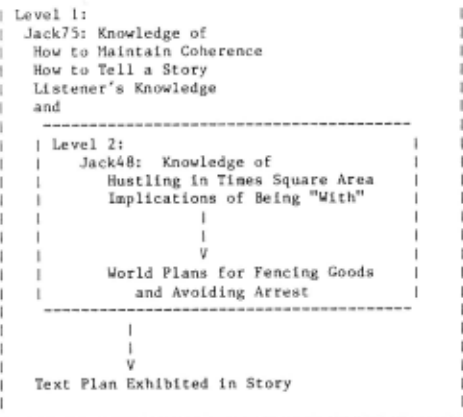
Before getting into the detailed analysis it will be useful to clarify the nature of our problem by casting it into a framework of levels developed by Bruce (1979) and illustrated in Figure 1. At Level 0, we have the real speaker, Jack, and the real listener, Mike. However, when they enter into a conversation they become an "implied speaker" and an "implied listener", by restricting the knowledge bases they build the conversation on top of to the knowledge they believe they share. We may call the speaker in this fragment Jack75. In constructing his narrative, he is developing a narrative plan on the basis of his 1975 knowledge about, among other things, how to maintain coherence, how to tell a good story, and what his listener knows, in addition to knowledge of the content of the story. On the other hand, the main character in his story, whom we may call Jack48, is acting out the steps in developing plans to obtain money and avoid arrest. He is using his expertise as a hustler, his knowledge of the Times Square area, and his knowledge about social relationships. All of this knowledge is contained in the knowledge base that Jack75 is using, but the reverse is not true, of course. Jack75 has Jack48's world plan in mind and develops a text plan, whose purpose is to convey it to his listener. His listener witnesses the execution of Jack75's text plan and uses what he perceives to recover Jack48's world plan, in part by discerning Jack75's text plan (though not necessarily consciously).
It will be clearest if we proceed by first laying out the principal world plans that figure at Level 2. We do this in Section 3. Then in Section 4 we consider the problems Jack75 has in generating a story that conveys these plans adequately, and the coherence devices he uses, that is, the text plan he constructs, in order to solve these problems. In Section 6 we close with observations about the relationship between kinds of plans. a few the two
3. The World Plans
Before describing the specific plans that are relevant to our data, we will describe the simple planning formalism we assume. First of all, it will simplify things if we collapse causality and implication into the single relation, "implication", represented by "--)", Implication is a relation between propositions, whereas causality is a relation between events. However, an event can be "described" by a proposition. What we will mean when we say that one event El implies (-->) another event E2 is that there is a proposition PI that describes event El occurring at time tl and there is a time t2 after tl and another proposition P2 that describes event E2 occurring at time t2, and Pl implies P2. Since our plans do not involve intricate temporal factors, we can get away with this simplification.
We will assume a knowledge base that includes a number of rules of the form "P --) Q", where P and Q are propositions. We assume some of the rules to be in focus at any given instant. A plan is an and-or tree that is constructed as follows. There is some goal proposition GO at the root. Given a goal or subgoal proposition G, there is a conjunctive branch from G to subgoals Pl, ··· , Pn, for all rules of the form "Not-Pi --) Not-G" that are in focus. For one or more rules "Gi --) G", there is a (disjunctive) branch from G to the subgoal(s) ~i. (The Pi's are the preconditions; Gl is the means by which the goal G is or could be accomplished.) If there is a rule "G --> S" in focus and G is a goal or subgoal in the plan, then S is a known side-effect of the plan, represented in the diagrams below by a horizontal arrow.
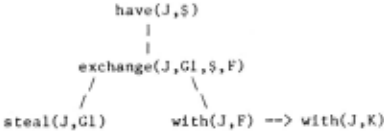
There are three plans that play an important role in this fragment. The first is the plan Ja ck brings into the situation --his plan to get money from the fence for the goods he has stolen. The plan is illustrated in Figure ~. Jack's goal is ttl have money. ln order to obtain money, he wants to exchange the gloves for money with Frenchy. ln order to do this, he first has to steal the gloves, which he has done. Then he must be with Frenchy. This much of the plan is probably prestructured, since it is something Jack has done often, and it is just instantiated for the occasion with Frenchy in the "fence slot" and the gloves in the "goods slot".
But there is a basic rule of social interaction that becomes relevant in this situation. It says that if you are with someone who is with someone else, then you are with that someone else. "With" is transitive.
(A x,y,z)(with(x,y) & with (y,z) --) with(x,z)) Since Frenc.hy is already with the kids, Jack's plan has the side-effect of Jack's being with the kids. Figure 2 illustrates all this. (Branches in all the diagrams are conjunctive unless otherwise indicated.)
The second relevant plan responds to a maintenance goal that Jack always has -- avoiding arrest. Here he presumably builds his plan on the fly in response to the situation out of individual rules of plausible inference encoding his knowledge of how the world works. The crucial rule is that when the police arrest someone, then everyone with him is generally arrested too.
(A x,y)(arrest(Pol,x) & with(x,y)--)arrest(Pol,y))
The other relevant facts are the facts about the police that if they know someone has done an illegal act, they will generally arrest him (assuming they are in a position to do so),
and the fact that if about an illegal act, the police, a "rat" hears someone tell he will generally tell it to
In addition we need two Saying something results in it: facts about speaking. the hearer's knowing
(A x,y,z)(say(x,y,z) --> know(y,z))
If you say something near someone else, that person will frequently hear you:
(A x,y,z,w)(say(x,y,z) & near(w,x)--)hear(w,x,z))
Out of these pieces we can build Jack's plan to avoid arrest, shown in Figure 3. We assume a typical rat R to avoid irrelevant complexities with quantified variables.
7. Not-say(K,x,do(K,Mug))
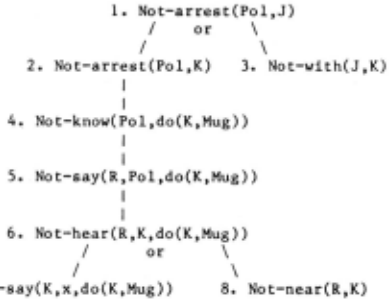
Figure 3. Jack's Plan to Avoid Arrest (Plan II)
For referential convenience, we call this "Plan II" and number the subgoals as indicated.
Two of the plan's terminal nodes conflict with reality. The kids are openly admitting a mugging, and as Jack48 says, there are rats nearby. The other terminal node conflicts with the side effect of Jack48's first plan. If he is to be with Frenchy to fence the goods, he must be with the kids.
In order to resolve this conflict, he could either give up his first plan and therefore not be with the kids, or he could make everyone go someplace that wasn't "crawling with rats", or he could cause the kids to stop talking about the mugging. The last is obviously the cheapest alternative, and Jack48's third plan has that as its goal. It is actually an extension of subgoal 7 in Plan II.
He could normally expect the kids to have the goal of avoiding arrest too, and to know that their display risked arrest, but evidently this presumed plan of theirs was breaking down. Either they didn't have the goal or they didn't know the risk. The two actions Jack takes are to explain the risk to the kids, (18) - (22), by laying out the chief elements of Plan II, and to emphasize the importance of the goal, (27) - (30). In addition, he tries an indirect cure by accusing Frenchy of failing in his responsibility to keep the kids quiet. We won't represent this plan formally since it would take us too deep into a notational morass.
There are other goals and plans that figure in this story, including Frenchy's plan to get the goods from Jack, his plan to get the diamond ring and money from the kids, and his own goal of avoiding arrest. Frenchy faces his own goal conflict between getting the prime goods that the kids have to offer and avoiding the arrest that their behavior invites. He solves it in a different way than Jack does, by deciding that getting the goods is important enough to risk arrest for, as he says in utterances (25) - (26). The potential gain outweighs the risk in Frenchy's case in a way that it doesn't for Jack. Part of Frenchy's plan must involve a decision not to tell off the kids as Jack does, because it could be taken as an insult and jeopardize the deal.
The kids bring their own plans into the scene, first their plan to get money for their goods, and second the plan that must underlie their display. It might seem strange to call the display planned behavior, rather than something that results from their character, but as Carbonell (1979) has shown, character traits can be analyzed into propensities to exhibit certain kinds of goal-directed behavior. Moreover, there is evidence in utterances (19) and (27) that Jack is treating their behavior as planned.
The final plans at Level 2 are Jack's text plans that he executes when he talks to the kids and to Frenchy, generating the internal structure of those sequences of utterances. These we discuss in the next section.
4. The Text Plan
The analysis in this section presupposes a familiarity with the coherence theory developed by the first author (Hobbs 1976, 1978). Briefly, it says that a speaker has various coherence relations, such as elaboration, contrast, and explanation, that he can use to organize his discourse so that it will be comprehensible, and that in comprehension a listener recognizes these coherence relations (though not necessarily consciously) by drawing inferences satisfying certain general constraints.
Let us take Jack75's view of the problem of generating the story. He has to indicate the two difficulties in Plan II -- that Jack48 should not be with the kids, and that they are making a dangerous display of themselves.
Utterance (1) expresses both significant facts that Frenchy was with the kids, and that the kids were ~· The former remains on hold for a time while Jack develops the latter, but it turns out later to be a significant piece of information. In utterances (2) - (5) Jack develops the theme of the kids' youth through a series of elaborations but the way in which it is elaborated is significant. First of all, in utterances (2) and (3), he gets more specific about their ages, and adds little that is new. In utterance (4), however, he calls them "bright-eyed", and to recognize this as an elaboration of the "youth" theme we must find something youth and bright-eyed ness have in common. There are many possibilities, but one of them is a careless naivete. Finally we learn in utterance (5) that they are "obviously not New Yorkers". For knowledgeable New Yorkers, which both Jack75 and Agar are, this statement conveys a lack of knowledge of the ways of New York. To see this as an elaboration of the youth theme, we must draw the inference about youth and bright-eyed-ness that when one is young and bright-eyed, one is likely to lack street knowledge. Thus, utterances (1) - (5) are tied together by a theme that could be characterized as "Frenchy was with two young and hence non-streetwise kids". This theme is important since Jack48's first attempt to overcome the goal conflict involves correcting the kids' lack of knowledge, and in fact the whole story of how Jack became a burglar is built around the contrast between Johnny's initial seeming ignorance and his subsequently revealed competence as a burglar. The fact that Jack75 gives the "unknowledgeable youth" theme such rich development indicates that it plays a crucial role in the story he is telling.
This is an important point, and it suggests how the notion of the "evaluative structure" of a story, introduced by Polanyi (1978), needs to be extended. Polanyi studied the use of various discourse devices, such as linguistic markers, and argued that these devices "evaluate" (in the sense of "indicate the importance or value of") the important portions of a narrative. The extension of the concept of evaluation suggested by our data is that it is not just linguistic markers that evaluate, but the elaborative coherence structure itself. Moreover, what is evaluated is material that points to crucial areas of the underlying world plan that must be constructed by the listener.
Let us return to the analysis. Having characterized the kids, Jack75 next describes their behavior in utterances (6) (12). Among the principal inferences that must be associated with character traits are inferences about the typical behaviors that the character traits result in (Carbonell 1979). Thus the relationship between (1) - (S) and (6) - (12) can be seen as one of general statement - specific instance. Jack has told us what the kids are like in a way that tells us that this information is important. Now he gets specific about why it is important. We learn two things. First we learn in (6) that they are talking so loud that they could easily be overheard, pointing toward a violation of subgoal 6 in Plan II. Then in (8) - (12) we learn that they are talking about illegal activities, filling in more crucial information in the violation of that plan. This is probably enough for someone reasonably familiar with the domain to construct at least the branch of Plan II from subgoal 2 to subgoal 7. Within this segment there is a build-up in intensity. In (8) the kid makes a statement that could be interpreted ambiguously. In (9) - (10) there is an explicit admission of a mugging . This could still be mere braggadocio, but in (11) - (12) the goods are actually displayed. The nearly identical repetition we find in (11) and (12) again evaluates or marks as important the information conveyed by these utterances. Jack75 shows us that the kids' lack of knowledgeability leads them to engage in very dangerous behavior.
This leaves Jack75 with the "with" theme to develop -- the problematic right branch of Plan II.
In utterances (13) (17) he gives us a very interesting counterpunctual development of the goal conflict surrounding the "with" relationship. In fact, we can view Jack48's moves here as an attempt to block the transitivity of "with". 'Utterances (13) and (15) serve to establish his "with" relationship with Frenchy, while the alternating utterances, (14) and (16) - (17), serve to distance him from the kids. They emphasize Jack's orientation toward the kids and thus call it into question. Utterance (14) indicates that Jack i s making a judgment, perhaps about their charact e r and behavior and its possible effects on him. Utterance (16) provides a negative evaluation of their behavior, and utterance (17) again emphasizes his orientation toward them. Jack75 could have conveyed the bare information simply by saying,
So I sat down with Frenchy and I said t o
the kids ····
By spinning it out at greater length, he gives the listener a sense of the conflict involved in the situation and Jack48's hesitation about entering it.
This segment is an int~resting illustration of how the hard facts about arrest and the life of a hustler interact with subtle factors of social interaction and get reflected in the fine details of social behavior and descriptions of soc i al behavior.
Now Jack48 begins to speak and the distinction between Level 1 and Level 2 disappears. If Jack7 5 remembered exactly what Jack48 had said, then his text plan would be merely this: describe telling the kids about the risk; describe asking Frenchy for an explanation; describe telling the kids about arrest. But it is not likely that Jack7 5 remembers, so he must construct a plausible text plan for Jack48 to execute. Hence we collapse Jack75 and Jack48 into simply Jack.
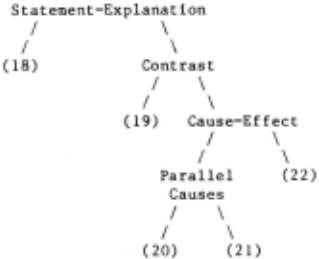
We can almost read the text plan off world Plan II. Jack begins in (18) by telling them subgoal 7 explicitly. The rest of the segment , (19) - (22), functions, in terms of the text pl an, as an explanation for subgoal 7. In terms of the world plan, the explanation is simply the higher subgoals in the tree. Thus, utterance (20) says that subgoal 6 is not being satisfied, utterance (21) says the same for subgoal 8, and utterance (22) draws the conclusion that subgoal 2 may fail. By referring to "the whole table", Jack points t o the real problem for him, to which he gives further development in (27) (30) -- subgoal 1. The contrastive coherence relation between (19) and (20) (22) highlights the importance of the latter: "I don't know the explanation for this, but whatever it is doesn't justify this display."
The coherence structure of this segment i s illustrated in Figure 4. The inferences that had to be drawn to recognize this could for the most part have been read off of Plan II, and it i s difficult to imagine how, in the absence of the world plan, the coherence of some of the utterances, such as the deep parallelism between (20) and (21), could have been discovered at all, Figure 4. Coherence Structure of (18) - (22).
In the final segment of the fragment, utterances (27) - (30), we see another interesting interaction between text plan and world plan, for the segment uses various coherence relations to evaluate heavily the top goal in Plan II. Instead of just giving the bare information,
I don't want to get arrested,
as he finally does in utterance (30), he first gives an explanation of this desire as following from a general principle (28), which he evaluates or highlights by a contrast with (27) and by elaborating it in (29) as being before him most of the time.
5. The Relationship
The text plan, or equivalently the coherence structure, of a passage is the trace of the s peaker's decisions about how to travel about the wo rld plan or other knowledge structure he is trying to convey. Our analysis has yielded info rmation about two kinds of decisions:
- How to choose a starting point and how to move from node to node.
- Why and how to develop a node beyond the simplest statement of its content.
Several solutions to the first problem seem to be possible. The speaker can start at the top, describing the most global goal, and then elaborate on the plan as he goes along by describing the particular steps implementing the top-level goal. Or he can give the most detailed nodes first and provide the higher nodes by way of explanation. This is what we see in utterances (18) - (22) and (27) - (30). (One interesting feature of this passage, if we take Plan II more seriously than we ought to, is that the intermediate subgoals 4 and 5 in the plan remain unexpressed as obvious and easily inferrable. Mann and Moore (1981) address the issue of omitting such nodes in a description.) Alternatively, the speaker could start at the beginning at the most detailed level and proceed in temporal order, producing the so-called normal narrative order.
The second problem facing the speaker is his choice of nodes in the world plan to which to give a richer development. As we have seen, this richness takes the form of elaborations, contrasts, and parallel examples -- the expansion relations. It was suggested in Hobbs (1978) that the expansion relations reflect the structure of the speaker's knowledge base, so in a sense the speaker develops a point by lingering in one locale of his knowledge base. He provides information inferentially related to the node of the world plan he is developing. This suggests two reasons for giving development to a node.
The first is that the node is particularly important for the story and lies in an important and hence richly developed area of the knowledge base, or in an area of listener ignorance, so that an expanded development gives the listener the time and material to absorb it more thoroughly. This is what we have seen in utterances (1) - (12), and on a smaller scale in utterances (27) - (30).
The other reason is quite the opposite. If the speaker is in an area of his knowledge base that is not richly developed, and is having difficulty expressing his thoughts, he is likely t o take several cuts at it, trying one expression, repairing or elaborating on that, or giving several parallel examples or a contrasting case. This kind of passage has a very different flavor to it, however, from the expansions arising from the first reason.
Our analysis has shown that the relation between text plan and world plan is close but not simple. Among other things, the speaker determines which parts of the world plan are most crucial to convey, and evaluates or highlights them through a variety of "expansion" coherence relations such as elaboration, exemplification, and contrast. These expansions provide the listener with repeated opportunities, and we would expect them to dominate the discourse just when the listener could not be expected to have construc ted the underlying world plan. On the other hand, once the world plan has been constructed, it can be used for the rapid selection of inferences to support coherence relations whose recognition would otherwise require a great deal of inferential work.
The interconnections between text plan and world plan are certainly richer and more complex than our investigation of this fragment has revealed. This is something further research will undoubtedly show.
Acknowledgments
The authors have profited from discussions with Livia Polanyi, Patricia Violi, and Bob Wilensky. This work was supported in part by SRI International Internal Research and Development Project No. 676D81-4G4 and NIDA Career Developme nt Award DA000055.
@inproceedings{ijcai1981p39,
  title     = {Text Plans and World Plans in Natural Discourse},
  author    = {Hobbs, Jerry R. and Agar, Michael},
  booktitle = {Proceedings of the Seventh International Joint Conference on
               Artificial Intelligence, {IJCAI-81}},
  publisher = {International Joint Conferences on Artificial Intelligence},
  editor    = {Patrick J. Hayes},
  pages     = {190--195},
  year      = {1981},
  month     = {8},
  note      = {Cognitive Science},
  url       = {https://ijcai.org/proceedings/1981/39},
}
TY - CPAPER TI - Text Plans and World Plans in Natural Discourse AU - Hobbs, Jerry R. AU - Agar, Michael T2 - Proceedings of the Seventh International Joint Conference on Artificial Intelligence, IJCAI-81 PB - International Joint Conferences on Artificial Intelligence PY - 1981 SP - 190 EP - 195 UR - https://ijcai.org/proceedings/1981/39 ER -Copied
Machine-readable versions of this paper, for tools and AI agents:





