
Learning Racquetball by Constrained Example Generation
Proceedings of the Seventh International Joint Conference on Artificial Intelligence. Learning. Pages 144-145.
© 1981 International Joint Conferences on Artificial Intelligence
Abstract
A model of learning in a highly active and competitive environment is presented here. This paper posits that learning, under these conditions, can be characterized as accommodating examples produced by the Constrained Example Generation (CEG) process. The role of the-CEG process in the LRCEG system is danonstrated by a typical learning scenario.
Full text extracted automatically from the PDF; figures, tables and equations may differ. The PDF is the version of record.
LEARNING RACQUETBALL BY CONSTRAINED EXAMPLE GENERATION*
By Leonard P. Wesley
Department of Computer and Information Science University of Massachusetts Amherst, Mass. 01003
The syntax of the expert's information was "IF A PLAYER ENCOUNTERS object-of-encounters THEN TRY AND MEET object-of-meet AND RESPOND object-of-respond.". The context within which learning occurs is the 'object-of-encounters', and the appropriate behavior for meeting and hitting the ball is 'object-of-meet' and'object-of-respond' respectively. An example of the expert's advice is "IF A PLAYER ENCOUNTERS a fast cross-court shot THEN TRY AND MEET the ball waist high AND RESPOND with a ceiling shot." Both the context and behavior knowledge is translated into velocity and RB court X,Y,Z coordinates (i.e., 'coordinate-velocity' information). This knowledge is represented in a frane-like data structure [Fig 1a ,b).
(CONTEXT (SEMANTICS (X dX) (Y dY) (Z dZ) (V dV)) (OBJECTIVE object!ve-funct!on-def!~it!on) (SITUATION s!tuat!on-fu~ction-defin!tion) (RESPONSE response-info-&-function-def!nltion)) (a.)
(long-term-success-rate X Y Z V)
(XS Y~ ZS VS)
(short-term-success-rate response-function-def)
(b.)
Fig_!
- (a.) This figure represents the LISP data structure used to represent the examples. X,Y,Z, and V are the coordinates and velocity of the ball. dX,dY,dZ, and dV specify the allowable variance of X,Y,Z, and V respectively.
- (b.) An expansion of a portion of Fig 1a. X,Y,Z and V specify the coordinates and velocity of where to return the ball. XJ, Y~. ZJ, and VS specify the maximum amount the modification process may change X.Y.Z. and V.
CONTEXT, in Fig 1a, is the context .or example name (e.g., cross-court). The values of the SEMANTICS, OBJECTIVE, and RESPONSE slots are the corresponding domain and 'coordinate-velocity' information.
III THE LRCEG SYSTEM --- ----- ------
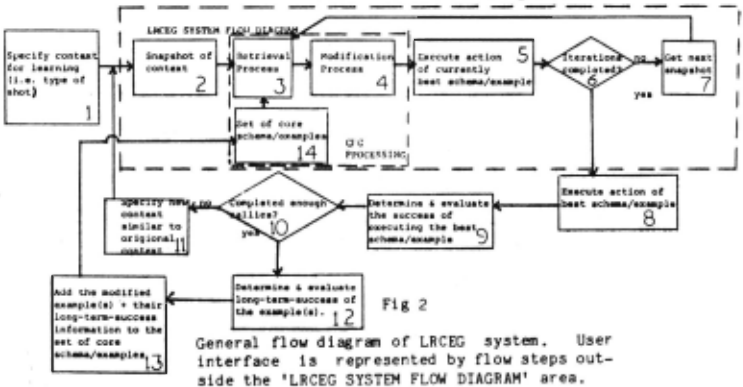
The LRCEG system is written in LISP and runs on a VAX 11/780. A flow diagram of the LRCEG system and how a user interacts with it appears ir Fig 2. System operation can be described in thirteen steps (corresponding to box numbers in Fig 2.) as follows: (1)Initial ball X,Y,Z position and
ABSTRACT
A model of learning in a highly active and competitive environment is presented here. This paper posits that learning, under these conditions, can be characterized as accommodating examples produced by the Constrained Example Generation (CEG) process. The role of the-CEG process in the LRCEG system is danonstrated by a typical learning scenario.
I INTRODUCTION
This paper introduces an emerging system designed to learn racquetball by a process of constrained example generation (LRCEG). Having the capacity to generate a set of constrained examples has been shown to be essential in many domains [1),[2]. Furthermore, learning as a form of accommodating and assimilating knowledge has beer. demonstrated to be useful to a number of systems [6]. .The implication here is that some forms of learning can be modeled, in pa·rt, as a process of retrieval, modification, or construction of domain speci fie knowledge, represented as examples [3J.[5J. Exploring a variety of learning issues within the RB domain is made possible by the generality and robustness of the CEG paradigm [4).
Racquetball (RB) as a learning domain has some advantages. The speed and competitive nature of the sport facilitates investigating learning under rapidly changing and strenous conditions. Many important occupations require learning the appropriate behavior for unpredictable, fast-paced, and demanding environments (e.g., medicine, athletics, aircraft piloting). The learning required to perform tasks in these domains can be very different (although not mutually exclusive) from a typical classroom education. The generality and robustness of the CEG paradigm allows exploring a variety of learning-RB issues [4).
II ACQUISITION AND REPRESENTATION OF DOMAIN SPECIFIC KNOWLEDGE
Some knowledge about RB must be obtained and represented before the LRCEG system can attempt learning. Knowledge for the initial set of six examples was extracted from interviews of a RB expert.
*This work supported, in part, by free computer time from the COINS department at the University of Massachusetts, Amherst, Mass. 01003.
velocity V, number of iterations, and discrete time interval is specified by the user. (2)A snapshot (instantaneous ball position ar.d velocity) information is gathered. (3)Retrieve example( s) (from box 14) with satisfiable semantic constraints(i.e. X,Y,Z,V from snapshot are within dX,dY,dZ,dV of X,Y,Z,V from semantics slot of the example. Retrieval output is a set of examples that are candidates for modification. (4)1't>dification involves calling the function-definition programs defined in the OBJECTIVE, SITUATION, and RESPONSE slots (see Fig 1a.). The objective program modifies the X,Y,Z coordinates of where a player meets the ball. The player computes the trajectory of the ball and modifies where, on the RB court, to be in order to satisify the constraint of meeting the ball at the position specified by the "object-of-meet". The situation function quantifies the players "situation" which is inversely proportional to the distance between the player and the objective. The response function modifies the X,Y,Z coordinates of where to hit the ball and computes the short-term-success-rate which is a "goodness" measure of the example's response specification. Examples are .modified if improvement can be made in the short-term-success-rate. Each example is trying to obtain the highest "goodness" (i.e., short-term-success-rate value) measure possible, in effect competing with other examples to be selected as the one having the best response. A better situation, higher long-term-success-rate, slower ball, and faster player will tend to increase the short-term-success-rate. All examples are sorted on their short-term-success-rate before step 5. This allows subsequent retrieval, modification, and execution of the currently best examples first. Being able to retrieve and manipulate the best examples first is important if time and quantity constraints are placed on the learning process. (5)Execute action specified by objective slot of currently best example (i.e., try to meet the ball by updating current X,Y,Z of player). (6)Iterations completed or player has hit the ball. (7)Update ball X,Y,Z and V for next iteration. {8)Execute the action specified in the response slot by returning the example with the currently highest short-term-response-rating. (9)An example has failed if executing its response results in a missed or skipped ball (hits floor before front wall). Otherwise, threshold the response rating of the returned example to determine the success or failure of its response. (10)Self explanatory (11)Change the initial context slightly (i.e., vary the initial ball position and/or velocity). (12)Compute the statistical success rate of the example(s) and use a sigmoidal function to update long-term-success-rate of the example from 9. (13)Replace old long-term-success-rate with updated one from 12 ar.d add the modified example to 14. This step is the accommodation process as the new example is now available for competition and evaluation with old examples in subsequent environments.
The LRCEG system is learning successfully if it returns a example having the bfst response rating for a previously similar context (i.e., what might work best in the future is what previously worked best in similar contexts).
IV EXPERIMENTAL RESULTS
This section presents Figs. typical learning scenario in ( 'player-1') learns the best cross-court shot. 3 thro.gh 7 as a which the system response for a
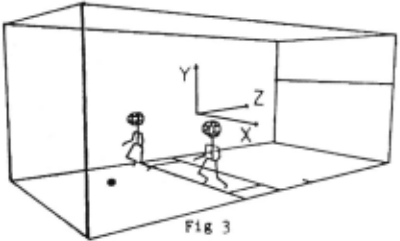
Illustrates a typical output of component of the LRCEG system. also displays a typical snapshot the object axes. the display The figure along with After rotating Fig 3 +45 degrees about the y axis. '1' traces the path of 'player-1'. 'B' traces the trajectory of the ball start ing at 'player-2' who does not move in this scenario. For display purposes the position of the ball and players are not indicated for every iteration.
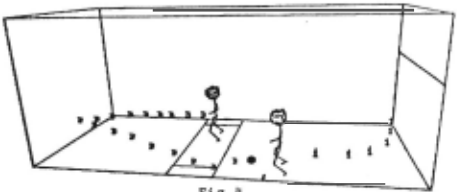
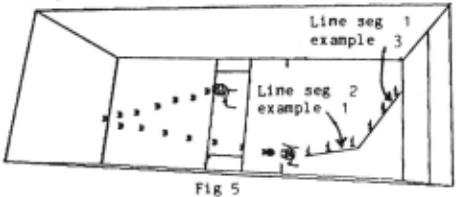
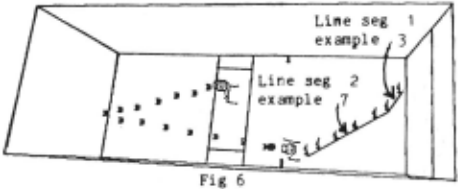
Same as Fig 4 except rotated -90 degrees about the z axis. Line segment 1 illustrates 'player-1' executing the action specified by example number 3. Line segment 2 intersects line segment 1 at the point where example 1's short-term-success-rate is higher than exam ple 3's. At the intersection point 'player-1' begins executing the action speci fied by example 1. When 'player-1' meets the racquetball example 1 specifies where to hit it.
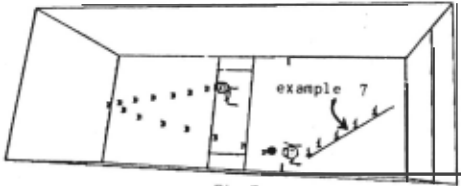
A new and seperate example 7 has been created and accommodated as a result of steps 12-14 in Fig 2. Except for the long-term-success-rate, information for exam ple 7 is a copy of the latest modification(s) to example 1. Example 7's long-term-success-rate was computed to be .75 The parent of example 7 (i.e., example 1) now has a long-term-success-rate of .55 Example 3's long-term-success-rate was r e duced to .45 (NOTE: initial long-term-success-rates for all examples was · 5). This figure shows how example 7 begins influencing player-1's behavior earlier in a similar rally. Examples 2 and 4-6 did not influence player-1's behavior because their semantic constraints were not satisfied an~/or their short-term-success-rate was not hiRh enouRh.
Finally the long-term-success-rate of example 7 is high enough so that 'player-1' begins executing the action specified by that exam ple from the first iteration.
V FUTURE IMPROVEMENTS AND EXTENSIONS
Future research will extend the limits of the LRCEG system to incorporate more functions currently per fonned by the user. Once the extensions have been implemented the following learning issues can be addressed: (1)Determine the limits of this paradigm for learning (2)Ascertain the knowledge and proceses necessary to learn a sequence of examples (i.e. sequence of actions) (3)Evaluate accommodation techniques and (4)Compare how well the system learns as a function of the expert supplying the knowledge.
VI CONCLUSION
This paper has demonstrated how some types of learning can be accompolished by applying the CEG paradigm to examples representing domain knowledge. ACKNOWLEDGEMENTS
Many thanks and much gratitude goes to Prof. Edwina L. Ri ssl and for her invaluable guid ar.ce, critiques, suggestions, and research that provided the foundation for this paper; Daryl T. Lawton for smoothing out my thoughts; and to the COINS department for free computer time on weekends.
BIBLIOGRAPHY
- Collins, A. and A. Stevens, (1979) AND STRATAGIES OF EFFECTIVE Bolt Beranek and Newnan Cambridge, Mass. "GOALS TEACHERS" Inc .·
- Rissland, E., and E. Soloway (1980) OF AN EXAMPLE GENERATION "OVERVIEW SYSTEM" Proceedings of First National Conference on Artifical Intelligence
- Rissland, E. (1980) "EXAMPLE GENERATION" Proceedings of Third National Conference of the Canadian Society for Com put at ion al Studies of Intelligence
- Rissland, E. L., and E. H. Soloway "CONSTRAINED EXAMPLE GENERATION: A TESTBED FOR STUDYING ISSUES IN LEARNING". In Proc IJCAI-81
- Rissland, E., Soloway, E., O'Connor, s., Waisbrot, S., Wall, R., Wesley, L., T. Weymouth (1980) "EXAMPLES OF EXAMPLE GENERATION USING THE CEG ARCHITECTURE" COINS Technical Report, in preperation .
- McDERMOTT, J. (1978) "ANA: AN ASSIMILATING AND ACCOMMODATING PRODUCTION SYSTEM" DARPA Report 3597
@inproceedings{ijcai1981p30,
  title     = {Learning Racquetball by Constrained Example Generation},
  author    = {Wesley, Leonard P.},
  booktitle = {Proceedings of the Seventh International Joint Conference on
               Artificial Intelligence, {IJCAI-81}},
  publisher = {International Joint Conferences on Artificial Intelligence},
  editor    = {Patrick J. Hayes},
  pages     = {144--145},
  year      = {1981},
  month     = {8},
  note      = {Learning},
  url       = {https://ijcai.org/proceedings/1981/30},
}
TY - CPAPER TI - Learning Racquetball by Constrained Example Generation AU - Wesley, Leonard P. T2 - Proceedings of the Seventh International Joint Conference on Artificial Intelligence, IJCAI-81 PB - International Joint Conferences on Artificial Intelligence PY - 1981 SP - 144 EP - 145 UR - https://ijcai.org/proceedings/1981/30 ER -Copied
Machine-readable versions of this paper, for tools and AI agents:





