
Analogy-Based Acquisition of Utterances Relating to Temporal Aspects
Proceedings of the Seventh International Joint Conference on Artificial Intelligence. Learning. Pages 106-107.
© 1981 International Joint Conferences on Artificial Intelligence
Abstract
PLAS is an nnnlogy-bnsod lancrunge ncquisition system t~nt cnn be tnught tht"ough examples, The pt'imit!ves of its knowledge ropresentotion nrc langungo expressions and ot'e len:rnt tht'ough into:rnction in the very same lnngunge that is being learnt. This pnper proposes extensions to cope with utternncos relnting to tempornl nspects.
- S..buca•oorthJ, V. •A Paradicaatic Laacuace Acqui•ition SJ•t••" Ph.D. The•i•. Co.puter Centre, Indian In•titute of Tech., BOIIbaJ-400 076.
- MaJ 1971.
- Nara•t•baa,R. Kodellinc Laacuace Bebaeioar Vol. 10., Sprincer Serle• in Lancuace and Coa•unlcatioa Cia print).
- Scbaak, R.C. •Conceptual DependencJs A Theory of Natural Lancuace Uader- •tandinc". Cocnitiee P•JcholocJ, 1 I 4 (1 17 4) 55 2-6 31
- Martin, W.A. "Kaoeledce Repreeentation Panel Diacu•aton". in proc. IJCAI-77, Ca•bridce, MA, Aaru•t 1977, 983-912.
References were extracted automatically from the PDF and may contain errors.
Full text extracted automatically from the PDF; figures, tables and equations may differ. The PDF is the version of record.
M.6J..OOY-l~ASSD AqUISI'!'ICl\ CF U'IT£..qANCZS RELATING TC TEl::PCRAL A~ECTS
V. SembucromooTthy Compu tar Con tr o Indian Institute of Technolo~y Eombny 100 076 Indio
PLAS is an nnnlogy-bnsod lancrunge ncquisition system t~nt cnn be tnught tht"ough examples, The pt'imit!ves of its knowledge ropresentotion nrc langungo expressions and ot'e len:rnt tht'ough into:rnction in the very same lnngunge that is being learnt. This pnper proposes extensions to cope with utternncos relnting to tempornl nspects.
Our approach to cope with tho fot'midnble complexity of de~ling with Naturol language as well as lent'~lng is to divide the effot't into two stnges. The fit'st-stoge system will begin with sensori motor mechanisms nnd lcot'n nn intcTpt'eta tional machineTy that onnbles compn:rntivcly pt'imitivo langunge pt'ocessing, Tho socond stngo system will stort with such nn intcrpretotional mnchinory and lenrn formal logic nnd grammnr of the lnngungc that support complex per forman co.
We have described elsewhere (1,2,3,4] tho teaching, language acquisition nnd undorstnnding machine:ry of PLAS, n 1 nngungo 11cquisition system belonging to tho first stage. PLAS is analogy-based and lenrns through examples, Tho primitives of its knowledge repTosentation are not gr 11mmatical constt'ucts but naturnl language expressions themselves. Those pTimitivos are lenrnt thTough intct'action in the very snme lnngungo thnt is being acquired (arguments for the nbovo features arc available in [1 to 5)l.
Thoug~ the language machinery of PLAS can cope, within its scope, with spatial as well as temporal aspects Of the external wot'ld, its sensori-motor machinery cnnnot t'eprosont the tempot'nl aspects. Moreover, though it cnn loorn to undet'stnnd new phrnsos and sentences, its cnpability to acquit'c words is comporativoly limited, This papct' pt'oposes extensions to remove these limitations (cnll tho extended PL~S ns PLAS.T).
The world of PL ."S.T is a system of ~~~c~~ (e.g.: the menning of YESI~RD~Y, !'.:ol~ 10) ond nspect-clas_!l_~ (e.g: the clnss of pnst events, the clns!' of mnl os) of the externol woTld, ond utt~t'nncos nnd uttot'nnco-clnsscs i,o., l11ngungo schemes or simply schomns ( o, g,: OC!.!E"CDY Wm-!T SOME'.'r..ERE SO.(ETIME i.e.,·- ''IF:~T- -') of tho linguistic woTld.
PLdS,T stnrts with n system of sensori-motor nspacts (~sensori-motor nspcct is nn nspect of tho extorn"l wot'ld thn t PL ~S. T becomes nwnt'o of through its sensing nnd m0nipulntin~ cnpnbilitios. For oxnmplo, n specific 11ction such ns walking, n specific <'!gent.) nnd nspcct cl oases.
Since tho cnso structures nrc closer to tho structures lenrnt byPLo\S(4] nnd Schonk's em roprcsent,-,tion (s) is 1 nngunge- free, we pt'opose to use C:rl'J. to represent tho sensori-motot' knowled~e given nbovo. Powevor, CJ:t! will not be used to rcpt'osont the systam of aspects nnd aspect-clnssos nt tho lflnr-;u,.,~c level, We believe th,.,t o pcTson·s lnngu,.,ge plnys · · koy role in determining his model of the world nnd thus structuTing his thought (1) .
Uttornncos, sensori-motor aspects and nspcct-classos are primitively related by tho tcochor os in PLAS (1) by naming. For ox nmplo,
CHAIR!; CHAIR, A CIIAIR; ol
'I(' stnnds for n CIN-roprcscntntion of the sensori-motor nspect-clnss cort'ospondin~ to tho cl,.,ss of chnirs. The exrmplc informs the system thnt CH~IR, o\ CHAIR nrc nomos of the ospoct CH ~lRI belonging to tho 11spect-closs specified byC(. tul n~me-uttor r nces need not be intt'oducod by naming, PLAS,T, using tho acquisition machinery of PLAS nnd the techniques discussed below, cnn lonrn them by nnnlogy, The teacher can also associate a linguistic nnd n sensori-motor representa tions of on event by the extra-linguistic marker 'DESCRIBES· which simulates the extra-linguistic behaviour viz,, simultaneously pointing to, and describing, a situation, For Example,
JOHN CAME. TO BCJdBAY/LAST WEm/
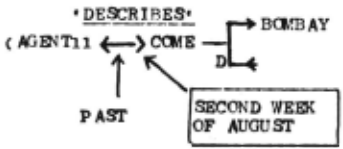
JOHN CAME TO BGIBAY IL!oST MONTH I · DESCRIBES·
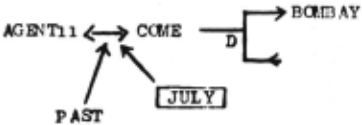
(For lack of spnce, ·Cct.tE· has not been described fully, and structures of tho linguistic representation wore not shown), Applying the rule that nny difference in tho linguistic representation of two events relates to tho difference in their sensori motor representations, PLAS.T cnn nssociato LAST MrnTH with JULY and LAST WEE!{ with SECOl'lD WEEK OF AUGUST, Using nnother rule, PLAS.T can relate the only non-understanda ble unit in a linguistic representation with the only one in tho sensori-motor representation that hns not been relnted to any unit in tho former, For example, the boxed units givon . below:
JOHN I S /TALL/ · DESCR IB ES·
AGENTll 4 l /T!a.l!/
Next, linguistic representntions of two events can be related by the te~chor using the extrn-linguistic ~nrkers, nnmoly · IS- A- RECC'LL ECTHN -OF· and · IS-mIM~q.JN ATil~l-S'l:'-:-F-o~xampl e-, ---
JILl. DRG'PED TFE DOLL YESTERDAY ·IS..A-_!lECOLLECTifN-.5'~ JII.L DRoPS THE )')(lLL
JILL WILL BE AT BCl.llHY IS- !oN _!!~�IN_A_!I9N-_OF JILL IS A.T BdTn/IY,
· IS..A-RECC'LLECTICN-OF· simul atos tho oxtrn lingui~tic monns employed by n language community to cnnblo tho henrer to recollect n past event and associate with its represent a tion the present one. The other morkor simulates tho extra linguistic means that enable the hearer to imagine n now situation and relate its representation with tho present one, With the help of such associations between statements, nnd the analogy-based capability of PLAS to transform utterances (details in (1,2,4) ), PLAS,T can convert tho tense of a statement, Teaching PLAS.T a text is as in PLAS (1,2,4) except that tho extra-linguistic markers described above can also be used in addition to tho ones nlrendy nvnilnble in PL 4S.
III UND:ERSTANDING AND KNCAVLEDGE RlifRESENTATI<N
Ia PLAS, T a aeaaori-·otozo aapect ia zoepreaeated bJ a Picture Pz>oducer aode, Aetioa aode, Pictuzoe Aider aode, Aotioa Aider aode or a ooaoeptualizatioa (') · Aa iatezopretatioD of aa attezoaaoe ia aa aapect Cat eithezo the aeaaozoi-aotozo ozo the laacuace leYel). The ... aatic catecor1 of ·· attezoaace ia repzoeaented bJ a aeaaozoi ·otor aapect-cla·· (aad aot 111 a la·cuace leYel aapect-claaa to aYOid oOII~tlexitJ).
Tbe aurface-atructure of a phraae or a aeateace coaaiata of the aaderlJiag acheaa aad the aurfftce-atructurea of ita filler·. For exa·ple, that of JORN BRUSHES HIS TEETH DAILY ias c- BRUSIES- -, JOHN, CHIS-, TEETH)). Tbe aapect-claaa atructuzoe of aa utterance (i.e., a pkraae ezo a aeateace) coaaiata of the aapect cla·· ef the utteraace aad the aapect-claaa atruoturea of ita fillera, The aapect atruoture of aa utterance coaaiata of the aapect of tile u tteraaoe aad the aapect atructurea of ita filler·. The aurfftoe, aapect-cla·· aad aapect atructure of a word ia reapectiYelJ the wozod itaelf, ita aapect-cla·· and aapect.
To uaderatftnd an utterance, PLAS.T haa to obtain ita three atructurea (detail· ef the aadezoatandiDC proce·· are ia (1, 2, 4] ) ·
WileD aD wtterance 1· aacceaatallJ aaderatood, the utterance and ita atructurea azoe 1atecrated into the. kaowledce Det of PLAS,T. Tbe knowledge aet called LBA-net ia a Laacuace Baaed (becauae the priaitlyea are laacuac· expreaaiona) ~aaociatiye aetwork [1] · It aupporta the followiac aaaoclatiYe 1afozoaatioD retrieYal.
1. Aapecta zoepreseated bJ an atteranoe1
- A-pect-ela··-·tructure· a··ociated with aD utterance aDd eice eer·a;
- A·pect-ela··-·tructure· a··ociated with an a·pect and eice eer·a;
- Filler· of a eariable of a ·ch .. a;
- ·· Utterance· that caD be ·ecaented throucb a ·cb .. a;
- Lancuace acb .. aa ··caentinc aa utterance.
Theae a·aociatiee function· con·tit·te the interface between the under·tandinc ~roc··· aad the knoeledce net (detail· ia [s) >.
IV C<Hf91TS
~be ac~uired ooa~etenc~ of PLAS.T caa be te·ted aa ia PLAS (1,2,4J · It ita re·pon·e i· incorrect, the teacher praaent lJ baa to ·witch PLAS.T to the atate of the late·t correct reapon·e and ·odifJ hi· teacbinc aaquence. Eztanaiona to enable the ·J·t·· to debuc it· knoeladce throucb \uaation-anaearinc haee baeD diacu··ed in L4) · Tboucb ·oae of the learainc principle· di·cu··ed aboee relJ on tbe concept of ·near ·i··'· the ceneralisation technique· of PLAS which PLAS.T inherit· do aot re~uire eza·ple· of ·near ·i··· tJpe. Since neither PLAS aor PLAS.T i· de·icned to learn a cra .. ar,and the knoeledce repre·entation doe· aot .. ploJ the uaual cr ... atical and ... antic pri·itieea, the coaputational ·achiaerJ of PLAS.T i· bound to lte unconeentlonal.
The ealuable ~Widanoe and ancourac .. ant of Prof. R. Nara·i·haa, Director, NCSDCT, TIFR, B011baJ are cratefullJ acknoeledced.
REFER91CES
- Se·buca·oorthJ, V. "PLAS, a Paradicaatic Lanruace Ac'l·i·ition SJ·t··; Aa O.ereiee". In Proc. JJCAJ -7t. TokJo, Japaa, ~cuat 1971.
- [:a) S.·buc .. oorthJ, V. ·Aa AaalocJ-Ba·ed Lane···· Ao41uiaition SJ·t·· that oaa be taucht throucb eza·pla··. I· Proc. 2ad Intern. Meet on AI. Repiao, usat, October 1180.
- S..b·ca·oorthJ, V. ·A Lanl"ace-Baaed A··ociatiee Knoeledce Repreaent~tioa that Bbpport· Aaalocy-Ba·ed Lanruace Ac~uiaition aDd Undor·taadinc". Technical Report, C011puter Centre, ladleD Jnatitute of Tech., BOIIbaJ-76. ltiO.
- S..buca·oorthJ, V. ·A Paradicaatic Laacuace Acqui·ition SJ·t··" Ph.D. The·i·. Co.puter Centre, Indian In·titute of Tech., BOIIbaJ-400 076. MaJ 1971.
- (a] Nara·t·baa,R. Kodellinc Laacuace Bebaeioar Vol. 10., Sprincer Serle· in Lancuace and Coa·unlcatioa Cia print).
- (e] Scbaak, R.C. ·Conceptual DependencJs A Theory of Natural Lancuace Uader ·tandinc". Cocnitiee P·JcholocJ, 1 I 4 (1 17 4) 55 2- 6 31 0
- Martin, W.A. "Kaoeledce Repreeentation Panel Diacu·aton". in proc. IJCAI-77, Ca·bridce, MA, Aaru·t 1977, 983-912.
@inproceedings{ijcai1981p23,
  title     = {Analogy-Based Acquisition of Utterances Relating to Temporal Aspects},
  author    = {Sembugamoorthy, V.},
  booktitle = {Proceedings of the Seventh International Joint Conference on
               Artificial Intelligence, {IJCAI-81}},
  publisher = {International Joint Conferences on Artificial Intelligence},
  editor    = {Patrick J. Hayes},
  pages     = {106--107},
  year      = {1981},
  month     = {8},
  note      = {Learning},
  url       = {https://ijcai.org/proceedings/1981/23},
}
TY - CPAPER TI - Analogy-Based Acquisition of Utterances Relating to Temporal Aspects AU - Sembugamoorthy, V. T2 - Proceedings of the Seventh International Joint Conference on Artificial Intelligence, IJCAI-81 PB - International Joint Conferences on Artificial Intelligence PY - 1981 SP - 106 EP - 107 UR - https://ijcai.org/proceedings/1981/23 ER -Copied
Machine-readable versions of this paper, for tools and AI agents:





