
Causal Understanding of Patient Illness in Medical Diagnosis
Proceedings of the Seventh International Joint Conference on Artificial Intelligence. Medical Application. Pages 893-898.
© 1981 International Joint Conferences on Artificial Intelligence
Abstract
First generati on AI in Med ic ine programs have clearl y demonstrated the usefulness of Alte chnique s. However . it h as al so bee n recog niz ~ d that the use of noti ons su ch as causal relationships . temporal patterns. ond aggregate disease categories in these programs has been too weak . From our study of clinician's behavior we reali1.ed that a diagno stic or therapeutic program must consider a case at various lev els of detail to integrate overall understanding with detailed knowledge . To explore these issues. we have undertaken a study of tht problem of providing expert consultation for electrolyte and acid-base disturbances. We have partly completed an implementation of ABEL. the diagnostic compo nent of the overall effort. In this paper we wncentrate on AUU .' s mechanism for de,crihing a patient. Called the patient -specific model, this description indudes data about the patient as well as the program's hypothetical interpretations of these data in a multi-level causal network . The lowes[ level of this description consists of pathophysiological knowledge about the patient. which is successively aggregated into higher level concepts and relations. gradually shifting the content from pathophysiological lo syndromic knowledge . The aggregate level of this description summarize!' the patient data providing a glob;~ perspective for efficient exploration of the diagnostic possi· bil itie s. Th~ pathophysiological level description provides the ability to handle complex clinical situations arising in illnesses with multiple etiologies, to evalu;lle the physiological validity of diagnostic pos sibilities being explored, and to organize large amounts of seemingly unrelated facts into coherent causal descriptions.
- metabolic-acidosis (severity: 0.4) 2
- chronic-respiratory-alkalosis (severity: 0.68) References
- I. Gorry. G. A .. Silvennan. II .. and Pauker. S. G., Capturing Clinical Expertise: A Computer Program that Considers Clinical Responses to Digit<~ is. American Journal of Medicine 64 :452-460. (March 1978).
- Patil . R. S .. Design of a l'ropram for Expert Diagno:.is of Acid Base and Elertrolyte Disturhanc~s. MIT Laboratory for Computer Science TM-132 (May, 1979).
- Paukcr. S. G .. Ciorry. tl . A .. and Kassircr. J. 1' .. and Srhwartz, W. B., Toward the Simulaunn of Clinical Cognition: Taking :o l'rc,cnl lllness by Computer. 7/te American Joamc1l of A!l'dicine 60:981-995 (June 1976).
- Pople. II. E .. Jr.. Myers. J. D .. and Miller. R. A .. DIALOG: A Model of Diagnost.ir L1•gic fi>r I ntern:tl Metlitine. Advance •Papers of the Fourth lnternarional.loint Cm(ference on Artificialfnle/ligence. available from the Artifitial llllclligencc Laboratory, Massachusetts Institute of Technology (1975).
- l'opk. II. E.. Jr .. •ntc Formatiun of C:ompo,itc llyf~'lhcscs in Diagnostic l'rohlcm Soh• in!!: an Fxcrci'~ in Syntltcti<: Rca>onin!;. l'mct•cdings of rhe Fijih lnlemlllt<> llitl .loinl Conference "" Art(lirial lntdligence, available from the l>cp:~rtmcnt of ('om puler Science, Carnegie-Mellon University. Pittsburgh.I'A 15l1J. (1977).
- Shortliflc. E. II.. Compurer Based Medical Conm/rari<•ns: MYCIN, Elsevier Nmth llollaud Inc. (1976).
- Smith. ll. C .. A Proposal for a Computational Model of Anatomical and Physiological ReaStming. Artifkiallntclligence Laboratory, Massachusetts Institute ofTcdmology. AI-Memo 493 (1978).
- Sml<ivits, 1' .. l'auker. S. c; .. Categorical and l'robahilist ic Reasoning in Mcdiral Diag;Hl'ii\, .1rr(/iri<lllnte/ligencdl.:l!5-l44 (1978).
- Swartout W. R .. Pr<>ducing Explanations and justifications for Expen Consulting 1' 1 pgrams. Laboratory for Computer Srience, Massachusetts Institute ofTechnology, Technical Report LCS-TR-251 (1981).
- Weiss. S. M .. Kulikowski. C. A .. Amarel. S .. and Satir. A .. A Model-Based Method for Computer-Aided Medical Decision-Making, Artificial Intelligence II :145-172 (1978).
References were extracted automatically from the PDF and may contain errors.
Full text extracted automatically from the PDF; figures, tables and equations may differ. The PDF is the version of record.
1. Introduction
We have studied difficulties ansmg in the operations of the "first generation" of AIJlrog.rams in medicine and have undertaken the development of knowledge representation stru·tures to support needed improvements. The description of a patient in e~isting programs such as INTERNIST-I (4), PIP [3) , and MYCIN (6) starts from a single list of findings about the patient. Using a database of associations between· diseases and findings (or rules establishing those connections). these programs form an interpretation of the patient's condition which is essentially a list of possible diseases, ranked by a calculated estimate of li~elihood or degree of belief in each.
Researchers have recognized the need [2,5.7]to usc notions such as causal rdation~hips. temporal pauerns. and aggregate disease categories in the description of a program's diagnostic understanding, but the mechanisms pro\'idcd to do this have been too weak. For example, although causality appears a; a term in descriptions in PIP and INTERNIST-I. in both cases its use is limited to guiding the propagation of likelihood measures. These programs fail to capture the human notion that explanation should rest on a chain of cause-effect deduction. Although. the CAS NET /Glaucoma [10) program uses a network of causally-related stales and defines diseases as paths in this network, its primary reasoning mechanism is nevertheless the local propagation ofprobahility weights.
Simibrly, it has been realized that a diagnostic or therapeutic program must consider a case at various levels of detail in order to integrate its overall understanding with its detailed knowledge. This insight also has not prevailed in the actual mechanisms provided in e.xisting programs.
To explore the issues outlined here. we have undertaken a study of the medical prohlem of providing expert consultation in cases of electrolyte and acid-base disturbances. We have partly comJlleted implementation of a program. ABEL. which is the di;,gn<~lic component of our O\'erall effort. In William 8 . Schwartz Tufts University/New-England Medical Center Boston, Massachusetts 02111
this paaer we concentrate on All[L's mechanism for describing a patient. Called the patient-specific model (PSM) [1). this description includes data about the patient as well as the program's hypothetical interpretations of these data in causal hierarchical networks. We describe the representations of medical knowledge and the processing strategies needed to enable ABEL to construct a PSM from the initial data presented to the program about a patient The same representations and procedures will also be useful to revise the PSM during the process of diagnosis, but we will concentrate here on the logically prior operation of building the PSM.
Our understanding of medical expert reasoning suggests that an expert physidan may have an understanding of a difficult case in terms of several levels of detail. At the shallowest that understanding may be in terms of commonly occurring associations of syndromes and diseases, whereas at the deepest it may include a biochemical and pathophysiological interpretation of abnormal findings. For our program to reason at a sophisticated level of competence. it will need to share such a range of representations. The PSM is, therefore, a multi-level causal model. each level of which attempts to give a coherent account of the patient's case. This model also serves as the basis for an English generation facility that provides explanations of the program's understanding.
The PSM is created by instantiating portions of ABEL's general medical knowledge and filling in its detail~ from the specific case being considered. The instantiation of the PSM is very strongly guided by initially given data, because the PSM includes only those disorders and connections that are needed to explain the current case. Instantiation is accomplished by five major operators. Aggregation and elaboration make connections across the levels of detail in the PSM by filling in the structure above and below a selected part of the network, respectively. In a domain such as ABEL's, multiple disorders in a single patient and the presence of homeostatic mechanisms requires the program to reason about the joint effects of several mechanisms which wllectively innuenoe a single quantity or state. Component decomposition and summation relate disorders at the same level of detail by mutually constraining a total phenomenon and its components; the net change in any quantity must be consistent with the sum of individual changes in its parts. The final operator, projection. forges the causal links within a single level of detail in the search for etiologic explanations. The operators all interact because the complete PSM must be self-consistent both within each level and across all its levels. Therefore. each operation typically requires the invocation of others to complete or verify the creation of related parts of the PSM.
2. Hierarchical Representation of Medical Knowledge
Based on our observation tllat a physician's knowledge is expressed at \'arious levels of detail, we have developed a hierarchical multi-level represen tation scheme to describe medical knowledge and procedures to instantiate this knowledge to describe a particular patient's illness. The lowest level of description consists of pathophy~iological knowledge about diseases. which is successively aggregated into higher level concepts and relations, gradually shifting the content of the description from physiological to syndromic knowledge. The aggregate syndromic knowledge provides us with a concise global perspective and helps in the ellicient e~ploralion of diagnostic possi bilities. The physiologic;~ knowledge provides us the capability of handling complex clinical situations arising in patients with multiple disturbances, evaluating the physiological validity of the diagnostic possibilities being explored. organizing large number of seemingly unrelated facts and formulating thcrap~ recomm~ndation, and prognosis. hnally, as the causal· phrsiological reasoning tends to lJ( categorical and syndromic reasoning probabilistic. the hierarchical description allows us to blend together the use of categorical and probabilistic reasoning.[8)
2.1 Multi-Level Description of States
Medical knowledge about different diseases and their pathophysiology is understood to varying degrees of detail. While it may lJ( easier for a program to reason succinctly with medical knowledge artificially represented. at a uniform level of detail , we must be able to reason with medical knowledge at different levels of detail to exploit all the medical infonnation available. Although this does not pose any difficulty in medical domains where the pathophysiology of diseases is not well developed, in a domain such as electrolyte and acid-base disturbances where, on the one hand, the pathophysiology of the disturbances is well developed, and on the other, the pathophysiology of many of the diseases leading to these disturbances is relatively poorly understood, we are constantly faced with this problem.
Secondly, the information about a patient parallels the physician's medical knowledge about diseases and therefore also comes at different levels of detail. For example, "serum creatinine concentration of 1.5" is at a distinctly different level than "high serum creatinine", 1 and "lower gastrointestinal loss" than "diarrhea". We need some mechanism by which we can interrelate these concepts. Finally, in order to be effective in diagnostic problem solving and communicating with clinicians we ought to have the ability to portray the diagnostic problem in a small and compact space. Yet to be efficacious, we must maintain the ability to take every possible detail into consideration. We have solved this problem by representing the medical knowledge in five distinct levels of detail from a deep pathophysiological level to a more aggregate level of clinical knowledge about disease associations.
Each level of the description can be viewed as a semantic net describing a network of relations between diseases and findings. Each node represents a normal or abnormal physiological state and each link represents some relation (causal. associational, etc.) between different states. A state (interchangeably used with node) in the system such as "diarrhea" is represented as a node in the causal network. Each node is associated with a set of attributes describing its temporal characteristics, severity or value, and other relevant attributes. A state is called a primitiv~nod( if it does not contain internal structure and is called a composit(·nod( if it can be defmed in tenns of a causal network of states at the next more detailed level of description. One of the nodes in this causal network is designated as the focus node and the causal network is called the tlaborollon structurt of the composite node. The focus node identifies the essential part of the causal structure of the node above it. Indeed, the collection of focal nodes acts to align the causal networks represented by different levels of the PSM. We note that very often a composite node and its focal description at the next level share the same name; this is typical in English, where the level of detail of place names, for example, is often obtained from context and not encoded in the name used. Nodes that do not play a role as the focal defmition of any node at a higher level are called non-aggregable nodes. They represent a detailed a~pect of the causal model which is subsumed under other nodes with different foci at less detailed levels of description.
| Lower-GI-fluid | Plasma-fluid |
|---|---|
| Na 100-110 | 138-145 |
| K 30 -40 | 4 - 5 |
| Cl 60 -90 | 100 - 110 |
| HC03 30-60 | 24 . 28 |
| FJ&. l. | |
To illustrate the description ot a state at vanous levels of aggregation, let us consider the electrolyte and acid-base disturbances that occur with diarrhea. which is the excessive loss of lower gastrointestinal fluid (lower Gl loss). The composition of the lower gastrointestinal fluid and plasma fluid are as follows. In comparison with plasma fluid, the lower Gl fluid is rich in bicarbonate (HC0 3 ) and potassium (K) and is deficient in sodium (Na) and chloride (0).
I. For a muscular Jldlltnl whose previously known value of crealinine is 1.3 we can assunll' 1h1~ tn he normal. hut for a patient with a I'HC\IOusly knowf\ \aluc of 1.0 this is drflllllci) hifh aud C011Id UIIJliY a IO\s of 'huul l/ .1 oflh< kidney function .
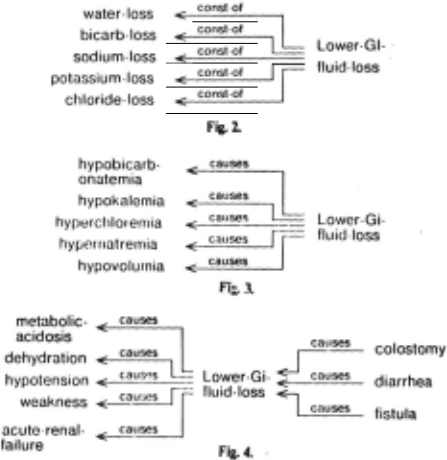
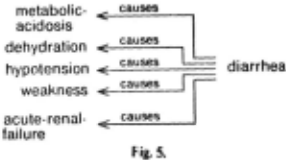
This infonnation is represented in the knowledge base by decomposing lower Gl Joss into its constituents (and associating appropriate quantitative infonnation with the decomposition). The loss of lower Gl fluid would result in the Joss of corresponding quantities of its constituents (in proportion to the total quantity of fluid loss) a~ ~hown in fig. 2. Therefore. an excessive loss of lower Gl fluid without proper r~placement of fluid and electrolytes would result in a net reduction in the total quantity of fluid in extracellular compartment (hypovolemia). Because the concentration of K and HC0 3 in lower Gl fluid is greater than in plasma fluid, there is a corresponding reduction in the concentration of K (hypokalemia) and HC0 3 (hypobicarbo· natemia) in the extracellular fluid. Finally, as the concentration of a and Na in the lower Gl fluid is lower than that in plasma fluid. there is an increase in the cor.centration of CJ (hyperchloremia) and Na (hypernatremia) in the extracellular fluid. This is represented at the next level of description as shown in fig. l Fig. 4 shows the aggregation of this information along with some additional causes and canscquences of lower Glloss at the next more aggregate level of detail. The lower GJ Joss at this level is a non-aggregable state and therefore does not have an aggregation at the next level above. Fig. 5 shows the description of the aggregate effects of diarrhea (one of the causes of lower GJ Joss). The summariz::l ion of the description of lower G I loss and diarrhea shown in fig. 5 is achieved through the use of link aggregation and elaboration, described in the next subsection.
2.2 Multi-Level Uescription of Causal Links
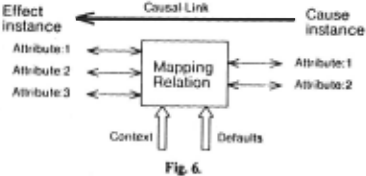
A causal link specifies the cause-effect relation between the cause (the antecedent) and the effect (the consequent) states. In past programs (e.g., PIP, INTERNIST), causal lints were de~cribed by specifying the type of causality (may-he-caused-by, complication-of. etc.), and a number or a set of numbers representing in some fonn the Jilelihood (conditional probability), importance, etc .. of observing t!.. effect given the cause or vice versa. We now believe that this simple representation of the relation between states is inadequate. The fonn of presentation of an effect and the conditional probability of observing it depends upon various aspects of the cause such as severity, duration. etc., as well as other factors in the context in which the link is invoked2 (such as the patient's age. sex and weight. and the current hypothesis about the patient). Therefore a causal link in the system (an object denoting the causal relation between a cause-effect pair) specifies a multivariate relation between various aspects of the cause and eiTect. and also specifies the context and assumptions which constrain the causal relation. as shown in fig. 6.
One imporumt function of diagnostic reasoning ts to relate causally the diseases and symptoms observed in a patient. These causal relations play a central role in identifying clusters that can be meaningfully aggregated in developing coherent diagnoses. The presence or absence of a causal relation between a pair of states can change their diagnostic and prognostic interpre L;ttions. llterefore, the system should and does have the capability of hypothesizing the presence or absence of H cHusallink. This is the reason why links are objects in their own right ntther tltan simple pointers between nodes.
To reason with a causHI network representHtion effectively. a program must make conclusions about a node or link depending only on infonnation that is locally available from the neighborhood of the mechanism in question. If non local effects are to he invoked in CHUsal explanations. they must be explicitly identified (e.g., as part of the context of the causal link) or else they corrupt our ability to reason with any portion of the network. lfHt s·>me level of detail two distant phenomena interact, we must aggregate the description of the causal network to a level where the two phenomena are adjacent to one another. further. because the causal relations specified by links are not guaranteed to be true under all circumstances (they represent strong associations, not logical truUt), the validity of deductions degrades with every additional intennediate link. That is, a causal pathway containing a large number of links is Jess likely to be valid th;m one using only a few links. Therefore, in order to explore a large diagnostic spHce, we must aggregate the diagnostic space to a level where eHch link represents an aggregate CHusal phenomenon covering larger distances and thus minimizing the possibility of error in the deduction. This ability to move from one level of description to another is provided by the multi-level description proposed here.
clinical level
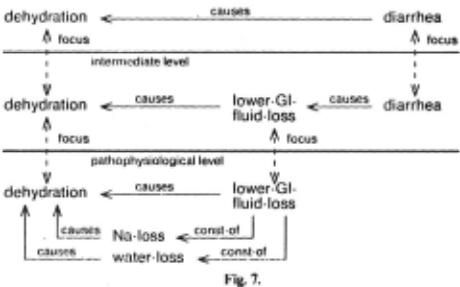
Links can be categorized, as nodes are. in_o two types: tlte primitive links and the composite links. To illustrate the concept of elaborating causal links to form a causal pathway, let us consider the causal relation between diarrhea and dehydration shown in fig. 7. Th~ causal mechanism of diarrheal-dehydration can be elaborated as follows: diarrhea causes lower Gl loss. which causes dehydration. Expressed at the next kvel of dewil. the lower Gl fluid loss can be described as consisting of the loss of water and sodium :dong with other electrolytes. The water loss in the pre-sence of the reduced tuutl quantity of extracellular sodium results in lower extracellular volume. which at the higher level of description is described as dehydration.
2. For example. a "''ere diarrhea cau'e' sc1ere hypokalemia. a"d a mild diarrhea causes m·hl hypokalemia
3. Reasoning About Components
One of the important areas of medical diagnosis not adequately addressed hy the first generation of AIM programs is the evaluation of the effect of more than one disease present in the patient simultaneously, especially when one of the diseases alters the presentation of the others. This problem does not place serious limitations on programs dealing with single problems such as the therapy of glaucoma or the diagnosis of bacteremia. But, in the case of electrolyte and acid-base disturbances where a large fraction of cases involve multiple diagnoses. the ability to evaluate the joint influence of multiple disease and the ability to decompose their influences on observable findings is particularly important
For example, let us consider a patient with diarrhea and vomiting leading to severe hypokalemia. Let us also suppose that we know about the diarrhea, but v.e are not aware of the vomiting. The observed hypokalemia is too severe to be properly accounted for by the diarrhea alone. Without the ability to decompose the hypokalemia. we would have to attribute it completely to the dilrrrhea or completely to something else. In either case 3 we fail because the toL;tl stiltc of hypokalemia is inconsistent with any of its possible single causes. 'Iltus. any single cause hypothesized by the program (e.g., vomiting) will not be severe enough to accouut for the observed hypokalemia by il!.elf. As argued abow. we need the ability to hypoth(l;ize that only a part of the hypokalemia is accounted for by diarrhea. We introduce the notion that any primitive node in the causal hierarchy 4 may have components, which are other primitive nodes which together make up the given node.
In our system this is achieved hy a pair of operators: component summation and its dual componefll decomposition. Using our example, these operators allow us to attribute only a part of hypokalemia to the diarrhea and to compute that part of hypokalemia that is not caused by diarrhea (called tlte unaccounted componen1 of the hypokalemia). lhese operations deal not only with the magnitude of some disorder but also with other attributes such as duration. They are implement~d by associating with each primitive node a multivariate relation tltat constrains attributes of the node and its constituents. Component summation combines attributes of the compon~nl' to generate tlte attributes of the joint node : component decomposition identities unaccounted components by noting differences between the joint node and its existing components. These operations enrich the PSM by iml:tntialing and unifying together component nodes when the case demmtds th~m. This occurs whenever niultiple causes contribute joinUy to a single effect. An important case of this arises whenever feed hack is modeled, becau$e in any feedback loop there is at least one node acted on both by an outside factor and by the feedback loop itself.
As the PSM iS built, component summation and decomposition operations can cause a node in the program's general knowledge to be instantiated as a node and its several components. If a node is primitive and there are multiple causes, the contribution of each cause is instantiated separately. Then the prome of the combination is computed using component summation. The combined effect is then instantiated and connected to its constituents by constituent links.
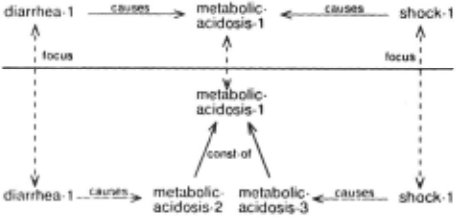
Because components are defmed only for primitive nodes, the instantiation of composite nodes which involve component summation must be in tenns of the summation of components in the node's elaboration structure. If the node is composite then we elaborate the constituent nodes around their focal nodes until we reach the primitive nodes associated with them at a level of greater detail. Then we combine these primitive nodes and aggregate their effects back. For example. if we know that a patient has two disturbances, diarrhea and shock. causing metabolic-acidosis (fig. 8), then we evaluate their contribution to metabolic-acidosis and then focally elaborate the two constituents until the metabolic-acidosis is described in terms of the quantity of serum bicarbonate lost. 5 We then aggregate the joint effects to derive the actual severity of meL1bolic·acidosis.
l All the pre\ ious programs would allow the en lire hypokalemia to be accounted for by d·arrhea. In panicular. PIP after allo··ing the hypokalemia to be accounted for by diarrhea will not allow hypokalemia to lend any suppon to the hypothesis of vomiting. IN ITR~ISI'· I . on the othrr hand. will allow the enure hypokakmia to tend suppon to the hypothesis of vomiting as well a' allow in~ it to be explamed by diarrhea.
4. Recall that primili·e means that it is not the aggregation of a funher·defined causal structure.
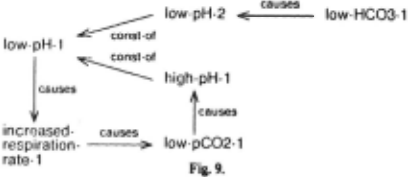
As menuoned atxJve, the mechanism of component summation allows us to represent feedback cxplici~y by representing the primary component of the change (!he forward path) and the secondary feedback component (the response of the homeostatic mechanism in defense of the parameter being changed) as components to be summed to yield the whole. Fig. 96 shows the primary change in serum pH caused by low serum bicarbonate and the response of the respiratory system in defense against the change in serum pH. R,·;~d the example as follows: the lowering of the concentration of serum bicarbonate causes a reduction in serum pH, which causes hyperventilation and. thus r~duces the pC0 2 . which in tum causes an increase in the serum-pH (negative feedback) This increase is less than the initial reduction, causing a net reduction in serum pll. The decomposition of an effect with multiple <.:ause~ inlo its causal components also provides us with valuable information in ~,·aluating prognosis and in formulating therapeutic interventions.
4. The Patient Specific Model
Diagnosis is the process of actively seeking information and identifying the disease process(es) causing the patient's illness. In other words, diagnosis involves ascertaining the facts and their implications. The effectiveness of the infomlalion gathering process depends on the analysis of the available facts. From our experience with the existing diagnostic systems [3,4), we are convinced that a relatively simple representation of physician's analysis of patient's illness (i.e .. a list of disease hypotheses) is incapable of providing the desired level of expertise. The patient description must unify all the known fa<.:ts about the patient, their interpretations. their suspected interrelationships and disease hypotheses in order to explain these findings. Finally, we observe that at any point in diagnostic reasoning practiced by human experts, there are only a few significantly different explanations for the patient's illness under consideration.
In the program. each such explanation is represented by a patient specific model (PSM): Note that within each PSM all the diseases. findings, etc., are mutually complementary, while the alternate PSM's are mutually exclusive and competing. In ll1is section we describe procedures for building and extending a patient specific model based on the known findings and the program's medical knowledge. These operations are initial formulation to create an initial patient description from the presenting complaints and laboratory results. aggregation 10 summarize the description al a given le\'el of detail to the next more aggregate level. elaboration to elaborate the description at a given level of aggregation to the nexl more detailed level and projection to hypothesize associated findings and diseases suggested by states in the PSM.
4.1 Initial Formulation
From observing the clinical behavior of physicians, we have noticed that when presented with the chief complaints and other voluntarily provided information in a case. the physicians set up a tentative diagnosis. This diagnosis serves as a specific framework which can be used in soliciting information and for organizing the incoming information. Similarly the program when provided with the initial findings and a set of serum electrolyte values constructs a small set of PSM's as its initial possible diagnoses, using the following steps. Fir;t it analyses the electrolytes and fomiUlates all possible singk or multiple acid-hase disturbances that are consistent with the electrolyte values provided and selects from them a small set which is consistent with the initial findings. Next. il generates a pathophysiological explanation of the clewolytes based on each of the proposed acid-base disturbance. This is performed b)· elaborating all lnown clinical information to the pathophysio logical level . where its relationships to the laboratory data are determined by projeCLing the unique causes and definite consequences of every node. Then the program summarizes these pathophysiological descriptions to the clinical level by repeated application of aggregation operations. This process results in the initial description of the patient at every level of del<lil. It is this description which is later modified by the diagnostic process as new information becomes available. Note that each of the mechanisms, aggregation, elaboration and projection are used in the initial formulation of the PSM.
4.2 Auregation
The aggregation process allows us to summarize the description of the patient's illness at any given level 10 the next more aggregate level. The summarization of a causal network can he achie' ed by recognizing that a central node and its surrounding caus:1l relationships may be expressed at a more aggregate level by a single node (called focal aggregation). and by summarizing a chain of relations between nodes by a single cau:>ill rl'lation between the initial cause and the fin;~ eflect nodes (called causal aggregation).
4.2.1 Focal Aggregation
In aggregating a <.:ausal network we must fir;t identify the nodes in the networl that form anchor point (i .e .. landmarks: points of special significance) around which the causal phenomenon can be summarized. Consider a partially-completed PSM in which some nodes at a detaikd level of aggregation ha\'c been in~wn1ia!cd . Any c.f these nodes is an anchor point if: (I) in the medical knowledge base such a node is the focus of some node at the next more aggregate level in the network. and t2) a! least one such higher level node already exists or can be instantiated within the PSI\.1 . If it exists and the constraints on the focallinl are satisfied. then the focal link connecting the two is inslantiated. If it does not exist. then both it and the focal link are 1nstanuated. Finally, if more than one possible description of the node is consistent with the causal structure above. we defer the aggregation process until we can obtain some additional information to resolve this ambiguity.
4.2.2 Causal Aurcgation
Once we have determined !he focal aggregations for nodes at a given level of aggregation we need to describe the causal relations among these aggregate nodes. The process of causal aggregation lakes a node and its causes and aggregates the relation between them according to one of three rules. First. if the node has no causal predecessor; or if none of the causal palhs leading into ll1e node (called pr~decem·r paths) have a node with a focal aggregation then the focal aggregation of th~ node either is an ultimate etiology or is. totally unacco"nled for and does not need to be causally aggregated. Second, if every predecmor palh has a node with a focal aggregation then the focal aggregation or L~e node is fully accounted for. The causal aggregation is achieved by instantiating a causal link between the focal aggregation of the node and the fi~t focal aggregation in each palh. Finally. if only some of the predecessor paths have nodes with focal aggreg~tions then the focal aggregation of this node is panially accounted for. The causal aggregation is achieved by decomposing the node into two components: I) due to paths which have focal aggregation (called accounted component); and 2) due to paths that do not (called unaccounted component). Then, the focal aggregation of the node is decompos~d based on the decomposition al the present level and the two cases arc treated as described above.
4.3 Elaboration
Ebbomtion is !he dual of the aggregation operation described above and is used to elaborate th~ description of a causal networl at a given level of aggregation to the next more dewiled level. This is achieved by elaborating each link in the causal network by first describing the cause and effect of the link at the next more detailed level (called focal elob01ation) and then instantiating the causal pathway between these detailed nodes (called causal elaboration). If the causal pathway being inst:tntiated interacts with other causal paths in the PSM. the combined effects of the multiple causality are computed using component summation. The combined effects of this summatinn can then he aggregated to reflect the better understanding of the ca~sal phenomenon at higher levels of aggregation.
4.3. I Focal Elaboration
Focal elaboration is the inverse of focal aggregation. To focally elaborate a comJlOSite node L~e program computes the possible profile of t11e focal concept associated with the gi\·en node. If a node at the next lower level of aggregation matches this profile and is consistent with the node above. it instantiates the focal link connecting the two. If not, it instantiates the focal node and the focal link connecting the two.
4.3.2 Causnl Elaboration
Caus;ol dalx·ration is the dual of causal aggregation. A composite causal link c:on he clahooatcd if the cause and the effect nodes of the link have focal clah<lralion;. 1 o clall<.rate a mmrositc link th~ rrogratn match~s the causal path associatnl with the linl ~larting, at the f<Kal nodes of the cau;e and the effect of the link with existing ratlt; in the I'SM. If some rart of this pathway is not prN·nt in the PSM. the program recursiveiy calls its~ if u11 earh link in the pathway (staning from the focus node of the source) that is absent in the PSM. If the link being recursively elaborated is a primitive link and if its effect node is not present in the PSM. the effect node and the link are instantiated. Otherwise, if the effect node is present, it matches the attributes of the cause and the effect nodes. If they are compatible. it instantiates the link. Otherwise, if the effect node is an ohservcd node. 7 the program decomposes the effect node and instantiates the link connecting the cause and the component of the effeci node contributed by it. Otherwise, if the effect node is accounted for by some other cause, it instantiates the combined effect by summing the compo nents of the two causes. Finally, it aggregates the effect node to revise the description at the next more aggregate level.
4.4 Projection
The Projection operation is used to hypothesize and explain the associated findings and disea5es suggested by the states in the PSM. The projection operation is very similar to elaboration. It diff~rs fi·om el;oboration in that the causal relation being projected is hypot11etical and therefore is not present in the PSM. Funhermorc. the projection operation fails if the causal description of the hypothesi1.cd link is inconsistent with t11e description in the PSM at any level of aggregation. As a result. t11e application of the projection operdtion cannot result in the decomposition of a fully accounted node, creating an additional unaccounted component and therefore degrading the quality of explanation.
We envision using t11e projection operation in the diagnostic problem solver for exploring diagnostic ·possibilities. evaluating their physiological validity and in generating expecwtions about the consequences of hypothesized diagnoses.
5. An Example
Let us consider a 40 year old 70 Kg patient who has been suffering from moderately se1cre diarrhea for the last two days and. as a result, has developed moderately severe mewbolic acidosis and hypokalemia. The laboratory analysis of the patient's blood sample (serum analysis) is: Na: 140, K: 3.0, a: 115, HC0 3 : 15, pC0 2 : 30, and pH: 7.32.
5.1 Initial Formulation
To exercise the program, let us provide it initially with only the laboratory data. .Based on these data, the program generates all possible acid·base disturbances that can ac.."ount for the laboratory data. They are:
- metabolic-acidosis
- chronic-respiratory-alkalosis + acute-respiratory-acidosis
- metabolic-acidosis + chronic·respiratory·alkalosis
- acute-respiratory-acidosis
- mewbolic·alkalosis + chronic-respiratory-alkalosis
- acute-respiratory-acidosis.
Based on the complexity, 8 likelihood and severity of each component, the list of possible disturbances is pruned and rdllk-ordered. 9 The rank-ordered list of likely disturbances is
- metabolic-acidosis (severity: 0.4)
- chronic-respiratory-alkalosis (severity: 0.68)
- acute-respiratory-acidosis (severity: 0.32).
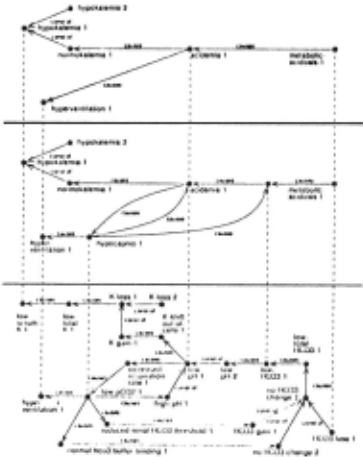
The program now creates a PSM 10 fur each possible acid-base disturbance and asserts in it instantiations of the laboratory data (at the pathophysiological level) and the appropriate acid· base disturbances (at the clinical level). In the rest of the example we will focus on the first acid·base disturbance, nan1ely metabolic acidosis. The program focally elaborates the mel<!bolic acidosis through the intermediate levels until it reaches the pathophysiological level and thus identifies the amount of HC0 3 loss corresponding to the severity of the metabolic-acidosis. Based on this information and the laboratory data, it instantiates the feedback loop corresponding to the acid-base homeostatic mechanism. Next, it projects back; 1 each node whose cause can be uniquely determined and projects forward the definite consequences of each node in the PSM. We now have the pathophysiological level explanation of the electrolytes consistent with the diagnosts of mewbulic·acidosis as shown in fig. 10.
5.2 Aggregation
After the pathophysiological description is completed, this description is aggregated through the intermediate levels to the clinical level of detail. To illustrate this operation let us consider the low·serum·K·l node at the patho· physiological level. Focally aggregating this node, we instantiate hypo kalemia·) as shown in fig. 10. To determine the causal aggregation of this node at the next level of detail we must focally aggregate the first aggregable node in each path leading back: in this case low·pH·l. Focally aggregating low· pH· I we instantiate acidemia· I. Next. we compute the component of low· serum·K that can be accounted for by low·pH· I and the component that remains to be accounted for because of the unaccounted K·loss-2. Then we compute the mapping of these components at the next level of aggregation and inswntiate normokalemia· I (the component accounted by low·pH·l) and hypokalemia-2 (due to unaccounted K-loss-2). We then connect the normokalemia-1 to acidemia-! and mark the hypokalemia-2 as unaccounted (indicated in the figure by an asterisk). Next. in order to causally aggregate low-pH-I we focally aggregate low-pC0 2 -t and low-HCOr 1 into hypocapnia-! and hypobicarbonatemia-1 respectively. As each path leading back from low-pH-I terminates in a node with focal aggregation. the focal aggregation of low-pH-I (acidemia· I) is fully accounted node. Therefore, we connect acidemia-Ito hypocapnia-! and hypobicarbonatemia-1. This process is repeated for each aggregable node at the current level and then the whole process is repeated at the next level until we reach the clinical level of aggregation.
7. or if the effect node i.' a causal predecessor of some observed node that completely accounts for it.
8. Triple dislurblnccs arc quite rare and arc generally not considered during initial formulation unless there is compelling evidence for their presence.
9 l'hc r.ank ordrring oft.hc di~ca!<.Cs is bi-'c.cd on Ocram·~ Ramr ·· !\impler hypotheses are preferred.
10. ror case of explanation. the example described here uses a three level PSM instead of the fi,c le1ell'SM used in the program
11 . Note here that a' we arc at palhophysiolO!lical lc1d. each link being projected is ,1ri111itivc. 'lhus. projcrtin~ back at th1s l~vcl can br restated as imtantiating the cause .md the hnl connrclln£ the c.'lusc and the effect node.
5.3 Projectloa
To illustrate the projection operator. let us assume that the diagnostic component has hypothesized that the unaccounted component of hypokalemia at the clinical level (hypokalemia-2) is caused by diarrhea and wishes to determine if this is so <111d how this assumption fits with the current PSM. The result of this operation is shown in fig. II.
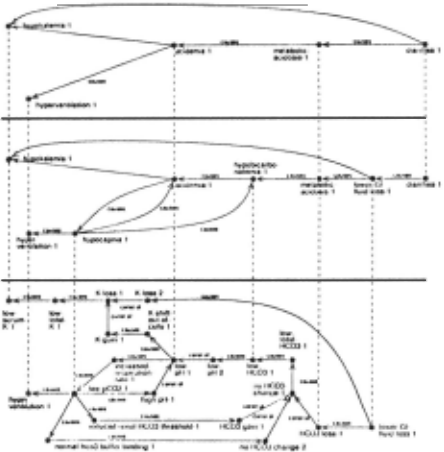
To project the link between hypokalemia and diarrhea the program evaluates the link to determine the attribute profile of the diarrhea consistent with hypokalemia-2 from which it determines the prome of diarrhea at the next more detailed level. It then attempts to match the causal path associated with the link (hypokalemia <--lower-Gl-loss <--diarrhea) at the next level. As none of the links in this pathway are present and as this causal pathway is consistent with the description at the next level, the program recursively calls itself on each link in the path. Considering the first link (that is, hypokalemia <--lower Gl-loss). it finds the causal p&th associated with this link at the next level of detail (low-serum-K <-- low-I.OUII·K <-- K-loss <-- lower-Gl-loss). Matching this path with the description in the PSM, it finds that all but one link (K-loss <-- lower-GI-Ioss) is already present. Since this link is primitive, the program evaluates the prome of the lower-Gl-loss consistent with the unaccounted component of K-loss and instantiates it and the causal link connecting lower GI-Ioss-1 to K-loss-2. To reflect this addition at the higher levels of detail, the program aggregates the low-serum-K-1 (the efh:ct node in the path). As the low-serum-K-1 is now a fully acc-ounted node. the component structure associated with its focal aggregation (hypokalemia-!) is deleted and the causal links associated wtth the accounted component of hypokalemia-! and an additional link from lowcr-GI-Ioss-1 are connected to it. This process is repeated until we establish the relation between the diarrhea and hypokalemia at the clinical level.
5.4 Elaboration
The process of clahordtion is similar to that of projection described above and differs from it in two major ways, 1) the causal link and the as.<;OCiated nodes already exist in the PSM at the higher le··el of aggregation and 2) we have already determined that the causal link being elaborated is valid. 'filerefore if a causal pathway associated with the link at some level of detail is not consistent with the d=ription in the PSM. the program modifies the PSM appropriately to accommodate the pathway. In ll1e example being described the semnd (and more interesting) case docs not arise. 1 o demonstrate the elaboration process let us eswhlish lite relation bet\l<ccn diarrhea-l and metaholic-acidosis-1 at the clinical level. The result of elaborating this link is shown in fig. 11.
6. English Explanation
To illustrate the pr:->gran.-s unrlcrstJnding of the patient's illness at ~arious levels of detail. an English generator was implemented to translate the PSM at any given level into i<s lnglish de-scription. 1 ~ Th~ dee..criplions <ire given at three levels of detail in fig. 12.
Clinical LeYel
This is a 40 year old 70.0 kg male patient with moderate diarrhea. His electrolytes are:
Na: 140.0 HC0 3 : 15.0
K: 3.0
a: 115.0
pC0 2 : 30.0
pH: 7.32
Agap: 13.0
The diarrhea causes moderate metabolic acidosis. which causes mild acidemia. The acidemia and diarrhea cause mild hypokalemia and acidemia causes hyperventilation. All findings have been accounted for .
Intermediate LeYel
This is a 40 year old 70.0 kg male patient with moderate diarrhea. His electrolytes are: ....
The diarrhea causes moderate lower G I loss, which causes moderate metabolic acidosis. The metabolic acidosis along with moderate hypocapnia causes moderate hypobi~arhonatemia. The hypobicarbonatemia along with hypocapnia causes mild acidemia. The acidemia and lower GJ loss cause mild hypokalemia and acidemia causes hypocapnia The acidemia also causes hyperventilation. All findings have been accounted for.
Pathophysiological Lent
This is a 40 year old 70.0 kg male patient with moderate lower Glloss. His electrolytes are: ....
Moderate lower G I loss, reduced renal Hco 3 threshold and normal HC03 buffer binding jointly cause no HC0 3 change. The no HC0 3 change causes low ocf HC0 3 . which causes low ~erum HC03- The low serum HCO and low serum pC0 2 joinlly cause low serum pH. The low serum pH causes/. shift out of cells and causes incre:tScd respiration rate. The increased respiration rate causes !ow serum pC0 2 . which causes normal Hco 3 buffer .binding. The low serum pC0 2 :~so causes reduced renal Hco 3 thn:shold and increased re>piralion rate causes increased ventilation. The lower Gl loss and ·K shift out of cells jointly cau~e K loss. The K loss causes low ecf K, which .causes low serum K. All findings have been accounted for.
Fig. 12. English explanation at difTerentltfels or detail
7. Conclusion
We have begun a complex and challenging task: to reason about difficult medical problems with a representation Utat is capable of capturing the subUety and richness of knowledge and hypotheses used by expert physicians. We have thus far succeeded in creating a representation and a set of structure building operators which are able to create a patient description b:tSed on causal models, multiple levels of dewil in description. and the explicit use of components of quantities and states. The various viewpoints on the patient represented by 'differettl cuts through this complex description arc kept consistent by the operators. We believe that this approach displa~s a level of understanding not achieved before in mcdiral 1 easoning programs or others which need to describe an organization of hypotheses or mechanisms at different levels of detail.
12. The generator makes usc of the methodology and some of the code of a generator built h) William Swanout a< ~an of an interactive system which explains and justifies pon10ns of e>pcrt pro~rams. (91
In continuing to develop our diagnostic and therapeutic programs, we believe that the organi7ational framework provided by the PSM and its associated opermors gives us a suitable machinery tor exploring the choice of reasoning strategies and recording our programs' changing conceptions of a case. The rich network of interconnections in the PSM constrains a diagnostic reasoner to generate only a relatively small number of coherent explanations, thereby r~ducing the space of possibilities to he investigated in seeking a diagnosis. In particular. enforcing the requirements of causal consistency (at each approptiatc level of detail) on any tenable explanation provides a means of pruning the diugnostic space and permits us to try a "hypothesize and debug" reasoning strutegy. The multiple level interconnenions of the PSM also help us merge decisions and considerations we lwve described as categorkal and probabilbtic. Although much work clearly remains before developments such as those described here form the fabric of truly successful medical consulting systems, we have proposed here a useful new represen tational basis for such work.
Acknowledgements
This research was supported (in part) by the National Institutes of Health Grant No. I PO! LM 03174-Q2 from the National Library of Medicine.
@inproceedings{ijcai1981p170,
  title     = {Causal Understanding of Patient Illness in Medical Diagnosis},
  author    = {Patil, Ramesh S. and Szolovits, Peter and Schwartz, William B.},
  booktitle = {Proceedings of the Seventh International Joint Conference on
               Artificial Intelligence, {IJCAI-81}},
  publisher = {International Joint Conferences on Artificial Intelligence},
  editor    = {Patrick J. Hayes},
  pages     = {893--898},
  year      = {1981},
  month     = {8},
  note      = {Medical Application},
  url       = {https://ijcai.org/proceedings/1981/170},
}
TY - CPAPER TI - Causal Understanding of Patient Illness in Medical Diagnosis AU - Patil, Ramesh S. AU - Szolovits, Peter AU - Schwartz, William B. T2 - Proceedings of the Seventh International Joint Conference on Artificial Intelligence, IJCAI-81 PB - International Joint Conferences on Artificial Intelligence PY - 1981 SP - 893 EP - 898 UR - https://ijcai.org/proceedings/1981/170 ER -Copied
Machine-readable versions of this paper, for tools and AI agents:





