
Variable-Depth Natural Language Understanding
Proceedings of the Seventh International Joint Conference on Artificial Intelligence. Natural Language. Pages 64-65.
© 1981 International Joint Conferences on Artificial Intelligence
Abstract
S tandard A I repr e s e ntations of knowl e dge oper ate a t fixed depth (i.e. th e ob je c ts manipulat ed are des c ribed by an amount of information whi c h r emains constant for every task). Contrary to thi s approach, Variable Depth Pro ce ssing (VDP) us es a progressive des c ription of objects, tries different strategies according to the quality of the re s ult it needs, a nd continually controls this quality by means of an evaluation of th e approximati ons it makes. -- --Contextual Production Rules are shown t o be effect iv e way to implement some features of VDP. We are currently developing a VDP questionanswering sys tem which works on texts c on ce rnin g a no n-technical subje ct , namel y an e x ce rpt of a genera l public - oriented encyclopaedia.
- COULON D., KAYSER D. "ftvoir reponse a tout ?" in Pr oc . IIFCET-RFIA r:ongr ess, Nancy ( Franee ) , Sept . 1981 (f or t hcomi ng ) .
- KAYSER D. "Vers une modelisation du raison- nement 'approximatif "' i n Pl'oc. Co Hoque s ur ~a r epr esentation de s connaissances et du raisonnemen t , I NRIA , 1980, 440-457 .
- LEHNERT W. , WILKS Y. "A Critical Perspective on KRL" Cognitiv e Science 3: 1 ( 1979) 1-28.
- MINSKY M. "A f ramework for Representing Knowledge" 1:11 Th e Psycho~o gy ~ Computer Vision (P . H. Winst on, ud .) , Me GrarJ Hl l7 , New York (19 7.' :. ) 217 -277 ..
- NEWELL A. •~reduction Systems : models of control structures" i n Visua ~ In f ormation Pr oc e s sing (W. C. Chase , e~cademic Press , New York (1973 ).
- SCHANK R.C. "Interestingness : controlling inferences" Ar tificia~ I n telligence 12 : ;~ (1979) 273-297 .
- SCHANK R. C., LEBOWITZ M., BIRNBAUM L. "Inte- grated Partial Parsing" Technica l Repor t 143, Compu ter Science Department , , Ya~e Uni - versity , New Haven, CT., 1978 .
References were extracted automatically from the PDF and may contain errors.
Full text extracted automatically from the PDF; figures, tables and equations may differ. The PDF is the version of record.
VARIABLE - DEPTH NATURAL LANGt;AGE UNDERSTANDING
Daniel KAYSER
E.R.A. 452 du CNRS Laboratoire de Reche rche en Informatique Bat.490- Campus d'Orsay
91405 ORSAY - FRANCE
ABSTRACT
Standard A I repr esentations of knowl edge ope r ate a t fixed depth (i.e. the ob jec ts manipulat ed are des cribed by an amount of information whi ch r e mains constant for every task). Contrary to thi s approach, Variable Depth Processing (VDP) us es a progressive des cription of objects, tries different strategies according to the quality of the result it needs, and continually controls this quality by means of an evaluation of the approximations it makes. -- ---
Contextual Production Rules are shown t o be effect ive way to implement some features of VDP. an
We are currently developing a VDP question - answering sys tem which works on texts conce rning a non-technical subject , namel y an exce rpt of a genera l public - oriented encyclopaedia.
I INTRODUCTION
The slogan "va:riabZe depth" appears from time to time in the A I literature (e.g. [3][7 1) ; neve r theless, nearly all knowledge representat ion sys tems can be said to operate at fixed depth. We shall fir s t attempt to define these terms (j'i;r,.,! depth vs. va:riabZe depth ) ; we then propoSl' a scheme to embody the latter concept.
In a fixed - Jepth representation the ob jects manipulated (usually words) are de~cribed by an amount of information which remains constant f or ever y task ; for instance : a f ormula in predicate calcu lus ; a diagram in conceptual dependency ; t o
some extent, a "perspec tive" in a KRL-like l anguage .
Fixed - depth repr esentation is usuall y a s t ep towards an alleged canonical representation of meaning. A r epresentation is canonical with r espec t to an equivalence relation on meanings two express ions yield the same r epresentation iff they have equivalent meanings.
We c laim that no universal equivalence relation can be interestingly defined ; hence, the quest for canonical representations is fruitless u~les~ it i~ acknowledged as a fir s t - orde r app;o x1mat1on to a much more complex phenomenon.
This work has been done under contract n°80/270 grantEd by 1 'Agence de 1' Inforrnatique
Daniel COULON
L.A. 2f>2 du CNRS Centre de Re~he rche en lnformatique de Nan~y ENS~IIN - Par e de Saurupt
5-'<042 NAt\CY - FRANCE
II VARIABLE - DEPTH PROCESS ING (VIll')
We prllpl)Sl' tcJ bt.>.stow the " 1\lt't'.z.;·:· .. ,;',Ffl:" l abe l to any sys tem having one or more o( the three fn ll owin~ features : (a) progressive descrip tion ; (b) multipl e strategies (c) eva luati on of approx imation.
A. Progressive Des cription
The sharpness of a computational analysis needs not be the same for every word t o process f7l . However, we mus t be capable to de epen it on any r equest ( tr igge r ed by internal fa c t ors : a coarse examinati on arouses our int e r est f 6 \ , or externa l f actors : intonation o r t ypog r aphy induces to think that some thing i s important in the authot s
mind).
This implies that any word should be rel ated to an ordered amount of knowledge, whi ch is made ~regressi vel y available as the depth of analysis
1ncreases.
Remark thi s o rde r is not rigid ; the r e ought t o be st rategi es (see below) ab l e to control orde r shift s (something analogous to the· transformation of point of view in f4 I section 1. 8 ).
. For instance, from a child's pe rspec tive , a Chr1stmas - tree could fir s t evoke the pre sent s , the ga rlands, the evening spent wi th the family, then - if needed - be defined in terms of a tree with trunk, branches, resin, and r e lated to what' the child happens t o know about firs, then rel a t ed t o more general topi cs , as winter, religi on, etc.
It is abso lut e ly unne ce sserary to make all these chunks of knowledge available at once : most of the utterances produced or understood by the child wi ll need but the first levels. Nevertheless, any cut-of f in the definition - which would corres pond t o some "··a>W>I1-,.al " l evel -would be arbitrary and excl ude the comprehension of some s ituations which a r e we 11 unde r stood by the child.
B. Multiple Strategies
We get different- and hopefully compatible interpre tations when we skim through a text, or when we read it carefully. We make more or less t ext - driven inferences, take more or less time to c r os s - check what we understood with what we know, detec t potential inconsistencies, point out spel ling or syntactic mistakes, etc.
This means that we are able to process a same t ex t under various strategies.
A VDP understander should be able to select a s tra t egy according to its needs ; more importantly, it should switch from one strategy to the other as the analys is proceeds ; it shares its resources among diff erent processes : syntax evaluation, t ight logi cal processing, loose semantic evaluation,
Each of these processes may in turn send r equests to the knowledge base, which recursively need VDP ; from time to time, the understander should look to what happens, and possibly modify the resource allocation or the strategy ; Moreover, it should be able to perform a general or partial r eo rdering of the features stored with the words, in order to reflect a change of perspective .
C. Evaluation of Approximation
The above strategies make use of incomplete desc riptions, on the grounds of which they take dec isions. This is all right, as long as we know the order of magnitude of the risk we take.
To stick a label "pr>vl·aL·le" on some knowledge, or "appr>oximate" on some methods, is far from ade quate. We want a measure which classifies the knowledge and the processes in such a way that, according to one's needs, one can selec t a method compatible with the required degree of accuracy.
We have argued elsewhere that such a measure could neither be probabilistic, nor "fuzzy"-like, and have proposed what we call "f ·l,nw lh' l ltu L'ul c·u Lus " [2 ] . This calculus relies on the assumption that only two composition laws may affect a plau sibility, namely weakening (symbolized by infix S ) and reinforcement (infix //) .
Ill CONTEXTUAL PRODUCTION RULES (CPR)
Production rules are known to be an efficient t ool for knowledge representation [5]. Surprizing l y , slight changes confer them the ability to adapt to VDP. Here is the syntax we use
This rule means : an occurrence of a can be r eplaced by {3 provided that conditions 'Yj hold. The plausibility of the sentence cont a ining {3 , pf ({3) , is ·computed from the plausibility of the sentence sibility pf<'Y.() conta1n1ng a , p£ (a) , and from the 'p lau to which the 'Yi have been sati s fied, by means of the following formula
Comments :
- if the plausibility of a 'Y~ is unknown, the result of p.i('Y.() // p('~ is defined to be equal to pi~ ; so pi.( reflects how the final result is weakened when the condition has not been checked ; it is thus a measure of the importance of the condition ;
- one interesting way to see the rule is to consider it as a set of n+l rules arran ged as an onion skin, ordered by decreased importance of the 'Yi ; according to the depth of analysis, one uses a more or less internal rule
··--- ---
· -----~
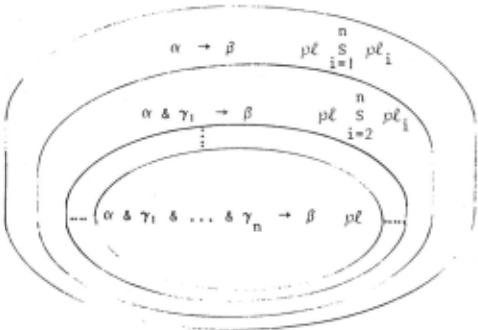
- the plausibility p(' is thus a residual uncertainty attached to the substitution a {3 , when all conditions are verified ; it copes for the factors one can not or will not identify, but still in fluence the substitution ;
- the 'Y· can be either texts - which must then be recursively validated through CPRs -or function calls, to embody specific computations (generally at the morpho-syntactic levels) or local strategies.
IV CONCLUSION
A. On Canonical vs. Variable - Depth Representa tions
As already stated, canonical forms -as every fixed - depth represen~ation - are d~scriptions for which a degree of refinement has arbitrarily been selected.
Moreover, they have practical inconveniencies
- ~ they often force to resolve ambiguities, while the required level of text processing would not need· it ;
- they lend themselves poorly to approximation if a procedure is attached to one form, . how to call it when the data are close, but not iden tical, to that form : what are then the para meters ? how to make s.ense of the results ? how to measure a distance between canonical forms ? etc.
VDP has also its own problems (e.g. how to weight the importance of such or such factors ? which canonical forms seem to avoid, bu~ we believe that these problems are intrinsically related to the nature of commonsense knowledge .
B. On Contextual Production Rules
CPRs are but one way to implement the idea of VDP in a computer. We are currently developing a question - answering system which operates on natural - language texts concerning a non - tech nical subject, extracted from a general public - oriented encyclopaedia.[!]
If thi s experiment turns out to be success ful, we might consider other areas of application, because we feel that variable - depth is a feature common to many human activities, including- but not restricted to - natural language understanding.
@inproceedings{ijcai1981p15,
  title     = {Variable-Depth Natural Language Understanding},
  author    = {Kayser, Daniel and Coulon, Daniel},
  booktitle = {Proceedings of the Seventh International Joint Conference on
               Artificial Intelligence, {IJCAI-81}},
  publisher = {International Joint Conferences on Artificial Intelligence},
  editor    = {Patrick J. Hayes},
  pages     = {64--65},
  year      = {1981},
  month     = {8},
  note      = {Natural Language},
  url       = {https://ijcai.org/proceedings/1981/15},
}
TY - CPAPER TI - Variable-Depth Natural Language Understanding AU - Kayser, Daniel AU - Coulon, Daniel T2 - Proceedings of the Seventh International Joint Conference on Artificial Intelligence, IJCAI-81 PB - International Joint Conferences on Artificial Intelligence PY - 1981 SP - 64 EP - 65 UR - https://ijcai.org/proceedings/1981/15 ER -Copied
Machine-readable versions of this paper, for tools and AI agents:
 Welcome
 Future Conferences
 AI Journal Division
 IJCAI Proceedings
 About IJCAI
 IJCAI Awards