
Quantitative Evaluation of Transmission of Meaning
Proceedings of the Sixth International Joint Conference on Artificial Intelligence. .
© 1979 International Joint Conferences on Artificial Intelligence
Abstract
As a step toward quantifying the processes whereby meaning is transmitted by language, an experiment was designed to facilitate observation of the process of verbalization by the sender as well as the process of comprehension by the receiver. Both sender and receiver characteristics were measured experimentally by confining the subject matter to ages and by restricting the available vocabulary to a small set of nouns. A model was then constructed for the entire process through which meaning is transmitted by a word, clarifying various causes of ambiguity and inaccuracy of transmission. The whole process was evaluated in terms of the amount of information and the r.m.s. error of transmission.
- Shannon, C. E. ancl I.J. Heaver: The Ma themat ical Theory~ Communication, Univ. of Illinois Press, 1949.
- Fujisaki, H., K. Hirose and Y .. Katagiri : Transmission of Heaning by Language, Annual Bulletine, Research Institute ~ Logopedi cs and Phoniatrics, Univ. of Tokyo, ~. 127-140, 1978.
- Brown, R. H. and E. H. L e nneber~: A Study in Language and Cognition, J. Abnormal Psychology, lo9, lo'i4-462, 1954. and Social ------
- Lenneberg, E. H.: IHological Foundations of Language, John Hiley & Sons, 1967.
- Zadeh, L. A.: Fuzzy Sets, Informa tion and Control, ~. 338-353, 1965.
References were extracted automatically from the PDF and may contain errors.
Full text extracted automatically from the PDF; figures, tables and equations may differ. The PDF is the version of record.
1. INTRODUCTION
Language is obviously an important medium of human thought and communication, and elucidation of its essential characteristics is indispensa ble not only for understanding the human pro cesses of thought and communication, but also for machine processing of linguistic informa tion. Most of the studies on language, however, have been concentrated on the nature of the lan guage itself as a sys tern of codes, and little attention has been paid to the relationship between the linguistic code and the information conveyed by the code (1].
The present study deals with the communicative roles of language between a sender and a re ceiver, and experimentally analyzes the send er's process of conversion from information to word as well as the receiver's process of con version from word to information. The process of transmission of meaning is then formulated and quantitatively evaluated in terms of the amount of transmitted information and the accu racy of transmission [2].
2. PROCESSES IN TRANSMISSION OF MEANING - -
We deal here with a situation in which a physi cally definable stimulus is converted by a sub ject (sender) into a linguistic expression (a noun in this case) and is received by another subject (receiver). The input stimulus is first per ceived by the sender and then expressed as a noun. The combined characteristics of perception and verbalization by the sender can be measured as the input-output characteristics, and will be re ferred to as the ooding characteristics. On the other hand, the communication is generally termi nated by the receiver's process of comprehension. In order to render the receiver's percept into a directly observable form, however, we add here another process in which the receiver reproduces the stimulus which he may find most appropriate for the received linguistic message. Thus the combined characteristics of comprehension and reproduction by the receiver can be measured as the input-output characteristics, and will be referred to as the decoding characteristics. The processes involved in this verbal communication situation is schematically shown in Fig. 1.

3. CODING AND DECODING CHARACTERISTICS
As an exampl e o f experimental determination of the coding and decoding characteristics, an investigation was conducted on the relation ship between the age of a person and the nouns of Japane s e commonly used to designate the age. These nouns were selected s uch that they were near ly complementary with each other in desig nati ng age and un i form in other aspects. The major part of the following experiments was conducted by using the five-word vocabulary,: "yo- nen", " sho-nen", "sei-nen", "so-nen", and "ro-nen", corresponding roughly to the English "childhood", "boyhood", "youth", "manhood", and "old age", respectively. The vocabulary size was va r ied, however, in studying the effect of i t s change on transmission accuracy. The method of constant stimuli was used to measure the coding and decoding charac teristics separately on each o f the nine subjec ts. Because of indi v i dua l di ff e r ences , the data from each subject had to be anal yzed separately.
Figure 2 s hows the coding characteristics of one s ub jec t a s the probability with which he assigns a noun agains t a given age. In the vicinity of a category boundary, each of the probability distr ibution func tions can be approximated by a Gaussian distribution function with a mean 6 and a standa rd dev i at i on p, to be clef i ned here re spec t ively as the coding boundary and the coding accur acy, s ugges t i ng tha t the se l ec tion of a particular noun is bas ed on a ca t egorical judg ment whose threshold fluctua t e s due to a number of psychological fac tors. Thus the coding char acterist ics of a subject can be represented by the set o f 6's and p's for all the category boundaries .
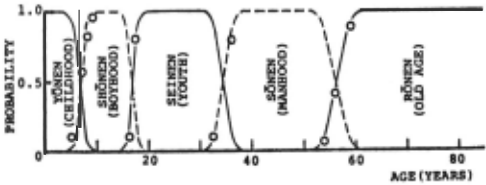
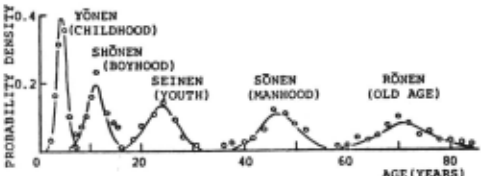
Figure 3 shows the decoding characteristics of the same subject as a set of five probability density functions, each representing the proba bility density that a certain age is reproduced against a given noun. In this case, each of the density functions can be approximated by a Gaus sian density function with a mean ~ and a stand ard deviation o, to be defined here respectively as the decoding reference and the decoding accuracy, suggesting that the reproduction of a particular age is based on a reference which is perturbed by a number of psychological factors. Thus the decoding characteristics of a subject can be represented by t he set of ~·s and a's for all the categories (nouns).
4. A MODEL OF -SEMANTIC INFORMATION TRANSMISSION - --- -
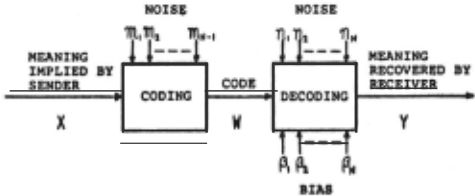
The results of the foregoing experiments lead to a model for the processes of semantic informa tion transmission shown in Fig. 4. The coding process at the sender can be considered as quan tization followed by code assignment. The quan tization is probabilistic since each threshold ei is perturbed by a Gaussian noise mi. On the other hand, the decoding process at the receiver can be considered as biased reproduction of the quantization levels. The bias Bi represents the discrepancy between the center of the ith coding step (ei +ei_1)/2 of the sender and the ith de coding reference ~i of the receiver. The repro duction is also probabilistic since each decod ing reference is perturbed by a Gaussian noise ni. The three variables x, w, and y in Fig. 4 respectively represent the meaning implied by the sender, the code word adopted for transmis sion, and the meaning recovered by the receiver. The entire process as a communication channel can be characterized by the conditional proba bility q(ylx).
These formulations allow one to evaluate the mu tual information R (in bit/word) and the r.m.s. transmission error E (in units of age) for a given probability density p(x) of the stimulus x presented to a sencler. They are ~iven respectively by
The mutual information R indicates the require ment on the lower bound of the channel capacity for semantic information transmission necessary to achieve the accuracy of transmission indicat ed by the r.m.s. error.
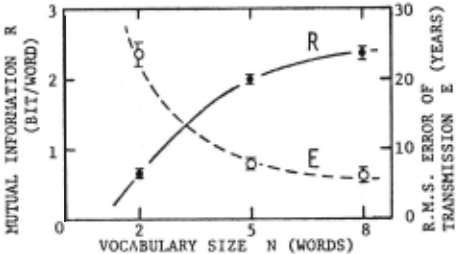
These quantities were calculated from the meas ured data of codin~ and decoding characteristics of three subjects, obtained for the vocabulary size of two, five, and ei~ht. The probability density p(x) of the stimuli was assumed to be uniform over the ran~e [0, 80], and the calcula tion was made for all possible sender-receiver pairs. The results are shown in Fi~. 5, where a small circle indicates the mean of all sender receiver combinations, and a vertical line seg ment indicates the ran~e of distribution. The results indicate that both the accuracy and the transmitted information increase with the vocab ulary size, but also indicate that there is a 1 imit to the accuracy attainable by increasin~ the vocabulary size. Thus there seems to exist an optimum size of vocabulary from the point of view of transmission efficiency.
5. DISCUSSION AND CONCLUSIONS
Thc> probabilistic nature of languageusewas ear lier point~d out by Lenneber~ and his co-workers [ 1, 41. Due to the use of unrestricted vocabulary and pooling of data from many subjects, however, thPsP authors did not attain a clear insight into thP underlying process of coding in a lan guagL' us(·r. The problem is also treated by ?:adPh [5] in connection with the concept of
"fuzziness.'' Despite the conceptual distinction made by Zadeh between probability and the ll'em bership function, the present authors consider that the membership function is equivalent to the probability distribution in the coding char acteristics. It should also be noted that these earlier stuclies did not separate the two kincls of indeterminacy in lan~uage use, i.e., the indeterminacy of coding and that of decodin~.
The present study was based on the clear separa tion of the two processes in semantic in forma tion transmission, and developed experimental techniques to observe both the process of ver balization by the sender and the process of lan ~uage comprehension by the receiver. The char acteristics of these processes were measured and formulated. Based on these results, a model was constructed for the process of semantic informa tion transmission by , means of a word, and a method was also shown to evaluate the process in terms of the ambiguity and the accuracy of transmission.
Although the results shown in this paper are quite limited, the techniques describecl here are applicable to a wide range of prob 1 ems of lan~uage use, such as the quantitatIve analysis of individual, contextual, dialectal, ancl lan guage differences in semantic information trans mission.
ACKNOWLEDGMENTS
The research reported here was supported by a Grant-in-Aid for Scientific Research (No. 110708) from Japanese Ministry of Education.
@inproceedings{ijcai1979p65,
  title     = {Quantitative Evaluation of Transmission of Meaning},
  author    = {Fujisaki, Hiroya and Katagiri, Yasuhiro},
  booktitle = {Proceedings of the Sixth International Joint Conference on
               Artificial Intelligence, {IJCAI-79}},
  publisher = {International Joint Conferences on Artificial Intelligence},
  editor    = {Bruce G. Buchanan},
  year      = {1979},
  month     = {8},
  url       = {https://ijcai.org/proceedings/1979/65},
}
TY - CPAPER TI - Quantitative Evaluation of Transmission of Meaning AU - Fujisaki, Hiroya AU - Katagiri, Yasuhiro T2 - Proceedings of the Sixth International Joint Conference on Artificial Intelligence, IJCAI-79 PB - International Joint Conferences on Artificial Intelligence PY - 1979 UR - https://ijcai.org/proceedings/1979/65 ER -Copied
Machine-readable versions of this paper, for tools and AI agents:





