
The Counterplanning Process: Reasoning under Adversity
Proceedings of the Sixth International Joint Conference on Artificial Intelligence. .
© 1979 International Joint Conferences on Artificial Intelligence
Abstract
A heuristic model of pianning In conflict situations is presented. This strateay-based model eccounta for dynamic plan adaptation and replanning in obstructive and constructive counterplanning situetiona. Ttt. former situation is characterized by an actor striving to thwart the goals and plans of a second actor. The latter, Is the dual situation; it provides general means for an actor to pursue his aoel In spite of attempts by others to block his plans. The model has been implemented as part of the POLITICS system, I comt;»uttr proaram that understends simple netutll lenguage accounts of International political conflicts.
- I. Newell, A. and Simon, H. A. Human Problem Sowing. New Jersey: Prentice-Hall, 1972.
- Fikes, R. E. and Nilsson, N. J. STRIPS: A New Approach to the Application of Theorem Proving to Problem Solving. Artificial lnteW.gence 2 (1971), 189-208. IJCAI
- Sacerdotl, E. D. A Structure for Plon1 end Behe11ior. Amsterdam: North-Holland, 1977.
- Schank, R. C. and Abelson, R. P. Script1, Cocll, Pl4nl end Under1t11ntlinr. Hillside, NJ: Lawrence Erlbaum, 1977.
- S. Wilensky, R. Underltendlng Cocl-Be1ed Storle1. Ph.D. Th., Yale University, 1978.
- Schmidt, C., Srldharan, N. and Goodson, J. The Plan Recognition Problem. Artificicl Intelligence 11,2 (1977), 45-83.
- Carbonell, J. G. Subjecti11e Under1tending: Computer Modell of Belief S~1tem1.. Ph.D. Th., Yale University, 1979.
- B. Carbonell, J. G. The Counterplonninr Proceu: A Model of Deci1ion-M11king in Ad11er1e Situoti.ofll. Rep. Computer Science Dept., Carnegie-Mellon University, 1979.
- Culllngford, R. Script Applicetion: Computer Under1tending of New1pe1per Storie1. Ph.D. Th., Yale University, 1977.
- Barstow, D. R. Autometic Con1tructi.on of Algorithm~ end Do.te Structu,.., U1inr o Knowledge Be1e of Progremming Rule1. Ph.D. Th., Stanford University, 1977.
- II. Newell, A. Productions Systems: Models of Control Structures In W. G. Chase, Vl1ucl lnformetion proce11lnr, New York: Academic Press, 1973, pp ..
- Hay«J:Roth, F., Mostow, D. J., Fox, M S. Understanding SpBech In the HEARSAY-II System In L Block, Speech Communiceti.on with Computers, Berlin: Sprlnger-Verleg, 1978, pp ..
References were extracted automatically from the PDF and may contain errors.
Full text extracted automatically from the PDF; figures, tables and equations may differ. The PDF is the version of record.
1. Introduction
Planning and problem solving have been active research topics in Artificial Intelligence (e.g., GPS [11 STRIPS [2], 1 and NOAH [3]). However, most research efforts only considered one-actor situations, with no adversaries and with a static world model. Plan-understanding systems [4, 5, 6] have also been largely confined to planning scenarios where actors do not scheme to thwart each other's plans while planning to achieve their own goals in
light of possible external interference.
We focused our research on situations where the decision maker has to contend with other parties that may be continuously trying to thwart his efforts. In such circumstances, plan formulation and decisions of how and when to implement the plans become much more complex than in simple one-actor planning situations. The primary problems that must be addressed in such situations include the non-deterministic nature of planning under uncertain outcomes c..,d changing circumstances, predicting the most likE:iy actions on the part of potential adversaries, formulating alliances with other parties that have common goals, and compromising with one's adversaries when necessary. We discuss part of our theory of counterplanning and its implementation in POLITICS, a computer program that models Ideologically-oriented decision-making tasks in the domain of international diplomacy and political confrontations.
1 Thi· r····rch w.. 1p0111ored in ptrl by the O.feftM Adv111ced Re .. erch Projecle Atellcy (DOD), Monitored by the Office of Nev1l R .. eerch under conlr1cl N00014-75-C-1111, 11\d ill p1rl by ARPA Order No. 35V7, monitored by the Ail' force Avionin Lebor~lory uftder Conlr1cl F33815-78-C-1511. The viewe eftd conclu1ion1 conl1inttd in lhie document ere thoM of the 1ulhor, 11\d 1hould not be interpreted 11 repre .. nlint the officill policiee, either etcprelled or hftplild, of the
DefenM Adv·nced ReMerch Project· Atency or the U.S. Gover111111nt.
2. The POLITICS System
The POLITICS system [7, 8]) understands a natural lansuage description of a conflict situation by abstracting Its meaning in terms of contextual knowledge of similar conflict situations (encoded as scripts [4, 9]), determining how the situation affects the goals of each political actor, and later applying counterplanning strategies to model the decisions open to the political actors under the circumstances defined by the input conflict situation. POLITICS evaluates possible decisions In terms of their effects upon the goals of the political actor, their likelihood for success (e.g., whether the planned decision can be implemented, or whether it is likely to be blocked by an opposing political actor.)
In the following example the POLITICS program analyzes a political event first from the point of view of a conservative American policy maker, and later from 1 liberal viewpoint, to answer some questions illustratlna the aoal-oriented counterplannlng process.
The United Sl1l .. Contrtll voted to fund the
o(INTERPRET US-CONSERVATIVE> INPUT TEXT: T riclenl 1ubm1rine project.
- Q: Whet did the US Contre .. do lhi1 for?
- A: THE UNITED STATES CONGRESS WANTS THE UNITED STATES
- ARMED fORCES TO BE STRONGER.
- Q: Why 1hould the US he ·lro~~ter? A: THE UNITED STATES ARMED FORCES SHOULD BE STRONG TO STOP COMMUNISt EXPAN!>ION.
- Q: Whet ehould the US do if Ru11ie build· nuciHr 1ubmerine1? A: THE UNITED STATES SHOULD BUILD MORE SUBMARINES.
.(INTERPRET US-LIBERAL) INPUT TEXT· The United Sl·t .. Co~~tr .. , voted to fund the Trident 1ubmerine project.
- Q: Wh·t did the US Conare .. do thi· for?
- A· THE UNITED STATES CONGRESS FEARED FAlliNG BEHIND IN THE ARt.AS RACE.
- Q: Wh· I ahould the US do If Ru11ie bullda SIAI11111rinea? A· THE UNITED STATES SHOULD NEGOTIATE WITH RUSSIA TO STOP THE ARt.AS RACE.
In processing the above example, POLITICS inferred that the US will build the new weapon system, and that this is an Important event whose consequences should be futher examined. At this point the liberal and conservative Interpretations diverged. The liberal analzyed the negative Implications towards peace, whereas the conservative focused on the beneficial effects of trident submarines to the US-Soviet strategic balance. Counterplannlng Is Illustrated In the answer to the last question In each Interpretation. In the conservative Interpretation, POLITICS focused Its counterplannlng on how to keep the Soviet Union from becoming stronger than the United States. It applied a mutual-exclusion strategy: only one country can be the strongest military power. Therefore, if the US cannot stop the Soviets from building submarines, it should at least build a larger number of submarines and thereby remain stronger. The liberal Interpretation focused counterplanning on how to end the arms race, as it considers this to be the most serious consequence of the arms race. Liberal POLITICS believes that both the United States and the Soviet Union want world peace more than military superiority. Liberal POLITICS applied a strategy that states that if a continued bilateral conflict violates more Important goals of the conflicting parties, then they should jointly work to terminate that conflict.
The questions answered by the POLITICS system require en Inference process that relates the input event to factual Information contained in memory, as well as a decision-making process whose focus is to further the goals of the United States as perceived by a conservative (or liberal) American policy maker. Although the POLITICS system Is essenti11lly an Integrated understanding system, It cen be divided conceptually Into several modules, Including: 1) Natural language understanding and generation In a semantically-rich domain. 2) A process to focus attention and thereby constrain inferences based In the goal hierarchy representation of political ideologies. 3) A script and situational Inference rule appller. 4) A reasoning ·system based on our heuristic model of counterplanning. This paper focuses only on the counterplannlng process, a significant aspect of human reasoning that has not been heretofore directly addressed In Artificial Intelligence.
Plannlna and Counterplannina require self-knowledge of the aoals that one strives for, and at least partial knowledge of the goals of other actors with whom one lnterects. In POLITICS, the goals of all relevant actors
form the bulk of the ldeoloatcal-bellef model. For instance, a model of a conservative American asserts that the primary Soviet goal Is world domination, and that the primary US goals are communist containment and a strong national defense. The POLITICS ,·,odel of a US liberal, however, states that the primary liS and Soviet goals are the malntainment of world peace, and that humanitarian goals are more Important than a strong defense. Because of the varying sets of goals and the different priorities among the goals, POLITICS Is able to model different political Ideologies using the same reasoning process. This reasoning process consists prlmerlly of the counterplannlng heuristics focused on fulflllina the ideoloslcal aoals.
3. The Counterplannlnc Control Process
The counterplanning process is encoded as a set of heuristic strategies applicable to general conflict situations, and a control-flow algorithm that determines when to apply the various classes of counterplannlng strategies. We first discuss the control-flow algorithm, later we analyze the structure and content of the heuristic strategies.
There are two general types of conflict situations where an actor may apply the counterplanning process. The first situation Is characterized by an actor (X) trying to thwart another actor (Y) from achieving his goal G(Y). X may prevent Y from achieving G(Y) by directly making the goal state Impossible to achieve, or by repeatedly blocking Y's plans to fulfill G(Y). We call this process obstructive counterplannlng. The second type of counterplanning scenario Is essentially the dual of the first type: An actor X is trying to achieve his goal G(X) In spite of attempts by Y to prevent C(X) and to block X's plans for pursuing G(X). This process, called constructive counterplanning, differs from obstructive counterplanning only in terms of the sub jectlve perspective of the counterplanner. The perspective shift causes the counterplanner to apply different strategies at different limes, as the application of strategies Is goal driven. Figure 1 Is a control-flow diagram for the obstructive counterplannlng process.
To Illustrate the obstructive counterplannlng mechanism, consider a simple example. Prison guard X wants to prevent prisoner Y from escaping. Hence, G(Y) is Y beln& free outside the prison. We enter figure 1 at the top. Does the guard know the prisoner's escape plan? Let us assume that he does not. His next step Is to determine what, If any, plan the prisoner formulated. This plan determination may Itself involve some planning: Should the guard ask the prisoner?, Should he threaten him? (Schank and Abelson [4] discuss the social planning units). Let us again assume that the guard fails. At this point we enter the third box in figure 1. The guard can ask himself ·what would I do if I was trying to escape?· If he finds a reasonable plan, he should assume that this may be the prisoner's plan and he should apply the obstructive counterplannlna strateales to block the plan. For Instance, the guard may find that stealing the key Is a reasonable plan, In which case he may apply the violate-necessary-precondition strategies (discussed later) to conclude that he should keep the keys eway from the prisoner.
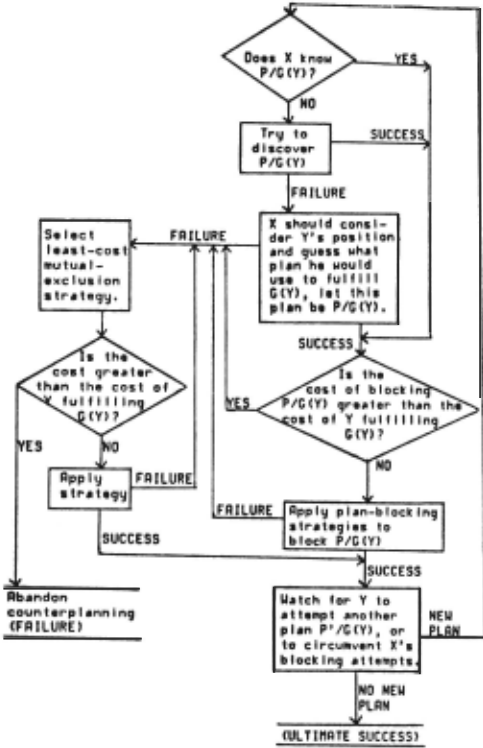
If no plen presents itself, the only option open to the guard is to take general precautions (I.e., epply mutuel exclusion strategies) such as pointing a gun et the prisoner and Informing him that either he remains put, or he will be dead. Thus escaping and steylng alive become mutuelly-excluslve stetes in the prisoner's mind.
There ere exit conditions In the counterplennln1 algorithm. For lnstence, If the prisoner's plen Is to blow UD the prison (end he hes the meens to do so), the guerd may decide that the risk of being blown up Is more costly than his goal of thwartlna the prisoner. Slmllerly, If he has to keep a gun trained on the prisoner for the length of the prison sentence, the guard may decide thet this Is more costly than letting the prisoner escape.
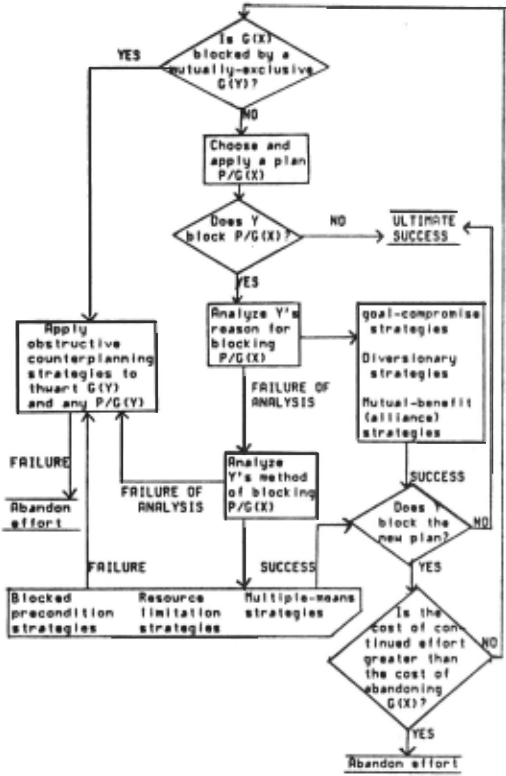
Figure 2 Is the control-flow for constructive counterplannlng. Using the constructive counterplannlng algorithm one can trace the options available to the prlaoner for formulating an escape plan teklng Into 1eeount the guerd's possible thwarting effortt..
4. The Structure of the Counterplannina Strateaies
Our model of counterplanning is essentially a goal-directed rule-based system. Each strategy is a rule that tests the goal conflict state between the two actors, the goal trees of each actor, and the plan that each actor is pursuing. If the test of a rule is true, the action part of the rule suggests a counterplanning method that Is likely to succeed. The action part of the rule may have additional conditions or refinements. The structure of a counterplannlng strategy is Illustrated below.
STRATEGY <rulelk> <IItie> TRIGGER Conjunction of <lull, test2, ··· , t .. tn>
IF Conjunction of <lntn+l, testn+2, ··· > THEN Sequence of <actlonl, actlon2, ··· > REFINEMENT <subrulelkl, subrulelk2, ··· >
F19ure 3t The structure of a counterplannln<J strat·CJIJ·
The test part of each rule is divided into the "TRIGGER" clause and an additional "IF" clause. In order for a rule to apply, both clausr!s must be true in the counterplanning situation. The rea!>On for our division of the test clause in such a manner is to reduce the time that the process model spends searching for an applicable strategy. All the trigger conditions are "inexpensive" tests: these tests can be applied directly to the situation without requiring further inference or complicated matching. These trigger conditions are compiled into a discrimination network. This organization allows the addition of new strategies without a corresponding linear increase in the search time required to test all the applicable counterplanning strategies.
Once the trigger conditions for a rule have been met, the additional "IF" tests are performed. These tests may be arbitrarily complex, perhaps ·requiring further inference and the invocation of other counterplannlng strategies However, the trigger conditions usually restrict the set of applicable counterplanning strategies to a small number In any given situation (typically three or four). Furthermore, counterplanning strategies reflect common-sense reasoning about how to deal with adverse situations. As such, each strategy is sufficiently general to apply across many reasonable types of human conflict. This means that the total number of counterplanning strategies . is relatively small compared to the total number of rules and information contained in the situation-specific scripts. We have found that approximately forty counterplanning strategies suffice to model the counterplanning actions in the situations and goal conflicts we have considered.
The action part of each strategy (preceded by "THEN") is a sequence of counterplannlng methods to be applied In the current context by one of the actors. If a strategy Is applied, the "refinement· field is checked after the sequence of actions is performed. The refinement contains one or more additional rules that usually provide further detail to the counterplanning situation. These rules are truly subrules to the counterplanning strategies because they are invoked only in the case that all the tests of the strategy are true, and, In addition, the test clause of each subrule Is also true. In structure, our strategies are much closer to the rules In expert systems (such as PECOS, [10]) than to more traditional production systems (e.g., the PSG system [ 11 )).
The following sections analyze some of the more significant types of counterplanning strategies. More complete sets of strategies are discussed in [7, 8). We also discuss the way In which counterplanning strategies are used in text-understanding and question-answering tasks.
5. Diversionary Counterplanninc Stratecies
We turn to some of the more specific counterplanning strategies applicable to a mutual-exclusion goal conflict. A frequently-encountered set of strategies operates on the principle of diverting the efforts of an actor In the goal conflict away from direct pursuit of his goal. There are essentially three classes of diversionary strategies, all relying on the fact that if an actor has to divert his efforts to other matters, he is less likely to succeed at his original task. We group the diversionary strategies into the three categories listed below:
DIVERSIONARY STRATEGIES.
- Threaten higher-level goals of one's opponent.
- Dissipation of effort: Threaten opponent's other goals.
- Deception: Misleadingly convince one's opponent that other goals are threatened.
Let us look at one important diversionary strategy and its deceptive option. The process of convincing one's opponent that the actions of a counterplannlng strategy have been carried out, without this being the case, Is called the deceptive option of that strategy.
STRATEGY 11 ll!REATEN HIGHER-LEVEL COAL
TRIGGER Mutual-exclusion CJOal-confllct situation between GIY) and CIXl .
IF X can find a 9oal G'IYl to block, where G' IV> Is a 9oal of higher IMportance to Y than C<Y>,
THEN X should try to block C'(Yl. X can expect Y to pursue G' !Yl ·nd abandon GIY),
- REFINEMENT X should choose G'!Yl such thatt ll Y cannot pursue both G'!Yl and G!Yl siMUit·neoualy, or
- 21 Y can accoMplish G' IV) only If the blocking ·ctlon Is abandoned.
Strateay 1 means that In a mutual-exclusion goal-conflict situation, one actor (X) may threaten a higher-level goal of the second actor (Y), in order to make Y divert his efforts to preserve that higher-level goal. Since an ector·s attention, time, and material resources are limited, Y may not be able to protect his higher-level goal and pursue the goal that conflicts with x·s goal simultaneously. Thus, X will be in a better position to win the conflict situation and achieve his own goal. The "refinement" part of the rule gives some advice to help X make his choice on which one of Y's higher-importance aoals to threaten. X knows which goals Y may consider more Important by examining Y's goal tree. Our model assumes that the various actors know about each other·s primary motivations. X should threaten a goal that requires Y's full attention, time or material resources to protect. Alternatively, X can threaten an Important goal that Y cannot protect. This gives X a bargaining position to tell Y that he will stop his threat only If Y abandons the (presumably less important) goal that conflicts with x·s aoal.
Let us see the deceptive version of strategy l. This strategy Is based on the same principle of divertlna the ettention and efforts of the opposing counterplanner eway from goal conflict. However, the method used need not correlate with reality. As such, one should expect that a deceptive strategy Is more likely to fall (e.a., If the opposlna actor discovers the truth.).
ITitATtGV 21 D£CEPTION1 FALSE THREAT
sa .. ·· etreteqy 1 but elthar
11 X only appaare to thraaten tha hlqher laval qoal G' IYI, or
21 X thraatana to bloct G'IYI but haa falaaly convlncad Y that G'IYI ehould be one of Y'· hl9h-lavel qoal1.
There are other diversionary strategies (listed In [7]); however they all share a common principle: An actor cannot overtax his attention and resources by simultaneously pursuing multiple courses of ection. Awareness of this simple principle applied to other actors (es well as the counterplanner) guides our formulation of the diversionary counterplanning strategies. Each strategy Is based on a different method of causing an actor to worry about more than one goal at a given time. There are various kinds of limitations on the different Items that an actor can focus his attention on at one time. We classify the limitations on the simultaneous pursuit of multiple courses of action Into the followlna cateaorles:
1) Limitations on available time.
- Mental and physical limitations on the number of actions that can be performed simultaneously.
3) Limitations of material resources.
4) Limitations of ability.
- !5) Goal of avoldlna certain consequences of one's actions.
6) Interactions between different courses of actions.
6. Counterplannlnc Stratecles Based on Goal Compromise
Bargaining strate.gies are characterized by the opponents· willingness to compromise. Willingness to compromise is mediated by many factors such as the two opponents· perceptions of whether compromise Is possible, necessary, or desirable. There are two basic classes of bargaining strategies: The first class Is based on partial goal fulfillment and the second is based on goal compromise. In order to discuss these strategies, we need to define the notion of partial goal fulfillment. For goals comprising of a conjunction of (possibly recurring) subgoals, partial fulfillment is defined In the obvious manner: The goal Is partially fulfilled If some of the subsumed goals are fulfilled. For Instance consider the following case:
EVENT 1: John wanted to marry Susan. They decided to live together Instead.
Did John achieve his goal? Strictly speaking the answer Is "no". But, If we understand that marriage is a complex goal, we realize that for all intents and purposes John fulfilled most of the goals subsumed by marriage, such as achieving companionship, periodic satisfaction of the sex drive, etc. Since marriage also involves a change In social and legal status not necessarily associated with living toaether, we say that John partially fulfilled his goal. Therefore, by this measure, partial fulfillment of a goal Is the case where the specific goal sought Is not fulfilled, but a significant fraction of the underlying reasons for pursuing the goal are fulfilled.
The second way in which partial goal fulfillment Is measured applies to goal states that can take a continuum of values. Acquisition of money and achievement of social stature are examples of continuous-valued goals1 there are virtually Infinite degrees of social stature and of the amount of money that a person can acquire. We define success differently for preservation goals than for achievement goals (called "P-goals" and "A-goals" respectively in the Schank and Abelson [4] goal taxonomy). Let us call the initial value of the goal state "1", the desired value of the goal state "D", and Its resultant value at the time when we must decide whether the goal succeeded "R". For P-goals it Is usually the case that I · D, and for A-goals I < D. The success and failure conditions of continuous-valued goals are given by the followina table:
I
--------·-------------t---------------------1-------------1
| t FAILURE | I PARTIAL SUCCESS | I SUCCESS | |
|---|---|---|---|
| A-COAL | I I I • It < D | I I I < It < D | --------1-------------1---------------------·-------------1 I I I < It • D |
| P-CDAL | I It < I • D I | --------:-------------:---------------------:-------------: It llltf!t tv < I • D | I It • I • D |
Here are the partial-goal-fulfillment and goal-substitution bargaining, strategies:
STRATEGY 3t COAL C011PROI11SE
TRIGGER CCX) and GCYI a~e MUtually exclualve and May be fulfilled pa~tl1lly.
I~ X c1nnot 1chleve CCXI by othe~ counterplannln9 atrate9lea,
THEN X ahould try to p·~tlally fulfill GCXI by ba~9alnlng withY to coMp~o·lae MUtuallll on pa~t l·lly full llllng the I~ ~eapectlve go·la.
Metaphorically, strategy 3 states that if one cannot have the entire pie then one should try to bargain for at leest a slice of the pie. Strategy 4 is more cooperative in nature than strategy 3, but involves the same principle of compromise on partially attainable goals:
STRATEGY 4t COOPERATION BY ftUTURL NEED
TRIGGER CCXI 1nd CCVI ·~e .utu1lly exclualve and Mly be pa~tl·lly fulfilled.
I~ nelthe~ X no~ Y can Independently achieve thel~ ~eapactlve goala, but c·n aucceed only by pooling thel~ effo~tl,
THEN X and V ahould coMp~o·lae on pa~tlally fulfilling CCXI and CCVI and plan Jolntlll fo~ thel~ fulflll .. nt.
Strategy 4 states that cooperation may be a necessary course of action In spite of conflicting goals. Event 2 illustrates this point:
EVENT 2: Jesse James and Bill Morgan joined forces to heist the payroU train.
We Infer that both actors had the A-goal of acquiring the money in the payroll train. These goals are mutually exclusive but may be partially fulfilled. Suppose we had to answer the question: "Why did .Jesse James and Bill Morgan join forces?" The most reasonable answer Is: "Probably because neither could heist the train by himself." This answer cannot be inferred from the goal conflict ltselh the existence of a goal conflict suggests competitive rather than cooperative actions. Therefore, the understander has to be aware of strategy 4 - cooper atiori between actors with conflicting goals is reascmable if neither actor can otherwise fulfill his goal.
The general goal substitution strategy, illustrated In the following event, Is presented below.
EVENT 3: Johnny and Billy were arguing over a candy bar. Johnny offered to let Billy ride his new bicycle if he would let Johnny eat the candy. Billy agreed.
STRATEGY St GOAL SUBSTITUTION
TRIGGER GCXI and GCYI ·~e coMpeting goala and X tnowa about Y'· other goalt.
I~ X can b~lng ·bout C'CYI, one of Y'a 90ale that Ia at leaat aa IMpo~t·nt ·· GCYI,
THEN X ahould b·~galn with Y to aubatltute G' CYI fo~ CCV) ·· Y'a lctlvely puraued 9011. CThla le1vea X f~ee to puraue GCXI.)
REFINEftENT Apply thle etratt~ only If GCYI 11 not a P-9oal.
7. Predictive vs Interpretive Reasonlna
For the task of generating hypothetical scenarios, one can only use counterplanning strategies in a predictive manner. However, in story understanding tasks, the counterplanning strategies are used to interpret the actions of the actors. In such situations, It Is better to apply the strategies In an Interpretive manner. To see what we mean, consider event 4:
EVENT 4: The United States supported Israel in the 1973 Middle-East war. Subsequently the Arabs Imposed an oil embargo on the United States and Its allies.
QUESTION: Why did the Arabs Impose the oil embargo?
Strategy 1 can be used in a predictive framework or In an interpretive manner. In understanding event 4 we need to pose and answer the question "Why did the Arabs impose an oil embargo?" Using knowledge about the goals of the Arabs and the goal of the United States to help Israel, the understander can establish the goal conflict between the Arabs and the United States. The mutual-exclusion goal conflict Is between the US goal of aiding Israel and the Arab goal of preventing US aid to Israel.
Having Interpreted the situation thus far, an understander can proceed in two different manners. The first manner Is to predict ·all the possible Arab counterplanning actions to make the US stop aiding Israel. If, in Interpreting the rest of the event, the understander matches an action with one of the previously predicted counterplanning actions, the understander can conclude that indeed the Arabs were counterplanning against the US and their counterplan was the predicted course of action. Such a process would require the understander to generate vast numbers of hypotheses and subsequently test each hypothesis as a possible explanation of the situation. There Is no evidence to suggest that people generate all possible inference paths in a given interpretation In order to discard all but one path that matches reality. It appears more plausible that people only pursue a small number of relevant inference paths. Therefore, generating all possible plans of action is not a reasonable psychological model of human thinking, nor does It lend Itself to reasonable constraints on the computational time that the system may require In order to aenerate and test all alternative actions on the part of the Arabs.
A more reasonable alternative to the generate and test process Is the following: Given the existence of the mutual-exclusion goal conflict, we can predict that the two actors may counterplan against each other. No further predictive Inferences are generated at this point. The rest of the event should be interpreted In light of the expectation that the two actors may counterplan to resolve their goal conflict.
When the understander learns of the Arab oil embargo, he tries to see if this is a reasonable course of action to take as a counterplan against the US goal of aiding Israel. Counterplannlng strategy 1 (refinement 2) matches the type of Interaction between the Arab plan and the US goal. The Arabs are threatening a hi&her-level US preservation goal by cutting off oil supplies, and the US cannot do anything to directly remedy the situation. Now the Arabs can bargain to end the embargo In return for the end of US aid to Israel. Therefore, the understander can establish the Arab counterplanning actions by applying strateay 1 In an Interpretive manner. The result of the Arab actions Is matched to the action part of the strategy. This match, suggested by our previous expectation that a counterplanning action was likely, allows the understander to Infer that the Arabs were invoking counterplannlng strategy 1. Therefore, we can say that the reason for the Arab action is the test clause of the strategy. Thus, we have a mechanism for using counterplanning strategies in an abductive manner to Interpret actions In conflict situations, as well as a deductive manner to propose counterplans. The general Interpretive technique of predicting an overall framework and subsequently instantiating its component parts has been successfully applied in other AI systems such as SAM [9] and HEARSAY-II [12~
The Interpretive mode of reasoning is superior to the purely predictive mode because it does not require the aeneratlon and subsequent testing of an arbitrarily large set of possible courses of action. It Is also a more reasonable model of human thouaht. Before. and durin& the 1973 Arab-Israeli war, few people foresaw an Arab oil embargo. When the embargo came, however, the reasons for the Arab action became tleer.
8. Concludin1 Remark
We have seen how counterplanning Is a necessary process for both rtecislon making in the face of adversity and for understanding natural language descriptions of such conflict situations. The counterplanning strategies discussed in this paper are illustrative rather than exhaustive. More complete sets of strateaies are discussed in [7, 8~ Counterplanning Is · general Inference mechanism for understanding human conflict situations. Since most interesting stories and events Involve some type of goal conflict, we need to Include counterplannlng as a necessary tool In the Artificial Intelligence repertoire.
@inproceedings{ijcai1979p33,
  title     = {The Counterplanning Process: Reasoning under Adversity},
  author    = {Carbonell, Jaime G.},
  booktitle = {Proceedings of the Sixth International Joint Conference on
               Artificial Intelligence, {IJCAI-79}},
  publisher = {International Joint Conferences on Artificial Intelligence},
  editor    = {Bruce G. Buchanan},
  year      = {1979},
  month     = {8},
  url       = {https://ijcai.org/proceedings/1979/33},
}
TY - CPAPER TI - The Counterplanning Process: Reasoning under Adversity AU - Carbonell, Jaime G. T2 - Proceedings of the Sixth International Joint Conference on Artificial Intelligence, IJCAI-79 PB - International Joint Conferences on Artificial Intelligence PY - 1979 UR - https://ijcai.org/proceedings/1979/33 ER -Copied
Machine-readable versions of this paper, for tools and AI agents:





