
SOLVING MECHANICS PROBLEMS USING META-LEVEL INFERENCE
Proceedings of the Sixth International Joint Conference on Artificial Intelligence. .
© 1979 International Joint Conferences on Artificial Intelligence
Abstract
In this paper we shall descibe a program (MECHO), written in Prolog [ 14), which solves a wide range of mechanics problems from statements in both predicate calculus and English. Mecho uses the technique of meta-level inference to control search in natural language understanding, common sense inference, model formation and algebraic manipulation. We argue that this is a powerful technique for controlling search while retaining the modularity of declarative knowledge representations.
- Bobrow, D. Natural Language input for ~ computer problem solving system. PhD thesis, MIT, , 1964.
- Bundy, A. "Computational models for problem solving," Learning and Problem Solving (part l), The Open Univ. Press, 1978. units 26-27 of the Open University Cognitive Psychology Course D303
- Bundy, A. & Welham, R. Using ~-level descriptions for selective application ~multiple rewrite rules in algebraic manipulation. Forthcoming working paper, Dept. of Artificial Intelligence, Edinburgh., 1979.
- Bundy, A., Byrd, L., Luger, G., Mellish, C., Milne, R. and Palmer, M. Mecho: ~ program ~ solve Mechanics problems. Working Paper No. SO, Dept. of Artificial Intelligence, Edinburgh., 1979.
- Charniak, E. Computer solution ~ calculus word problems, pages 303-316. IJCAI, 1969.
- Davis, R. & Buchanan, B.G. Meta-~ knowledge: overview and applications, pages 920-927. IJCAI, 1977.
- De Kleer, J. Qualitative and qua,ntitative knowledge 2!!, classical mechanics. Technical Report AI-TR-352, MIT AI Lab, 1975.
- Haviland, S.E. & Clark, H.H. What's new? Acquiring new information as a process in comprehension. Journal ~ Verbal Learning and Verbal Behaviour 13:512-521, 1974.
- Hayes, P. Computation and deduction. Czech. Academy of Sciences, 1973.
- Humphrey, D. Intermediate Mechanics, Dynamics. Longman, Green & Co., London, 1957. 1027
- Larkin, J. Problem so.lving in Physics. Technical Report, Group in Science and Mathematics Education, Berkeley, California, 1977.
- Marples, D. Argument and technique in the solution ~ problems in Mechanics and Electricity. Technical Report CUED/C-Educ/TRI, Dept. of Engineering, Cambridge, England, 1974.
- Novak, G. Computer understanding ~ Physics problems stated in Natural Language. Technical Report TR NL30, Dept. Computer Science, Univ. of Texas, Austin., 1976.
- Pereira, L.M., Pereira, F.C.N. and Warren, D. H. D. User'~ guide ~ DECsystem-.!.Q PROLOG. Dept. of Artificial Intelligence, Edinburgh, 1978.
- Stallman, R.M. & Sussman, G.J. Forward reasoning and dependency-directed backtracking 2!!,~ system for computer-aided circuit analysis. Technical Report No. 380, MIT AI Lab, 1976.
- Waltz, D. Generating semantic descriptions ~ drawings of~ with shadows. Technical Report MAC AI-TR-271, MIT AI Lab, 1972.
- Weyhrauch, R.W. Prolegomena ~ ~ theory of mechanized formal reasoning. RWW Informal Note 8., Stanford University, 1979.
- Winograd, T. Understanding Natural Language. Edinburgh University Press, 1972.
References were extracted automatically from the PDF and may contain errors.
Full text extracted automatically from the PDF; figures, tables and equations may differ. The PDF is the version of record.
SOLVING MECHANICS PROBLEMS USING META-LEVEL INFERENCE
Alan Bundy, Lawrence Byrd, George Luger, Chris Mellish & Martha Palmer. Department of Artificial Intelligence, University of Edinburgh, Edinburgh, Scotland.
In this paper we shall descibe a program (MECHO), written in Prolog [ 14), which solves a wide range of mechanics problems from statements in both predicate calculus and English. Mecho uses the technique of meta-level inference to control search in natural language understanding, common sense inference, model formation and algebraic manipulation. We argue that this is a powerful technique for controlling search while retaining the modularity of declarative knowledge representations.
Keywords :
Natural Language, Mathematical Reasoning, Search Control,
Meta-level Inference, Predicate Calculus, Mechanics.
l. Introduction
The work described in this paper addresses the question of how it is possible to get a formal representation of a problem from an English statement, and how it is then possible to use this representation in order to solve the problem. Our purpose in studying natural language understanding in conjunction with problem solving is to bring together the constraints of what formal representation can actually be obtained with the question of what knowledge is required in ·order to solve a wide range of problems in a semantically rich domain. We believe that these issues cannot sensibly be tackled in isolation. In practical terms we have had the benefits of an increased awareness of common problems in both areas and a realisation that some of our techniques are applicable to both the control of inference and
the control of parsing.
Early work on solving mathematical problems stated in natural language was done by Bobrow (STUDENT [1)) and Charniak (CARPS- [5)). However the rudimentary parsing and simple semantic structures used by Bobrow and Charniak are inadequate for any but the easiest problems. Our intention has been to build on advances in natural language processing (eg [18)) in order to study parsing and problem solving in a domain which requires sophisticated knowledge about the world. The domain we have been working in is that of mechanics problems, which deal with idealised objects such as smooth planes, light inextensible strings, frictionless pulleys etc. The idealised nature of this domain made it feasible to consider building an expert inferential system which would be able to cope with a wide range of problems. To date, our program has tackled problems in the areas of: pulley problems, statics problems, motion on smooth complex paths and motion under constant acceleration. Our intention is to continue expanding this in order to force generality into our solutions. In recent years a lot of similar work has been in progress on Physics-type domains such as ours. (eg [13), [7), [15), [Ill). We have been concerned to adopt methods developed by these workers into Mecho, and to solve mechanics problems tackled by them.
This work was supported by SRC grant number B/RG 94493 and an SRC research studentship for Chris Hellish.
2. Description of the Program
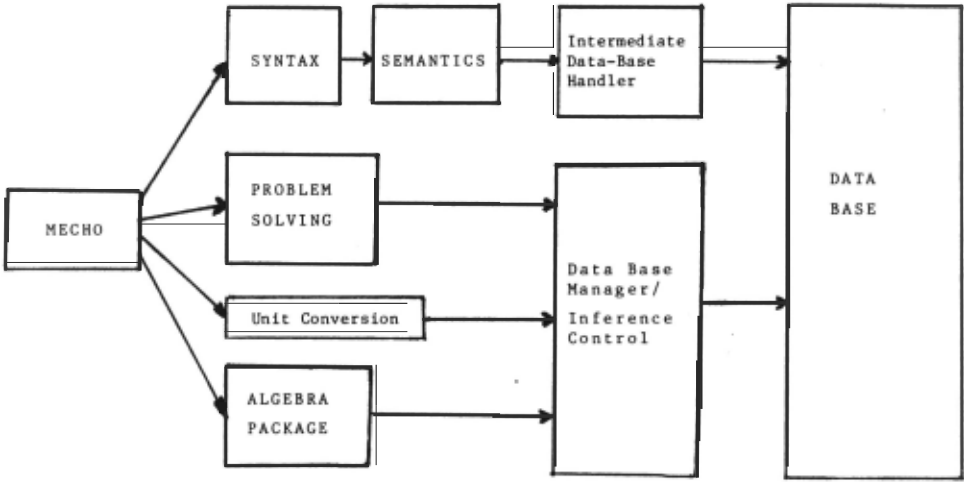
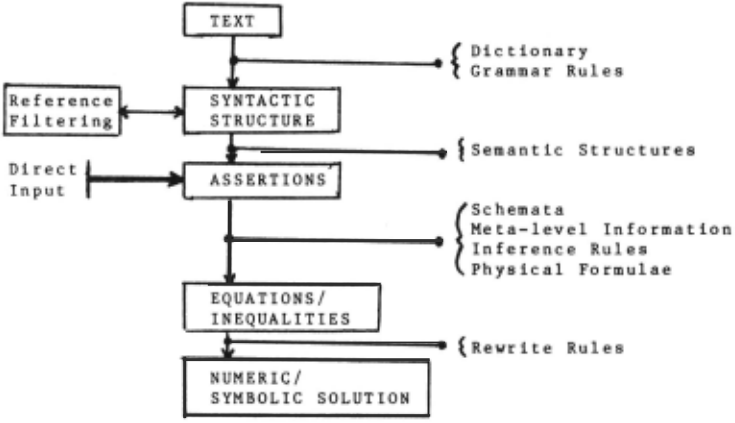
The block diagram (fig l) gives a very general overview of the structure of the MECHO program. Each block represents a closely related collection of Pro log clauses (procedures), the arrows between blocks indicate invocation/communication links. (For practical reasons MECHO is split into three separate modules, but this is irrelevant to the overall structure). The accompanying diagram ( fig 2) tries to capture the changes in representation and the various types of knowledge required during the execution of the program. The following discussion will elaborate on these.
Input to the program is in the form of English text. An example taken from the area of pulley problems would be:
"Two particles connected by a over a smooth acceleration of mass b and c are light string passing pulley. Find the of the particle of
mass b." (l)
(Taken from [10))
The purpose of the natural language module is to produce a set of predicate calculus assertions which will enable the problem solver t o solve the problem. This objective of producing a symbolic representation of the 'meaning' of the problem statement has been used by us as a vehicle for exploring syntax-semantics interaction. The syntactic parser calls semantic routines as soon as possible in order to interpret fragments of text and quickly reject inappropriate syntactic choices. The work of the syntax routines divides into clause syntax and phrase syntax.
The purpose of syntactic analysis at the clause level is to establish clause boundaries and , within each clause, to prepare the ground for the semantic analysis of the main verb. Clause analysis thus involves identifying the start of new phrases, assigning syntactic roles to the phrases and performing phrase analysis to interpret the internal structure of the phrases. The internal phrase analysis typically returns simply a referent (and some t yping information) to the higher levels. This means that preliminary reference evaluation is carried out locally, with the information conveyed by a phrase being captured in assertions produced as 'side effects' by semantic routines called during the analysis. Thes e semantic routines are responsible for i nterpreting what it means for a given object t o have a certain property, and indeed for checking whether or not i~ can have the pr operty. Domain specific information concerning typing, idealisation and object-property possibilities is used to answer these questions. Failure of the semantics indicates that the following (simple) parse is invalid. The example shows the kind of * meta-level structures used in this process.
meaning(light,Object,mass(Object,zero)).
type_constraint(light,physobj).
The meaning predicate states that the meaning of applying the property light to an object, is that the object has a mass of zero. type constraint asserts that being a physical obje~ is a necessary condition to having the property light.
It is interesting to note that the declarative assertions which give the meaning of a phrase can be specified independently of how they will be used. Meta-level information concerning the state of the analysis is used to determine whether they are used to add new information or to test neccessary constraints on previous information. (This is basically the 'given' /'new' distinction discussed in [8)).
One of the aspects of natural language understanding that has interested us especially is the way in which criteria of semantic well-formedness can be used to resolve cases of ambiguity in reference evaluation. Our program incorporates a full deductive mechanism, as opposed to semantic markers, to capture the global semantic constraints that arise during the interpretation. Reference evaluation proceeds continuously during the combined syntactic and semantic analysis with semantic information being used to filter sets of possible candidates for referents. The method used to achieve this in a general way is basically that of Waltz filtering [16). As can be seen, the referent returned by the phrase syntax is likely to be incompletely specified and for this reason all interaction between the semantics and the data-base is handled by an intermediate data-base handler which implements the inference system and reference filtering system over these referents.
* The notation used here, and in following
examples, follows the Prolog convention that names starting with an upper case letter are logical variables which are purely local to the structure (Prolog clause). Atoms, which are in lower case, and compound terms all stand for themselves. Rules are of the form 'P <-- Q & R' meaning 'if Q and R then P' . Most examples have undergone slight cosmetic alteration.
The syntactic structure built by the clause syntax specifies a main verb, and positions such as 'logical subject' and 'logical object' are filled by referents. (We do not construct a complete parse tree as such). From this structure a set of assertions is generated by invoking semantic routines. The semantic analysis of the verb maps the main verb onto a base verb and establishes a mapping between the syntactic roles of the clause and the deep roles associated with the base verb. As a result the referents are fitted into conceptual slots in a way similar to conventional 'caseframe' analysis. The base verb then specifies the assertions (in terms of the referents) which follow from this mapping. Base verbs differ from case frames in that while they attempt to generalise collections of related verbs, they are not defined in terms of universal primitive roles or slots.
Given a satisfactory parse of a sentence, which produces a set of consistent assertions and disambiguates the referents, we are then able produce a set of assertions (by instantiating out the referents) about the objects in the problem. Th~se are supplied to the problem solving module . As an example, the assertions produced fo.r the above problem statement (1) would be:
isa(period,periodl) is a( particle ,p 1) is a( particle ,p2) isa(string,sl) is a( pulley, pull) end(sl,endl,right) end(sl,end2,left) midpt ( s l,midpt 1) fixed contact(endl,pl,periodl) fixed-contact(end2,p2,periodl) fixed-contact(midptl,pull,periodl) mass(pl ,mass 1, period!) mass(pl,mass2,periodl) mass(sl,zero,periodl) coeff( pull, zero) accel(pl,al,270,periodl) accel(p2,a2,90,periodl) measure( massl, b) measure(mass2,c) sought( al) given(massl) given(mass2) (2)In addition the following schema is cued:
cue pullsys_stan(sysl,pull,sl,pl,p2,periodl)
The cueing of schemata is necessary to provide extra information, defaults etc. which are not given explicitly but are 'house rules' in this domain. (Eg That the pulley in a pulley system has negligable weight). We cue schemata, fairly simplistically, by recognising key words and certain object configurations. For example the following structure asserts that a pulley-system schema can be cued if objects can be found which satisfy the ideal-type contraints and have certain relationships between each other.
sysinfo( pullsys, [Pull,Str,Pl,P2), [pulley,string,solid,solid), [ supports(Pull,Str), attached(Str,Pl), attached(Str,P2) 1 ) ·The effect of this cue would be to invoke a schema such as:
schema( pullsys, [Pull,Str,Pl,P21, Time, [ constaccel(Pl,Time), constaccel(P2,Time), ), cue stringsys(Str,[Lpart,Rpart) ), (tension(Lpart,Tl,Time) <-- coeff(Pull,zero) & tension(Rpart,T,Time) ·) [ coeff(Pull,zero), mass(Pull,zero,Time) 1).This schema asserts that in a standard pulley problem the objects undergo constant acceleration, the tension in both parts of the string are equal if there is no friction (only one rule shown), and that the friction and mass of the pulley default to zero if not otherwise given. (This example has been somewhat simplified).
The predicate calculus notation can be used to input problems directly to the problem solver and in fact research on the problem solver has resulted in it being able to tackle a wider range of problems than the natur al language module can currently handle. The representational principles behind these assertions view the objects of Newtonian Mechanics in terms of simple zero and one dimensional objects (points and lines) which are typed and have properties and relations defined over them. For example particles , pulleys, spatial points, moments of time are all types of POINT while rods, strings, paths (trajectories), and periods of time are types of LINE. Physical quantities, such as length, veloc i ty, force etc., form the other main branch of our type hierarchy. (see [4)).
The work of the Problem Solver divides into two types of task. There is the overall strategic task of deciding what to do, how to solve the problem by producing equations which solve for unknown quantities (including intermediate unknowns introduced during the solut i on). On the other hand there is the tac tical task of combining the input assertions with general facts and inference rules in order to prove required goals. We shall discuss each
of t hese in turn.
Our overall strategy is a general goal directed algorithm for equation extraction developed from a study by David Marples of student engineers [12). For instance, suppose a l, the acceleration of particle pl, is the (onl y) sought unknown. (Here we continue the example started above (1) (2) ). Resolution of forces about pl will be chosen to solve for al and this produces the equation:
All possible force contributions on pl are examined and since pl is attached to the end of the string this results in the string being considered. tension! was formerly unknown but the f unction properties of the predicate 'tension' enable it to be created (see later) to allow the equation to be formed. We have to introduce tension! as an unknown because it is not possible to solve for al without doing so. The next step is to solve for tension! which is a fo rce and involves the string sl . Again reso lution of forces is selected - p1, pull, p2 being objects on the string which are possible cand idates for resolving about. pl has been previously used and only p2 can be used without introducing unknowns. The result is the equat ion:
These t wo equations can be solved to produce a
solution for a1.
The i nput assertions provide meta-level information about whether certain quantities are sought or given. The Marples Algorithm works by traversing the list of sought unknowns in a f ixed order: the (quantity) type of each unknown being used t o provide a shortlist of formulae that could solve for it, and the definition of the quantity (ie the assertion which introduced it) being used to find the physical objects, t imes and angles involved. Notice that there is a distinction made between 'formulae', which are composed of variables over quantities (eg 'F · M *A'), and 'equations' which are instantiations of formulae (eg (3) and (4) above). In the Marples algorithm we are reasoning about the properties of formulae in order to successfully produce appropriate equations.
Before the application of a formula to produce an equation , there is a stage of qualitative analysis where general facts about the problem are used to decide applicability. Our interest here is in exploring the selective use of meta-level reasoning to guide the equation extraction process. As well as deciding applicability we have to prepare a situation within which to apply a formula. This may involve, for example, collecting together all the objects connected to a particle if we wish to resolve forces about it. General independence criteria (eg 'You can' t resolve forces about the same object i n linearly dependent directions') are also used to eliminate redundant equations.
The following are (simplified) examples of the meta-level structures used during the above example:
kind(a1,accel,
relaccel(pl,earth,a1, 270,period1)).
relates(accel,
[resolve,constaccel-N,relaccel)) .
prepare(resolve,relaccel(P,earth,A,Dir,Time),
situation(P,Set,Dir,Time))
<-- isa(particle,P) &
findall(X, sameplace(X,P,Time), Set) .
isform(resolve,situation(Obj,Set,Dir,Time),
F · M * A )
<-- mass(Obj, M ,Time) & accel(Obj,A,Dir,Time) & sumforces(Obj,Set,Dir,Time, F).
The kind predicate asserts that a1 i s a quantity of type accel defined in the given relaccel assertion. relates states that all the formulae whose names are given i n the list , contain variables of type accel and therefore can be used to solve for acceleration. prepare gives the criteria for constructing the situation within which to resolve forces, and the isform defining predicate the meaning defines the equation by of its component variables.
The equation extraction algorithm is two pass in that it first tries to produce a solution which does not introduce new unknowns before allowing the introduction of extra (intermediate) unknowns which are added to the unknowns list and have to be eventually solved for. Notice that the quantities manipulated are purely symbolic; they can be introduced by the creation mechanism (see later) without their values being known at this stage. E.g. When the first equation (3) was formed in the above example, the quantity tension! was introduced without the program knowing, or trying to find, its actual value. As can be seen, it is the Marples algorithm which will eventually produce an equation which solves for tension!.
The data-base stores all the facts supplied by the English statement, but to bridge the gap between the explicit information derived from the problem statement and that needed to solve the problem the program requires a general knowledge of mechanics which is formalised in a set of inference rules. An example of such (object-level) inference rules would be:
relaccel(Pl,P2,zero,Dir,Period)
<-- constrelvel(Pl,P2,Period).
constrelvel(Pl,P2,Period) <-- fixed_contact(Pl,P2,Period).
The first rule says that the relative acceleration between two points of reference is zero if there is a constant relative velocity between them (over a certain period), and the second rule says that two points of reference have a constant relative velocity if they are in contact (again, over a certain period). The inference rules are a set of horn clauses which have been hand ordered and contain certain typing information to guide selection. The search strategy is depth first, with pruning of semantically meaningless goals, and while this could be improved upon, current performance has' not yet necessitated such a step.
An important part of our work has been the investigation of search control mechanisms which will enable effective use of this wealth of implicit knowledge. All requests to retrieve assertions from the data-base, either directly or via inference, are handled by the inference control module. This module uses information from the request along with meta-information and inference rules in an attempt to satisfy the goal. The first step involves normalisation of the goal to remove syntactic sugar or to express it in terms of a smaller set of underlying predicates. This is performed with a one pass rewrite rule set. The resulting goal is then classified according to the instantiation state of its component arguments and the possibility of using function properties and certain other mathematical properties of the predicate (such as reflexivity, symmetry and transitivity). This information is used to select appropriate proving strategies. (A basic strategy of 'unit preference' will always first check the data-base directly) .
Our two most important strategies are the use of function properties to prune search and the use of equivalence class type mechanisms to direct it. The representation treats what would normally be considered functions as predicates with extra control information. Being a function means that certain arguments are uniquely determined by certain other arguments. For example, in the predicate tension(String,T,Time)' The actual tension T is determined once the String and the Time have been given.
These function properties can be used to prevent useless inference if another (different) value of a function argument is already known (uniqueness property); to create new entities to satisfy a goal if all attempts at inference have failed (existence property); and to automatically eliminate backtracking by disregarding choices made during inference (uniqueness again). Examples of the meta-level structures used by the program in performing the above are:
rewrite( accel(P,A,Dir,Time), relaccel(P,earth,A,Dir,Time), strategy( db in f) ) ·
meta( relaccel, 5, [Pl,P2,A,Dir,Time), [pt of ref,pt of ref,accel,angle,time),
fun~ti;n( [Pl~P2~Time) => [A,Dir] ) ).
The rewrite rule tells us that any accel predicate can be rewritten to a relaccel predicate with the earth as the other point of reference, and that the standard inference strategy is then applicable. The meta predicate specifies the argument types and the function properties of the predicate relaccel.
The second major strategy, which provides an alternative to using the inference rules, is a general similarity class mechanism based on equivalence class ideas. Predicates which are (pseudo-) equivalence relations and would normally produce self-resolving inference rules are defined in terms of this mechanism. A tree is used to represent similarity class membership and the goal (such as 'being in the same place') is proved by establishing equivalence of roots. This can be seen as an alternative (and less explosive) axiomatisation of these predicates. Our extension over traditional uses of this method has been to allow labelled arcs and calculation during the separation' and 'relative velocity' which have pseudo-equivalence properties can also use this strategy. Here is an example of a structure
tree traversal. Thus predicates like 'vector used in these cases:
rewrite( sameplace(P,Q,Time), [ sameclass(P,Q,touch(Time)), merge( P, Q, touch(Time)) ) , strategy( simclass) ) .
This states that the predicate sameplace should use the general sameclass mechanism on the particular tree touch(Time). Also specified is an updating mechanism for adding new sameplace asse rtions; in this case it would involve merging two separate trees.
These general strategies can be applied to a wide range of predicates and often capture important facts about the domain (eg the fact that an object cannot be in two places at once is a fact about the function properties of 'at(Object,Place,Time)'). The explicit control of new object creation coupled with the goal directed backward reasoning method of the Marples algorithm results in a create/consider-by-need type of behaviour. Restrictions, such as 'don't create' or 'don't infer', can be added to the request for a goal to be proved and this enables the Marples algorithm to be selective over its use of the Infe rence Control in accordance with its needs at the time.
For some mechanics problems a process of prediction is required to answer questions like "Will the particle reach the top of the slope if it starts with velocity V ?". Each question about the motion of a particle on a complex slope unpacks into a series of questions about the behaviour on simple parts of the slope. Some of these can be answered immediately on the basis of the qualitative shape of the slope, but others involve the solution of inequalities containing unknown quantities. These unknowns are declared as sought and the equation extraction algorithm is called to solve for them. The inequalities can then be solved to answer the - question. Our present prediction system is special purpose and built around problems similar to those in tackled by De Kleer, ie motion problems.
Since the equations produced by the equation extraction algorithm are in terms of symbolic quantities, there is a stage of Unit Conversion where the actual values are substituted and a final unit system is selected - conversion factors being added where appropriate. (Some problems involve a combination of all sorts of different units- feet, yards, miles ...... ). The two equations produced above ((3) & (4)) are very simple in that no particular units are involved. The only step will be the substitution of b and c for mass! and mass2 respectively giving:
The set of simultaneous equations and/or inequalities produced by the problem solving module is passed to the algebra module (PRESS) which will solve them to produce a final answer to the problem. Let us look at how PRESS produces a solution for al given (5) and (6). The two equations are solved by isolating tension! in the second equation (which was intended to solve for tension!), and then using the result as a substitution into the first equation. This final result can then be simplified with al being isolated on the left hand side to give the final answer:
The extension of equation solving techniques to inequalities (there are interesting connections) has enabled us to solve the inequalities produced by the prediction problems, but in addition we have found that the information required to justify the use of certain rewrite rules is often of the form 'only if X> 0' etc. Solving and proving inequalities is therefore of direct use within the system.
However, PRESS was not developed purely as a service program for MECHO. It was intended as a vehicle to explore ideas about controlling search in mathematical reasoning using meta-level descriptions and strategies [3) .
Rather than using exhaustive application over a large set of rewrite rules, it uses the meta-level stategies of isolation, collection and attraction to carefully control application of sever~! different sets of rewrite rules. This selectivity has many advantages: principled methods for guiding search cut down useless work, identical rules may be used in different ways (eg left to right or right to left) in different circumstances without causing problems, and theoretical requirements such as proof of termination of the rewrite
rules are made much easier.
When PRESS is used as an equation and inequality solver (ie as a module of MECHO), it classifies the equations (inequalities) to be solved so as to generate guidance information. An exciting area of research that we would like to expand on is that of designing inclusion and ordering criteria to classify algebraic identities which are produced by a theorem prover. This would enable the system to automatically learn new rules. The use of meta-level reasoning to place new rules into a framework where they will be selectively and correctly applied overcomes many of the obvious 'explosion' and 'looping' problems that would occur with haphazard additions to a large single rewrite rule set.
3. Discussion
Throughout the above description of the Mecho program we have constantly emphasised the importance of 'meta-information' in controlling search. This has been applied in the rejection of semantically meaningless parses, the control o f inference, the extraction of equations and the guiding of algebraic manipulation.
The theme that has emerged from our work is the benefit to be gained from axiomatising the meta-level of the domain under investigation and performing inference at this level, produc i ng object level proofs as a side effect. This is the methodology investigated by Pat Hayes in the GOLUX project [9), except that we have developed our meta-level representation for a particular domain rather than adopting general purpose representations based on r esolution theorem proving systems.
In [2) we showed how GPS could be viewed in this way. At the object-level the search space can be viewed as an operator/state OR tree in which the states are nodes and the operators are arcs between them. At the meta-level the search space can tree in which methods are arcs first search at highly complex, object-level. viewed as a method/goal AND/OR the goals are nodes and the between them. A simple depth the meta-level then induces a middle-out search at the In order to make clear the distinction we are drawing between meta-level and object-level representations in Mecho, we shall list below examples of the descriptions used at each level. When defining a notation it is usual to define the constants, variables, function symbols and predicate symbols of the language ; and then to show how terms and formulae can be formed by composing them together with the logical connectives. We shall follow this type of outline in an informal fashion. (To avoid confusion with earlier terminology we shall use the words 'assertion' and 'rule' to replace 'formula').
At the object-level we have the following kinds of primitive:
constants
variables pl, endl, mass2, al, right, 90 , 270, lbs, feet etc.
Pl, Str, Period, Accel, F, M, etc.
function symbols+, *· cos etc.
predicate symbols accel, relaccel, fixed contact etc. mass,
These are formed into terms assertions such as 'F z M 270,periodl)' etc. connectives are used to into inference rules like: such as 'M * A' and * A', 'accel(pl,al, Finally, logical form these assertions
relaccel(Pl,P2,zero,Dir,Period) <-- constrelvel(Pl,P2,Period).
The only function symbols at the object-level are for straight forward arithmetic and trigonometric functions. This is because we have recorded function properties by making meta-level assertions about object-level predicates.
At the meta-level all these object-level descriptions are meta-constants along with additional meta-constants for schema names, formula names, object types, strategy types etc. As examples of meta-level primitives we
have:
constants (Any object level description). physobj, pullsys, resolve, particle, line, length, dbinf etc. variables Type, Eqn, Goal, Strategy, Exprl etc. (see later) function symbols Constructors for lists, sets, bags etc. predicate symbols meaning, sysinfo, schema, kind, relates, isform, rewrite, meta etc. Aga in these can be formed into meta-terms and me ta-assertions and we gave several examples during the program description. What we shall now examine are the meta-rules which are formed f rom these assertions. (These use the same log ical connectives as the object-level rules). We shall take simplified examples from each of t he four main areas of our work. The first example is a rule used by the Na tural Language module, which specifies the conditions for a property to be correctly applied to a particular entity. a ttribute(Property,Entity,State) <-- type constraint(Property,Type) & isa(Type,Entity) & meaning(Property,Entity,Assertion) & consistent(Assertion,State). Th is rule states that a particular Property can be attributed to an Entity in a given State (of t he parse), if the 'Entity satisfies the t ype constraint of of the Property, and if the meaning of the attribution is consistent with a ll the other assertions in the current State. (I f, for example, the Assertion was 'mass(sl, ze ro)' then this would involve checking that no other mass was known for sl. It is here that we see one of the key connections with our work on Probl em Solving, since this is precisely a matt er of 'function properties'!). The followi ng is an example taken from the Mar ples Algorithm, and it defines the requirements for an equation to solve for a par t icul a r quantity. solves_ for( Q, Eqn) <- - kind(Q,Type,Defn) & relates(Type,F list) & select(Formula~F list) & prepare( Formula ,Defn, Situation) & isform(Formula,Situation,Eqn).
This rule states that Eqn solves for Q if Q has type Type and Formula is a formula that relates Type quantities to other quantities, and if Situation is the situation within which t o apply the Formula given th<> Defn of Q, and if Eqn is the instantiation of the formula in the given Situation. It can be seen that this rule is a direct axiomatisation of our earlier description of how the Marples algorithm extracts equations. (The select goal would specify the qualitative guidance and apply the independence criteria (given extra arguments)).
In a similar way we give the following example of rules which describe how the Inference Control uses function properties.
is satisfied(Goal) <-- rewrite(Goal,Newgoal,Strategy) & decompose(Newgoal,Pred,Args) & meta(Pred,N,Args,Types,Func info) & method(Strategy,Func_info,Newgoal). method( strategy(dbinf), function(Fargs 2 > Vals), Newgoal) <-- all bound(Fargs) & use:function_properties(Newgoal).The first rule states that Goal is satisfied if it rewrites to Newgoal whose predicate symbol has certain Func info, and if a method is used based on the Strategy and this Func info. (Certain arguments to meta have been ignored). The second rule states that the normal inference method will prove Newgoal given its function properties if all the function arguments, Fargs, are bound, and if object-level inferencing is performed using function property pruning.
As a final example we take a rule concerned with algebraic equation solving. This rule is interesting in that while PRESS does not currently use it, it could be derived from rules PRESS does have. Automating this procedure would be an interesting area for study.
solve(U,Exprl,Ans) <-- occ(U,Exprl,2) & collect(U,Exprl,Expr2) & isolate(U,Expr2,Ans).This rule states that Ans is an equation which solves for U given Exprl if Exprl contains two occurances of U, if Expr2 is an equa tion derived from Exprl in which these two occurances have been collec ted together, and if Ans is an equation derived from Expr2 in which U has been isolated on the left hand side.
All the above rules can be seen as classifying object-level descriptions and using this information in deciding what to do. However the effects are very different in the different areas. In the natural language processing meta-level rules monitor object-level assertions, rejecting semantically unacceptable consequences of a parse. In equation extraction the effect is to select equations using a means/ends analysis technique. In Inference Control the result is use of the most effective axiomatisation for the goal in hand, and in Algebraic manipulation multiple rewrite rules are selectively brought to bear on expressions. Thus relatively simple meta-level search strategies can induce a wide vari e ty of complex object-level behaviours.
These meta-inference techniques were strongly suggested by our use of the programming language Pro log. The fact that Pro log procedures are also predicate calculus clauses and the fact that predicate calculus has a clear semantics, encourages the user to attach meanings to his procedures and these meanings are usually meta-theoretic. However, Prolog as a programming language only offers a single level of 'syntactic' structures (atoms, compound terms etc.), and a lack of care can lead to a blurring of theoretical distinctions. During the development of Mecho, a lack of emphasis (realisation?) of these distinctions resulted in a mixing of object and meta levels. (for example the use of Prolog variables to represent variables at both levels, the mixing of object and meta level assertions in rules such as isform) . We plan to remove these
aberrations.
Weyrauch's work on the FOL system (See [17)), is of importance in relation to this need for an adaquate theoretical formalism. The distinction between the object-level and the meta-level is fundamental within his system, and his use of 'reflection principles' is designed to capture the relation between these levels. We feel that his work is of direct value to workers in the field of expert systems, such as ourselves.
The principle of utilising 'knowledge about knowledge' is becoming increasingly important in practical AI programs. Davis and Buchanan [6) classified four different kinds of meta-level knowledge used by their TEIRESIAS system. They represent knowledge about objects
and the data-structures used to describe them in schemata and describe the argument type characteristics of their functions in templates. Their program can classify and build models of the inference rules it uses and meta-rules are used to guide the choice of inference rules to be used and the order of using them. In MECHO, the Natural La nguage and Inference Control modules both use information like that stored in TEIRESIAS templates. MECHO meta-level inference rules are similar in spirit to TEIRESIAS meta-rules except that the MECHO rules are more general purpose and they generate a variety of different search strategies in different contexts.
4. Conclusion
In this paper we have discussed Mecho, a program for solving mechanics problems. We have shown how the technique of using and controlling knowledge about the domain by inference at the meta-level, can be applied to a range of different areas. Many workers in the field (eq [9), [6), (17)), have argued that controlling search by using meta-level inference is superior to built-in, smart search strategies because the search information is more modular and transparant. The argument is for systems to make explicit the full knowledge involved in their behaviour, which in turn aids the modification of their data and strategies, thus improving their robustness and generality. This leads the way to systems which could automatically modify their strategie s and explain their control decisions.
We conclude that meta-level inference can be used to build sophisticated and flexible strategies, which provide powerful techniques for controlling the use of knowledge, while retaining the clarity and modularity of a declarative knowledge representation.
5. References
- [1) Bobrow, D. Natural Language input for ~ computer problem solving system. PhD thesis, MIT, , 1964.
- [2) Bundy, A. "Computational models for problem solving," Learning and Problem Solving (part l), The Open Univ. Press, 1978. units 26-27 of the Open University Cognitive Psychology Course D303
- [)] Bundy, A. & Welham, R. Using ~-level descriptions for selective application ~multiple rewrite rules in algebraic manipulation. Forthcoming working paper, Dept. of Artificial Intelligence, Edinburgh., 1979.
- Bundy, A., Byrd, L., Luger, G., Mellish, C., Milne, R. and Palmer, M. Mecho: ~ program ~ solve Mechanics problems. Working Paper No. SO, Dept. of Artificial Intelligence, Edinburgh., 1979.
- [5) Charniak, E. Computer solution ~ calculus word problems, pages 303-316. IJCAI, 1969.
- [6) Davis, R. & Buchanan, B.G. Meta-~ knowledge: overview and applications, pages 920-927. IJCAI, 1977.
- [7) De Kleer, J. Qualitative and qua,ntitative knowledge 2!!, classical mechanics. Technical Report AI-TR-352, MIT AI Lab, 1975.
- [8) Haviland, S.E. & Clark, H.H. What's new? Acquiring new information as a process in comprehension. Journal ~ Verbal Learning and Verbal Behaviour 13:512-521, 1974.
- [9) Hayes, P. Computation and deduction. Czech. Academy of Sciences, 1973.
- [10) Humphrey, D. Intermediate Mechanics, Dynamics. Longman, Green & Co., London, 1957.
- [11) Larkin, J. Problem so.lving in Physics. Technical Report, Group in Science and Mathematics Education, Berkeley, California, 1977.
- [12) Marples, D. Argument and technique in the solution ~ problems in Mechanics and Electricity. Technical Report CUED/C-Educ/TRI, Dept. of Engineering, Cambridge, England, 1974.
- [ 13) Novak, G. Computer understanding ~ Physics problems stated in Natural Language. Technical Report TR NL30, Dept. Computer Science, Univ. of Texas, Austin., 1976.
- [14) Pereira, L.M., Pereira, F.C.N. and Warren, D. H. D. User'~ guide ~ DECsystem-.!.Q PROLOG. Dept. of Artificial Intelligence, Edinburgh, 1978.
- [15) Stallman, R.M. & Sussman, G.J. Forward reasoning and dependency-directed backtracking 2!!,~ system for computer-aided circuit analysis. Technical Report No. 380, MIT AI Lab, 1976.
- [16) Waltz, D. Generating semantic descriptions ~ drawings of~ with shadows. Technical Report MAC AI-TR-271, MIT AI Lab, 1972.
- [17) Weyhrauch, R.W. Prolegomena ~ ~ theory of mechanized formal reasoning. RWW Informal Note 8., Stanford University, 1979.
- [18) Winograd, T. Understanding Natural Language. Edinburgh University Press, 1972.
@inproceedings{ijcai1979p223,
  title     = {SOLVING MECHANICS PROBLEMS USING META-LEVEL INFERENCE},
  author    = {},
  booktitle = {Proceedings of the Sixth International Joint Conference on
               Artificial Intelligence, {IJCAI-79}},
  publisher = {International Joint Conferences on Artificial Intelligence},
  editor    = {Bruce G. Buchanan},
  year      = {1979},
  month     = {8},
  url       = {https://ijcai.org/proceedings/1979/223},
}
TY - CPAPER TI - SOLVING MECHANICS PROBLEMS USING META-LEVEL INFERENCE T2 - Proceedings of the Sixth International Joint Conference on Artificial Intelligence, IJCAI-79 PB - International Joint Conferences on Artificial Intelligence PY - 1979 UR - https://ijcai.org/proceedings/1979/223 ER -Copied
Machine-readable versions of this paper, for tools and AI agents:





