
Hierarchical Concepts Structure for Natural Language Understanding System
Proceedings of the Sixth International Joint Conference on Artificial Intelligence. .
© 1979 International Joint Conferences on Artificial Intelligence
Abstract
Hierarchical concepts structure is introduced to widen acceptability of input seficences of natural language understanding system. It consists of a set of defined concepts (SDC) and scenarios each of which is a set of scenario elements. A scenario is one utilized everywhere. In our SDC concepts are defined with another concepts related through basic semantic relations. Types of these relations are presented with some examplP.s. As compound semantic relations are composed of basic ones it is enough to construct SDC with only basic semantic relations.
- Schank,R.C. : "Concept ual Information Processing", North-holla nd/Ame rica n elsevier, 1975.
- Mylopoulos,J., Cohen, P ., Borgida,A. and Sugar ,L. : "Semantic Networks and the Genera- tion of Context", Proc.4-IJCAI, 1975. IJCAI
- Hayes,P.J. : "On Semantic Nets, Frames and Associations", Proc. 5-IJCAI, 1977. IJCAI
- Hendri.x:,G.G. : "Expanding the Utility of Semantic Networks through Partitioning", Proc. 5-IJCAI, 1977. IJCAI
- Shudo,K., Tsurumaru,H. and Yoshida,s. : "A Predicative Part Processing System for Japanese Englis h Machine Translation", Trans. IECE of Japan, E60-l0, 1977.
References were extracted automatically from the PDF and may contain errors.
Full text extracted automatically from the PDF; figures, tables and equations may differ. The PDF is the version of record.
1. Hierarchical concepts structure
Instead of efficiency of inference, use of scenarios 1 ) is in the opposite direction to afford those rich features of natural language to the system.
To overcome this situation, we introduced a set of defined concepts (SDC) and constructed a hierarchical concepts structure with scenarios.
A hierarchical concetps structure consists of a SDC and scenarios and a scenario is a set of scenario elements.
A scenario element is a partial scenario that correspond to a small part of story, and there fore can easily prepare, delete or correct.
SDC gives general (closer to natural language ) definition of each concept by using basic semantic relations (and view-points) with other concepts so that it functions as to widen acceptability of input sentences of natural language understanding system.
An input sentence is analysed syntactically and the conceptual dependency representation wlth respect to the sentence (CDRS) is generated. CDRS is a directed, labeled graph which repre sents dependency relaitons among concepts expressed by words appearing in the sentence.
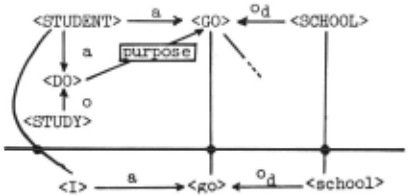
Figure 1 is a CDRS of a sentence "I go to school." Using this CDRS the system chooses a scenario element from a suitable scenario, say "GO TO SCHOOL" scenario and attaches this CDRS to it as an instance. We call scenario element with an instance attached in this way as :.;emantic (';raph 2 ), 3 ) ( with respect to a sentence 'V ) ·
Figure 2 shows a part of "GO TO SHCOOL" scenario element with attached instance
(sematic graph).
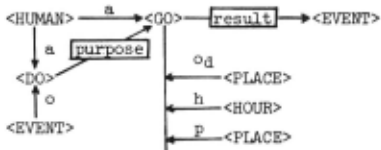
However, there may be no scenario element that fits to an input sentence "I go to school to meet my son" in any scenario. In this case, the system tries to find out general definition of "<GO>" in the SDC.
As SDC has definition for every co.ncept, it fits to wide variety of CDRSs. Figure 3 shows "<GO>" element of SDC.
2. Construction of SDC ---
2 .1. ~of concepts
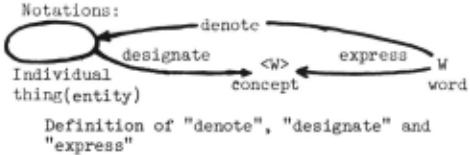
Concepts are classified into four types that r oughly correspond t o t he concepts expressed by concrete nouns , ver bs , adj ectives/adverbs and abstract wor ds as f ollows ( see Not ations ).
- ( i) 'concrete object' concepts ( ii) 'event' concepts (iii) 'modality' concepts
- (iv ) 'abstract thing ' concept s : Abstract concepts t hat are desi gnated by 'aspects (move ments or modalities ) of things', 'relations amone t hi nr;s 1 or 'time and place'.
2. 2. Semantic r elations among concept s
Ther e are followinc; e i ght bas ic semantic r e l at ions among concepts .
(i) Super concept-subconcept relation (kind or extent i on relation)
(i i ) Aspect relation: Relation among a 'concret e object' concept and concepts that r;ive aspects of the concepts . This relation is given by usinc; bas ic view-points such as "purpo::;e of use", "color", "amount (thicknes s)". Basic vi ew-points necessary to define <PRODUCT THING> like <PAPER> are given in Table 1.
| Aspect relation | Basic view-point |
|---|---|
| Aspect s about use | purpose of use, ways of use (what to use) (how to use) |
| Aspects about manufacturinli | material, how to make |
| Aspec t s •tbout s t r ucture | arranr,ement,••• pa r"Ls , |
| Aspects about pr operty | phys ical, mental,••• |
| Aspects about quantit Y | number, we i ght, length,••• |
| Aspects about aspec t | col or, shape , value, • • • |
| Aspects about time | exi::;ting time |
| Aspects about pl ace | exi::; t i ng pl ace |
{iii) Case r elation
(iv ) Cause-effect r elation
(v) event-event relation other than cause effect relation
Five relations of "logical", "accompanying", "befor e and after wrt. time", "condition" and "direct (indirect)" belong to this.
(vi) Descriptive definition relation
Thi s r elation describes an event using with another bas ic semantic relations and concepts . (vi i) Modality relation
View-points used in this relation are given by classifying "modality" concepts.
(viii) Synonym and antonym r elation
2.3. Construction of SDC
i) Definition of concret e obj ect s
Concrete obj ects ar e defined by us ing kind relation and aspect r el ation. Vi ew-points belonging to these r el ations ar e call ed "basic view-points" (Table 1).
a. Definition of subconcepts
Properties possesed by a super concept i s inherited to its subconcepts unless ot herwise stated in the definitions of them.
b. Definition of supreme concept s
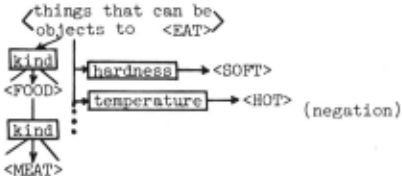
It i s very important that SDC contains every supreme (mos t general) concrete obj ect conc ept that appears as a supreme concept of a given event concept in the case relation. For example, the supreme concept of the given event concept <EAT> in the (object) case r el <> t.i on is <things that can be opjects t o eat >{ Figure 4). This gives judging conditions (or r equirements) whether any given type of concept statisfies case relation with a given event concept. For example , i f "plastic er aser" sat isfi es conditions " soft", "not hot", ·· · then "human be ing" can "eat" it.
ii) Definition of an "event" concept
This concept is defined by us ing case relation, cause-effect r elation, event-event relation, descriptive definition r elation , modality relation and synonym-antonym r el ation. iii) Definition of a 'modality' concept
This concept is defined by using case relaiton, descriptive definition relation , cause-effect relation, modality r elation and synonym-antonym relation.
iv) Definition of an "abstrac"t thing" concept This concept is defined by us ing case rela tion, cause-effect relation, modality relation, descriptive relation, kind relation and synonym-antonym relation.
3. Composition of view-points
There can be many finer view-points other than basic ones.
Is it necessary to define a concept us ing all of these finer view-points?
We are getting rid of this problem by com posing these finer view-points of basic semantic relati ons , basic view-points and other concepts.
Let r be an arbitrary m-ary semantic r elation and a 1 , a 2 , ···, ~be concepts for which r (a1 , a 2 , ···, ~) can be asserted.
We obtain a r elation,
:\xr(a 1 , a 2 , ···, x, ···,~) from r (a 1 , a 2 , ···, ~), where x is a concept variable and A is an
abstraction operator.
We express a concept a for which a certa in semantic relation r(a) is asserted~) as,
For example ,
means that a is a concept for which a~S is asserted.
Let (l) and (2) asserted .
Where r, r 1 are semantic r el ations and a 1 , a 2 , ···, a~ ar e concepts. In this case composition of relation is defined as follows.
By repeated application of composition and abstraction to semantic relations, we can obtain any relation from only basic semantic relations and basic vi ew-points.
On the other hand, any sentence i s expressed by CDRS briefly explained in chapter l by using semantic relations listed in chapter 2 . For example, 'He hate him very much.' has the following CDRS.
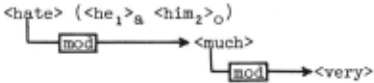
From this CDRS, we can define a binary hate relation (>.xy)rh(x,y) as follows.

Therefore, we can define any semantic rela tion if we could give definition of the semantic relation by sentences (hence CDRS).
4. Concluding remarks
We discussed about general structure of SDC necessary for constructing natural languaGe understanding system.
We proposed t o introduce a hierarchal concept system in which essentially the same semantic r elations are used to define concept s in each stage of hierarchy.
We could not discus:..; about 'mode ' in this paper. For example , CDRS of a sentence, 'I should go there.' is glven as follows.
Here the information given by (necessity ) is a 'mode' of an event concept <go> . We s ingled out eighty four such modes whi ch are used in ordinary written sentences 5 ). Detailed comJ~:..;i tion rules of semantic r elations including the:..;e mode will be discussed in our forth-coming paper.
Acknowledgements
I would like to acknowledge the contributions of H. Tsurumaru while preparing this paper. He i s thankful to T. Hitaka, K. Shuda and T. Fujita for their discuss ions and suggestions as members of our research project. This research has been sponsord by Japanese Ministry of Educat ion Science Foundation and Takeda Science Foundatio~
@inproceedings{ijcai1979p219,
  title     = {Hierarchical Concepts Structure for Natural Language Understanding System},
  author    = {Yoshida, Sho},
  booktitle = {Proceedings of the Sixth International Joint Conference on
               Artificial Intelligence, {IJCAI-79}},
  publisher = {International Joint Conferences on Artificial Intelligence},
  editor    = {Bruce G. Buchanan},
  year      = {1979},
  month     = {8},
  url       = {https://ijcai.org/proceedings/1979/219},
}
TY - CPAPER TI - Hierarchical Concepts Structure for Natural Language Understanding System AU - Yoshida, Sho T2 - Proceedings of the Sixth International Joint Conference on Artificial Intelligence, IJCAI-79 PB - International Joint Conferences on Artificial Intelligence PY - 1979 UR - https://ijcai.org/proceedings/1979/219 ER -Copied
Machine-readable versions of this paper, for tools and AI agents:





