
Knowledge-Driven Interpretation of ESCA Spectra
Proceedings of the Sixth International Joint Conference on Artificial Intelligence. .
Abstract
A system l'or automatically interpr e ting raw s pectral data o f an ESCA (r•:l 0 <:L1·on :;pectrosr~opy 1" o 1· Che mical Analysis) .is d e scrib ed . 'l'hi s s yl~ tem can r e mo ve bac kgr o und n o i sr ~ fr om t.hP spectr1trn, i d e ntil'y each spectra l peak, assitjn each peak t o u. co rr· espo ndint' at o mi. e ll rbitu L and ca n o btain t he c he mical co mpo s ition of a sample. A knowledg e -dr .i ven me thod enablec> Lhrc ~> yst c m to i.dt!nt i f'y very small pe aks and rider peaks, a nd t o o btain the most reliable as signme nt t o each p ea k on t he basis of' spec i ric chemical knowledg e , Util iza t.i o n of knowl e dge in low Leve l proces s i n1' is o ur main interest, while higher-l e vel logical inf e r e n ce is e mphasized in other knowl e d ge -b ased s ystems, for example DENDRAL and MYCIN.
Full text extracted automatically from the PDF; figures, tables and equations may differ. The PDF is the version of record.
KNOWLEDGE-DRIVEN INTERPRE'rATION OF ESCA SPEC'rRA
Masato Yamazaki
Automatic Control Division Electrotechnical Laboratory Nagata- cho, Tokyo 100, ,Japan Hideo Ihara Materials Division Electrotechnical Laboratory 'l'anashi-shi, Tokyo ll.\8 , Japan
A system l'or automatically interpre ting raw s pectral data o f an ESCA (r·:l 0<:L1·on :;pectrosr~opy 1"o1· Chemical Analysis) .is de scribed . 'l'his syl~ tem can r emove background no i sr~ from t.hP spectr1trn, i dentil'y each spectral peak, assitjn each peak t o u. corr·espondint' atomi. e ll rbituL and can obtain t he chemical compos ition of a sample. A knowledge-dr.i ven method enablec> Lhrc ~>yst cm to i.dt!nt i f'y very small peaks and rider peaks, a nd t o obtain the most reliable as signment t o each peak on t he basis of' spec i ric chemical knowledge , Util izat.ion of knowl edge in low Leve l process i n1' is our main interest, while higher-level logical infe r ence is emphasized in other knowl edge-based systems, for example DENDRAL and MYCIN.
l . INTRODUC'l'ION
An ESCA spectrometer is an important equipment which g ives much information about chemical composition, bond nature and electronic struc ture o f a sample. Considerable efforts have been done for r emoving large background noise[l] and for analysing bond nature from this spect rum. In thi s ver s i on of our system we intend to per form the composition analysis by a wide-range ESCA spectrum. It would be the first attempt to deal directly with the wide-range spectrum and to obtain a extensive result automatically.
Chemical knowledge is effectively utilized for identifying a peak and r;iving rational a ssign ment t o each peak . 'l'his paper briefly explains the automatic interpre tation system and demon strates an experimental result.
2 . ESCA SPECTROMETER
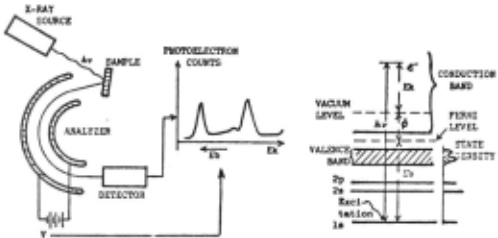
The ESCA spectromet er i s illustrated in l<'ig.l . A monochromatic X-rays (EJ.t =~ll186 . 6ev) is used t o irradiate a sample in a vacuum. The ejected photoelectrons have a variety of kinetic energy, depending on whi ch element and which l evel they come from. The bindinr; ener gy E~ relative to the Fermi l evel i s cal culated by the followinr; equation:

wher e EIC is the measur ed ki net ic enerp;y and fJ i s the work function of a sampl e .
Both an element and orbitals can be <kt.ermi n<~d by the particular positious of' a set o r peak;. . Relat ive quantity of each r~ L<'mcnt can b<' l'a l.c u lated by measured peak area, o r the inte17,ra1.<'d intensity, and theoretical cross secti on va.Lur.'.
3. INTERPRETATION PROCESS
3 .1 Outline
Fig. ;:> shows in outline the i dentification and assignment process . First~y, in the preproces sing stage , background noise of low fr equency is r emoved. Secondly, in the knowledge-dr iven identification stage , obvious peaks and peaks r e l ated to them ar e identified , then peak assignment pairs (P-A pairs) ar e made f rom t hese peaks and the corresponding possible ass i gn ments. This stage is carri ed out effic i ently by makinG use of chemical knowl edge . Thirdly, in the bottom-up idenLification stage, al l the rema1n1ng peaks that are not relevant and are not related to other peaks are identified by a conventio nal statistical test. Fi nally, in the consistency checking stage, the Relia bility and other proper ties of the P-A pairs are determined and the final interpretation is obtained.
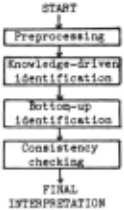
Fig . 2. Outline or the pro..:eea
3. 2 Knowledge used
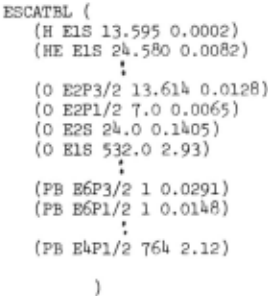
The chemical knowledge which will be used in f6llowing sections consists of the expected binding energy and cross section values[ 2 ]. former corresponds to peak position, and the latter to the peak area. These values are stored in ESCATBL as follows: the The
In this formula, EBE~, the expected binding energy, and CRS11· the theoretical cross section value , ar e represented for e~ch LEVELl.of ATOM&. Fig.3 sh~ws part of this knowledge table.
The CRSi;are normalized by s etting the value of Carbon ls to 1.000. Let Salbe that of level i of the element A, and let S).be that of level j of the element B. The composit i on r atio is calculated as

3. 3 Knowledge-driven identification stage
Obvious peaks and peaks related to them are iden tifi ed , and possible P-A pairs ar e obtained as the output of this stage . The know1edge- driven mehtod used here consists of the following four steps (see Fi g.4) :
STEPl: The process begins by finding large peaks . A list HPEAKS of large peaks t hat are higher than a threshold TH is constructed by scanning through the preprocess ed data DP
This TH is determined by an operator for termi nating this stage.
STEP2: The highest peak is selected from the HPEAKS. All assignments whi ch are consistent With the exi stence of this peak are chosen, and P-A pairs are made and stored in PALIST . A peak k is char acterized by a t riplet as
where HGT"'means peak height, POS" peak position, and BEtc. the binding energy value corresponding this position. From Eqs .(4) and (7), a P-A pair is represent ed as follows:
Compar i ng BEs wi t h EBEs, mat~hing torclance sho~ld be determined by estimated instrumental error and t he possible chemical shift .
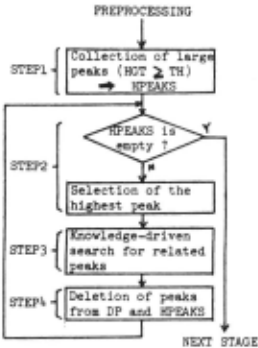
STEP) : For every can didate element the related peaks are knowledge- drivenly searched for , and all possible assignments are chosen. The P-A pairs are then made and added to the PALIST .
STEP4: The process deletes all peaks men tioned above from HPEAKS and DP . It then returns to STEP2, and repeats S'rF.P2 through STF.P4 unt i.l there remains no peak higher than the TH.
3 .4 Cons i stency Checking stage
We explain three typical checking r outines.
- Rel i abili t y test for P-A pai r s: Let A be an element, suppose it has m l eve l s and CRS,, - - 1 CRS&_, ,CRS"" be the cr oss section values, relia bility factor RF is then defined as
Only reliabl e set of P- A pairs ar e selected based on this criter ion .
- (? ) Calculation of the composition f ormula: Estimating peak areas on the original s pectrum, calculate Eq.(5).
- Test of chemical shift: The chemical shift , a small deviation of a peak position , should be approximately equal for t he same element and the same chemical state. So , if onl y a f ew shifts are clearly different from others under these condit ions, a r ational explanation of the fact would be that Lhe irlenU fic·ati.on sLat~e has fail ed to find a cor rect peak and has f ound instead neighbouring onP. There aro two cases ; l) the correct peak is too small to identify and 2 ) the correct peak is a rider peak .
4.EXAMPLE
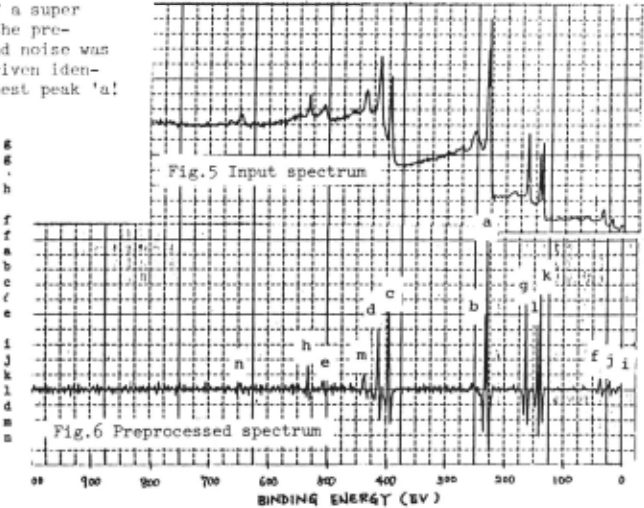
Fig. 5 shows a 10?4 point spr!ctrum of a super conductive mat erials Pb Mo r; . In the pre process ing stu~e step-like hnck~round noise was removed (Fig . 6 ). Next. , knowl edge- dr iven iden tification began by findin{~ the highest. peak 'a!
RF · 0.93 ((565 857 163.1) ( s E2p3/2 165 1.11)) ((565 857 163.1) ( S E2p1/2 165 0. 567)) RF · 0.86 ((158 479 532. 2) ( 0 E1a 532.0 2.93)) RF · 0.93 ((88 987 36 .1) ( M0 E4p3/2 35 0.86)) ( (88 987 36.1) ( MO E4p1/2 35 0. 445)) ((1003 789 229 . 5) ( MO E3d5/2 227 5.62)) ((491 786 232.4) ( MO E3d3/2 230 3.88)) ((302 620 394 . 5) ( MO E3p3/2 392 5.94)) ((162 602 412.1) ( MO !3p1/2 410 3.04)) (( 53 505 506.8) ( MO E3a 505 2. 34)) RF · 0.68 ((61 1004 19. 5) ( PB E5d5/2 19 1.58)) ((32 1002 21.5) ( PB. E5d3/2 22 1.11)) ((643 882 138.6) ( PB E4t7/2 138 12. 73)) ((432 877 143.5) ( PB E4t5/2 143 10. 01)) ((162 602 412 .1) ( PB E4d5/2 413 13. 02)) ((98 578 435 . 5) ( PB E4d3/2 435 8.87)) ((42 363 645.5) ( Pd E4p3/2 645 6.33)) Pb : Mo : S: 1 : 7.4 : 9.5 - g - g - h - r - t - a - b - c - c - e - 1 - J - k - 1 - d - Ill - nCandidate assignments were selected as Sulfur ~'s , Molybdenum 4d3/2 , and Molybdenum 4d5/2 . In STEP3 other peaks of Sulfur and Molybdenum were sear ched for , all the possible assignments were chosen for these peaks , and P- A pairs were made. Thirty- three pai r s were produced on 14 peaks in t his example . Reliability factor was then cal culated for each element . S , Mo , Pb and 0 were verified and Ti , W, Ne , C and F wer e r ejected . Final assignments and the composition r atio are shown in Fig. 7 . Difference of about ;'O% f r om the correct compositi on ratio (= 1: 6:8) is thought to be due t o inaccuracy of evaluated peak areas .
5 . CONCLUSION
We have presented a sys t em for interpretin~ ~;cA spectra on the basis of chPmical knowJ edf,e . Cor e- level peaks are identified and ~iven rati o nal assignments . The chemical composition of' a sample is obtained. An example have shown effectiveness of our method in some difficult cases , f or example , in finding a small peak, detecting a rider peak and choosing the most reasonable assignment · from many n]ternat.ivPs.
[ l] J.N . Chazalviel, M. Camrn~na , G.K .Werthelm, and P.H . Schmidt, Physical Review B, Vol . ll1 , No . lO, 45A6, Nov. l97G
(? ] J . H. Scofie l d , J . of EJPc . ;.pee . RcJ . Ph·'n., No . A, pp . l ?9 , 1976
@inproceedings{ijcai1979p217,
  title     = {Knowledge-Driven Interpretation of ESCA Spectra},
  author    = {Yamazaki, Masato and Ihara, Hideo},
  booktitle = {Proceedings of the Sixth International Joint Conference on
               Artificial Intelligence, {IJCAI-79}},
  publisher = {International Joint Conferences on Artificial Intelligence},
  editor    = {Bruce G. Buchanan},
  year      = {1979},
  month     = {8},
  url       = {https://ijcai.org/proceedings/1979/217},
}
TY - CPAPER TI - Knowledge-Driven Interpretation of ESCA Spectra AU - Yamazaki, Masato AU - Ihara, Hideo T2 - Proceedings of the Sixth International Joint Conference on Artificial Intelligence, IJCAI-79 PB - International Joint Conferences on Artificial Intelligence PY - 1979 UR - https://ijcai.org/proceedings/1979/217 ER -Copied
Machine-readable versions of this paper, for tools and AI agents:





