
Experimental Japanese Language Question Answering System MSSS78 - Using Case Patterns with Procedures
Proceedings of the Sixth International Joint Conference on Artificial Intelligence. .
© 1979 International Joint Conferences on Artificial Intelligence
Abstract
MSSS78 is an experimental computer system made in a series of research efforts to construct a natural language man-machine interface. The system accepts sentences about arithmetic or geography, and then responds to the queries on the basis of its own knowledge and dialogue context. The system analyzes sentences, using Case Patterns, in which procedures are embedded. Case Patterns are linguistic knowledge associated with main words. The system uses Case Patterns for syntactic and semantic analysis. Additionally, Parsing is controlled by the utilization of a pushdown stack and a list. The system generates somewhat intelligent responses, considering results of the database reference or lack of input information.
- Bruce, B., "Case Systems for Natural Language", Artificial Intelligence 6, 1975.
- Tanaka, H., Sato, T., and Motoyoshi, F., "EXPLUS, A Semantic Parsing System for Japanese Sentences", In Proc. of 3rd UJCC, 1978.
- Amamiya, M., Shimazu, A. and Wakana, T., "Japanese Question Answering System o n the Topic of Figure Manipulation", Review of the ECL, NTT, Vol.26, Nos.7-8, 1978.
- Kaplan, R. M., "On process models for sentence analysis", In Rumelhart, D. E. and the LNR Explorations Freeman, 1975. in Cognition, Norman, D. A., reseach Group, San Francisco,
- Collins, A., Warnock, E., Aiello, N. and Miller, M. "Reasoning from incomplet knowledge", In Representation and Understanding, edited by Bobrow, D. G. nad Collins, A., Academic Press, 1975.
- Takeuchi, I. and Okuno, H., "A List Processor LIPQ", Re view of the ECL, NTT, Vol.26, Nos.5-6, 1978.
- Minsky, M. A., "Framework for Knowledge" , In The Psychology Vision, edited by Win s ton, P. H., NY, 1975. Representing of Computer McGraw-Hill,
- Bobrow, D. G. and Winograd, T., "An Overview of KRL, a Knowledge Representation Language", Cognitive Science, 1, 1, 1977 .
References were extracted automatically from the PDF and may contain errors.
Full text extracted automatically from the PDF; figures, tables and equations may differ. The PDF is the version of record.
1 INTRODUCTION
Various natural language understanding systems or sentence analysis programs, including those for Japanese language, uses case frames[l) [2). The method using case frames seems to benefit problems such as modularity and extendability to many components, which construct an intelligent understanding system.
Mainly from such the case frame viewpoints, an experimental Japanese language question answering system, MSSS7a·, was made in a series of research efforts intended to construct a natural language man-machine interface. The system uses Case Patterns, which are linguistic knowledge associated with main words. Case Patterns can be regarded as a new style of case frames. There are three features concerning the parsing mechanism.
- Case Patterns are used for both syntactic and semantic analysis.
- Procedures are usually embedded in Patterns to accomplish fine analysis construct semantic structure. Case and
- A list, called RLIST, is introduced effectively control parsing as reanalysis. to to
As another feature, somewhat intelligent results of the database input information. A the system generates responses, considering reference, or lack of deduction program based on a PLANNER-like pattern matching method uses three logical values, true, false and unknown to make sensible responses.
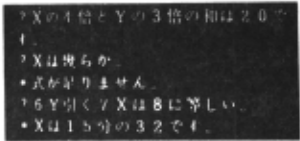
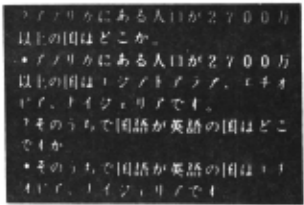
MSSS78 accepts sentences about arithmetic or geography, and responds to the sentences from its own knowledge and context of dialogue (Fig.l). Input sentences are typed in KATAKANA, a square form of KANA (the Japanese vowel and consonant combination syllable symbols), or ROMAJI (a method of writing Japanese language using the Western alphabet). The system responds by output sentences spelled in KATAKANA. Additionally, the system displays KANJI-KANA-MAJIRI-BUN (Japanese ordinary style of writing, spelled in KANJI (Chinese ideographs) and KANA) for both input and output
sentences.
2 SENTENCE ANALYSIS OUTLINE
The MSSS78 analyzes a Patterns, carrying out analysis, and then solve system has to deal with. sentence by Case syntactic and semantic a problem, which the
The analysis process, roughly speaking, consists of two phases. First, the system analyzes all the possible sentenc~ structures. Second, the system performs processing, such as composition and execution of a command to search database, composition of equations, etc. In the first analysis, the system fills case slots with return values of procedures embedded in Case Patterns. another procedure, Patterns, interprets the system purpose dialogue context . In the second analysis, embedded in the Case the filled case slots for from its own knowledge and
3 BUNSETSU ANALYSIS (MORPHOLOGICAL ANALYSIS)
A Japanese sentence can be divided into a sequence of BUNSETSUs, a kind of syntactic unit. A BUNSETSU consists of two parts, a main part and an auxiliary part. The main part is a MEISHI (Japanese noun), a root of a DOUSHI (verb) or KEIYOUSHI (adjective), a FUKUSHI (adverb), or a RENTAISHI etc . The auxiliary part is a JOSHI (postpositioned word), KATSUYOU-GOBI (inflectional ending of a verb or an adjective), or JODOUSHI (auxiliary verb). They convey misce llaneous information, such as case information, tense information, or modal information. In addition, they show how a focused BUNSETSU modifies a succeeding BUNSETSU.
JJ"iti'':JI\ r''J: P 1 R.AJJ, is a sentence written in KATAKANA, which means "where is Gabon", where JJ"iti":JJ\, r"J: and P'R.AJJ. are BUNSETSUs. Each BUNSETSU is internally transformed to a BUNSETSU spelled in ROMAJI, GABONWA, DOKONI and ARIMASUKA. BUNSETSU analyzer separates a BUNSETSU into main and auxiliary parts, that is, GABON-WA, DOKQ-NI and AR-I-MAS-U-KA-. where GABON, DOKO, and AR are main parts, and WA, NI, and I-MAS-U-KA-. are auxiliary parts . In detail, GABON (noun) is a place name, DOKO (pronoun) means "where". AR is a root of a verb ARU which means "be" or "lie". WA and NI, usually connected to a noun, are JOSHI. I-MAS-U-KA-. is a composition of I (KATSUYOU-GOBI of ARU) , MAS (root of an auxiliary verb MASU which indicates politeness), U (KATSUYOU-GOBI of MASU), KA (JOSHI which represents a question) and (period). We can expresses such relations between main parts and auxiliary parts, or between auxiliary parts, by a transition network dictionary.
In Japanese written language, it is not a recognized custom to leave a space between BUNSETSUs. In MSSS78, Input sentences can be typed while not leaving a space between BUNSETSUs. The network .dictionary has special symbols, which designate an ending of a BUNSETSU element. BUNSETSU analyzer can identify a BUNSETSU by the special symbols.
4 CASE PATTERNS WITH PROCEDURES
Case frames of many case systems can be viewed more or less as frame-like linguistic knowledge. Case Patterns in this paper can be regarded basically as a new member of case frames. Case Patterns accomplish various kinds of processing, including syntactic and semantic analysis. Especially, elaborate analysis is
#Quadruple X plus thrice Y is 20. What is X?
The number of equations is insufficient .
#6Y minus 7X equals B.
X is 32 over 15.
#What are African countries whose population is 27 million or more?
African countries whose population is 27 million or more are Egypt, Ethiopia, Nigeria.
#What are the countries among them whose language is English?
The countries among them whose language is English are Ethiopia, Nigeria.
Fig.l An actual dialogue with MSSS7B. Left is KANJI-KANA-MAJIRI-BUN for input and output sentences. English, where # is a prompt for input sentences . the displays of the Right is the translated possible by procedures embedded in Case Patterns. Case patterns are given in advance to main words, such as noun, verb and adjective. Case Patterns are constructed as follows.
Case-Patterns (Case-Pattern Case-Pattern Case-Pattern= (slots [procedure-!)) slots = (slot slot) slot = (slot-name syntactic-conditions semantic-conditions procedure-2 [procedure-3) )
The parser locates dependent BUNSETSUs or phrases by matching BUNSETSU sequence with slots. The evaluation of slot constituents; syntactic conditions, semantic conditions and procedures, carries out the matching. Each slot may be regarded as a surface case.
The following is an explanation of Case Pattern constituents.
- Slot name provides a tag, by which the slot is associated in the succeeding analysis.
- Syntactic conditions ~rovide conditions as to whether or not a BUNSETSU modifies a focused BUNSETSU. The focused BUNSETSU invokes the Case Patterns used. The modifier BUNSETSU is the right most BUNSETSU of a phrase , and the right most BUNSETSU represents the phrase. Syntactic conditions are generally JOSHI, or BUNSETSUs connection information in case a main part of BUNSETSUs is a verb or an adjective. Conjugation form of a verb or an adjective, or auxiliary parts of the BUNSETSU determins connection information. A special tag in syntactic conditions shows an obligatory or optional category for a slot.
- Semantic conditions provide semantic or conceptual conditions which a main part of a modifier BUNSETSU has to satisfy. These conditions make more detailed analysis, and e xclude syntactically correct but semantically meaningless sentences. BUNSETSU main parts normally show semantic information to be examined. Semantic information is given in advance by the dictionary. In some cases, procedure-2 changes the information later on.
- Procedure-2 carries ou~ mi sce llaneous processing: the e xamination of other conditions, which the above syntactic
- conditions or semantic conditions cannot cover;
the utilization of context information; or the extraction of semantic structure, etc . Syntactic conditions and semantic conditions provide conditions of a modifier BUNSETSU itself, rather than a phrase, although the BUNSETSU represents the phrase implicitly. Procedure-2 can examine the phrase s tructure explicitly, if necessary.
If a procedure-2(3) returns a non NIL value , the parser judges that the examined BUNSETSU (phrase) satisfies the slot, that is, the BUNSETSU modifies the focused BUNSETSU. In addition, if the value is non NIL value other than T, the value fills the s lot. This slot i s kept with the focused BUNSETSU, and is used by the succeeding analysis.
- Procedure-] is a kind of procedure-2 for use when a connective form of a BUNSETSU to a focused BUNSETSU is RENTAl modification, a kind of a participial modification.
- Procedure-! is invoked for a phrase (in MSSS78, a sentence) interpretation, when there aren't any more BUNSETSUs which modify the phrase. The procedure-! interprets slots filled by evaluation of Case Patterns slots, and accomplishes processing, which the system has to deal with. The processing by procedure-! may be considered as problem solving processes, or as a sort of deep structure analysis.
5 PARSING MECHANISM
5.1 Matching by PSTACK
The parser analyzes a sentence from left to right and from bottom to top, matching Case Patterns to a sequence of BUNSETSUs, or phrases put in a pushdown stack called PSTACK[3).
5.2 Reanalysis by RLIST
Parsing by case patterns doesn't necessarily succeed in a forward direction. In some cases, the parser must examine the res t part of a sentence to determine whether or not a BUNSETSU modifies a focused BUNSETSU. Augmented Transition Network grammar shows a similarity in the selection of several paths from a state[4). In MSSS78 , the parser uses a list, called RLIST, to reanalyze an input sentence.
If a sentence can be segmented into different BUNSETSU sequences, or some word has a homonym, the parser can reanalyze the sentence on the
same framework.
6 ANALYSIS EXAMPLES BY CASE PATTERNS
(l) Syntac tic conditions: In the following sentences,
820WO 79DE WARUTO IKURAKA.(Divide 820 by 79, what do you get?)
WO a nd DE (auxiliary parts of BUNSETSUs) make a diffe rence between a dividend and divisor. The next Case Pattern to WARU (divide) provides the syntactic conditions.
(((TSYl (WO ZERO) (KAZU HENSUU) (F-S-SISOKU2)) (TSY2 (DE RNT) (KAZU HENSUU) (COND ((AND (EQ GVN-SYNTYP 'DRENTAI) (CDDR TREE) (EQ (SYNTYPE (CAAAR (CDDR TREE))) 'ZERO ) ) NIL ) ( (F-S-SISOKU2)) (S-ASSOC 'ATAI (CDDR SS)) )) (SISOKU) )- Semantic conditions: In the next phrases , which have the same meaning, two
KOKUGOGA HURANSUGONO KUNI (the country whose language is French) !!URANSUGOGA KOKUGONO KUNI (the country whe re French is its language)the concepts expressed by the underlined phrases are both language, but one, HURANSUGO (French), which is a compound of HURANSU (France) and GO (language), is an instance of languages, and the other, KOKUGO (language), is a generic concept. Procedure-2 of a Case Pattern to GO or KOKUGO determines a modifier of the underlined phrase by the next inner r epresentations of modifiers.
(GNN KOKUGO) (TSB KOKUGO (ION 2)) ;KOKUGO ;HURANSUGO- Context: The following dialogue in MSSS78 shows an e xample concerning context processing.
#YQ-ROPPADE MOTTOMO ZINKOUNO OOI KUNIWA DOKO DESUKA.
(What is the most heavily populated in Europe?) country
YO-ROPPADE MOTTOMO NISHIDOITSU DESU. ZINKOUNO OOI KUNIWA
(The most heavily populated country in Europe i s West Germany.)
- #[SONO] ZINKOUWA DOREKURAI DESUKA. (About how large is the population?) ZINKOUWA 61830000 NIN DESU. (It is 61830000.)
where # is a prompt symbol to accept input sentences, and words surrounded by [ and ] can be omitted. ZINKOUWA (the population) in the underlined sentences implicitly indicates the population of West Germany. If there is SONO (its) befor e ZINKOUWA, SONO explicitly indicates West Germany. Procedure-2 to SONO recognizes this indication from the context information in STM (short-term memory) . The Japanese language contains no articles, but it seems that the function, which corresponds to the work done by an article, covers many different modes of expression. In this example, WA in ZINKOUWA functions a s a definite article to indicate the ·context.
In the next sentence,
lWO 2NI TASHI 3WO KAKERUTO IKURA DESUKA. (Add l to 2 and multiply the result by 3, the n what do you get?)the result of "lWO 2NI TASHI" (add 1 to 2) implicitly indicates the multiplicand of KAKERU (multiply). Procedure-2 to KAKERU references the result through a slot attached to the phrase.
- Compound nouns: The parser analyzes the phrase,
100 MAN NIN IZYOU (one million persons or more)as a compound of 100 (one hundred), MAN (ten thousand), NIN (person), and IZYOU (or more). In Japanese language, we normally consider IZYOU as a word like a suffix, but here the system treats IZYOU as a noun whose concept is a suffixal number. Procedure-2 to IZYOU changes the concept of the right most BUNSETSU, IZYOU, which represents the phrase, to a number. In the suceesing analysis, the BUNSETSU, IZYOU, is treated as a number.
- Reanalysis: In the next two sentences,
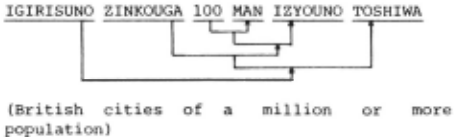
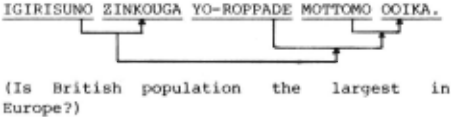
when the parser focuses on ZINKOUGA (population), there is a possibility that IGIRISUNO (British) either modifies ZINKOU, or not. Procedure-2 to ZINKOU reports the alternative possibilities to the parser by the flag setting. At this stage, the parser takes the relation, wherein IGIRISUNO modifies ZINKOU, as the first selection, and holds the information about the other relation, wherein IGIRISUNO does not modify ZINKOU, in RLIST with the environment information. Later on, the parser picks out the element from the RLIST, and reanalyzes the sentence from the state reset by the element.
- Ambiguity: Ambiguity is an interesting problem for an understanding system to deal with, from various viewpoints, such as syntax, semantics and pragmatics. In MSSS78, the system parses the underlined phrase in
1 TASU 2NO 3BAIWA IKURA OESUKA.
into two phrases,

where each phrase has either meaning of (1 + 2) x 3, and 1 + 2 x 3. At present, the system responds to the sentence as an ambiguity sentence, and asks for reinput.
As an ambiguitiy dependent upon the of the problem domain, the system the underlined phrase in knowledge interprets
1 TASU 2 KAKERU 3WA IKURA OESUKA.
as either meaning (1 + 2) x 3, or 1 + 2 x 3, from arithmetic knowledge. Procedure-2 in a Case Pattern to a number detects this ambiguity at the stage of the underlined phrase analysis.
- A variety of expressions: The following are among those which can be analyzed by Case Patterns to words whose concept is an equality, a number or a variable.
4WA X KAKERU 2NI HITOSHII. 4TO XNO 2BAIWA HITOSHII. (4 is equal to twice X.)
3X TASU 2YWA lNI HITOSHII. 3XTO 2YNO WAWA lNI HITOSHIIOESU. (3X plus 2Y is equal to 1.) lNI 2WO TASUTO 3NI HITOSHII. lNI 2WO TASUTO SONO KEKKAWA 3NI HITOSHII. (1 plus 2 is equal to 3.)
7 SEMANTIC INTERPRETATION
7.1 Interpretation by Procedure-!
The parser analyzes a sentence by evaluation of Case patterns slots towards the solution of the problem, which the system has to deal with. Procedure-! of a Case Pattern to a BUNSETSU, which represents a phrase(in MSSS78, a sentence), interprets the resulting filled case slots to set up an equation, or construct and execute command to query database, etc.
From the underlined part in the next sentence,
AHURIKANI ARU ZINKOUGA 1000 MAN NIN IZYOUNO KOKUGOGA EIGONO KUNIWA OOKO OESUKA. ----- (What are countries in Africa, whose population is ten million or more, and whose language is English?),
the parser recognizes three phrases, such as the country in Africa, the country whose population is ten million or more, and the country whose language is English. The inner representation including filled slots to the phrases is as follows.
(GNN KUNI (RNT ARU (TSYl (TSB TAIRIKU (ION 2))) (ZMK (TSB KAZU (ATAI "GlOOOOOOO") (GNN ZINKOU) ) ) (ZMK (TSB KOKUGO (ION 212)))Procedure-! to OESU constructs the next command by interpretation of the filled slots, and executes the command.
(TEST ((KUNI 2 (V KUNI)) (WAWA (V KUNI) KUNI) (ZINKOU (V KUNI) "GlOOOOOO") (WAWA (V KUNI) KUNI) (KOKUGO (V KUNI) -3) ))The TEST commmand searches into database by means of PLANNER-like procedural deduction mechanism (no backtracking unlike PLANNER) . According to the return value of the command, a sentence generator constructs response sentences. (The sentence generator reconstructs an output sentence from a parsed tree of an input sentence, supplementing or replacing necessary words input sentence pattern or problem solving.) according to the result the of a
7. 2 Interpretation by World Knowledge
Complete set of objects and relations in the geography world is unknown[5). In MSSS78, the answer to the question
KANADANO SYUTOWA MONTORIO-RU KA.
(Is the capital of Canada Montreal?),
turns out to be
IIE, KANADANO SYUTOWA MONTORIO-RU DEWAARIMASEN. KANADANO SYUTOWA OTAWA DESU. (No , the capital of Canada isn't Montreal. The capital of Canada is Ottawa.),
or KANADANO SYUTOWA MONTORIQ-RU KA WAKARIMASEN. (I don't know that the capital of Canada is Montreal.)
according to whether or not the fact that the capital of Canada is ottawa is in the database. For the above responses, the deduction program uses three logical values, true, false and unknown. Procedural type knowledge prepares logica l value and additional information.
8 CONCLUSION
The experimental Japanese language question answering system, MSSS78, was made in a series of research efforts intended to construct a natural language man-machine interface. The system uses Case Patterns for syntactic and semant i c analysis. The Case Pattern method seems t o produce modularity and extendability of syntactic and s emantic programs, and the
readiness of system making.
Procedures in Case Patterns are a good tool for testing various processings. However, from a viewpoint of easy de scriptiveness and system stabi lity, it would be better to describe various functions absorbed in the procedures, using the so-called declarative style.
MSSS78 generates a response based on three logical values as well as additional information as to the result of the reference to the database. Such responses can be thought to place reliance on database. For the reference to a database, it seems convenient to be able to utilize the previous reference result in accordance with the context indication.
For written Japanese, it is better to display KANJI-KANA-MAJIRI-BUN for input and output sentences. In KANJI-KANA-MAJIRI-BUN display, output sentences are redundant at present.
MSSS78 was implemented on PDPll/55 with extensive utilization of disk memory capacity. The language used for the implementation i s mainly LIPX, an extended ve rsion LIPQ(6], plus a little bit of assembler. The dictionary contains more than 600 words at the time. To analyze and respond to each sentence, takes from a few seconds to a few minutes, where most of the latter is search time for data in the
database.
ACKNOWLEDGEMENTS
The authors gratefully thank Dr. N. Ikeno for his guidance and encouragement, and also thank Dr. H. Nomura and N. Osato for their cooperation in the implementation. They express their gratitude to the members of the Visual Communication Applications Section in ECL for their offer of KANJI and KANA pattern data.
@inproceedings{ijcai1979p177,
  title     = {Experimental Japanese Language Question Answering System MSSS78 - Using Case Patterns with Procedures},
  author    = {Shimazu, Akira and Iida, Hitoshi},
  booktitle = {Proceedings of the Sixth International Joint Conference on
               Artificial Intelligence, {IJCAI-79}},
  publisher = {International Joint Conferences on Artificial Intelligence},
  editor    = {Bruce G. Buchanan},
  year      = {1979},
  month     = {8},
  url       = {https://ijcai.org/proceedings/1979/177},
}
TY - CPAPER TI - Experimental Japanese Language Question Answering System MSSS78 - Using Case Patterns with Procedures AU - Shimazu, Akira AU - Iida, Hitoshi T2 - Proceedings of the Sixth International Joint Conference on Artificial Intelligence, IJCAI-79 PB - International Joint Conferences on Artificial Intelligence PY - 1979 UR - https://ijcai.org/proceedings/1979/177 ER -Copied
Machine-readable versions of this paper, for tools and AI agents:





