
An Active Frame for the Knowledge Representation
Proceedings of the Sixth International Joint Conference on Artificial Intelligence. .
© 1979 International Joint Conferences on Artificial Intelligence
Abstract
This paper describes micro-actors which construct the knowledge representation in which the modularity was established without sacrificing the interaction. The behavior of the micro-actor is defined in terms of only one kind of action: sending message to another micro-actor. The micro-actor is composed of a script and an acquaintance. The script consists of the pairs of the message pattern and the action corresponding to the pattern. The micro-actor has the acquaintance as a memory space to hold the data and the names of the other micro-actors it directly knows about. As a result of using the micro-actors, we can deal with knowledge about the actions as well as knowledge about the world states. The information about an action sent from a micro -actor is effective only in the micro-actor which received it. This guarantees the modularity of mi era-actors. An example shows that the continuation in a message make both the subroutine control coroutine control possible. The other indicates a dialogue in the question-answering using the micro-actors.
- Bobrow, D.C. & Winograd, T. "An Overview of KRL, a Knowledge Representation Language", Cog- nitive Science, 1:1 (1977) 3-46.
- Ernst, G.W. & Newell; A. "GPS: ACaseStudy in Generality and Problem Solving", Academic Press, 1 Q69.
- Fikes, R.E. & Nilsson, N.J. "STRIPS: A New Approach to The Application of Theorem Proving to Problem Solving", Artif. Intell. 2 (1971) 189-208. IJCAI
- Hart, P.E., Nilsson, N.J. and Raphael, B. "A Formal Basis for The Heuristic Determination of Minimum Cost Paths", IEEE, Trans. on ~ Sci.~ SSC-4:2 (1968).
- Hewitt, C. "PLANNER: A Language for Prov- ing Theorem in Robots", Proc. IJCAI-69 (1969) 295-301.
- Hewitt, C., Bishop, P. and Steiger, T. "A Universal 14odular Actor Formalism for Artificial Intelligence':, Proc. IJCAI-73 (1973) 248-249. 675
- Hewitt, C. &Baker, H. "Towards a Program- ming Apprentice", IEEE Trans. onSof.Eng.(l975).
- Kuiper, B. "A Frame for Frames", Represen- tation and Understanding, Academic Press (1975).
- McDermott, D.V. & Sussman, G.J, "The CONNIVER Reference Manual", MIT AI Lab, AI-MEMO No. 259 (1972).
- Minsdy, M. "A Framework For Representing Knowledge", The Psychology of Computer Vision, McGraw-Hill (1975).
- Ogawa, H. & Tanaka, K. "A Structure F.or the Representation of Knowledge --A Propos a 1 for a Micro-Actor--", Proc. IJCAI-77 (1977) 248-249.
- Ogawa, H., Kitahashi, T. and Tanaka, K. "The Theorem Prover Using A Parallel Processing System", Proc. IJCAI-79 (1979). IJCAI
- Robinson, J.A. "A Machine-Oriented Logic Based on the Resolution Principle", Jour. ACM12 (1965) 23-41. ---- (14
- Roberts, R. & Goldstein, I. Manual", AI-MEMO 409 (1977).
- Roberts, R. & Goldstein, I. Primer", AI-MEMO 408 {1977). "The "The FRL FRL
- Rulifson, J.F., Derksen, J.A. & Waldinger, R.J. "QA4: A Procedural Calculus for Intuitive Reasoning", SRI Tech. Note No . 73 ( 1972).
- 14inograd, T. "Frame Representations and The Declaratve/Procedural Controversy", Repre- sentation and Understanding, Academic Press 1975.
- Winston, P.H. "Learning by Creatifying Transfer Frames", Artif. Intell. (1978) 147-172.
- Yonezawa, A. "A Specification Technique For Abstract Data Types With Parallel ism", Res. Rep. C-17, Dept. of Information Science, Tokyo Institute of Technology {1978).
- Bobrow, D. G. "Dimension Of Representation", Representation and Understanding, Academic Press (1975).
References were extracted automatically from the PDF and may contain errors.
Full text extracted automatically from the PDF; figures, tables and equations may differ. The PDF is the version of record.
1. INTRODUCTION
Artificial Intelligence is a branch of computer science which is mainly concerned with the pro blem solving, the cognition, and the comprehen sion of natural languages. Many approaches to the problem solving have been developed; forex ample, the algorithm A* (Hart) [4] for searching trees, the resolution principle (Robinson) [13], GPS [2] and its application: STRIPS (Fiks, Nilsson) and so on. The resent approach is the development of the programming language for ar tificial intelligence. The cognition is the intelligence process to acquire knowledge in the image understanding and the speech understanding. The comprehension of natura 1 1 anguages needs the integration of many approaches in artificial intelligence.
The common issues of the above mentioned themes are the knowledge representation and the mecha nism of understanding and inference. In this discussion, "Knowledge" does not mean only the facts about a world state but also the tech niques dealing with the facts. The artificial intelligence system obtains information from the scene and/or the statements in natural language .. The system, then, acquires new knowledge by com paring the obtained information with the knowl edge the system has. Therefore, the knowledge representation is necessary, in which it is easy to specify knowledge, modify it and refer to it. There have been two types for the representation of knowledge: the declarative one and the pro cedural one [17]. The modularity is emphasized in the former; e.g., the logical formulas. On the other hand, the interaction is stressed in the latter; e.g., PLANNER [5], QA4 [16], CONNEVER [9] and so on. The declarative representation has sever a 1 benefits: The separation of knowledge into data and procedures brings the flexibility and economy of the declarative representation. The independence of the axioms or facts leads to the understandability and learnability of them. On the contrary, in the procedural representa tion, a frame axiom need not be specified. Fur thermore, the heuristic knowledge can be treated in it. To utilize both benefits of the declara tive representation and the procedural one, it is necessary to develop the method in which the mod ularity is established without sacrificing the possibilities for interaction.
KRL (Bobrow, D.G. & Winograd, T.) [1] and FRL (Roberts, R.B. & Goldstein, I.P.) [14, 15] are developed as the approaches to the problem men tioned above. Both KRL and FRL are based on frames, and attempt to integrate procedural knowledge with a broad base of declatative forms. By the way, there is some knowledge about the action; for example, the control of the reason
ing mechanism, the data base processingandsoon.
Such knowledge is preferable to be expressed by the procedures rather than the dec 1 a rat i ve forms. If declarative knowledge is integrated with the procedures which deal with it, and the proce dures have the modularity, then we can freely use both declarative knowledge and procedural one.
This paper describes a micro-actor* as a method for knowledge representation. The script of a micro-actor contains procedural knowledge to deal with only the acquaintance of the micro -actor. The acquaintance has declarative knowl edge in the form of frame.
2. REPRESENTATION OF WORLD-STATE
2.1 Frame Representation ~Acquaintance
A micro-actor is composed of a script and an ac quaintance. The script describes the behavior which the micro-actor should take when it re ceives a message. The acquaintance is the mem ory space for the micro-actor. The acquaintance stores the data that the micro-actor knows; for example, its native values, its attributes, the names of the other micro-actors it directly knows about, and the relation with them. The followings are the reason why the concept of Frame Theory [8, 10] is used for construction of an acquaintance:
- A frame is a data-structure rep:-esenting a stereotyped situation.
- Several kinds of information can be at tached to each frame, and some of this informa tion is about how to use the frame.
- Frames enable us to represent knowledge in a hierarchical structure.
Fig. 1 shows a slot array representation to in dicate a frame intuitively. A frame is, however, represented by the nested association lists as shown in Fig. 2 in its implementation. The re spective substructures of a frame are named; Slot, Facet, Datum and Comment. A slot shows which property the data in it are connected with. A facet shows kinds of the data; e.g., values, constraints, procedures and so on. A datum is elementary information associated with the facet, and a comment is additional information
* The micro-actor was proposed as the im plementation of some of abilities of actor (Hewitt, C.) [6, 7] in 1S77 [11]. A new version of a micro-actor described in this paper has similar abilities of actor. Parallel process and coroutine control are possible in a micro -actor system. There is a slight difference between the micro-actor and the actor in point of notation. ·
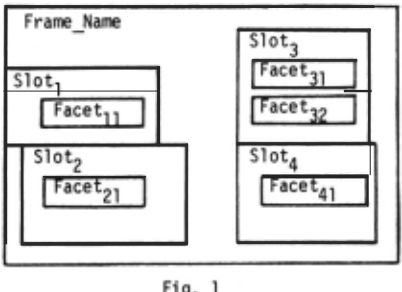
Slot array representation of a frame.
for the datum.
2. 2 Effect On Other Frames
An addition of procedures to a slot of a frame enables the frame to acquire information from other frames and to change the contents of the other frames. This may make it possible to com bine the declarative knowledge and the proce dura 1 knowledge; that is, the modura 1 i ty and the interaction. However, a question still remains to be solved.
A frame is freely dealt with using three basic functions; obtaining something from the frame, putting somthing to it, and removing from it. The use of only the three functions is, however, inconvenient and uneconomical when a frame is dealt with in several ways. New functions should be made either in advance or afterward. We will try to put box A on box B in a block world.
Assume that there are frames which correspond to box A and box B. To put box A on box B is executed by the following process; If both box A and box B are a kind of Block and Cleartop*, and box B is Supportable**, then let box A be supported on box B and let box B support box A. The knowledge concerning the process mentioned above is represented in three methods: ( 1) Func tion ON is made in order to put an object on an other, and is added to the basic fuctions. (2) The process is distributed to the frames corre sponding to box A and box B. (3) A new frame is created correspondinq to the function ON.
In ( 1), there exists the chunk of procedures dealing with frames. A slight change of a pro cedure often affects the other procedures. As a result, (1) is not good to represent the know ledge about actions in A.I. system. General functions can be used in both (1) and (3). On the contrary, a procedure depends on a particu lar frame in (2). (2) is convenient to describe
the procedure closely depending on the frame, and to establish the modularity among procedures. It is, however, wasteful when several frames have the similar function. (3) is equal to (1) in essence. So there remains the possibility of the unlimited and unrestricted interactions. However, the app 1 i cation of the ide a of actor to (3) leads the module for representing knowledge with proper interaction method.
The actor model is suitable to control and des cribe the -interaction between the modules. Namely, the action of an actor is defined in terms of only one kind of action; sending mes sages to the other actors, and any other side effect is not permitted. When the actor re ceives a message, it becomes active and tries to play its role. The authors think that the actor model is useful for parallel processing.
3. REPRESENTATION OF ACTION
The chapter 2 said that a frame is good for re presenting the knowledge about a world state, but not so good for representing the knowledge about an action. On the other hand, a micro -actor is very suitable for representing the action. The micro-actor, which is a procedure, is a basic module in order to construct the knowledge base. This chapter describes the form of script which represents the behavior, and illustrates how to deal with the knowledge about the world state using message passing.
----------------------------------------------- * Cleartop means the state in which the box supports nothing.
** The box which is supportable can suppor another box.
3.1 Micro-Actor
The script of the micro-actor precisely repre sents the message passing, the parallel compu tation and the coroutine control. The form of the script is similar to Yonezawa's notation[l9]. But the micro-actor is based on LISP whereas his notation is based upon PLASMA.
(i) Script
The script is specified with a set of pairs of message patterns and rules as follows:
(ii} Message Pattern
There are two types for pattern:
- (MES: ?%N content TO: ?CONT).
- (RE: ?%N content).
?%N is only matched with the message number %n, where n is a positive integer. Amessagenumber is assigned to an input sentence or a message for distinguishing it from the others as a tag. The message number is also used to distinguish a datum from the others stored in the same micro -actor. The atoms prefixed by"?" (e.g., ?CONT) are the variables for pattern matching. The prefix "!" is used instead of the prefix "?" to refer to the pattern matching variables for their values; for example, !CONT. "MES:" means a message and "RE:" means a reply. "TO:" means that the continuation is !CONT. The continua tion is the micro-actor which is sent a reply. Assign "NO-ONE" to !CONT in the case that the answer is not required. Assign "ME" to !CONT when the reply is demanded. This is equal to the subroutine control.
(iii ) Rule
A rule is a set of programs, which carries out a job. The rule consists of three parts as
follows:
"P-C:" is an abbreviation for pre-condition. "N-C:" means next-condition which is an option. "C-E:" is an abbreviation for caused-events in which the messages are sent to the other micro -actors when both the pre-condition and the next-condition are satisfied. The form of the rule is given by Dr. Yonezawa, and it is suggested that the form of the rule is useful to deal with the parallel computation. The pro grams should be carried out in order of the ap pearance of them in the pre-condition and the next-condition. On the other hand, the pro grams in the caused-events can be executed con currently.
( i v) Program
A program is written in the restricted LISP no tation. The user can freely use the LISP func tions which don't have influence upon the pointers to lists and atoms; e.g.,MEt~BER, ASSOC and so on. The variables are restricted to the form !m or !!n (Both m and n are positive inte gers.) for the LISP functions which have influ ence upon the pointers; e.g., SETQ and so on. This restriction prevents the behavior of a micro-actor from giving unitentional effect to other micro-actors. The variable !m is used as well as PROG variable, whicle ! !n can be used in a special way as mentioned in the next section.
A specification for message passing is as fellows:
(=> the_name_ of_a_miaro-aator> a_message ). The user uses the basic function ( FGET, FPUT and FREMOVE) to deal with the acquaintance. These functions differ from those of FRL in point of the necessity of the frame name. The functions in this paper do not need the frame name because the micro-actor deals with only its ac quaintance. Therefore, the execution of the basic function does not affect the other micro -actors.
(v) Behavior of Micro-actor
A micro-actor tries to find a message pattern which is matched with a messge t11 when it re ceives M1 · If the message pattern P1 is found, a rule R1 is searched for, which is one of rules making a pair with the pattern P1 , and whose pre-condition should be satisfied. When there is the next-condition in R1 , all programsinthe next-condition should be evaluated. If the next -condition is satisfied, the caused-events are executed. If there is no rule whose pre-condi tion is satisfied concerning the pattern P1, the micro-actor tries to find another message pattern which is matched with M 1 ·
Since the system holds the COMMON-SCRIPT which is necessary for all micro-actor, the users may specify the micro-actor by the peculiar script. The COMMON-SCRIPT has the message pattern (MES: ?%N ?X TO: ?CONT) and acts as follows:
(a) If the variable !X (corresponding to ?X) indicates on~ of the basic functions (FGET,FPUT
and FREt10VE), then it is put into practice. (b) If !X shows one of the extension functions (i.e., there exists a micro-actor corresponding to it), the rules are obtained from the micro -actor corresponding to the extension function, and they are performed. The vari ab 1 es ! ! n (n = 1, ... , 5) are corresponded to the argu ments; for example, ! !1 means the first argument. (c) If !X indicates a set of rules, then !X is accomplished.
3.2 Example
A block world gives us good examples to illus trate the representation of the script and the acquaintance of a micro-actor, and message passing. The following discussion concerns with the micro-actor PROPERTY. It is used in the implementation of putting an objict on another. The script of the micro-actor BOXl is NIL, be cause it needs just only the COMMON-SCRIPT. The acquaintance is expressed by one slot as follows: ((AKO (:VALUE (BOX))). This means that boxl is a kind of box. The AKO slot has a higher level concept of boxl as the value marked by the :VALUE facet. Concerning the micro-actor BOX, the script is NIL as well as boxl, and the acquaintance is as follows:
((AKO (:VALUE (BLOCK))) (INSTANCE (:VALUE (BOXl BOX2 BOX3))) (PROPERTY (:VALUE (SUPPORTABLE))) ) .
This shows the following facts: (1) Box is a kind of block. (2) The instances of box are boxl , box2 and box3. ( 3) The native property is supportable which means that the box can support another box.
Fig. 3 gives the script and the acquaintance of the micro-actor PROPERTY which deals with the rules about the properties. In the rest of this paper, a variable prefixed by"!" indicates its value until it is quoted. The script has a rule to ask the mi ere-actor ! B if it has the property !A. According to the rule, PROPERTY sends !B the rules in which !A is substituted for "!!1". The AKO slot means that PROPERTY is a kind of E-FUNCTION (which is an abbreviation of extension function). The CONTENT slot shows the rules which contain the following algorithm. If the micro-actor which executes the rules has the value SUPPORTABLE in its PROPERTY slot,then it sends the reply OK to !CONT. Otherwise, if it has the value A in the AKO slot, then A is sent the message to ask if A has the property SUPPORTABLE. If A has it, A sends the reply OK to !CONT; otherwise, A sends NIL to !CONT. Note that A need not answer the micro-actor which sent the message to A. This means the possi bility of a coroutine control.
( (I~ES: ?%N ?B PROPERTY ?A TO: ?CONT) ((P-C: (SETQ !1 (FGET CONTENT :VALUE))) (N-C: (SETQ ! 1 (*SUBS ! 1 (LIST (CONS (QUOTE !!1) !A)) ))) ( C-E : ( => ! B ( MES : ! 1 TO: ! CONT) ) ) ) ) (a) (AKO (:VALUE (E-FUNCTION))) (CONTENT (:VALUE ((P-C: (SETQ !5 (FGET PROPERTY :VALUE)) (ASSOC !!1 !5)) (C-E: (=> !CONT (RE: !%N OK))) ) (SETQ !4 (FGET AKO :VALUE)) (SETQ !4 (CAAR !4))) (C-E: (=> !4 (MES: !%N PROPERTY !!1 ) TO: !CONT))) ((P-C: (NULL (FGET AKO :VALUE)) ) ) ) ) ( C- E: ( => ! CONT ( RE: ! %N NIL) ) ) (b)Fig. 4 shows the diagram of the message passing for the process to see if boxl is supportable. The user can communicate with the micro-actor system using the special micro-actor * as shown in Fig. 4. For example, when the user wants to know whether boxl is supportable or not, he may
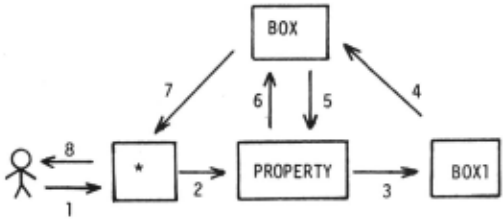
write as follows: (*PROPERTY BOXl PROPERTY SUPPORTABLE). The first argument of* is the target of the message whose content follows the first argu ment. The micro-actor * composes the · message and sends it to the micro-actor PROPERTY (See linel and line 2 in Fig. 5). ( (P-C: (NOT (AS SOC ! ! 1 ( FGET PROPERTY :VALUE))) Fig. 3 (a) The script of the micro-actor PROPERTY. (b) The acquaintance of PROPERTY. Fig. 4 The diagram of the message passing.
1 (* PROPERTY BOXl PROPERTY SUPPORTABLE) 2 (* PROPERTY <= (MES: %2 BOXl PROPERTY SUPPORTABLE TO: ME)) 3 (*+ BOXl <= (MES: %2 (((P-C: (SETQ !5 (FGET PROPERTY :VALUE)) (ASSOC SUPPORTABLE !5)) TO: ME)) (C-E: (=> !CONT (RE: !%N OK))) ) ((P-C: (NOT (ASSOC SUPPORTABLE (FGET PROPERTY :VALUE))) (C-E: ((P-C: (C-E: (SETQ !4 (FGET AKO :VALUE)) (SETQ !4 (CAAR !4)) ) (=> !4 (MES: !%N PROPERTY SUPPORTABLE TO: !CONT))) (NULL (FGET AKO :VALUE))) ( => ! CONT ( RE: ! %N NIL) ) ) ) 4 (*++BOX<= (MES: %2 PROPERTY SUPPORTABLE TO: ME)) 5 (*++*PROPERTY <= (MES: %2 FGET CONTENT :VALUE TO: I~E)) 6 (*++*REPLY: (RE: %2 (((P-C: (SETQ !5 (FGET PROPERT :VALUE)) (ASSOC ! ! 1 !5)) ) ) ) 7 (* REPLY: (RE: %2 OK)) 8 (* RE: %2 OK) (C-E: (=> !CONT (RE: !%N OK)))) ((P-C: (NOT (ASSOC !!1 (FGET PROPERTY :VALUE))) (C-E: ((P-C: (C-E: (SETQ !4 (FGET AKO :VALUE)) (SETQ !4 (CAAR !4))) (=> !4 (MES: !%N PROPERTY ! !1 TO: !CONT)) ) ) (NULL (FGET AKO :VALUE)) ) (=> !CONT (RE: !%N NIL))) ) Fig. 5Messages and Targets shown in Fig. 4.
Fig. 5 gives us the messages and the targets illustrated in Fig. 4. Each line inFig.5shows the message passing which is represented by the arrow attached the same number that the 1 ine has. The front atom in each 1 ist (i.e., *, *+, etc.) illustrates the level of message passing. The symbol "*" means the subroutine control, and"+" means the coroutine control. Each line will be explained.
L inel: The user communicates to the system the messadge {*PROPERTY BOXl PROPERTY SUPPORTABLE).
Line2: The micro-actor *composes and sends it to the micro-actor PROPERTY.
Line3: The micro-actor PROPERTY sends the BOXl the message including the rules to see if the target has a datum SUPPORTABLE in its pro perty slot. The continuation of the message on the 1 i ne3 is the same one on the 1 i ne2. ln·other words, "ME" means the micro-actor *.
Line4: BOXl puts the rules into practice according to COMMON-SCRIPT. As BOXl does not have a property slot, BOXl sends~ message to the BOX which is the higher level concept of boxl. The continuation "ME" is BOX in this case, and this means the subroutine control.
Line6: PROPERTY returns the rules to BOX. Line7: BOX carries out the rules. As BOX has the value-siTPPORTABLE in the property slot, BOX sends OK to the micro-actor*.
LineS: ~replies OK to the-user.
This example shows about the method of the coroutine control and the subroutine control, and explains how the extension function defined as the micro-actor is used and is executed. furthermore, it gives the preferred inference about the knowledge represented with frames.
4. QUESTION ANSWERING SYSTEM
In the question answering between a machine and a human, one of most important things is a topic of conversation and a context to understand what the partner said. We assume that the speaker and the 1 is tener have the common knowledge about the discourse. Consequently, the inference plays a great role to understand the partner's intention. The micro-actor can get a good pol icy from the acquaintance in which the facts of the worlq state are expressed by a frame.
4.1 Mapping From World
The authors consider that the knowledge about a world is a "snapshot (Bobrow, D. G.) of world state. The followings show the difficulty of mapping data from a world state to a knowledge state. What part of a house one directs his attention to when he sees it? Someone might direct his attention to the door. A qardener might be interested in the trees and flowers in the garden. An architect might look the style of the house. Consider another example. When we hear "John is like a frog", what individ uality do we assume about John? The answer depends on the context and the topic of the dis course. If one heard that Mike was a handsome boy just before, then he considers that John is ugly. If one heard that Mary was gentle then thinks that John is noisy.
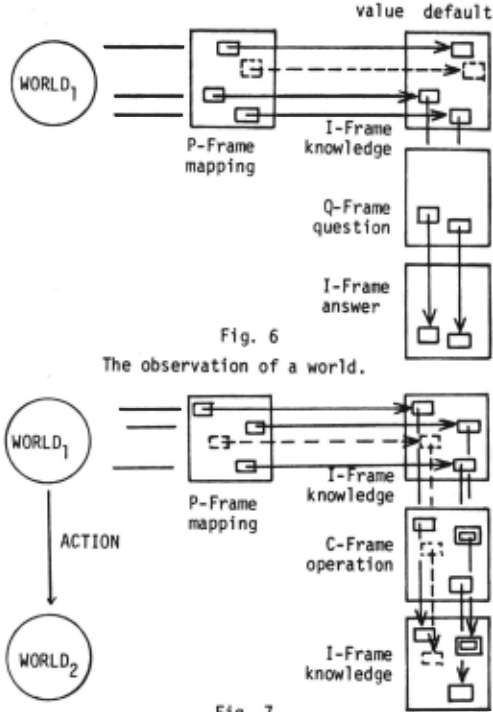
The frame representation is suitable for ex tracting information from the world. The map ping method using the frame is to move a part of the world state to a slot of the frame. The data acquired by the mapping must satisfy the condition of the slots which depend on the topics and the context. So, we will use the frame called P-Frame (Prototype Frame), which has the slots to fill out. The P-Frame is used to compose an !-Frame (Instance Frame) which represents the knowledqe state. The P-Frame has the default values which are communicated to the !-Frame if necessary. In the same way, using a Q-Frame (Quary Frame) whcih corresponds to "que stion", the !-Frame for the answer obtains the data from the !-Frame for the knowledge. A Q-Frame means such an action as human observes a world and gets the data (See Fig. 6). In Fig. 6, the knowledge is indicated by a frame for brevity. The knowledge is, however, repre sented by several frames in practice.
Fig. 7 gives two !-Frames which correspond to the worldl and the world2 changed from the worl dl. A C- Frame (Change Frame) represents the action which affects the world, or which changes the observer's situation (In the latter case, the world is not changed.). A C-Frame trans fers the data from an !-Frame to another frame, and changes the data if necessary.
4.2 Conversation Examples
The question answering system about the geome trical figures is constructed with the micro -actors according to the consideration in 4. 1. The user communicate~ with the system in the limitted Japanese for the present. The authors are developing a Japanese analyzer. After it is accomplished, the user will be able to converse with the system in Japanese. Fig. 8 presents the examples in the conversation. The sentences in the figure are written in English for the readers to understand. The user's sentences are marked by "*", and the replies are marked by II! II·
The system has the geometrical world as the context in advance . The context, of course, is changed during the conversation. The system also has the knowledge about several kinds of triangles, the rectangle and square. The system tries to associate the input sentence with the knowledge. If it fails, the system asks the user about the sentence as shown in line2.
When the micro-actor build receives the sentence (linel), it tries to make the micro-actor house. As "house" is s ti 11 undefined and the other parts of linel are not associated with the knowledge, the system asks the user about a house (line2). The user defines the house as shown in line3, then build can create the micro -actor house (line4).The context plays a great role to decide kinds of slot in the acquaintance of house and to fill the slot with the data. In this case, build is regarded as P-Frame. As the world "roof"Oilline5 is not defined yet, the micro-actor prefer will associate an isosceles triangle with the knowledge as follows. Since
- * Build a house.
- ! What is a house .
- * It is the composition in which a triangle is on a rectangle.
- ! OK.
- * I prefer an isosceles triangle for the roof.
- ! Is the roof the triangle of the house?
- *Yes, it is.
8. ! OK.
- *The house is like a tower.
10. OK.
- *What a kind of house is it?
12. ! It is a tall house.
Fig. 8
Examples of the conversation. *· user, ! : computer.
the topic is about the house, prefer investi gates the relation between the house and the isosceles triangle. The triangle is in the AKO slot of the micro-actor isosceles triangle. The house is in the PART-OF slot of triangle. Then prefer infers that the roof is a part of the house, and asks the user if the result of the inference is correct (line6). If the user ans wers yes (line?), prefer creates roof and adds the PREFER facet into the PART slot of house (lineS). In this case, prefer acts as aC-Frame . The above process is smoothly performed using message passing between the micro-actors as mentioned in the chapter 3.
There have been several studies of metaphors using transfer frames [18] . Our system makes use of these studies (lines9,10,11 and 12). The like behaves like a P-Frame. That is, like receives the slot which has an extremal value from the tower, and communicates it to house.
5. CONCLUSION
This paper presented the micro-actors which construct the knowledge representation .in which the modularity is established without sacrific ing the interaction. The micro-actor is also suitable to represent the knowledge about the actions. The micro-actor mainly consists of the message patterns and the actions corresponding to them in the script. The micro-actor acts according to the script, refers to and modifies the acquaintance, and sends the messages to the other micro-actors if necessary. Since only message passing is the interactive method betw een the micro-actors, the modularity is establ ished. The message can communicate enough inf ormation to the micro-actor. Furthermore, the continuation in a message makes both the subroutine control and the coroutine control poss ible. This is very useful for obtaining the data from another micro-actor, in particular, acquiring information from the higher level concept.
The acquaintance is a memory space whcih stores the data and the names of the other micro-actors. Since the frame is employed to represent the acquaintance, the data in the acquaintance is used smoothly. The acquaintance is treated by only the micro-actor which has it. This pre vents the acquaintance from being affected by acother micro-actor.
The chapter 4 presented examples of the question answering system using the micro-actors. The dialogues show the following abilities: the creation of new micro-actors, the association using the higher level concetpt, the comprehension of metaphors, and the recognition of the constructed figures. These abilities greatly depend upon the frame representation. On the other hand, the form of the micro-actor is very useful to implement the system.
ACKNOWLEDGEMENTS
The authors appreciate many helpful sations with several graduate students members of Prof. Tanaka's Laboratory of University. conver and Osaka
@inproceedings{ijcai1979p147,
  title     = {An Active Frame for the Knowledge Representation},
  author    = {Ogawa, Hitoshi and Nanba, Hideaki and Tanaka, Kokichi},
  booktitle = {Proceedings of the Sixth International Joint Conference on
               Artificial Intelligence, {IJCAI-79}},
  publisher = {International Joint Conferences on Artificial Intelligence},
  editor    = {Bruce G. Buchanan},
  year      = {1979},
  month     = {8},
  url       = {https://ijcai.org/proceedings/1979/147},
}
TY - CPAPER TI - An Active Frame for the Knowledge Representation AU - Ogawa, Hitoshi AU - Nanba, Hideaki AU - Tanaka, Kokichi T2 - Proceedings of the Sixth International Joint Conference on Artificial Intelligence, IJCAI-79 PB - International Joint Conferences on Artificial Intelligence PY - 1979 UR - https://ijcai.org/proceedings/1979/147 ER -Copied
Machine-readable versions of this paper, for tools and AI agents:





