
Describing Natural Textures
Proceedings of the Sixth International Joint Conference on Artificial Intelligence. .
© 1979 International Joint Conferences on Artificial Intelligence
Abstract
There have been many different approaches to texture description, primarily statistical techniques although there has been some work on structural texture analysis all along. We present here a technique which can be used to easily derive parts of the structural description- the regularity information in particular. Some limits on this method and its use in an overall texture description system are discussed.
- J. Weszka, A. Rosenfeld, "A Ccmparative Study of Texture Measures for Terrain Classification," IEEE Trans Sr.t::-6, April 1970.
- A. Rosenfeld and Kak, Digital Picture Processing, Academic Press:New York, 1970.
- R. Bajcsy, "Ccmp.~ter Identification of Visual Surfaces," CGIP-2, Oct. 1973, pp. llb-UU.
- J.T. Maleson, "Understanding Texture in Natural Images," University of Rochester, Rl.D. Thesis, to appear.
- bj H. 'l'amura, s. Mor i, T. Yamawaki, "Textural Features Cor responding to Visual Perception," IEEE Trans Sr.t::-8, June 1978, pp. 46U-473.
- l"IJ D. Marr, "Early Processing of Visual Information," AI-M-340, Artificial Intelligence Laboratory, MIT, Cambridge, MA, 1975.
- R. Nevatia, and K. R. Babu, "Linear Feature Extraction and Description," in proc. IJCAI-/9, Tokyo, Japan, August 1979. IJCAI
- R. Nevatia, and K. Price, "Locating Structures in Aerial Images," Proc. of 4th IJCPR, Kyoto, Japan, Nov. 1978, pp. 686-90.
- R. Nevatia, K. Price, and F. Vilnrotter, "Describing Natural Textures," USCIPI Report b6U, USC, Los Angeles, CA, March 1979.
References were extracted automatically from the PDF and may contain errors.
Full text extracted automatically from the PDF; figures, tables and equations may differ. The PDF is the version of record.
1. INTRODUCTICN
Areas of an image may be better characterized by their textures rather than by pure intensity information. 'l'exture is the pattern of the spatial arrangement of different intensities. The different textures in an image are usually very apparent to a human observer, but automatic description of these patterns has been difficult. We wish to describe the texture in the same terms as a human observer, rather than by a purely statistical method.
Many statistical textural measures have been proposed aoo studied in the past [1-4), including analysis of the discrete Fourier transform [4], analysis of generalized gray-level co-occurence matrices [1], and analysis of the micro-edges in a subwindow [3). We are not interested in finding one texture measure which will distinguish between all areas, but in finding a texture description to use in conjunction with many other features(~].
'!he work in structural texture description has been more limited. Maleson [5] used simple regions as the basic elements and used relations between regions and shape properties in his analysis. Tamura et al. [6) developed a set of operators to rate textures on several scales, comparable to their ratings by human subjects. The proposals of Marr [/] for texture analysis based on the primal sketch are similar to some of the analysis which we perform.
*This research was supported by the Defense Advanced Research Projects Agency and waE monitored by the Wright Patterson Air Force Base under Contract F-33615-/6-c-1203, ARPA Order No.
311~.
2. ANALYSIS OF TEXTURE
We have chosen to first explore the description of regular patterns (e.g. street patterns of certain cities shown in the top of Fig. 1). Other attempts to derive much of the structural information from the Fourier transform were only partially successful [4), so we felt other methods should be attempted. The individual textural elements could be located and analyzed l~J, but the simple regions are unreliable when the textural elements are very small. Another option is to analyze an edge image to find the structure. '!he patterns in the original image will cause related patterns to appear in the edge image, which should be more consistent and easier to analyze than the original image data.
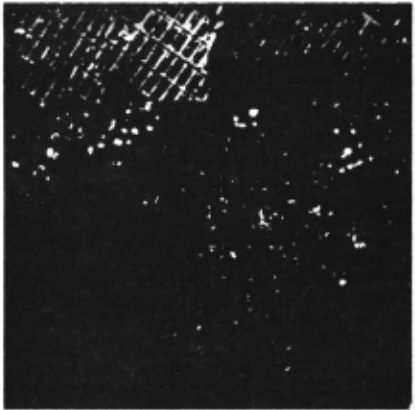
We are interested in the edges between adjacent textural elements arrl not so much in edges between adjacent textural patterns or exterrled regions. The edge operator has been applied to other types of analysis [b), and is applied over a 3 x 3 window to generate an edge magnitude arrl direction (1 of ~). Fig. 2 shows the edge output for the subwindows in Fig. 1.
The edge images retain the regularity of the initial image, but now the regularity is in the spacing of edges not texture elem~nts. A Fourier transform applied to this binary edge image may indicate the repetitive nature of the edges, but is obscured by the dec)eneracies introduced by the binary nature of the input.
3. EIX>E CXH)CCURRENCE ANALYSIS
Generalized gray level co-occurrence matrix analysis is a basis for much of the statistical texture analysis [1). Basically a set of matrices are computed where the (I,J) entry of a matrix is the probability that a point with value J occurs at a given spacing arx'l angle from a point with value I. Usually the image values are partitioned into a small set of values (~ rather than 25b), so that it is even possible to compute the initial matrices. Also the computation is made for several spacings (l,~,J,b, etc.) and directions (00, 45°, 9UO, etc.). Because of the large number of matrices that are generated by this method, various measures are computed on the matrix values, and the classification is performed using these measures [1]. '!he carman measures do not capture the important feature in the edge images: the regular spacing of edge elanents. The measure we use is one that irx'licates the probability at edges occurring at two points at a certain distance and angle from each other, given that an edge occurs at one of the points.
'!here are several ways to determine if an edge occurs at two points, with different features indicated by the different comparison methods. Using all edges for every direction presents severe problems in the analysis of the output since long lines running in the same direction as the co-occurrence computation will be included along with lines running perperx'licular to the direction. (Tamura et al. [6] used this feature to irx'licate linear patterns in their texture experiments.) The first limitation is to consider only those edge elements perperx'licular to the direction of search, that is in the computation of co-occurrences in a horizontal direction, only vertical edges are considered. 'I'he variations on this basic restriction include: allow sane freedom in the edge direction (45° either way) , accept only perfect matches (up arx'l up, down arx'l down) , and accept only owosites (up arx'l down, not up arx'l up).
4. DISCUSSION
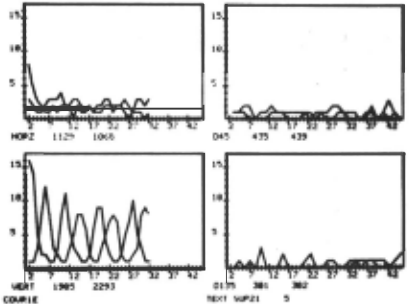
None of this analysis would be worthwhile if it did not ease the task of describing regular textures. The highly regular patterns of the urban area (the top row of the image, and Fig. 3) and raffia (the bottom row and Fig. 4) produce strong periodic patterns in the plot of the co-occurrence measure. A high value in the graphed · measure irx'licates that pairs of edges frequently occur at that particular spacing arx'l angle.
The spacing of pairs of textural elements is given by the peak to peak spacing in the measure which matches edges only in th@ exact same direction (see Fig. 3). The size of individual elements is best given by the measure which allows edges in the owosite direction (see
Fig. 4). 'Ihe solid line in the graph irx'licates the size of dark objects and the dotted line the size bright objects. The size is from the first major peak, the succeeding peaks are caused by the repeated pattern. '!he patterns usually do not line up with one of the 4 directions, so tl1ere will be some response in 2 directions. WhEn these directions are 45° apart the dominant direction is probably between them (urban, Fig. 3). But when they are 9u 0 apart there should be a regular pattern in two directions (Raffia, Fig. 4). Thus, from the data we can say that the urban subwindow has a regular pattern of bright and dark regions oriented in one direction, near 45°, with the bright regions being larger (width about 10 pixels) than the dark ones (width about 4). Note that the size of the blocks in the other direction is near the size limit of the co-occurrence computation arx'l also that few of the relevant edges are detected.
The irregular textural patterns (e.g.the suburban areas of the second row of Fig. 1, and the grass, sarx1, and wool of the third row,) do not produce the same clearly periodic patterns of raffia. But it is possible to derive certain useful features from the results, primarily that of the size of the textural elements.
'Ihis is not a complete description of the textures, but serves as a good initial description of the patterns. There are still other important features of the textures which are not derived by this method, but may be computed by other techniques. The simple edges are not interx'led to be the final elementary object in the texture description, others such as exterx'led edges, lines arx'l regions may be required for complete analysis. This procedure has been applied on many other less regular patterns with similar results [lu].
5. CONCLUSIONS
General texture analysis is a very difficult problem, but this analysis of edge images appears to be an effective method to extract many important structural features from the textural patterns. One major unanswered question is whether or not all of the information derived by the human user can be reliably derived by a program. We are still working on the automatic extraction of this information from the data which is produced by this textural analysis method.
REFEREOCES
Ill R.M. Haralick, I. Dinstein, "Textural K. Sharmugam, Features for and Image
- Classification," pp. oou-621. IEEE Trans Sr.t::-3, 1973,
- J. Weszka, A. Rosenfeld, "A Ccmparative Study of Texture Measures for Terrain Classification," IEEE Trans Sr.t::-6, April 1970.
- [j] A. Rosenfeld and Kak, Digital Picture Processing, Academic Press:New York, 1970.
- R. Bajcsy, "Ccmp.~ter Identification of Visual Surfaces," CGIP-2, Oct. 1973, pp. llb-UU.
- J.T. Maleson, "Understanding Texture in Natural Images," University of Rochester, Rl.D. Thesis, to appear.
- [bj H. 'l'amura, s. Mor i, T. Yamawaki, "Textural
I I.
··II 1/1.1··'· .I, I
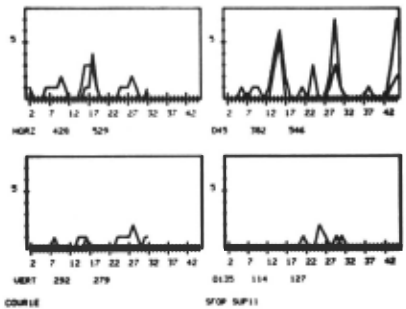
Fig. 3. Co-occurrence Results for San Francisco Exact Edge Direction Matches Only.
- Features Cor responding to Visual Perception," IEEE Trans Sr.t::-8, June 1978, pp. 46U-473.
- l"IJ D. Marr, "Early Processing of Visual Information," AI-M-340, Artificial Intelligence Laboratory, MIT, Cambridge, MA, 1975.
- [b] R. Nevatia, and K. R. Babu, "Linear Feature Extraction and Description," in proc. IJCAI-/9, Tokyo, Japan, August 1979.
- [!1] R. Nevatia, and K. Price, "Locating Structures in Aerial Images," Proc. of 4th IJCPR, Kyoto, Japan, Nov. 1978, pp. 686-90.
- tlu] R. Nevatia, K. Price, and F. Vilnrotter, "Describing Natural Textures," USCIPI Report b6U, USC, Los Angeles, CA, March 1979.
@inproceedings{ijcai1979p141,
  title     = {Describing Natural Textures},
  author    = {Nevatia, Ramakant and Price, Keith E. and Vilnrotter, Felicia M.},
  booktitle = {Proceedings of the Sixth International Joint Conference on
               Artificial Intelligence, {IJCAI-79}},
  publisher = {International Joint Conferences on Artificial Intelligence},
  editor    = {Bruce G. Buchanan},
  year      = {1979},
  month     = {8},
  url       = {https://ijcai.org/proceedings/1979/141},
}
TY - CPAPER TI - Describing Natural Textures AU - Nevatia, Ramakant AU - Price, Keith E. AU - Vilnrotter, Felicia M. T2 - Proceedings of the Sixth International Joint Conference on Artificial Intelligence, IJCAI-79 PB - International Joint Conferences on Artificial Intelligence PY - 1979 UR - https://ijcai.org/proceedings/1979/141 ER -Copied
Machine-readable versions of this paper, for tools and AI agents:





