
Visual Mapping by a Robot Rover
Proceedings of the Sixth International Joint Conference on Artificial Intelligence. .
© 1979 International Joint Conferences on Artificial Intelligence
Abstract
- Can'• world. mod.el ltC tbe eud. of a 14 lurcb ru.a. Pboto I• vi.., from llual poaltlo.a. '•IICurea are mlllr.ed. by circle•, IDd.lcatlrJ4 po•ltlou UZJcertalnt;y, oZJ tbe &rouZJd.. 45 de&r-linea &rowlrJ4 out of clrcl•• are bel&lJt ot l•uruw• above &rouDd.. Cart'• podtlon I• marbd. by blacA aquer•. 'orward polutlrJ4 ra;ya ar• Ita field. of vl•w. Tracu NbiDd. It are It• ltluerar;y, •acb •top -.rlutd. Grapb ou lett Ia It
- abowa
- U. llmltlrJ4 accuracy (a
- A.A. Schmidt, "A Study of the Real-Time Control of a Computer Driven Vehicle", Stanford AI Memo 149, Auguat 1971 .
- H.P. Moravec, •Towards Automatic VIsual Obstacle Avoidance•, ProcH<Jinga of the 5th IJCAI, MIT, Cambridge, Mass., 1977, p. 684. The featurea In the cart'a 30 world model can be tholqrt of aa fuzzy 3. E. W. Dljk.atra, • A Note on Two Problema In Connection with Graphs, • elllpaolda, whole dlmenalona reflect the program'• W~Certalnty of their position. Numerische Mlthemet/1<,1 , 269-271 (1959). Repeated appllcatlona of the lntereat operator aa the cart moves cause virtually
References were extracted automatically from the PDF and may contain errors.
Full text extracted automatically from the PDF; figures, tables and equations may differ. The PDF is the version of record.
Introduction
The real -'«! provldN potentially t.lge ~ltlea of nolay data. The '- levela of the perwptlon proceM nuat extract ...tl.tlle and meaningful ~ from thla aullled -lth. Much exlatlng WOit. In vlalon ev.- the bulk of the noiM problem, either by phyelcally optlmlzq the natln, IW!tlng and ooloratlon of the viewed ac-, or by atartlng with very hfWI quality digitized phot~y.
Thla p..,er Ia Mlout a altuatlon In which the noiM could not be IQnored. The routlnM dNcrlbed extract very reliable three dlmenalonal lnfonnatlon from .-eNtrained - perceived by an lmpreciM vehicle lraMmlttlng plcllna ~ quality hu cauaecl aome vlalon reaNrchera to hold their (met8phorlcal) -· The cut'a noiM problema may be unu-lly aev .... , but - preaent to aome
_.. In all rNI world aMaora and effectot8. For thla rNaon our aolutlona may be generally uaeful u put of the solid. fOinlatlona of ambltloua ayatema well beyond robot explorera, u computer vlalon movN from optimized wO!Upacea Into the Inherently dirty real world.
The Lnderlylng theme of the WOit. Ia the uae of recblclancy (which the real -'«! auppllea In profualon) to ccxmer nolae. In many CUM I wu forced Into thla by parfonnance fall~n of other approechN.
Setting
The Cart [1] '-a rk:Qty -a equipped rover, computer oontrolled over a radio link. Thla report dNcrlbN a WO!t.lng program that hu -ceeafully uaec1 plotlfta obtained from the cut aa It waa ~van, W~gUided, t11ro1q1 cluttered real -ld anvlronmenta to obtain navJoatlonal lnfonnatlon and to build cotrect ttrM cllmeNIIonal mapa of Ita IUirOI.Wldlnga and to plan obstacle avoiding patha to dNired '-tiona. The program bullda a aparae 30 map of Ita llft'OUIIdlnga, but makN no attempt to claaalfy the objecta It -·· except u obataclea or non-obstacles. Worlt lftlerway will -ble the program to actively keep the cut on the plamed path.
In 1W7 I abandoned aa wwvorbble an approach [2] that tried to obtain depth lnfonnatlon from a - exclualvely throuF motion atereo palra. The matching errora In our very nolay plctlfta, combined with an W~eertaln baaellne aet by vehicle motion, often cauaed Incorrect --ta from the routine which cleducecl vehicle motion from the perceived lhlft of featwN In the scene. The navigational model quickly became hopeleaaly lnaocurate. Several attempta at aoftwtn flxN proved frultleaa.
New hardware, to extract more nolay data from the -'«!, hu overcome the problem. The cut Ia now equipped with a rnechanl1111 that uaea a stepping ..tor to alicia the TV ~ horizontally on a 62 em track In preciM 0.26 rrrn napa. The cut ayatem uaea thla arrangement to obtain nine vlewa of the acene, It 8.4 em lntervala. ThNe provide a highly rNntant nine-eyed atereo baMIIne fclr reliable dlatance --ta evan In the preeance of much nolae.
Overview
Mapping Mil oocaalonally begin with a camera oallbratlon atep (at other tiiiiN old calibrations are uaed). The cut Ia placed 3 metara In front of and pointed towarde 1 3 meter equare pattern of dote on a -11. A program dlgltlzN the pattern, and automatloally locatN the apota and daterm!Ma the -a·a focal length ae -11 ae dletortlona.
The cart Ia· than placed on 1 cl.., path In 1 cluttered apace ( envlronmanta have Included a large room cluttered with boxN and old machinery, and an outdoor roadway with patUd cara, trNa and elgnpoata). A navigating progrwn Ia beglna by rNdlng In 1 calibration file. It than alldea the -· to the left limit of Ita track. A TV Image Ia digitized, the camera than alldN IU em to the rfght, -Iller plctln Ia taken, and eo on for a total of nine Images. The cart elta Immobile for Mlout tan realtime mlnutea while our tlmeehared KL-10 worlta on the plcturea for 180 compute eeconda. Than It IIM'Chea about a meter forward, atQPt, and repeata the -· motion.
Ae the cut movN slowly forward, meter by meter, the prowam generates and 141datN a three dlmanalonal world model of featlfta It hu aean, and deG!ces the vehlcle'a motion tllrolql them. Thla model Is dlapJ.yed In map form. Initially the map Ia blank. Aa time (and the cut) proceada more and more polnta - added. The map lncludee the cart'a put trajectory, and a path to a dNired destination that avokla all known obataclee.
The program J. being extended to leaue steering commande, Intended to keep the cut on Ita planned obstacle avoiding path, before each h.rch.
Visual Mapping by a Robot Rover
RazuP.lrltoravec AI £all, Co..,ater 8cleuce Dept. IJtiUdord UZJiverdty, Stazdonf, Ca., 84305
Digitizing (Tempo,.·l .RecfUDCfaucy)
Digitizing Images over a aometlmee nolay radio link haa Ita problema, but gaining adequate lmagaa Ia a crucial put of the cart ayatem. ·
The plct~n Ia tranamltted at 624 MHz, a wavelength of 67 em. Reflections from neartly objects sometimes cancel the algnal to 1 receiver. The program~ - able to get their picture through any one of 4 TV recelvera. They meaau"e acanllne to acanllne nolee on each In tum, and than pick the one with loweat noiM. In fulln I may sln.,ly awltch antannaa to 1 alngle receiver.
Clu' decada old digitizer extracta a plctlft 280 aamples wide by 240 high by 4 blts/.,.q~le from broadcaat standard video. Four bits Is only sixteen grey levele, and aometlmN the noiH level Is high. Sunmlng a number of frame· can lncre... the Intensity reaolutlon and average out nolae, but Introduces new problema. The sync detector on the digitizer sometlrnea falls, especially when the signal Ia nolay, and the picture jlttera or ·rolla". Adding Improperly registered plcturN reautte In biiMTing. The problem haa been solved by a program that dlgltiZN a large l'll.ll1ber of frames {about 30), and by an efficient sampling of the plxela lntercomparea them to find the aubset of plctlfta that are moat nearly alike. ThNe are than combined. Since mOst Images have not suffered sync loaa, the reault Ia alrnoat always a tolerable elx bit picture.
Picture Reduction (Area lledaudaucy)
The cart vision programs make extenelve ua· of reduced veralona of I~ lmagN. Dtgttlzed pictures are compreseed repeatedly by linear factora of two, four plxela being added to become one, until the whole Image has ahrunk to 1 single pixel. The original Image and all of Ita reductlona are available to all aubMquant atepa.
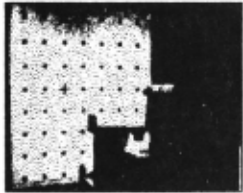
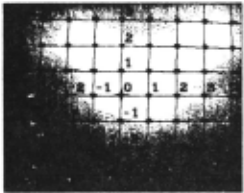
Tile cart be~ore Ita callbraUoD array, UJd tbe dl<Jzed apot patteru, overlayed by aD Ideal t.rld dlatorted by tbe calibration polyuo·lti,
Calibration (lledundancy In lle.Warlty)
The cut camera's Image Is distorted by the details of Ita lana, and of Ita vidicon'· acan. Ita precision haa been enhanced by an automatic focal length and distortion determining pro"am.
The cut Is parked a precise dlatance In front a aquare pattern of apota arout1d 1 central croaa. The pro"am digitizes an Image of the array, locates the spots and the croas, and constructs a 20 polynomial that relate· the position of the apota In the Image to their poaltlon In an Ideal unity focal length camera, and another polynomial thllt converts polnta from the Ideal camera to points In the Image. ThNe polynomlala are uaed to correct the poaltlons of perceived objects In laterac-a.
The algorithm begins by determining Ita approximate apeclng and orientation of the apot array. It trims the picture to make It square, reduces It by averaging to e4 by 84, calculates the Fourier tranafonn of the reduced Image and takee lte power apectrum, arriving at a 20 transform symmetric about the origin, and having strong peaks at frequencies correapondlng to the horlz.ontal, vertical and half diagonal spacing, with weaker peaka at the harmonica. It multiplies each point [I,J] In thla tranaform by point [ -J,I] and points [J-I,J+I] and [I+J,J-1], effectively folding the primary peaka onto one another. The strongest peak In the 90 degr- wedge around the y axla gives the spacing and orientation Information needed by the next part of the proceas.
The directional variance Interest OPerator deacrlbed later Ia applied to roughly locate a apot near the canter of the Image. A apeclal OPerator examines a window surrounding thla position, generates a histogram of lntenalty valuea within the window and selecta a threshold for separating the black aoot from the white background. It calculatea the centtold and verlflea the spot's allape by meaSU"Ing the flrat and aecond moment. The revton of found apots Ia grown outward from this seed, using thla operator guided by the Fourier determined orientation/spacing parametera.
The Fourier runbers are alao used to construct a template for the expected appearance of the cro .. In the middle of the array. Each of the found apota Ia matched to thla croaa template, and the cloHst match In the central portion of the picture Is declared to be the origin.
Two fourth devree leaat squares polynomlala In two variables relating the actual positions of the spots to the Ideal poaltlons are generated and written Into a file.
The program tolerates a wide range of apot parameters (about 3 to 12 ~pots aero .. ), arbitrary Image rotation, and Ia very robuat. It has worlted without error on over 60 lmagea. The test pattern for the c.rt Is a 3 meter square painted on a wall, with 6 em apots at 30 em Intervals. The program has alao been uaed successfully with a small array (22 x 28 em) to calibrate cameras other than the cart'··
Choo·lng Feature· (lleduDdaDcy iD BouDdariea)
The cart vlalon code deals with vwy almple primitive entltlea, localized regions called featurea. A feature Ia conceptually a point In the three dlmenalonal world, but It Ia found by examining localltlea larger than points In pictures. A feature Is good If It can be located unamblguoualy In different views of a scene. A uniformly colored region or a simple edge does not make for good feat..-ea because Its parts are Indistinguishable. Reglona, such as comers, with high contrast In orthogonal directions are best.
New features In Images are picked by a llb'outlne called the lntere.t operator. It tries to select a relatively uniform scattering, to maximize the probability that a few features will be picked on every vlalble object, and trlea to choose areaa that can be eully found In other lmagea. Both goals are achieved by ret~n1lng revtona that are local maxima of a directional vartance meaSU"e.
Directional variance Is meaSU'ed over arnall square windows. Sums of aquarea of differences of pixels adjacent In each of to..- directions (horizontal, vertical and two diagonals) over each window are calculated, and the window's Interest meas..-e Ia the minimum of theae four auma.
Features are chosen where the lntereat rneaSU"e haa local maxima. The feature Is conceptually the point at the center of the window with thla locally maximal value.
The effects of nolae are alleviated and the proceaalng time Ia shortened by applying the operator to a reduced Image. In the current program original lmagea are 240 lines high by 256 pixels wide. The lntereat operator Ia applied to the 120 by 128 version, on windows 3 pixels squana.
Once a feature Ia chosen, Its appearance Is recorded aa aeries of excerpts from the reduced Image sequence. A 8x8 window Ia excised around the feature's location from each of the variously reduced plcturea. Only a tiny fraction of the area of the original (unreduced) Image Is extracted. Four times as much of the x2 reduced Image Is atored, sixteen tlmea as much of the x4 reduction, and so on until at aome level we have the whole Image. The final result Ia a aerlea of e by 6 pictures, beginning with a very blurry rendition of the whole picture, gradually zooming In linear expansions of two to a sharp closeup of the feature.
Finding Feature· Again (ReduDdaDcy iD CoDtiDuity)
Deducing the 30 location of features from their projections In 20 tmagea requires that we know their position In two or more such lmagea.
The correlator Ia a subroutine that takes a feature description (such as the Interest operator produces), and flnda the best match In a different Image. Its search area can be an entire new picture, or a rectangular u-wlndow.
The search usea a coarse to fine strategy that beglna In reduced versions of the pictures. Typically the flrat step takes place at the x 16 (linear) reduction level. The 6 by 6 window at that level In the feature description, which covers about one seventh of the total area of the original picture, Is convolved with the search area In the correspondingly reduced version of the second picture. The e by 6 description patch Ia moved pixel by pixel over the approximately 16 by 16 destination picture, and a correlation coefficient Ia calculated for each trial position.
The position with the bast match Ia recorded. The 6x6 area It OCCIIPiea In the second picture. Ia mapped to the x8 reduction level, where the correapondlng region Is 12 pixels by 12. The 8 by 6 window In the x8 reduced level of the feature deacrtptlon Ia then convolved with thla 12 by 12 area, and the position of best match Is recorded and uaed as a search area for the x4 level.
The process contlnuea, matching smaller and amaller, but more and more detailed windows until a 6 by 8 area Is selected In the unreduced picture.
The worl< 111 each level Ia about the same, finding a 8 by 6 window In a 12 by 12 search area. It Involves 411 summations of 36 quantities. In our example there were 6 auch levela.
Slider Stereo (Spatial lleduDdaucy)
At each pause on Ita computer controited Itinerary the cart slides Its camera from left to rl~t on the 62 em track, taking 9 pictures at preclae 8.6 em Interval a.
Polnta are chosen In the fifth (middle) of thNe 9 lmagea, either by the correlator, to match featurea from previous positions, or by the Interest operator.
The camera slides parallel to the horizontal axis of the (dlatortlon corrected) camera co-ordinate ayatem, so the parallax Induced apparent dttpla~t of features from frame to frame In the 9 plcturea Ia PlftiY In the X direction.
The correlator loob for the selected featurea from the central Image In each of the eight other plcturea. The search Ia reatrlcted to a narrow horizontal bene!. Thla has little effect on the c~tatlon time, but It reducaa the probability of Incorrect matchea.
In the caae of correct matches, the distance to the feature Ia tnveraety proportional to Ita dltplacement from one Image to another. The uncertainty In such a meaSU'ernent Ia the dlffefWICe In distance a shift one pixel In the Image would make. The uncertainty varlaa Inversely with the phyalcal separation of the camera poaltlons where the pictures were taken (the stereo baseline).
After the correlation step the ~ knowa a feature's poaltlon In nine lmagea. It conaldera each of the 38 possible Image palrtnga aa a stereo baaellne, and recorda the estimated dlat.nce to the feature In a histogram of Inverse dlatancea. Each measurement adds a little normal curve to the histogram, with mean at the estimated distance, and atWKiard deviation lnveraety proportional to the baseline, modelling the distance uncertainty. The area under the each curve Is made proportional to the product of the correlation coefficients of the matches In the two lmagea (In central Image thla coefficient Ia taken aa unity), reflecting the confidence that the correlations were correct. The area Ia atao -led by the normalized dot products of X axla and the shift of the featurea In each of the two baseline Images from the central Image. That Is, a distance measurement Ia penalized If there Ia algnltlcent motion of the feature In tha Y direction.
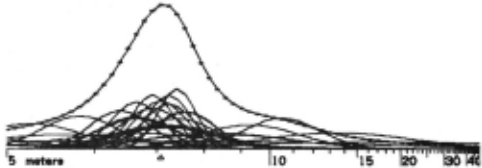
lleaulta or a Di--e7ed atereo razl4l!J4 OD a alrJ4le featrue. T.lae ·mall curvea are fro· iDdividual im.&e pain, UJe &eacled carve ia &be tiDal biato~tram. Tbe feature ia 7.1 aetera cliatUJI.
The dlatance to the feature Ia Indicated by the largeat peak In the reaultlng histogram, If thla peak Ia above a certain threshold. If below, the feature Ia forgotten about.
This adding of normal curves and locating the peak In the sum Ia an efficient way of finding the atrongeat cluster of mutually agreeing meaSU'ementl. The distance measurements from different palrtnga of Incorrect matches are u..lly lnconslatent. When the normal curves from 38 palra are added 1111. the correct matches agree with each other, and build up a large peak In the histogram, while Incorrect matches tpread themaelvea thinly. Two or three correct correlation· out of the eight will -fly build a peak sufficient to offaat a larger runber of errors.
In thla way eight applications of a mildly nallable operator Interact to mak .. a very reliable distance meaSU"ement.
Motion Stereo (lleduDdaucy ot lliltfd MotioDa)
Tha cart navigates exclusively by vlalon. It deduces Ita own motion from the apparent 30 shift of the features around ft.
After having determined the 30 location of objecta at - position, the computer drives the cart about a meter forward.
At the new position It alldea the camera and takea nina plcturea. The correlator Ia applied In an attempt to find all the features aucceaafully located at the previous position. Feature descriptions extracted from the central Image at the last position are aearched for In the central Image at the new stopping place.
Slider stereo then determines the distance of the featurea 10 found from the cart's new position. The program now knows the 30 position of the featurea relative to Its camera at the old and the new locations. It oan deduce Ita own movement by finding the 30 co-ordinate tranaform that relatea the two.
There can be mis-matches In the correlations between the central lmagea at two positions. Before the cart motion Ia deduced, the feature poaltlona are checked for conslatency. Although It doesn't yet have the co-ordinate tr-form between the old and new camera ayatema, the program knows the dlatance between palra of positions should be the same In both. It makes a matrix In which element [ i,J) Is the absolute value of the difference In distance· between polnta i and J In the flrat and aecond co-ordinate syatems divided by the expected error (based on the one pixel uncertainty of the ranging).
Each row of this matrtx Ia aoowned, glvl~ an Indication of how much each point disagrees with the other points. The Idea Ia that while polnta In error dl...,... with virtually all pointe, c-.ct poeltlone aar- with all the oth« con-ect OMe, and dleacre· only with the bad -.
The wore! point 11 deleted, and 111 effect 11 I'MIIOVed from the rwmalnlng pointe In the row IUIIII. Thle pruning Ia repeated W~tll the worat error Ia within the error elqleCted from the rqlng uncertainty.
After the p!Vllng, the pr<>IJ"Mn nae a runber of pointe, typlcelly 10 to 20, whoM poaltlon error Ia -11 and known. These are recorded In a world model.
From the 30 cemera co-ordinate· of theM unitized pointe at both poaltlona, the PI"OIJ"&m flnda a thrH dlmenalonal rotation and tranalatlon that, If ~lied to the co-ordlnatN of the featiiN at the flr.t poaltlon, mlnlmlzN the IUITt of the eq~WN of the dlatancea between the hnlfonnecl flrlt co-onllnatea and the raw co-onllnatN of the correapondlng pointe at the aecond poaltlon, each t.m divided by the ~ of the 1 priori expected error.
The error expreaalon Ia expanded. It becomN a function of the rotetlon and tranalatlon, with perametera the! are the wel"'ted averagea of the x, y and z co-ordlnatN of the featu-ee at the two poaltlone, and average~ of their various crou-producte. TliNe averagea need to be determined only once, at the beglnlng of the tranaform finding procNa.
To minimize the error expreulon, Ita pertlal derivative with reapect to each variable II aet to ~:ero. It Ia ... Y to almult~ly eolve the thrH linear equatlonl lhla reaultlng for the vector offHt, getting the optimal ofteet valuea for a general rotetlon. Thll glvN aymbollc expreaalone (linear combination& of the rotetlon matrb1 coeftlclenta) for each of the thrH vector componenta. ~tltutlng theM valuea Into the etror expreaalon makee It a fW~Ctlon of the rotation alone. Thla recb:ed error expreaalon Ia UNCI In all the Uaequent atepa.
Minimizing the error expreaalon ~ rotetlon Ia turprlelngly difficult, mainly *-· of the non-linear constraint· In the 30 rotation matrix.
The ~ beglna by IW'orlng the non-llnearltiN. It IOIVN for the general 30 linear tranaformatlon, nine elemente of a matrix, that mlnlmll:N the l ... t aquare error. The derlvatlvN of the error expreulon with reapect to each of the matrix coefflclenta are equated to 1:ero, and the nine re.~ltlng almultaneous linear equatlone are eolved for the nine coefflclenta. If the polnta had undergone an error-free rigid rotation and tranalatlon beiWHn the two poaltlone, the reault would be the dealred rotation matrix, and the problem would be aolved.
Becauae there are errora In the determined poaltlon of the featurea, the rNUitlng matrix Ia UM~&IIy not alfT1IIy a rotation, but lnvolvN atretchlng and ek-Ing. The PI"OIJ"&m ortho-normalll:N the matrix. and converta Ita 9 hlepeudent linear elernenta to W~Avolably non-llneer expr ... lona In three par-t .... that W~lquely cheracterl~:e a rotation.
Thla new error expreaalon Ia differentiated with reapect to eact1 of the tlwM rotation pararnetera, and the reaultlng expr ... lona - equated to zero, giving ua thrM non-linear equatlona In thrH l.llknowna. TheH - eolved by Newton'· method.
Fou- or five lteratlona uaually brlnga the ~~ .... to within 0\1' floating point ace~n~cy of the correct valuea. In the occ:aalonal caae of non-oonvergenoe, the ~ plc:U a new atartlng point, and triN again, up to 100 tlmea. The rotation with the amalleat leaat aquare .ror ever encoW~tered cUing IUOh a March Ia returned u the anawer.
Since the IUI'IWII&IIona over the co-ordinate croaa-producta - clone once and for all at the beglnlng of the tranaformatlon determination, each Iteration, Involving evaluation of about a dozen moderately large expr ... lona and a 3 by 3 matrix lnveralon, Ia relatively faat. The whole aolvlng proceaa, even In caaea of pathologlcel non-convergence, take· one or two aeconda of C0111JUier time.
Path Planning
all vlalble objects to be become modelled as cluatera of overlapping elllpeolda.
To ~llfy the problem, the elllpaolda are approximated by apheres. Thoae ipherea auftlclently above the floor and below the cert's maxlnun height are projected on the floor as circles. The cart ltaelf Ia modelled aa a 3 meter sphere. The path finding problem then becomes one of maneuvering the cart' a 3 meter projected circle between the (uaually smaller) circles of the potential obstacles to a dealred locetlon.
It Is convenient (and equivalent) to conceptually shrink the cart to a point, and add Ita radius to each and every obatacle. An optimum path In this environment will conelst of either a atralght n.n between start and flnlah, or a aeriN of tangential aegmenta between the cylinders and contacting arcs (Imagine looHiy laying a atrlng from start to flnlah between the cylinders, then pull ing It tl"'t).
There are four poaslble paths betw-each pair of obatacles, bee-· each tangent can approach clockwise or counterclockwlae. The program finds a near optimal obstacle avoiding route to the dealred goal In O(n3) time, using an extenelon of a shortest path In a graph algorithm first given by Oljkatra [ 3]. a.cauae ow tangent apace cannot be modelled exactly a1 a almple graph, beceule of the route dependent arc lengtha on the circular part of the paths, the prOIJ"am flnda good paths, but not alwaya the beat.
Reaulta
Becauae of a hardware problem with the s!Hrlng electronics, the program hu tRia far driven the cart without steeriAQ control, In nearly stral"'t linea only. Oiling these runa It has built correct world maps, and planned (but not executed) good obatacle avoiding paths.
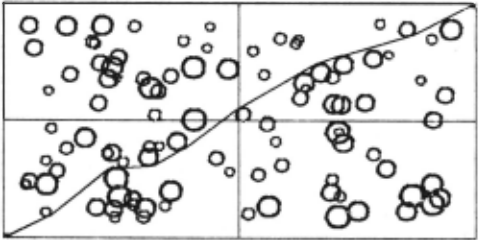
The longest n.n thus far haa been for 14 nine-picture sets, a total dl1tanoe of about 10 metera. During thla n.n, made In a large cluttered room, the program lnaerted 120 features Into Its world model, of whlch·about naif were potential obataciN, moat of the other half being marlta on the floor. I waa able to f ind no errora beyond the known position ~alntlel In the reaultlng map. The perts of the room that were In the cart'· field of view for the bulk of the run are densely repreaented, with no po .. lble patha falaely ·-mlng to be obstacle- fr-. Several ahorter runa gave almllarly robust reaults.
The ateerlng problem 11 being repaired, and I expect a long outdoor run, In which the cart will maneuver ar()(Rj aeveral obataclea, In the near future.
A longer description of thla work 11 available from the author.
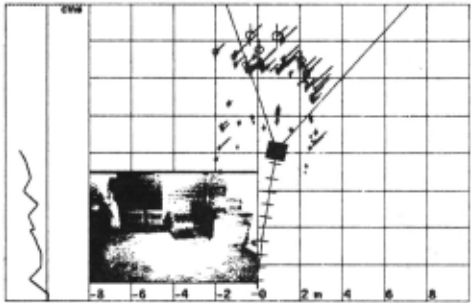
Can'· world. mod.el ltC tbe eud. of a 14 lurcb ru.a. Pboto I· vi.., from llual poaltlo.a. '·IICurea are mlllr.ed. by circle·, IDd.lcatlrJ4 po·ltlou UZJcertalnt;y, oZJ tbe &rouZJd.. 45 de&r- linea &rowlrJ4 out of clrcl·· are bel&lJt ot l·uruw· above &rouDd.. Cart'· podtlon I· marbd. by blacA aquer·. 'orward polutlrJ4 ra;ya ar· Ita field. of vl·w. Tracu NbiDd. It are It· ltluerar;y, ·acb ·top I· -.rlutd. by a bar. Grapb ou lett Ia It· eatlmate of owu bei&JJt abov· &rouud.. It abowa U. llmltlrJ4 accuracy (a few c·ntlmet·r ·) of It· aell-po·ltlou mod.el.
- A.A. Schmidt, "A Study of the Real-Time Control of a Computer Driven Vehicle", Stanford AI Memo 149, Auguat 1971.
- 2.. H.P. Moravec, ·Towards Automatic VIsual Obstacle Avoidance·, ProcH<Jinga of the 5th IJCAI, MIT, Cambridge, Mass., 1977, p. 684.
- The featurea In the cart'a 30 world model can be tholqrt of aa fuzzy 3. E. W. Dljk.atra, · A Note on Two Problema In Connection with Graphs, ·
elllpaolda, whole dlmenalona reflect the program'· W~Certalnty of their position. Numerische Mlthemet/1<,1 , 269-271 (1959). Repeated appllcatlona of the lntereat operator aa the cart moves cause virtually
@inproceedings{ijcai1979p132,
  title     = {Visual Mapping by a Robot Rover},
  author    = {Moravec, Hans P.},
  booktitle = {Proceedings of the Sixth International Joint Conference on
               Artificial Intelligence, {IJCAI-79}},
  publisher = {International Joint Conferences on Artificial Intelligence},
  editor    = {Bruce G. Buchanan},
  year      = {1979},
  month     = {8},
  url       = {https://ijcai.org/proceedings/1979/132},
}
TY - CPAPER TI - Visual Mapping by a Robot Rover AU - Moravec, Hans P. T2 - Proceedings of the Sixth International Joint Conference on Artificial Intelligence, IJCAI-79 PB - International Joint Conferences on Artificial Intelligence PY - 1979 UR - https://ijcai.org/proceedings/1979/132 ER -Copied
Machine-readable versions of this paper, for tools and AI agents:





