
A Polarimetric Approach to Shape Understanding of Glossy Objects
Proceedings of the Sixth International Joint Conference on Artificial Intelligence. .
© 1979 International Joint Conferences on Artificial Intelligence
Abstract
A polarimetric method is proposed to find surface normals, which will help the 3-D shape understanding of glossy objects. Attention is directed to the fact that glossy objects are characterized by conspicuous specular reflection, which has a certain polarizational property as a function of the incident angle and the refractive index of the material. The relation is formulated between the local normal and the polarizational parameters. The Stokes parameters are used to express the state of polarization. As to several materials preliminary measurements are done to examine for utility of polarizational information to finding local normals. The proposed method will be effective in extracting geometrical parameters from glossy objects whose gloss occurs on dielectric surfaces such as plastics, lacquered items, polished paper and so on.
- Horn, B. "Obtaining Shape From Shading Information, Winston,P.H.(ed.), The Psychology of Computer Vision." McGraw-hill, 1975.
- Clarke, D. and Grainger, J.F. "Polarized Light and Optical Measurement." Pergamon Press, 1971.
- Aspnes, D.E. and Hauge, P.s. "Rotating-compensator/ analyzer fixed-analyzer ellipsometer; Analysis and comparison to other automatic • ellipsometers." .J... Qm.. ~.Am,. 66:9 (1976) 949-954.
References were extracted automatically from the PDF and may contain errors.
Full text extracted automatically from the PDF; figures, tables and equations may differ. The PDF is the version of record.
1. INTRODUCTION
We propose a polarimetric method of obtaining surface normals, which will help the 3-D shape understanding of glossy objects.
Horn(l] has obtained shapes information. Glossy surfaces, little shading information, dominantly reflect specular rays. from shading however, have since they
The specular ray has a certain polarizational characteristic as a function of the incident angle and the refractive index of the surface material,
We examine for utility of polarizational information to finding local normals.
2. POLARIZATIONAL RELATION
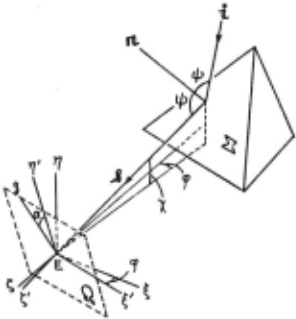
In Fig.l ·, f and_J are rays of incidence and reflection upon a plane 1}, respectively' and n is the normal, ~is the frame to which the Stokes parameters(2] are referred, and ~ 1 is the reference direction. 3 implies the intersection of the frame and the plane of incidence.
The polarization state of the ray .I contains information about the angles 1./.J and (k' , which will provide a clue for finding the normalla.
We regard the specular plane as a partial polarizer with retardance, and use a right circular ray as an input. Then, the Stokes vector * of the reflected ray will be derived by the Mueller calculus as follows;
* a 4xl column vector whose elements are the four Stokes parameters
where rur· the amplitude reflection. coefficients of components vibrating perpendicular to and parallel to the plane of incidenceo
- o the phase difference between both components
C, ,Se COB {!) ,sin 9
Ic the intensity of the light source P:(~-~ I (zl+~, Uo;2llrJ:& I (tft-~, Va211JiSI I (z!+~
occurs expression
where Id and Ip depolarized and respectively. are the intensities of polarized components,
3. MEASUREMENT OF THE STOKES PARAMETERS
We use a simplified "rotating-compensator/ fixed-analyzer ellipsometer configuration"[3], which can eliminate the polarizational effect of the detector.
The intensity transmitted by this configuration is proportional to
where ~ is an azimuth of the 1uarter-wave plate, with the analyzer kept at c:
Using its values I"" sampled at ~ =22. 5··m (m=O,l, · ·, 7), we find
4. SEQUENCE .!Q. .E!!!£ 1]! ~ ~
1. Calculate Ip asJL 1 +X 2 +0 2 · If Ip is too small, reliable values cannot be obtained at that point. otherwise,
- Find lJJ to fill o-=U.
- Find P and V corresponding to~.
- Find (X using l,x ,P and V.
- Determinel\,using,,'X,.,and ex.
5. PRELIMINARY EXPERIMENT
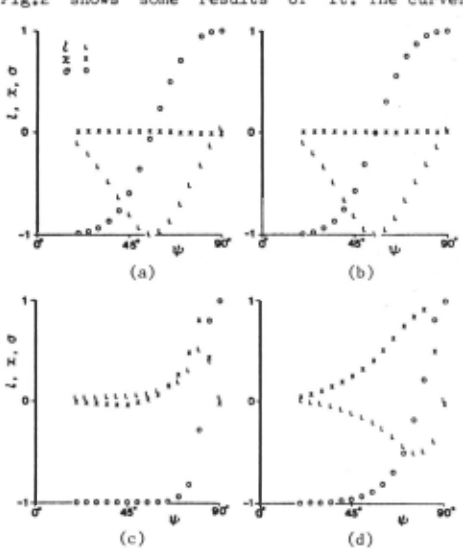
In order to examine for utility of P,U and V to finding t.p , we measured l,x and o- as to actual materials, changing tP at '=l=o·, CX=90° (that is, 1=-P, x=-V and o-=U).
Fig.2 shows some results of it. The curves feasible for use are obtained from the dielectrics such as the acrylic resin board and the polished paper, while riot from the metals.
In this experiment we used Polaroid sheets of quarter-wave plate, linear and circular polarizers, a PIN photodiode detector and a DC-supplied incandescent lamp as a light source.
6. DISCUSSIONS
If l.P is closer to o· or 90·, both P and V become too small to find a reliable value of ex · The normal can be determined for ~=0~ since it coincides with the observed ray, while, not for ~90· by this method.
P, U and V can be theoretically derived from the refractive index, if known, by Fresnel equation. Otherwise it will be practical to get them by preliminary measurements as we did.
As far as a method of finding normals depends on specularly reflected lights, the light sources must be arranged so as to observe the specular ray from any investigating part of the surface. We, however, need not know their intensities, directions or positions.
The proposed method will be applicable to extracting geometrical parameters from glossy objects such as plastics, polished papers, lacquered items and so on. The objects have no need of uniform coloring, if their surface is coated with a dielectric.
It is under investigation to actually determine the normals from TV camera data.
ACKNOWLEDGMENT
The author is very grateful to Dr. Yoshiaki Shirai for suggesting to him to publish this work.
@inproceedings{ijcai1979p109,
  title     = {A Polarimetric Approach to Shape Understanding of Glossy Objects},
  author    = {Koshikawa, Kazutada},
  booktitle = {Proceedings of the Sixth International Joint Conference on
               Artificial Intelligence, {IJCAI-79}},
  publisher = {International Joint Conferences on Artificial Intelligence},
  editor    = {Bruce G. Buchanan},
  year      = {1979},
  month     = {8},
  url       = {https://ijcai.org/proceedings/1979/109},
}
TY - CPAPER TI - A Polarimetric Approach to Shape Understanding of Glossy Objects AU - Koshikawa, Kazutada T2 - Proceedings of the Sixth International Joint Conference on Artificial Intelligence, IJCAI-79 PB - International Joint Conferences on Artificial Intelligence PY - 1979 UR - https://ijcai.org/proceedings/1979/109 ER -Copied
Machine-readable versions of this paper, for tools and AI agents:





