
Japanese Word Processor
Proceedings of the Sixth International Joint Conference on Artificial Intelligence. .
© 1979 International Joint Conferences on Artificial Intelligence
Abstract
Japanese word processor(JWP)presents a typewriter which can easily handle Japanese documents with newly developped and quite different way from conventional Japanese typewriters. Japanese documents consist of more than two thousand letters (Kanjis:Chinese characters, Kanas: Japanese alphabet, alphanumerics, and so on). The conventional Japanese typewriter is equipped with all these letters. It means that typewriting is very difficult and typing speed is low. JWP overcame these difficulties with Kana-to-Kanji translation technology.
Full text extracted automatically from the PDF; figures, tables and equations may differ. The PDF is the version of record.
1. OVERVIEW
Japanese is a very unique language in its variety of letters. It has several kinds of letters: Hira-Kana (Japanese alphabet;&?,~,, 3 ,---), Kata-Kana (Japanese alphabet used for foreign words; 7 , .-( , ·) , ---), Kanji (Chinese character;lll ,JII, J.l~,---), and alphanumerics (a,b,c,---,O,l,2,---).
Kanas consist of about fifty letters. Popular Kanjis amount to about two thousand. These letters appear in ordinary Japanese documents such as newspapers, business letters, and so on. The abundant letters invoke difficulties in typing Japanese documents. The conventional Japanese typewriter has to be equipped with all letters, and typists must look for letters one by one. Thus "letter-searching" is an intrinsic problem in the Japanese typewriting. In order to overcome this problem, Kana-to Kanji translation thechnology is applied in the Japanese Word Processor (JWP). A Kana sentence is just a sequence of phonetic sym bols. So the Kana sentences are easy to type because of the small number of keys, but they
are difficult to understand.
The new techniques to translate Kana sentences into ordinary Japanese sentences are discussed henceforth.
2. KANA-TO-KANJI TRANSLATION
Grammatical analysis is applied to get correct translation by JWP. Kana sentences are trans lated into Kanji sentences phrase by phrase.
The definition of the phrase is given as follows:
Phrasec(prefix)substantive word(suffix) (functional word*)
Substantive word=noun/pronoun/verb/adjective/ adverb/conjunction/interjection
Functional word=particle/auxiliary verb
Here parentheses indicate optionality, the asterisk indicates one or more occurences, and
the slant indicates alternatives.
Generally speaking, nouns are accompanied with a particle which indicates cases. Verbs are accompanied with conjugating auxiliary verbs, which indicate tenses, moods, and voices, with out any separation between them (Fig.l).
?tid: tt tl.~ f.'£ 13 fd: /)\-, ft
minakerebanaranakatta Thad to ~;) -- -
Each underlined part denotes a verb, auxiliary verbs, and a particle.
Fig.l An example of Japanese verb phrase
The grammatical analysis means analyzing the phrase grammatically. There are two ·main difficulties here, conjugation and concate nation of verbs and auxiliary verbs, and appearance of homonyms.
2 . 1 GRAMMATICAL ANALYSIS
Japanese sentences consist of a series of the phrases. The role of the Japanese phrases in sentences is approximately similar to English one (Fig.2), but structure of the phrases is different as shown by the above definition.
Here pl is a noun phrase, p2 is a pre positional phrase, and p3 is a verb phrase.
Fig,2 An example of the role of phrases
The analysis of verb phrase will be cited below since it is the most intricate. Japanese verbs do not express tenses, moods,and voices by their conjugation. If it is necessary to express ·them, auxiliary verbs which denote them respectively are concatenated to the verb . The verbs are classified into five conjugational groups and there are 25 auxilia ry verbs. They have six or less conjugational forms. These numerous conjugational forms of all verbs and auxiliary verbs make the verb phrases very complex.
The conjugational forms indicate the condition of the concatenations of verb and auxiliary verbs in the phrase. That is, they indicate what kind of word is concatenated to the verb or auxiliary verb. We made a connection table for all verbs and auxiliary verbs to check the concatenation. Figure 3 showes examples of the structure of the verb phrases.
iL6 (hasiru) run
.i:l2 ~ (hasit~)
iL IJ /.:~' (hasiritai)
ran
want to run
Fig.3 Examples of the structure of the verb phrase
In the figure 3, each underlined part indi cates a verb and an auxiliary verb.
2.1.1 Dictionary consultation
The first step of the grammatical analysis is to consult a dictionary for finding the sub stantive words. All possible candidates are extracted from the dictionary. We take the phrase "l.ll,'?~>~ '" (hasiranai;do not run) as an example to explain the grammatical analysis. Candidates for "liLS~·P" areshownby figure 4. Only stems are stored for verbs to reduce the number of items in the dictionary. The dictionary has the following contents for a word; Kanas, Kanjis, grammatical informations such as part of speech, conjugational type,etc., and frequency of use.
| KANJI | KANA | PART OF SPEECH | (MEANING) | |
| a | l<t.LS(hasira) | noun | (column) | |
| f ' '"' | IJL | (hasi) | noun | (bridge) |
| ~ | 1;11.., | (hasi) | noun (chopsticks ) | |
| ~ | 1<1: (., | (hasi) | stern of verb | (run) |
| !+1 | 1<1: | (ha) | noun | (leaf) |
| t!;J Fig.4 | IJ | (ha) Candidates | noun for "liLS~~''' | (tooth) |
2.1.2 Analysis of conjugation and concatenation
The conjugational part of verb "j£ "(hasi) must be S (ra) ,I') (ri), 0 (ru), t\ (re), or ?>(ro) according to the grammatical information of the dictionary. As the third Kana of Ul,O:,~~' is (ra), the verb "~" satisfies the conjugational condition. Then it must be checked that the conjugating form of " it~:> "(hasira) can be accompanied with the string "f.< ~'" (nai). It is known by the connection table that the auxilia ry verb "f.··~'" can be attached to "il:.S ". "ltS'd:~'"(hasiranai) satisfies the condition of the concatenation. Therefore ~~~~::;ts~'" is one of possible translations. Nouns are accompanied with specific particles. These particles are stored in a table. The attached Kana-string to "U "( lil.,S;hasira) is "16~'" (nai). But this string is not found in the table~ accordingly "H ~-·~' "does not satisfy the condition of the concatenation as the phrase. By the same pro cedure, all the nouns of the candidates are also rejected. Thus only one translation" it~)~ ~' " is got.
2.2 Homonyms
2.2.1 Reduction of homonyms by grammatical analysis
There are a lot of homonyms in Japanese. It results from the fact that plural Chinese characters have the identical pronunciation expressed by Kanas. Chinese character itself is a letter and not a word in Japanese. The words are composed of one or more Chinese characters. The words have homonyms, too. That is, plural words have the identical Kanas. JWP reduces the homonyms by the grammatical analysis. For example, the phrase "~.~; ?I?J: <.t" (kyouryokuna; powerful) is translated uniquely into " ~tJu " by analyzing it grammatically. If the grammatical analysis is omitted and only consultation of the dictionary is applied two homonyms occurred: "5!llhf.J:" and "lntJfd: ". Here " IC&tJfd:" is meaningless · since " lntJ " is a noun meaning "cooperation" and "fd: "(na) is a conjugating part of the adjective with which noun can not be accompanied. The meaningless translations like this often happen without the grammatical analysis.
In case of the simplest translation technique, a table of Kanjis and their corresponding Kanas is used (Fig. 5).
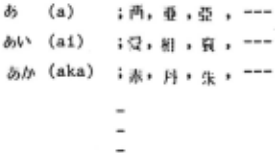
There are a lot of homonyms to a phonetic unit which is expressed by Kanas. For example, a phonetic unit " <~ J: -) "(kyou) corresponds to 137 Chinese characters; "'""· "~","~",and so on. "t)J:<." has six; "JJ", "H", "HJ", and so on. Moreover " ·~ J; ? I') J; <."has other possi bilities of combination of phonetic units except "kyou-ryoku";that is, "kyo-u-ryo-ku", "kyo-uryo-ku", and so forth. If including these, homonyms increase enormously and many meaningless translations occur.
2.2.2 Reduction of semantical homonyms by learning
JWP has two kinds of memories to avoid seman tical homonyms: a short term memory and a long term memory. The former is valid during typing one document and is reset when other documents are typed. When homonyms appear on a CRT dis play of JWP and one of them is selected by the typist, the word is memorized by JWP. When the same homonyms occur , the memorized word is indicated on the CRT display as the most possi ble candidate word in the context of the text. The latter is implemented as an administrator of the frequency of word use: JWP administrates its dictionary regarding to the frequency. When one of homonyms is selected as mentioned above, the frequency of the word increases by one. Accordingly the dictionary is becoming suitable to a certain field such as science, economics, literature, etc., since JWP refers the frequency during translation and th~ most frequent word is given priviledge to appear on the CRT display first. This method is effec tive for the semantical homonyms depending fields.
3. CONCLUSION
The automatic Kana-to-Kanji translation made the touch method possible in Japanese typing and released the typists from the burden of searching letters among .the huge number of
letters on the keyboard.
JWP occupies a remarkable status against the conventional Japanese typewriter and other related machines for its ability of automatic translation. Several new techniques applied here are quite effective to realize high performance translation. Figure 6 showes an example of translation which is a Japanese sentence of the abstract of this paper.
~u~~?-~7ut7~~~~i~~b& ~~~75~~~U~?k<.~~~~~k6 G <. /JI~\I,L:>~ tt/;:IJ"Jil ·) ~J; ~)I;:: IJ~<::' tl)..S~~ G.t ~ J; -) H,::J.;-.)/JI.;l~ ~~-(/51' 9~H'<!J.-)�J;<t.
--- Typed Kana sentence
EJ ;j\~9- ~/r:l 1~-:tltl<t.:h.t (· tl)nJ)(~ ~/~~9~U~<.Wt~~�<.~R~hk n~~J;~R*~tl)~~ksa~~~~.;l~ 9~I7~9H({)t�1lJ".
--- Translated sentence
Fig.6 An example of Kana-to-Kanji
translation
4. ACKNOWLEDGEMENT
We would like to thank Dr. Hiroshi Genchi and Dr. Ken-ichi Mori, our supervisors at Toshiba R&D Center for their encouragement and support in the course of the work reported here. We also wish to acknowledge Kimihito Takeda for his cooperation to us in developping JWP.
@inproceedings{ijcai1979p102,
  title     = {Japanese Word Processor},
  author    = {Kawada, Tsutomu and Amano, Shin'ya},
  booktitle = {Proceedings of the Sixth International Joint Conference on
               Artificial Intelligence, {IJCAI-79}},
  publisher = {International Joint Conferences on Artificial Intelligence},
  editor    = {Bruce G. Buchanan},
  year      = {1979},
  month     = {8},
  url       = {https://ijcai.org/proceedings/1979/102},
}
TY - CPAPER TI - Japanese Word Processor AU - Kawada, Tsutomu AU - Amano, Shin'ya T2 - Proceedings of the Sixth International Joint Conference on Artificial Intelligence, IJCAI-79 PB - International Joint Conferences on Artificial Intelligence PY - 1979 UR - https://ijcai.org/proceedings/1979/102 ER -Copied
Machine-readable versions of this paper, for tools and AI agents:





