
Experiences in Evaluation with BKG - A Program that Plays Backgammon
Proceedings of the Fifth International Joint Conference on Artificial Intelligence. Problem-solving and Search. Pages 428-432.
© 1977 International Joint Conferences on Artificial Intelligence
Abstract
Because of very high branching factors, a backgammon program must rely on knowledge rather than search for performance. We here disc.uss insights gained about the s tructure of evaluation functions for a large domain s uch as backgammon. Evaluation began as a single linear polynomial of backgammon features . Later, we introduced s tat e-c lasses, each with its own evaluation function .. This · improved the play, but cau se.d problems with e dge-effects between state -c lasses. Our latest effort use s models of position potential to select across the set of best members of each represented sta te-class. This has produced a significant jump in performance of BKG. Because of the localization of knowledge, state-classes permit relatively easy modification of knowledge used in evaluati on ,. They also permit the building of opponent models ba se d upon what evidence shows the opponent knows in each state-class. Ou r program plays a generally competent game at an intermediate level of skill. It correctly solves a high percentage of intermediate level problems in books
- Berliner, H. J., "BKG--A Program that plays Backgammon", Computer Science Dept., Carnegie-Mellon Univ., Pittsburgh, Pa., July, 1977.
- Holland, Tim, "Better Backgammon", Rei . ~R Game .~, I nr.., New York, 1974.
- Keeler, E., and Spencer, J., "Optimal Doubling in Bac.kgammon", ()prrntioru RcRcar•cla, VoL 23, No. 6, Nov.-Dec., 1975, pp. 1063-1071.
- Levner, David, "Is Brute Force Backgammon Possible?", SIGIIR'/' Ncw.dcttcr 5H, June 1976, p . 20.
- Samuel, A. L., "Some Studies in Machine Learning Using the Game of Checkers", in ComprHers and Tt.ortght, (Feigenbaum, E. A. and Feldman, J., Eds.), pp. 71-105, McGraw-Hill, 1963.
- Samuel, A. L., "Some Using the Game . Progress", /lU.f IJm,clopmcni, Nov. Studies in Machine Learning of Checker'S', II -Recent Journal of Re . ~carch arid 19&7, pp. 601-617.
- Thorpe, Edward 0 ., "Backgammon: Part I, The Optimal Strategy for the Pure Running Game", Presented • at the Second llnmta.l Con[erm1r.c 011 Gamllling, Nevada, June 1975.
- Zadeh, N., and Kobliska, G., "On Optimal Doubling in Backgammon", Ma.nagement Scie•ncc, VoL 23, No. 8 April, 1977, pp. 853-858. Problem-Solvin~-1: B~rl iner
References were extracted automatically from the PDF and may contain errors.
Full text extracted automatically from the PDF; figures, tables and equations may differ. The PDF is the version of record.
Experiences in Evaluation with BI<G - A Program that plays Backgammon 1
Hans Berliner Computer Science Department Carnegie-Mellon Univers ity Pittsburgh, Pa. 15213
ABSTRACT
Because of very high branching factors, a backgammon program must rely on knowledge rather than search for performance. We here disc.uss insights gained about the structure of evaluation functions for a large domain such as backgammon. Evaluation began as a single linear polynomial of backgammon features. Later, we introduced stat e-classes, each with its own evaluation function .. This · improved the play, but cause.d problems with edge-effects between state -classes. Our latest effort uses models of position potential to select across the set of best members of each represented state-class. This has produced a significant jump in performance of
BKG.
Because of the localization of knowledge, state-classes permit relatively easy modification of knowledge used in evaluation,. They also permit the building of opponent models based upon what evidence shows the opponent knows in each state-class.
Our program plays a generally competent game at an intermediate level of skill. It correctly solves a high percentage of intermediate level problems in books.
I. Why Yet Another Game?
Backgammon is a game of skill and chance. It is an interesting object of study . for AI because in any given position (of with there are 10 20 [Le76]), there are 21 possible combinations that the throw of two dice can produce. Each of these, can be played legally in '!he average board position about . 40 different ways ( about 17 in actual game positions). Thus if one were to investigate a backgammon position by tree searching, it would be necessary to deal with a branching factor of more than 800 (!!) at every node. Clearly this is completely impractical. Therefore backgammon mu5t be approached with evaluation and knowledge in mind. Position P 1 will have to preferred over posi tion P2 because it has features that more ende·ar it to the player who can produce it than the features thar obtain in P2.
In a game such as chess, it has been customary to search very large trees of 5000 to 2 million terminal nodes. In such a paradigm, fhe execution of a terminal evaluation function requires a certain amount of time, which must then be multiplied by the expected number of terminal nodes in the search. Thus designers of chess programs are very circumspect in creating evaluation functions which require lengthy execution times. For this reason certain features that are not trivial to compute are usually ·Jeft out, so that the program may operate faster and search more. Since. there can be little or no searching in a practical backgammon program, these contingencies will not apply. .On the contrary, it is desirable to apply all possible knowledge to successor positions of the root .node, in an attempt to find the best next move. Further, the fact that modern backgammon involves doubling places an even greater emphasis on the use of knowledge, since it requires an understanding of a position (not just the ability to discriminate the best move) to know · when to double and when to accept or refuse.
I This work was supported by the Advanced Research Projects Agency of the Office of the Secretary of Defense (contract F44620-73-C-0074) and is monitored by the Air Force Office of Scientific Research.
II. The Structure of BKG
BKG is an interactive program. For a given roll ·of the dice, it generates a list of all possible legal plays. If it is the program's turn to play, it serves these potential plays up one at a time to the evaluation procedure. It then selects the . best. If it is a human opponents's turn to play, it waits to receive a legal play from its environment.
BKG now plays a completely legal g.ame of backgammon. It is cCl pable of doubling and accepting or refusing doubles C~t all times. It will also resign positions in which there is no possi bilty of winning, and accept resignations . when there is no possibility of it winning a gammon.
IlL Some Evaluation Terms
In versions of BKG up to the end of' 1976, a linear polynomial of backgammon features was .used to produce evaluations in positions where the two sides were still engaged. This polynomial derived most of its st r ength from excellent recognition of blot danger (the dC~nger of a man being hit by the opponent on his next roll), and block·ading factor (the ability to keep opponent's men bottled up). Both these calculations went through a considerable history of experimentation whi ch is described in [Be77]. Below, we briefly describe their current form. When the sides are disengaged, a running game calculation is performed since capturing and blocking are no longer possible.
A. Blot danger calculation
Our procedure considers all hitting relations between potential hitters and blots. It finds the optimal way to play every potential roll ·so as to hit the greatests number o.f biQts , .or po..i nt Qn <1 . blot . If only one blot .can be hit, it calculafes hitting \he most advanced one. Thus it cCln decide for ahy posi.lion what the probability is of · having one or more men hit, and what. the expected loss of pips in being hit is. This information is basic to understanding the risk of any potential play.
8 . Blockading Factor
A blockade consists of a set of points "made" by one side, which prevent an opposing man from having access to those points. Clearly, such points can have a great effect on the opponent's movements, and their location is of great importance.
We note that since there are only 15 men on a side, it is impossible to have more than 7 blockading points. Fo.r each combination of zero to seven blockading points at a dis! ance of 1 to 12 spaces in front of a man, we computed the number of rolls that could legally be ple~yed by the blockade runner. This · number was put into a table associated with the blockading pattern. This allows quick lookup of the degree to which each man is blockaded.
C. The Running Game
BKG has been doubling and accepting doubles in the r unning game almost since its inception. There has be.en much published on ·when to double and accept in the running game phase of backgammon [Ke75, Th75, Za77 ]. We have tried to follow this advice in structuring algorithms for deciding who is winning and by how much. This has . resulted in quite good performance by the program, even in sitwations where the decision is close.
To support decision making during the bearing off phe~se, BKG has extensive tables which give the probe~bility for a given position of one side, of bearing of f all men in 1,2,'-- . 8 rolls and the expected number of roll s (ENR) to bear all men off. The tables cover all si tuat ions for up to and including 8 men in the home board, and up to ctnd including 25 pips worth of men in the home board.
The use of the tables in move select ion is simple. BKG moves to the position with the lowest ENR. There are two exceptions to this case; that is when it is far behind or far enough ahead to have a chance of winning a gammon. In the former case, it moves to the position which has the greatest probability of bearing all men off in the number of rolls that are expected for the opponent to get off. When it is far ahead, it moves to the position which gives it the greatest chance of bearing all men off in the number of rolls it expects to have before the opponent gets his first ~an off.
For doubling and accepting· doubles the situation is more intricate. Whenever, BKG can legally double during this phase, or when i t has been doubled, it executes a win probability calculation. If the positions of" both sides can be looked up in the tables, then BKG can calculate the exact probability of the side on move winning by itteratively calculating the probability that the side on move will get all its men off on this roll , and then changi ng whose move it is, unt il" the sum of the p robe~bilities ~ 1.0. If both posit ions cannot be looked up, the win probability calculat ion is based on adjusted pipcount of both sides, but this is notably less accurate than the table lookup method, which performs superlatively.
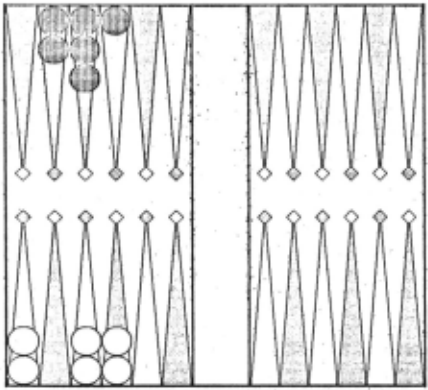
The power of the bear-off tables is very impressive. To illustrate the type· of thing BKG does to amaze its author, we show an example.
1 2 3 4 5 6 . Black 7 8 9 10 11 12
Figure
In the bottom part of Figure 1, White is to play a 6,2. The 6 must obviously be played from the 21 point. But what is the correct way to play the 2? Almost every human pi ayer would say 21-23. However, this is not correct ; 22-24 is better. The bear-off tables report the r espective ENR's to be 2.748 · and 2.739. Upon examination, it turns out that all sequences of future roll s produce the same results in the two positions except when one of the next two rolls is 1,1. If this occurred, it would leave men on the 21 and 23 points with the preferred play, which allows 6 additional combinations of getting. them both off on the next roll ove r the other way of playing it .
The second example in the top part of Figure l has similar features. Here Black is to play a 6,1. The 6 must be played from the 4 point; the question is how to play the 1. Again human players would automat ically play 2- 1, but this is incorrect. 3-2 is correct because of fut ure double 2's. For these two examples it would seem that the rule : "When there . are a small odd number of men on the board, play to maximize use of doubles" · would seem to be the correct way for humans to capture the knowledge that is contained in the tables. Thi s illustrates that · at times precise calculation will outdo good intuition.
IV. The Evaluation Process
In the first several years of development of BKG, we used a linear polynomial to order states in the state space. This was fine while new and better terms were being developed for the polynomial. However, once· a fi rm basis for detecting advantages and disadvantages was established, it became apparent (as indeed· the research of Samuel [Sa63, Sa67) would indicate) that such a polynomial would not serve. It was possible to tell BKG about the ger)eral utility of any feature, but not · enough about the utility of the feature in specific circumstances.
Therefore, we began partitioning the state-space into stale-classes. The issues assoCiated with stale-classes are these: We assume that it is poss ible to partition al~ states in the state-space into mutually exclusive state classes: This is not difficult and can be accomplished by merely having recognizers for a set of state -classes, invoking these recognizers in a canonical. order, and putting all not-recognized states into a grab- bag class. We further assume that within a state class, a linear polynomial function exists which can order the members of this class according to goodness. It is apparent that this i.s true in the limit, when there is. a · state-class for each state; however, the degree fo which thi s is possible when ·there are a large number of members in a given class is not clear. In practice it is possi ble to get very good (if not perfect) orderings, and to split a stale-class when the ordering procedure becomes too complex.
Thi s approach produced a significant improvement, but also brought some additional problems to the forefront. Whenever it was normal to progress from one state-class to another, but such a transition required .the progl'am. to submit to temporary danger, it would not do so unless there was no safe alternative. With this organization as with earlier ones, BKG was unwilling to take any unforced risk, since it had no understanding of the advantages that could be accrued if the risk succeeded, but did understand the dangers of the risk. Another cause of vacillation comes up when a reshaping of the advantage is required in the transition. This can occur when the new state-class does not value highly what is v alued highly in the old state-class. An example of this would be reluctance to give up. containment of enemy men in order to make a transition to a superior running game position. This type of problem occurs in chess too.
To correct the above problems within the framework of the linear polynomial, it would be necessary to pinpoint where postponing the taking of the risk could no longer be justified, or when a certain advantage had outli ved its usefullness.
We tried to overcome these problems by having some functions which were invoked only when a change of state-class occured. This type· of recognition produces in effect a different slate-class for two identical positions, given that one is reached from a member of the same stale -class and the other not. We found this. to be a very difficult method of doing business that did not loo.k anything like a long: term solution to the problem.
The purpose of having stale-classes was to get away. from the purely linear relations among terms in the evaluation function. This way we could emphasize certain features that would have a strong impact on future situations derivable from the current state-class. Such features include the. stability (likelihood of being hit in the case of backgammon) of the state, and measures of the degree of difficulty in making further ·progress. · Usually, the side that is closest to winning will want more stable positions, and the side that is closest to losing more unstable ones. However, this is not always the case. · The side that has a slightl y better position may want to introduce some instabilit y in the hope it will result in an even more favorable position (or even won), while risking losing the advantage or possibly getting sl ightly the worse of it. This kind of decision is ·ve-ry difficult to program, unless the terms in the evaluation function interact with one another. However, the edge-effect situation between stateclasses became extremely difficult to overcome.
Actually, notions such as progress and ri sk are· crutches that are ·not needed when a universal measure of goodness such as expectation exists, as it does in backgammon. Thus we should always move to the state wit h the greatest expectation, and state-classes are not needed at all . However , this is only in a system with perfect kroowledge. · When there is imperfect knowledge, such crutches appear ne.cessary.
Therefore, our present system attempts to overcome edge-effects in the following way: For each applicable state-cl ass, the best member is chosen by the linear polynomial for that state-~lass. Then we compute the expectation associated with each selected state-class representative, .and choose the one with the highest expectation as the actual move. Thi s has the <tdvanlage of appfying the lin.ear polynomial of a slate-class to select the play with best local features, and then letting procedures with more global knowledge select the best across state-classes. The difficult part of this is to be able to compute the expectation in complicated positions. In Figure 2 below, we show how this can be done for a moderately difficult example.
1 2 3 4 5 6 · Black 7 8 9 Hl 11 12
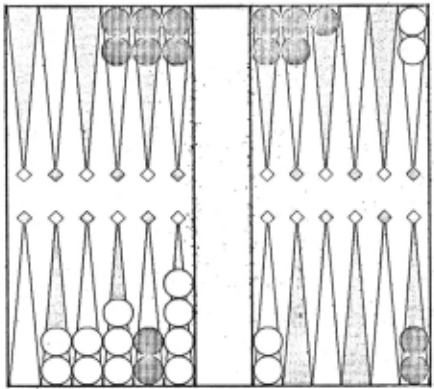
White is on move. The current slate-class (I) is c-h<1r acterized by the winning side being ahead in the pipcount, having to cross exactly two more enemy points with his most-back man, and having no hitable blots. We can now imagine an evaluation function . ·for this class which would consider the position of the doubling cube, the exact difference in the pipcount, the ease with which the most-back man can be safely moved up, the containment power of the losing side should· he succeed in hitting a blot, the time lost in entering such a hit blot, and the number of pips that are available to be played as slack before any of these values a·re materially ch;mged. This function would compute the r.xper.tation of White. Such a function could be derived either by analytic means or by actual simulation of positions in the class to find out how each of the above variables affected the ·expectation of White. Further, such a function could be tuned · as experience is accumulated. Let us assume that such a function exists and predicted that in the situation of Figure 2 White should win 667.: of the time, win a gammon 2"7. of the time, lose 30 7: of the time and lose a gammon 2'7. of the time, for a net expectation for White of +.36.
Now from this position it is poss ible to move to four state-classes: the present one (class l), an unstable state -class where White has two points to cross, but has a blot in danger of being hit (class II), an unstable class where White has only one more point left to cross (c lass IV),· and a stable class where White has only one point left to cross (class III). Further, if a blot is hit in state-classes II or IV, we have another state class (V) in which White has a man on the bar which must enter in front ol Black's blocking position. For each of these state-classes an evaluation function will be able to calculate the expectation.
White's win probability, W, ·in a state where he is to move is the SUM i=1 to n (Ti*Wi) where Ti is the probability of tr ansi ting to state i on the play by playing it optimally, and Wi is the probability of winning once state i is reached. If it is Black to play, While's win probability can be computed in a like manner . This method can .be used to decide between plays that result in differing s t<~te -classes even though on.e class may be unstable and the other not. We illustrate by an example.
Let PH denote the probability of a blot being hit on the next roll. Let W'i be the probablility of winning in state class i if the losing side is on move. Further, assume W2 = .85, W3 = .92, and W4 =.92. Then:
To get w 5 we must compute the probability of White escaping over the blockade on his next roll, as otherwise he will be doubled and will have to resign. If he does escape, he has about an even chance in the. resulting posi tion. These constants should make clear the computation below. It should be noted that when W for a side that is on roll and can double is ~ .75 (i.e. his expectation ~ .50) he can double and force his opponent's resignation. Thus such terms should b.e ignored as their value drops to 0. This · is true for instance of the term dealing with the situation where White is hit and contained.
We now use this method to decide how to ·play a difficult roll, 6-1, in Figure 2. There are basically two plays: run one man from the 12 point resulting in a position of class II, or play · both m·en from the 18 point remaining in class I. For the first play:
For the second play, there are 5 rolls which result ·in transition to state-class III (2-2, 3-3, 4-4, 5-5, 6-6), 2. roll s that result in a class II position (6-2), 8 rolls that result in class IV positions (6-1, 6-3, 6-4, 6-5), and 21 rolls that result in remaining in state-class I. The appropriate computation is: (note that w1 has dropped to .55 since White reduced his chances of bringing up his most-back man safely) .
Therefore, it can be seen that it is better to make play two. It should be noted that as the probability of containing a hit man varies with Black's defensive · formation, this calculation will also vary accordingly. The Wi 's we have given above are very crude and probably off by a considerable amount. However, the main purpose of this exercise was expository. As of this writing, we have implemented somewhat as sketched the state-class computations required for the above example. BKG now plays all rolls involving 6's correctly.
The method we have described above can be used for deciding the very important prob~em of when to move to a state that is in a state-cla.ss different from the one we are currently in. However, the whole method assumes that an evaluation function exists for each state class which properly orders its members, and that reasonable expectations can be produced across state classes. At the moment we have confidence in the first part of this procedure, and the second part has been coming along extremely well.
We would still like to co.mment on how such a system can be improved in the face of error. For each state-class there are new state-classes , that can be reached in one optimal play for each side without a capture being made. We call these classes forward with respect to the original class. Likewise, there are new classes that can be reached from the current class ·in one optimal play by each side, when there has been at least one capture. of a man. We call these classes bar.kwflrd with respect to the original class.
It is possible to start with a class for which we have excellent expectation data, i.e. the class of bearing off positions that can be looked up in our tables (class · B). Next, we consider all classes for which class B is forward, and improve the evaluation function for those classes, tuning the coefficents of existing ter.ms and adding new ones as required. This will improve these
. evaluation functions. We .also note all classes ·that. are backward to this class, and put them on a list together with the name of the current class. We can continue this process indefinitely, but painfully until every class has been encountered. Whenever the evaluation function of a class that is on the backward list is improved, we go back and modify all the evaluation functions of the affected classes. ·We can theri continue our process or go back to· one of the clas.ses whose function has just been modified and start anew from there. It is clear that this is a converging procedure. · It would probably be necessary to eventually automate this proceedure, if for no other reason than that eventually the. evaluation functions would become so good that they would do 11 · better job of ordering members of a class than the experimenter would. Such automation except for the introduction of new terms has been previously done by Samuel [Sa63] for checkers. It would appear likely that for a game such as backgammon, it would be possible to get a selection of terms such that no new ones will ever be required. Then it will be merely a matter of tuning old evalution functions, and occasionally try ing a new {but known) term to see if if can improve prediction.
BKG has a simul·ation facility which can be useful · in acquiring the above data. We can ask BKG to play both sides repeatedly any number of times. It will play as it ordinarily does; doubling and accepting when appropriate. BKG plays all running game posit ions and those where one side is bearing off, with one or fewer .points to cross, nearly perfectly. Data from simulations can then be used to determine the expectation for the w inning side as a function of various para.meters of the original state. We have now done this for representative states of some of the simpler staleclasses and used the data for fitting curves of critical variables to the statistically expected outcome. The equations derived appear reasonable, and are working out quite well in practice.
As data are collected and the evaluation ·functions improve, two things become possible. It is possible to keep track of how the pr-ediction works out for the program's own play, which can be used as an indicator of which functions need to be tuned next. It is also · possible to keep track of individual opponent's results and come to the conclusion that they don't appraise certain state-classes correctly, and use this information in future games.
V. Testing of BKG
When testing BKG (we refer now to the version before the expectation models were put in) on typical beginners books, it gets the right answer in excess of 701. of the time. A much better appraisal of the program can be obtained by analyzing its successes and failures on more difficult tasks. For this we chos~ the problems in a very fine intermediate level· book [Ho74]. There are 7 4 doable problems in this book {at the time of these experiments, BKG could not do problems involving doubling decisions before disengagement). We have classified the problems according to the major knowledge required to get the right answer. This is a rather arbitrary way of looking ·at things, but it is helpful in trying to unqerstand the strengths and lacks in the program. w~ divided the problems into seven categor ies:
- Genet al positional,
- Running game: bearoff,
- Engaged: bearoff,
- Back game (this a speci al defensive posture),
- Timing {this involves advantages that presently exi st · going away because one side or the other ·must destroy hi s position), · ·
- Defensive plays,
- Advanced defensive plays (including the return play).
We followed the practice in scoring the results of giv ing BKG part credit for answers that were not perfectly correct but showed it understood the main point o.f the problem, althotJgh the execution was not perfect . We also deducted part credit when it got the correct answer without understanding what the main problem was. Table I below shows the results of the tests.
| Position Class | Number | Right | Wrong | % Right |
|---|---|---|---|---|
| Po s it i onal | 28 | 18.75 | 9.25 | 67 |
| Running Bearoff | 5 | 5 | e | Hle |
| Engaged Bearoff | 11 | 2 | 9 | 22 |
| Back Game | 8 | 3.25 | 4.75 | 41 |
| Tim i ng | 13 | 4 | 9 | 31 |
| Advanced Defense | 6. | B.S | 5.5 | 6 |
| Defense | 3 | 1 | 2 | 33 |
| TOTAL | 74 | 34.5 | 39.5 | 47 |
In evaluating these results, several things should be noted. The subject matter is relatively advanced, and would for the most part come up in only one of 20 or more games. There are usually on· the order of three plausible answers to a problem. BKG is good enough in almost every .. case to know what these · are; thus attaining a score of 337. or less could be regarded more or less as the result of chance. We can see that BKG is extremely good in run.ning game play. Also it has a good understanding of the relative posit ional · advantages. · However, its performance in other intermediate level aspects of the game is at best ~ediocre . It has · ·heuristics to help it do bearing off while still engaged, but these are for run-of-the-mill situations, not for the more sophisticated ones in the test set. It has no specific understanding of the back game. Since the objectives in the back game · are rather different than anything else in backgammon, it will be necessary to implement a specific set of stale-classes which recognize back-game potential and how to maintain and destroy it. The problem of timing is · one that will be resolved soon. Essentially, this requires having a measure of how many men are presently bound to essential roles in the current evaluation, and how many pips are available to · be played by the remaining men before the important men will have to be moved. Bl<i'G's main knowledge of defense consists of its blot hitting knowledge. It does not understand the ·concept . of coverage, i.e. controlling points on which an opponent 's blot may land in the next roll or two. It do.es not under stand that at times it may be beneficial to expose a blot in dire circumstances or to make the "return" play. Thus this series of tests has pinpointed some specific knowledge that BKG lacks and that is not subsumed in its present knowledge base.
It is encouraging to note that even though we have just bee,un implementing the expectation models, BKG now gets correct 9 of the above set that it formerly got wrong.
@inproceedings{ijcai1977p98,
  title     = {Experiences in Evaluation with BKG - A Program that Plays Backgammon},
  author    = {Berliner, Hans J.},
  booktitle = {Proceedings of the Fifth International Joint Conference on
               Artificial Intelligence, {IJCAI-77}},
  publisher = {International Joint Conferences on Artificial Intelligence},
  editor    = {Raj Reddy},
  pages     = {428--432},
  year      = {1977},
  note      = {Problem-solving and Search},
  url       = {https://ijcai.org/proceedings/1977/98},
}
TY - CPAPER TI - Experiences in Evaluation with BKG - A Program that Plays Backgammon AU - Berliner, Hans J. T2 - Proceedings of the Fifth International Joint Conference on Artificial Intelligence, IJCAI-77 PB - International Joint Conferences on Artificial Intelligence PY - 1977 SP - 428 EP - 432 UR - https://ijcai.org/proceedings/1977/98 ER -Copied
Machine-readable versions of this paper, for tools and AI agents:
 Welcome
 Future Conferences
 AI Journal Division
 IJCAI Proceedings
 About IJCAI
 IJCAI Awards