
Understanding and Improving LISP Programs
Proceedings of the Fifth International Joint Conference on Artificial Intelligence. Aids to Programming. Pages 377--1.
© 1977 International Joint Conferences on Artificial Intelligence
Abstract
- CHAILLOUX J., VLISP-10, Manuel de n!ft!rences, Opt. lnformatique, Universitt! Paris 8, RT-17-76, 1976
- GOOSSENS D., CAN, RT .()3-77, 1977
- GREUSSAY P., Difft!rence et rt!pt!tition dans les systM!es VISION, RT -06-77, 1977
- WERTZ H., PHENARETE, Springer Verlag, G-1.6 Jahrestagung,Stuttgart, oct.1976, pp. 427-441 .
References were extracted automatically from the PDF and may contain errors.
Full text extracted automatically from the PDF; figures, tables and equations may differ. The PDF is the version of record.
UNDERSTANDING AND IMPROVING LISP PROGRAMS
Harald WERTZ Universit~ Paris 8 Departement d'lnformatique 15012 PARIS
We are currently investigating the creation of an didactic environment for the teaching of a programming language to approximately 1500 students each year. At this effect we are constructing a robust and perspicious system : VISION & CAN & PHENARETE (GREUSSAY 1977, GOOSSENS 1977, WERTZ 1976). a system designed to help the individual apprentice in the process of deve loping, writing and debugging programs.
In this note we will describe some aspects of PHENARETE, the convivial part of the system : PHENA RETE receives as input a student proposition of a program - which may contain as well syntactic as semantic errors - and will deliver as output her improved propositions of this program : a finite sequence of approximations.
With the help of our system, the learning of a programming language is done in a cycle :
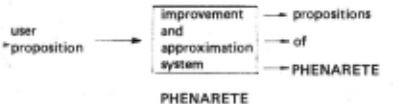
PHENARETE
Before constructing PHENARETE we observed for one year our students beginning to learn LISP, to see which kinds of errors are statiscally the most current. There we found principally five sorts of errors :
- absence of variables
- inversion of variables
- grouping errors
- absence of the coriditionnal instruction
- non-representation of the termination of a computation.
Our system is particularly efficient in the detection of these kinds of errors. It doesn't try to verify the program with respect to the intentions of the programmer, but it tries to understand the programming language constructs used in the program, to see the interaction of the dif ferent parts of the program and to detect inconsistencies, with a particular emphasis on the verification of the termination of the program. In sane way PHENARETE may be considered as an intelligent interpreter : she does not execute but she iD~JP..rm the program, and the result of an interpretation are some propositions (propositional interpreter). PHENARETE incorporates the programming knowledge of a programming apprentice.
Let me illustrate the reasoning involved in an inter pretation <>f a simple LISP program (main steps only) : suppose a student has submited the following program (the numbers are for references in the te>t).
- .1. (DE REV (X Y)
.2. . ((REV X (CONS (CAR X) Y)))
.3. ((NULL Y) X) )
First, (line 2 and 3) the grouping of the body of the function suggests that the user has omitted the COND-function call, so PHENARETE introduces (line 2-b) «COND». Then (line 2) we find as the first clause of the COND immediately a ·recursive call of the function REV, and following (line 3) another clause. Knowing that line 3 can never be attained during an execution of the program we can invert the two clauses. This gives :
.1'. (DE REV (X Y)
.2'. (COND
.3'.
((NULL Y) X)
.4'. (T (REV X (CONS (CAR X) Y)))))
So far the surface improvements. Now a closer look at line 4' tells us that X and Y will be lists, when the function is invoked, and that the first argument (X) is inchanged and the second argument (Y) will grow longer. In line 3' the case second argument = NIL is solved, but this is the only case where the computation of REV will terminate. If Y is different of NIL, the only constructive computation done in the program is the creation of the new list argument 2. So, when hypo thesising that the result of REV will be this list just created, we have to force a recursion stop. Let us try to call REV with the CDR of argument 1 :
(T(REV (CDR X) (CONS (CAR X) Y)))
but the recursion will not stop either. So let's try to introduce a supplementary test ((NULL X)). And, always under the hypothesis that Y will be the result of the computation, this gives us
((NULL X) Y).
This will be the first proposition of PHENARETE
Proposition 1 (DE REV (X Y) (COND ((NULL Y) X) ((NULL X) Y) (T (REV (CDR X) (CONS (CAR X) Y)))))But this new line is just the line 3' with X and Y inversed, so let's try without line 3'. 0<, that is also a recursive procedure which stops with the correct algorithm, so another proposition :
(DE REV (X Y)
(COND
((NULL X) Y)
(T (REV (CDR X) (CONS (CAR X) Y))))) Finding no more possible interpretation, PHENARETE will stop, after these two propositions. During the interpreta tion-phase she justifies all the modifications she proposes in a way similar we did.
The system is implemented in VLISP-10 and is currently used by about 1500 students.
REFERENCES :
CHAILLOUX J., VLISP-10, Manuel de n!ft!rences, Opt. lnformatique, Universitt! Paris 8, RT-17-76, 1976
GOOSSENS D., CAN, RT .()3-77, 1977
GREUSSAY P., Difft!rence et rt!pt!tition dans les systM!es VISION, RT -06-77, 1977
WERTZ H., PHENARETE, Springer Verlag, G-1.6 Jahrestagung,Stuttgart, oct .1976, pp. 427-441 .
@inproceedings{ijcai1977p86,
  title     = {Understanding and Improving LISP Programs},
  author    = {Wertz, Harald},
  booktitle = {Proceedings of the Fifth International Joint Conference on
               Artificial Intelligence, {IJCAI-77}},
  publisher = {International Joint Conferences on Artificial Intelligence},
  editor    = {Raj Reddy},
  pages     = {377---1},
  year      = {1977},
  note      = {Aids to Programming},
  url       = {https://ijcai.org/proceedings/1977/86},
}
TY - CPAPER TI - Understanding and Improving LISP Programs AU - Wertz, Harald T2 - Proceedings of the Fifth International Joint Conference on Artificial Intelligence, IJCAI-77 PB - International Joint Conferences on Artificial Intelligence PY - 1977 SP - 377 EP - -1 UR - https://ijcai.org/proceedings/1977/86 ER -Copied
Machine-readable versions of this paper, for tools and AI agents:





