
The Declarative Representation and Procedural Simulation of Causality in Physical Mechanisms
Proceedings of the Fifth International Joint Conference on Artificial Intelligence. Representation of Knowledge. Pages 250-255.
© 1977 International Joint Conferences on Artificial Intelligence
Abstract
A theory of cause - effect representation is used to describe man-made mechanisms and natural laws . The representation, consisting of 10 link types that interconnect events into large declarative patterns, is illustrated on a relatively sophisticated device, the home gas forced air furnace . Next, a procedure and framework for translating the declarative description of a mechanism into a population of associatively triggerable computation units is described . The associative, or procedural, form can then be used to perform a discrete cause-effect aimulation of the device. The delcarative to procedural translation, including a simulation trace, is shown for the furnace. Topics of nechanista abstraction and mechanism inven!iion are discussed, and the entire "Mechanisms Laboratory' is placed in tne larger perspective of our research into human problem solving.
- SL1] SS1]
- SS2]
- Brown, J., and Burton, R., Hultiple Representa- tions of Knowledge for Tutorial Reasoning, in Representation and Understanding, D. Bobrow and A. Collins (eds7)7 Academic Press, 1975
- Davis, R., Applications of ~leta Level Knowledge to the Construction, Maintenance and Use of Large Knowledge Bases 1 Doctoral Dissertation, Stanford A.I. Lab. AIM 28_j, 1976
- Johnston, R., and White, M. Simulation of an Artificial Heart System~ i971 Sumner Computer Simulation Conference, 19!1 London, P., Abstraction l~pping as a Self- Organizing Scheme for Problem Solving Systems Doctorial Dissertation Proposal, University o! !~ryland, 1976
- Luetscher, J., Boyer, D., and Resneck, J., Control of the Renal Circulation and Kidney Function, 1972
References were extracted automatically from the PDF and may contain errors.
Full text extracted automatically from the PDF; figures, tables and equations may differ. The PDF is the version of record.
1. Introduction
Nan-;aade physical mechanisns provide an interesting dondill in which to study human problem solving and cause-effect knowledge representation. In this paper, we describe and illustrate a represe11tation framework which permits us to express and simulate the commonsense internal cause- effect structure of a variety of man- made taechanisms (both mechanical and electronic), as well as a variety of natural mechanisms (laws of physics, physi ological mechanisms, etc).
Since our strategy has been to use the mechanisms donain as a medium for investigating human problem solving and cause-effect knowledge represe11tatlonl we have developed our "Mechanisms Lab" within the ex sting framework of our Cor.uno.1sense Algorithn (CSA) Project, a broader in vestigation of cognitive mechanisms. Following this strategy has lead u~ to a mechanisms theory in which the base representation of a mechanism is a declarative, cause-effect graph, but in which simulation is accon plished by transforming such a representation into pro cedural form, then executing it. Thus in addition to the theory of representation and simula don, we feel the technique provides an interesting case study ill declarative-procedural correspondence.
The Jiscussion of our Hechanisms Laboratory is divided into five main parts: (1) background and theoretical framework of the mechanisms research, (2) cause-effect representation and example, (3) back~round and strategy for the simulation aspects of the Qro ect, (4) a simula tion example, and (5) philosophy of t e approach.
2. Motivation
Our motive in this mecl1anisms research is to understand human problem solving and cause-effect knowledge repre sentation. ~ian-made mechanisms provide an excellent medium for carrying out such research because mechanisms are in a sense final snapshots of the human problem solving process . By developing representations for the cause-effect notions inherent to all mechanisms. as hu mans perceive them, we stand a good chance of also gain ing insight into how humans encode the various princi ples and physical laws that are evoked during the mecha nism's invention or design.
Besides this theoretical relevance of studyin" mecha nisms, there are some interesting practical appfications of a cognitive theory of mechanisms representation and simulation. For example, a mechanisms theory can provide the basis of a potentially powerful CAl facility in which a mechanisms-naive user could interactively ex plore the design principles and behavior of a device. Provided the system is conversant in the same terms as the user (i.e. higher-level, symbolic terms 1 rather than lower-level numerical or parametric terms}, such in teraction can comr.tunicate concepts rather than details.
l1any other specific applications exist . In one, the the ory could provide the basis for medical applications, through the modeling of, e.g., human physiological mech anisms. In a second, the theory could be applied to pro vide a self-model in systems with a self-maintenance ca pabilities (martian rovers, 2001 vacuum cleaners?). In a third, the theory could provide the basis of interactive design systems in which engineers specify high level goals to the system, which then does the design. Com pletely automatic "mechanisms invention" is within the realm of possibility and, we feel, would closely resem ble the behavior of current-day problem solving and pro gram synthesis theories. Finally, a future application might be to use the representation as a sort of Dewey Decimal System of cause- effect pattern classification.
3. Background and Related Work
There are many ways to approach the description of a mechanism. liost in the past (e.g . [JWl], [LBRl], [RJS1], [SL1], and [WBL1]) have tended to be more analytical in their approach. In analytical simulations, the mecha nism is typically described by parameterizing it in a form suitable for a numerical simulator. The problem with this approach is that the representation of a mech anism is very different from the human cause and ·effect kn01<ledge of the mechanism.
We are by no means the only ones addressing the issues of symbolic modeling or simulation of physical systems. Two other notable examples are the ~~CIN project and an tHT electronic circuit analysis program (EL) . The MYCIN medical diagnosis project at Stanford [D1] has been con structing models of tne techniques clinical pathologists presumably apply when attempting to make sense out of the raw data which describes some possible pathology or set of pathologies. In this sense they too are symboli cally modeling cause-effect mechanisms. EL, Sussman's and Stallman's electronic circuit analysis program ([SS1] and [SS2]), is both an application program and a theory of circuit design. The main concerns of the pro ject are: how are laws of electronics expressed in a way that is of use both to the analysis of a given circuiti· e . g. the user specifies the starting states of al "active" components such as ~ransistors, then asks the program to analyze the circuit s behavior, or the user requests the system itself to derive the various modes of operation of the active devices in the circuit and to the design of a circuit from descriptions of what it should accomplish.
4. Theoretical Framework
l<e have approached the representation and sir.tulation of mechanisms from within the framework of our larger Commonsense Algorithms Project . Since one main purpose of the project has been to understand more about how hu mans might represent and use all sorts of causal knowl edge, we have explicitly chosen to develop the mecha nisms theory in the context of the larger CSA theory, drawing upon existing CSA mechanisms which themselves seem to be broadly applicable in all aspects of cogni tive modeling. Specifically, this has resulted in (1) adopting as the mechanisms representation the same rep resentation that is used in the other two phases of the project, namely, the plan synthesizer [R1J and the lan guage comprehender [R1J and [R2], and (2) applying our notions of "spontaneous computation" [R3] to simulation. Although the running LISP Hechanisms Laboratory which has resulted is not efficiency-wise competitive with ap plications simulators, this is of little concern, since efficiency considerations are not relevant to our cur rent goals.
In summary, then, we want to be able to express and si mulate mechanisms (and hence, also the physical princi ples upon which they are founded) in ways that might ap proximate how humans do these tasks. To accomplish this, we have chosen to embed the simulator in the same framework as the plan synthesis and language comprehen sion components of our project.
4.1. CSA Cause-Effect Representation
The declarative representation of a mechanism is a cause-effect graph whose nodes are events and whose links are drawn from a set of the ten theoretical forms of inter-event causal interaction. Each event falls into one of four categories: action, tendency, state or statechange. With the exception of "tendency", these terms are intended to reflect their standard connota tions. We use the term "tendency" to describe action like events in which there is an absence of intention. Gravity, for example, is a tendency, since it is a force generator, but has no choice about, or reasons for, acting.
The links of our theory are intended to reflect what we believe-To be necessary (and close to sufficient) under lying human concepts relating to causality in physical mechanisms. (Th~se same links are also the basis of the plan synthesizers representation.) We arrived at sever al of the ten by obvious intuitive reasoning, and at the remaining ones by considering many mechanisms and at tempting to capture the recurring concepts. None of the links by itself is particularly novel to us, or individ ually provocative; yet, taken as a set, we believe these links are both theoretically significant, and convenient to use in practice.
4.2. Representation Exacple: Forced-Air~
We introduce the CSA cechanisms representation first via an exmlple that illustrates both the individual links and the general size and complexity of mechanisms we are currently representing and simulating. The example is the Hoce Gas Forced-Air Furnace, and reflects our un derstanding of this relatively sophisticated devTCe.
For convenience in the presentation, we have segmented the exar.tple into three boxes: (1) thermostatic control, (2) heat generation, and (3) heat delivery. Interconnec tions A through G between boxes are indicated in cir c les. We have provided an event-wise cross-indexed Eng lish description of BOX 1 to accompany its schematic re presentation, but have omitted the English descriptions of BOXes 2 and 3 (see [RCl] for more details).
~ l (Control Subsystem)
We assum., that the system hea ts a sing le room, a nd that this room contains a mercury-filled, glass envelope style thermostat. A tem perature change of the thermostat (1) is equivalent to a state of temperature fluctuation (2). Such fluctuation continuously enables the tendency TH£RMAL tXPAilSION (3) to produce a continuous change in the length of the the r mostat strip (4). Provided the glass envelope is attached to this coil (5), this length change is equivalent to a change in the angle (phi) of the glass envelope (6) . The ang le of the g lass enve lope can also be influenced by an ex ternal adjusting action (7 ,!l). At any llOment, the net cl1ange (9) of this angle is governed by these two causal sources.
As pili ci1anges , there are two points of interest: one when phi is below zero (10), i.e. the envelope begins tilting to the left (11), and one when it is above zero (16), i.e. begins tilting to the right (17). When the envelope is tilting left (11), and the left edge of the mercury is not already at the ex treme l ef t end of the envelope (12), the mercury is in a condi tion of being unsupported to the left (13). This allo>~s the ten dency Gtl.AVlTY (14) to r.tanifest itself and to begin continuously changing the 1oercury' s location toward the left (15) . Returning to the other threshold polnt for phi (when phi is above zero), a symmetric system of unsur,ported ness pertains (16 1 17 ,1B,lY,l4, 21) , influencing tt1e mercury to move toward the right. At any monent, the net cf1ange in the mercury's lo~ation (22) is gov erned by these two systems.
Continuous and One-Shot Causal


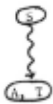
would annihilate S or SC if A or T were removed). For the one-shot form, A or T is required only momentarily. The gates govern the effects the action or tendency will have on its environment, in that their continued and si multaneous presence during the action is required for the indicated causality "to flow" from the action or tendency to the state or statechange. These gates are distinct froc A or T's enablements ; enablements gove rn the execution of the action itself, independently froo any effects it may produce.
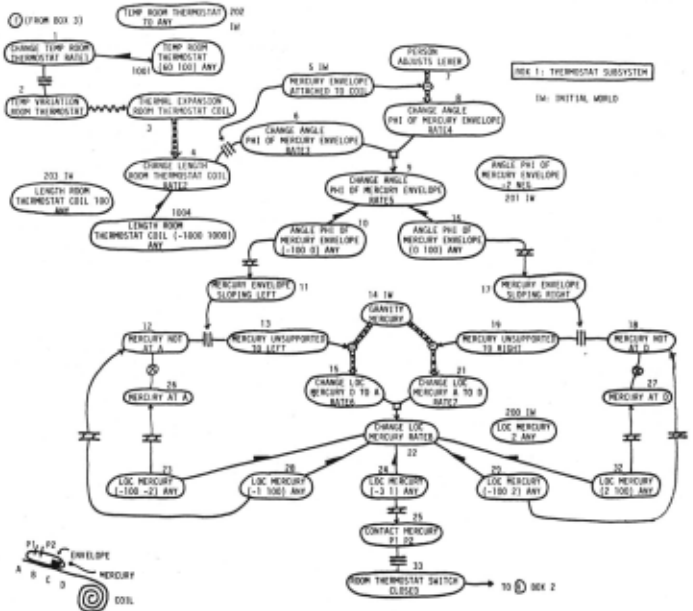
There are five points of interest (23,24,28,29,32) along the r.~ercury's pa th of trav.,l (lower part of BOX 1). When the left edge of the mercury reaches point A (less than or equal to - 2) (23) 1 the mercury will cease being un supported, and GRAVITY s influence will be severed (i.e. the mercury will stop moving left). While the r.~ercury is between points Band C (i.e. between -3 and 1) (24) there will be physical contact of the mercury and the electrical contact pins Pl and P2 (25). This amounts to the thermostat having closed the furnace's control cir cuit (33). This condition feeds into BOX 2 via tie point A, serving as one precondition for the main supply gas valve opening. Conversely, contact between the mer cury and Pl and P2 ceases at points less than -3 or greater than 1. ------
The Control Subsystem participates in a large feedback loop via tie point F from BOX 3. The descriptions of BOXes 2 and J are similar (see [RG1]). BOX 1 introduces all the link concepts in the representation.
4. 3. Hechaniscs Cause-Effect Links
with this ex.ample in mind, we now give a very brief de scrip·tion of the ten links. See [RGl] and [R2] for more detailed discussions.
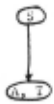
curs when the performance of A or T modifies its en vironment in a way which liberates the ac tion from the influence of the original enabling condition.)
Action A or tendency T causes state S or statechange SC to exist, providin~ gating condi tions Sl, ··· ,Sn are in effect . For the continuous form, the ac tion's continued presence is re quired to sustain the state or statechange (i.e. there is some other unspecified force which
Continuous and One-shot Enablement State S enables action A or tenT - dency T. For the continuous I form, S's continued presence is required in order to begin and sustain A or T. For the oneshot form S's presence is required oniy mor.~entarily to allow Gh::D the action to begin. (Semantically, one-shot enablement oc-
Continuous and One-Shot State Coupling
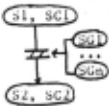
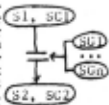
means of expressing implicit intervening causal rela tions which are either unknown or irrelevant to some de scription (i.e. states do not directly cause states). They accept gating states in the same-manner as the
State Sl or statechange SCl in-~ ~~~S~C~l~ directly produces 52 or SC2. For ~ 1. SCl the, continuous form, 52's or ~- SC2 s continued existence is coupled to 51's or SCl 's continued existence. For the one-shot~S�n form 52 or SC2 is independent of ~1 or SCI after the initial S2 , SC coupling . These links provide a
State Equivalence
State 51 or statechange SCI is an equivalent formulation of state 52 or statechange SC2, providing gating conditions SGl ··· ,SGn are present. "Equivalent formulation" means that the two states are paraphrases - syntacti cally different expressions of the same und erlying event. Eguivalences, we feel, will always be present 1n any representation, and hence ought to be dealt with explic1tly .
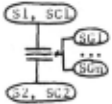
Host frequently, an equivalence plays the role of buffering two different points of view of the same event (e.g. the output of one mechanism i1j "photons ellis t" tlte input to ano ther mechanism is 'light present', anJ say, during mechanisms invention, we wish to join the two mechanisms) . The existence or non-existence of either equivalenced event implies the exis t ence or non existence of the other.
State Antagonism
Threshold
llet statechange , sc, reaches a threshold, S, of interest to the description of tt1e mecha nism. S is an instantaneous description Of an entity with respect to the feature which is varying in the statechange, e . g . the tem perature of the heat exchanger is 400 degr ees. \le distinguish positive and nega tive thresholds graphically and in the in ternal representation and si!llulation so as to provide for hys.teresis.

This concludes the discussion of the GSA cause-effect links relating to mechanisms description. There are sev eral other links relating to motivation and intentional ity of huwan actors. These other links permit us to ex JllOrt! the areas of plan synthesis and language compre hension in the social as well as physical domain within the sane representational framework.
We have represented a number of other physical, electri cal and elect ronic mechanisms in these same terms, in cluding (1) a computer flip-flopi (2) a "drinking duck" novelty toy, (3) an incandescent ight bulb, (4) a me chanical oscillator, (5) a reverse-trap flush toilet, and (6) descriptions of composite events involving the Bernoulli effect , gravity and momentum. Additionally , we have used the representation to describe a computer al gorithm for conput ing the average of a table of inte gers, and feel that the GSA links will provide a good language for programming concepts as well as !'hysical laws. These and other examples appear in [RGI], [Rl] and [R4].
5. Simulation Strategy
As we pointed out earlier, our purpose has not been merely to build a mechanisms description and simulation laboratory, but to build one upon concepts which are generally applicable to a wide spectrum of other types of cognitive modeling as well. We feel that we have succeeded in the description aspect by embedding the mechanisms description language in the same framework as our problem solving and language comprehension languages, namely these GSA links just cove red.
For the simulation strategy, we have drawn up,on ano ther aspect of the GSA system that we call the 'spontaneous computation" component. This is a generalized implemen tation of pattern-directed inference, wherein cot:tputa tions occur spontaneously, rather than on demand from another computation.
The simulation strategy (see flow diagram below) is this: convert the declarative (GSA) cause-effect repre sentation of the mechanism to a population of autonomous computation units, each of which models one event in the declarative representation. If each unit in this popula tion of spontaneous computations (SC's) contains a model of all other event schemata that can influence it (both within, and external to, the particular mecljanlsm in which the event participates) then the modeling SC can be caused to run when all influences are just right by including all those influences in its (potentially com plex) invocation pattern. Thus, our strategy is to model each declarative event by an SC whose trigger pattern is sensitive to other prerequisite events in the mechanism.
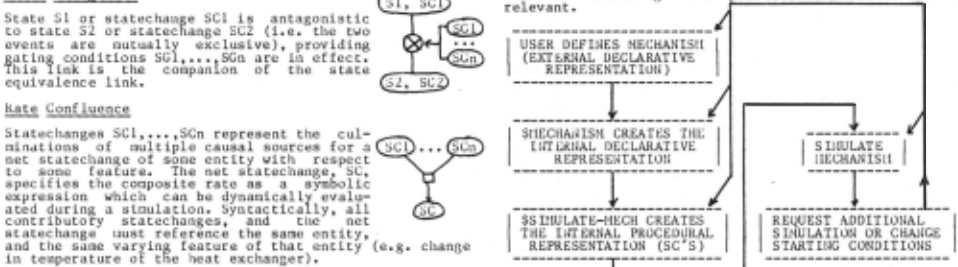
A simulation will amount to embedding the reactive SC population modeling the events in the mechanism in an environment in which static conditions are appropriate for triggering the mechanism. The environmentl as well as all instantaneous states during the simulat on , are modeled as a collection of database assertions. Trig gering of the mechanism will lead to a conceptually par allel avalanche of activity wherein the running of one or more SC units can prompt the running of one or more other units, and so on . The simulation becomes quiescent when no remaining SC's perceive themselves to be r elevant .
There are some important issues relating to ~ we have hhosen this sthategy for si~ulation rather-man a more straightforward strategy that manipulates the declara tive r epresen t ation directly. We will discuss the phi losophy behind this approach to simulation later. We now describe the GSA system's spontaneous computation compo nent which provides the substrate for the simulator .
5.1. Spontaneous Computation and Channels
Our implementation of spontaneous computation is a generalization of the pattern-directed invocation no tions embodied in l1ICRO-PLANNER [SWCl] and COil!H VER [HSl]. By "generalization", we mean specifically that we have provided for the specification and organiza ti.on of more complex invocation patterns, and for more complex hierarchical organizations of SC populations .
The invocation (trigger) pattern of an SC in the GSA system is constructed from nested n-tuples composed in virtually any degree of complexity using the logical re lations AND, OR and AllY . Each component of the trigger can be one of the following types: (l) associative, (2) non-associative, or (3) computable. Associative trigger components come to be organ.ized into a reactive data structure we call a "trigger tree"; these are the compo nents which can react to passing stimuli (to be defined) and cause the entire pattern to be tested (polled). Non-associative trigger components represent aspects of the trigger's environ<aent that must be true (when ex plicitly polled) in order for the SC to fire fully, but which themselves are incapable of initiating the firing. Computables are any EVALable LISP forms other than (l) or (2), and must evaluate non-NIL for full triggering of the pattern to occur.
An SC body is an arbitrary EVALable LISP expression. Each SC is context sensitive in that it can be masked and unmasked i ndependently within its trigger tree. (The simulator relies on this feature to prevent looping in certain cases .) Entire trigger trees are also context sensitive, as will be described.
Beyond this organization of complex trigger patterns into trigger trees, the GSA SC component provides for ~~~e~ig~~~~~jve~o~~~~~~~~~~~l c~ii~~iz~~~~~nel~". tri~gs~ channel (see [R3]) is intended to be the analog of a hardware channel, and a generalization of the PLANNER/CONN! VER pat tern-directed invocation scher.te.
The SC's that the mechanisms simulator creates as the procedural representation of a oechanism all exist in two trees attached to two channels . The passing signals on these channels '~ill be the symbolic descriptions of changing events in the simulation, entering and exiting the database via these channels. When it runs, a fully triggered SC will place a new event description on one of these channels, and possibly mask or unmask itself and/or other SC's in the population, as we will describe.
We feel the trigger tree/channel paradigm is a powerful one. Currently, the mechanisms simulator employs only these two relat1vely simple channels in performing its tasks, (analogous to the store and erase channels of PLANl;ER and CONNIVER) but we expect it to utilize the full potentials of this system in future ~hases of the project, especially when we address the top1c of mecha nisms invention.
This concludes our brief sketch of the GSA SC component insofar as it relates to our purposes here. For a more complete discussion, including several other theoretical applications of the SC system in the areas of inference, problem solving and language comprehension, see [RJ].
6. The Hechanisr.1s Simulator
The simula tion subsystem is a collection of LISP func t1ons that t ake the internal declarative representation of a mechanism, convert it to a population of spon taneous cOtaputations, then awaken a subset of the popu lation via a triggering assertion. A subset of the a"ak ened SC's will r equest that their bodies be run. The evaluation of the bodies will cause other SC's to awak ened . This will cons titute an execution of the mecha~!~~~dina~~e d~~~~~~~~d l~eg~~ di~!b~:ea~~dm;~;~;~ 1 ~h1~h are changing with time will be updated. The status of an event is de t ermined by its causal relationships to o ther events as they becor.1e asserted and deasserted.
The initiation of the simulator is caused by the asser tion of some event: semantically, either an action per formed by an external .;~ctor, a tendency relating t o a natural force, or a state, as derived, e.g., as an out put fro1>1 the simulation of another mecftanisro. This latter initiating event will ~rovide for mechanisms in teraction where several mechan~sms have a comnon event and the assertion of that event in one mechanism will initiate (or con tribute to the initiation of) execution of the other mechanism.
Each link in the internal declarative representation of a mechanism has a set of SC's autor.Jatically created for it according to a set of rules for each theoretical link type. An SC is activated when its preconditions have been satisfied. The running of an SC will generally cause a database modification or a masking or unmasking of ano ther SC.
b.l. Declarative!£ Procedural Conversion
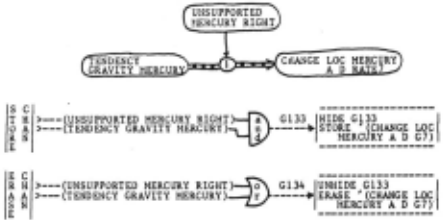
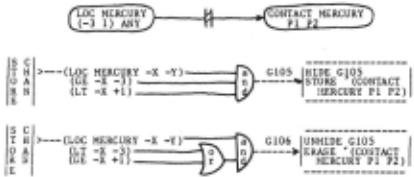
Ue now give two examples to illustrate the process of declarative-~rocedural conversion. The SC's are display ed \Jith the following conventions. Each SC representing some potential event is imaained to be watching a path to the database (channel). $fhe path t ype (STURE or EkASE) is located between the double bars on the left side of the display. The logical connectives in the created SC's trigger pattern are to the right of the trigge ring events and the arro\Js out of the , triggering events flow into these connectors. On the far right side of the figure is the body of the SC. These are the activities which \Jill be performed when the SC is run. A reference na<Je for the !';c is located on the arrow into the body of the SC.
I
To illustrate, in the exar.1ple of the SC's created for the continuous causal (C-GAUSE) link ~overning the move ment of the . mercury in the furnace s thermostat, when the tendency GfiAVITY or the state "mercury unsupported on the right is asserted and the other event is cur rently in tfte database (i.e., also present), then the state-change of the location of the mercury is stored (i.e · . asserte~) in the database. If either the tenden cy GRAVITY or mercury unsupported on the right is deasserted (i.e. erased) from the database, then the state-change of the location of the mercury is erased from the database.
E
---------------
The second example is the SC's crea ted for the con tinuous coupling (C-GOUPLE) link which watches for the mercury to enter the region between Pl and P2. When the location of the mercury is between -3 and l there is contact between the mercury, Pl, and P2 (i.e the contact event is asserted in the database). When the location of the mercury moves above or below the given range, the contact event is erased from the database .
This illustrates the conversion process on two of the simpler link types. More complex processing may be re quired for other links. For example, the ra te confluence (R-COtlFL) link requires symbolic rate computations to be performed. Details of the conversion process appear in LRGl].
6.2. Simulation Example
\/e have successfully simulated the entir e furnace, il lustrated ear lier in its declarative form, althou~h the simulation must be done in three pieces (because of mem ory limitations). The furnace cuts on, heats the roor.1 up, then cuts off , providing a trace of all events in the sequence. To convey a picture of the simulator's operation, we inc lude an excerpted and annotated se quence showing the simulation of the thermostatic con trol portion of the furnace.
Input Syntax l2E. BOX .!.
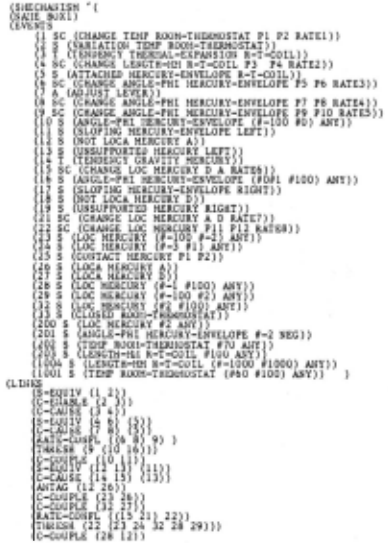
The t1echanisms Lab requires that each mechanism's GSA description be coded into a machine readable form. This form is the external declarative GSA representation and is used as input to a mechanisms defining function cal l ed $MECHANISH. This function generates the internal de clarative representation of the mechanism from the ex t ernal declarative representation. Below is the call on $l!ECHANISt1 in the external declarative form for the thermostatic control section of the furnace.
Simulation ~
i~~r~ol;~~in,2ilg~~~ra~~~af~d of~~utt~is t~:ct~~~u~~t~~~ furnace. For space reasons, only a small portion of the trace has been left intact to convey the flavor of the simulation. For clarity, the editea trace has all data base activities removed except those which affect the location of the mercury and those events directly linked to ther.t . The right-hand side of the trace is an English description of tne sir.tulation.
the declarative form to spontaneous computation units? Clearly, it would be possible to simulate a mechanism by applying relatively simple graph algorithms directly to the declarative representation.
To understand why we have adopted this SC strategy, re flect on the nature of any physical system - a ~echanism in particular. A mechanism is built from physical prin ciples and components that act autonomously, in the sense that they are governed by physical laws that "run in parallel". The mechanism just happens to work in de sired ways because the inventor has managed to identify, harness, and coordinate a population of autono~ous agents. In this setting, very minor or very local alter ations to one co~ponent or its environment can propagate to all parts of the mechanis~ in a falling-dominoes fashion. In particular, embedding the mechanism in alien or novel environments can significantly alter the micro and macro behavior of the ~echanism in ways that will always relate to the individual components of the mecha nism, viewed as autonomous agents, but seldom to the mechanism as a whole. Certainly, the net effect of em bedding the mechanism in an environment will be to change the cumulative, overt behavior of the mechanism; but the overt behavior changes will be nothing more that the sum of many smaller, possibly unrelated influences.
By converting the mechanism's declarative form into SC form, we effecti11ely crack the description open, expos-
(~SIMULATJ:::-!U:CH 'BOXl) HAX '[ IC' CUUtiT (T · INF!tHTY) ·· INITIAL WORLD t.:VEtlTS ·· (TEtiDEtiCY GRAVITY MERCURY) STUKLU Gl43 HY IATTACHED MeRCURY-ENVELOPE R-T-coiLl STORED Gl44 ~~~L~=~r.~·~.tM~!~u~l~~~~ ~~~ 5 N~u~TORED Gl4o ~I~iJ~r~~~-·~~r-~~~IA~~~6° An~1 > s¥~~~ 0 cYl~ 7 s~Y ~~w ** END WlTlA.l. \./URLU ** BY l\1 aY rw g~¥PE~/f.~~g~~YE~rE~¥~~~Emosi~t'&~o~l49 oY Gill **** unedited trace begins **** (UNSUP?uKTW MI:RCURY LEFT) STOKED ~151 HY Gl2l G lJ5 lllUDEtl BY ~ 135 (CHANGE LOC HEt«.:URY D A Go) STORED ~l5l HY ~135 (Ct!AttGE LOC MERCuRY Pll Pl2 G8) STORtill Gl53 BY GIS �~H HIDDEN HY �~S G99 HIDDEN BY �~9 (LUCA tiEKCURY D) STORED Gl54 BY G99 G94 rliDDEN 8Y �~l (CHAtiGE TEHP R-T PI P2 Gl) STUREO Gl55 HY TRIGGER TlCK.Q.~!!!lli.~ �ll~ tllDD£11 BY �il~ Gl3U HIDDEN 8Y Gl2Y (VAitiATlON TJ:l.tP ROOt1-TH.OOlUSTAT) STOR£0 Gl56 BY Gl2'J ~141 HIUOEN BY Gl4l (TLNDEHCY THLKM.AL-EXPAHSION R-t-cOIL) STORED GL57 BY Gl41 enabled by temp variation. GlJ9 HlUDEtl 8Y Gl3Y (CHAHGE LENGTII-!-IM R-t-cOIL P3 P4 Gl) STORED Cl5H BY Gl:J9**** end of unedited trace. **** ILOC MERCURY 1-2 NEG) CIIANGED Gl45 HY G87 ~~e~§~fiT ati~~:mR:;t.sf.U > si¥~~ GAt Az 8 h G AYI 3 l UNSUPPORTEU MERCURY LO:FT) ERAStlU GIS! BY Gl23 ~~~g~ t2~ ~m~~~ ~~1 ~tl t~~~~ 2 �U3�k? 6 �76 LOCA MERCURY A) STORED GlS3 BY G96 (NOT LOCA MERCURY D) STOKED Gl5l HY GlOl 1!£.!> .!. !\Mb. ~ ~ (ChANGE LOC lltlRCURY -B -E G8) NO LONGtlR CIIANGING 1!£.!> l !\Mb. !!!lli. i!!.ill. (UtiSUPPuRTEO nt:RCURY RIGHT/ STORED GlS4 BY ~117 l5~~m~ tgg :l~~tl~~ M ~li mR~~u~~~~�gDc~p�75 1!£.!> ~ !lli& ~ lli.!l lt8\iT~tf~J~c~~/~~ > P~1~lli£g 1 ~MY s~ 8 6wij l CLUSEO ROUM-THEKIIOSTAT) ERAStlU Gl62 BY GUS tiUT LOCA MERCURY A) STORED Gl5J BY ~9ij ~~~P~~~E5~/~6~cM¥6Jfi�m0E~s5~4�l54 BY �il~ LIST ADOITIOtlAtL ACTIVITIES: NIL * * FINAL WOkLU ** (T Efll'IUl"ofl=Tli"OUIOSTAT I 79 PUS) IAtiGLE-PHI ltERCURY-ENVtlLOPE 1210 PUS) ~~~gX':\i;ft~IU~YT~OIL 11104£2 l'OS) l LOC M!:RCURY ll i'OS) · SLOPING MtlRCURY-t;tiVELOPt; RIGHT) ~fm~t6u Tni\'ptAt;i.ij~!~ruJM;J)' 0 ILl ! CHANGE TEHP RUOH-THOOIUSHT P l P2 G l) ATTACHtlU HERCURY-t:NVELUPE R-T-GUIL) TENDENCY GRAVITY :iERCURY) JUX l S I :iULAUO
7. Simulation Philosophy
Why do simulation this way? llamely, why do it symboli cally, and why go through the contortions of converting
sloping left since angle is -2. mercury not at A since at 2. ~~~~~~ 1 u ~~u~~~~~~~ at left since at 2. mercury moving to A since left sloping and unsupp. net state-change t o mercury. location of mercury is U since at z. temp change to therwustat is trigger for wechanlsm. temp variation caused by trigger. changing coil length caused by thermal-exp. cercury moves to -2. contact between n:aercury-Pl-P2 since location is -2. thermo closed because of contact of mercury-Pl-P2. mercury now supported on left. ~~ ~~a~:!c~~Y 1~~a~~~~e~f c~:~~~~~ ~~e l~~g!~f~c~~~f~R. mercury now at A. mercury not at D. mercury no longer moving. mercury tu!come~ unt~upported on riRht. taercury tltart moving toward Ll. net location of mercury now changing. new mercury position is 2. sinct! ut 2: . ~~~~~t~~ ~~ni~~g;~; ~~~~~d~ 11ith Pl-P2 mercury aupported on right since at D. current rootll temperature is 79. ~~~~=~~ ~~ffe1!~g 2 h is 104 mm. currrent oercury iocation is o. mercury located at 2. ~~~~~~e e! 1 ~~!~~n r!f~fi occurtng. variation fn temperature of thermostat. temp of thcrllO&tot t1t1ll changin(t. envelope stUl attached to coil. gravity still affecting the mercury.ing all the invididual cause-effect relationships directly to the environment. Each is free to behave as its trigger ~attern dictates. Thus, when we embed the eviscerated form in a nev environment, each cause-effect relationship must fend and produce results on its own.
In particular, this makes possible the more detailed study or debugging of the mechanism when placed in an environment where there are other mechanisms, as occurs, say when a new mechanism is invented out of existing mechanisms and physical laws. For example, suppose that two mechanisms, designed separately, are thrust into the same environment and made to coexist, as happens when the two become part of a larger mechanism. Without cracking each decsription apart and casting the re sulting spontaneous units into a large population in which the two mechanism's boundaries are lost 1 it would not be apparent how the two might interact. tsut using such a strategy, event-wise crosstalk is more readily discovered.** A case in point was the much publicized glitch in Polaroid's new SX-70 camera, where the sensi tive electronics were interfered with by noise spikes produced by the concurrent operation of the picture ejecting motor. The interaction was a simple, but ob scure one, and was solved by clever timing of events to retaove the cone urrency.
** Forcing two independent mechanisms to coexist in one environment is the analogy of forcing brother subgoals to coexist in one environment in plan synthesis; in both domains·, there is the possibility of unanticipated interactions. See [RLl].
7. 1. ! Related ~ Hechanisms Abstraction
There is quite often a need to suppress much of the re~ resentation or simulation detail present in the system s full model of a given mechanism. There would be a need for suppresssion of detail, for exauple, if we wished to provide a very high-level overview of a mechanism to serve, sar· as a black box in a larger invention effort, or as an ntroduction of the mechanism to a totally naive CAl user. Since the suppression of mechanism de5:i~s~st~~a~~~~u~a~~t~~~t~~Rp,~ession of detail in text,
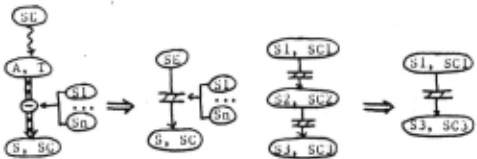
One of our current areas of interest is in automating the process of mechanisms abstraction. Note that we already have provisions in the representation for ex pressing abstracted forms: the state coupling link. This link allows us the freedom of direct state-state causality. The abstraction technique can therefore be one of syntactically replacing certain patterns in the detailed representation with state coupling links.
It appears that there will be only a small number of syntactic abstraction rules. Two of the most obvious ab stracting rules are depicted below. Such rules, applied transitively, could perform both minor and major ab stractions. A major abstraction would amount to a simple coupling between the input and output states of a mecha nism, e.g. "A falling te~aperature causes the thernostat to close."
Such abstracting would be applied to the declarative representation before simulation, so that the converted computation units would directly reflect the abstrac tion. Abstraction could be ripplied uniformly over an en tire IJechanism, or locally to excise parts which are not of imr,·ediate interest. Non-uniform abstracting, in which all uninteresting sections have been defocussed, would deliver practical advantages by allowing the simulator to devote more time to the relevant aspects of the simu lation. This could be inportant if, for example, we sus pect the audio stages of a radio are at fault, but know the p9wer supply is functional. Before simulation, the radio s power supply description could be defocussed be fore conversion to simulation representation (i.e. popu lation of SC's).
In addition to simple syntactic defocussing, we will also be exploring more semantic forms. Semantic mecha nisns abstraction would be useful if, for example, we wished to know about the gas furnace with respect to a· particular aspect of its operation, such as "heat production". We might scan through the description, as sessing each event according to its semantic relevance to the concept of heat production. Then, using the highly ranked events as milestone events, the syntactic abstraction procedure could be applied to yield an abstraction with respect to the desired point of view, i.e. one which retained only the milestone states.
8. Conclusions
We have presented a theory of mechanism description and simulation which is based on tenets and processes we hy pothesize to be applicable to other aspects of human cognition. \~e feel the theory of cause-ef feet represen tation is sound and expressive for a wide variety of mechanisms, and that it bears significance as a theory of human cause-effect knowledge representation.
Our next specific goals are threefold: (1) to make the acquisition of new mechanism patterns interactive, hav in~ the model prompt the userl and verify that the us er s use of the repre~entat on coincides with the mod el's notions of semantic well-formedness, (2) to study the processes of mechanisms abstraction, and (3) to ap ply the existing GSA plan synthesizer to the task of mechanisms invention, involving the simulator in a de bugging loop.
Acknowledgments
We wish to thank the other members of the !~ryland GSA group (Phil London, l~che Creeger, John Boose and Georgy Fekete) for their participation in numerous discussions and for their suggest ions. · We wish also to thank the Office of Naval Research for its support of this re search under Grant N00014-76C-0477.
@inproceedings{ijcai1977p55,
  title     = {The Declarative Representation and Procedural Simulation of Causality in Physical Mechanisms},
  author    = {Rieger, Chuck and Grinberg, Maurice},
  booktitle = {Proceedings of the Fifth International Joint Conference on
               Artificial Intelligence, {IJCAI-77}},
  publisher = {International Joint Conferences on Artificial Intelligence},
  editor    = {Raj Reddy},
  pages     = {250--255},
  year      = {1977},
  note      = {Representation of Knowledge},
  url       = {https://ijcai.org/proceedings/1977/55},
}
TY - CPAPER TI - The Declarative Representation and Procedural Simulation of Causality in Physical Mechanisms AU - Rieger, Chuck AU - Grinberg, Maurice T2 - Proceedings of the Fifth International Joint Conference on Artificial Intelligence, IJCAI-77 PB - International Joint Conferences on Artificial Intelligence PY - 1977 SP - 250 EP - 255 UR - https://ijcai.org/proceedings/1977/55 ER -Copied
Machine-readable versions of this paper, for tools and AI agents:





