
A Conceptual Theory of Question Answering
Proceedings of the Fifth International Joint Conference on Artificial Intelligence. Natural Language. Pages 158-163.
© 1977 International Joint Conferences on Artificial Intelligence
Abstract
A theory of Q/A has been proposed from the perspective of natural language processing that relies on ideas in conceptual information processing and theories of human memory organization. This theory of Q/A has been implemented in a computer program, QUALM. QUALM is currently used by two story understanding systems (SAM and PAM) to complete a natural language processing system that reads stories and answers questions about what was read. Keywords: natural language processing, computational question answering, conceptual information
- Culling
- ford, R. E. (1977 ). Organizing World Knowledge for Story Understanding by Computer. (thesis) Department of Engineering and Applied Science. Yale University, New Haven, Ct.
- Goldman, N. (1975). Conceptual generation. In R. C. Schank, ed: Conceptual Information Pro- cessing. North Holland Amsterdam.
- Lehnert, w. (1977).
- Answering. (thesis) partment of Computer New Haven, Ct. The Process of Question Research Report #88. De- Science, Yale University,
- Riesbeck, C. and Schank, R. (1976). Compre- hension by Computer: Expectation-Based Analysis of Sentences in Context. Research Report #78.
- Schank, R. Processing. C. (1975). Conceptual Information North Holland, Amsterdam.
- Schank, R. C. and Abelson, R. P. (1977). Script~L Plans, Goals and Understanding. Law- rence Erlbaum Associates.
- Hillsdale, N.J. Shortliffe, E.H. (1974). MYCIN: A Rule-Based Computer Program for Advising Physicians Regard- ing Anti-Microbial Therapy Selection. (thesis) Stanford Artificial Intelligence Laboratory Memo-AIM251. Stanford University, Stanford, CA.
- Wilensky, R. (1976). Using Plans to Understand Natural Language. Proceedings of the Annual Conference of the Association for Computing Ma- chinery. Houston, Texas.
- Woods, W.A., Kaplan, R.M., Nash-Webber, B. (1972). The Lunar Sciences Natural Language In- formation System: Final Report. BBN Report No. 2378, Bolt, Beraneck and Newman, Inc. Cambridge, Mass. Natural L<lnP'II<'~P.:~-8: LPI-tnert
References were extracted automatically from the PDF and may contain errors.
Full text extracted automatically from the PDF; figures, tables and equations may differ. The PDF is the version of record.
Wendy G. Lehnert Department of Computer Science Yale University New Haven, Ct. 06520
A theory of Q/A has been proposed from the per spective of natural language processing that re lies on ideas in conceptual information proces sing and theories of human memory organization. This theory of Q/A has been implemented in a computer program, QUALM. QUALM is currently used by two story understanding systems (SAM and PAM) to complete a natural language processing system that reads stories and answers questions about
what was read.
Keywords: natural language processing, computa tional question answering, conceptual information
If a computer is going to answer questions in a manner which is natural for human inter action, the computer must have knowledge of how people ask questions and what kinds of answers are expected in return. A competent question answering system must be based on a theory of human question answering that describes:
- {1) what it means to understand a question
- how context affects understanding
- what kind of responses are appropriate
- how to extract answers from memory
A theory of conceptual question answering has been developed which- addresses these four prob lems [Lehnert '77). This theory has been imple mented in a computer program (QUALM) which runs in conjunction with two story understanding sys tems, SAM [Cullingford '77) and PAM [Wilensky '76), enabling these systems to answer questions about the stories they read.
The theory of question answering proposed by QUALM is a theory of natural language processing. This distinguishes QUALM from many other question answering systems which are oriented towards in formation retrieval. Many systems which attempt to answer questions phrased in natural language have been designed in two pieces: (1) a memory retrieval system, and (2) a natural language in terface. Very often the interface problem is considered secondary to the retrieval system and the two subsystems are designed as _if they were
This work was supported in part by the Advanced Research Projects Agency of the Department of Defense and monitored under the Office of Naval
Research under contract N00014-75-G-1111.
theoretically independent of each other [Short liffe '74, Woods '72).
The theory behind QUALM extends theories of memory processing which originated with the study of parsing [Riesbeck & Schank '77) and generation [Goldman '75). Conceptual Dependency [Schank '75) has proven to be a strong representational system for the task of question answering. Parsing and generation strategies based on Con ceptual Dependency were naturally adopted for question answering without significant altera tions. This approach to question answering which utilizes existing theories of natural language processing constitutes a major departure from the information retrieval viewpoint where natural language is considered to be merely a "front end" for a question answering system.
In order to understand questions, QUALM must interface with a conceptual analysis program that parses an English question into its Conceptual Dependency representation [Schank '75). In SAM and PAM, QUALM interfaces with a parser designed by Christopher Riesbeck [Riesbeck & Schank '76). In order to produce answers in English, QUALM also needs a generator that can translate Con ceptual Dependency representations into English. The generator used by SAM and PAM is based on a generator designed by Neil Goldman [Goldman '75). All of the processing specific to answering questions occurs on a conceptual level that is language independent. If QUALM interfaced with a Russian parser and a Chinese generator, it would be able to understand questions stated in Russian and produce answers to these questions in Chin ese. No changes in QUALM are required to accom modate different languages since the question answering processes are independent of language.
b_ CON~EPTUAL CATEGORIES FOR QUESTIONS
When QUALM initially receives a question from the parser, the question is represented as a Conceptual Dependency conceptualization. This conceptualization must then be categorized into one of thirteen possible Conceptual Categories. The Conceptual Categories for questions are:
- Causal Antecedent (7) Instrumental/Procedural
- Goal Orientation (8) Concept Completion
- Enablement (9) Expectational
- Causal Consequent (10) Judgemental
- Verification (11) Quantification
- Disjunctive (12) Feature Specification (13) Request
The conceptual parse of a question represents a very literal or naive understanding of the ques tion. Conceptual Categorization constitutes a higher level of interpretation which is designed to determine exactly what the questioner really means. For example, if a stranger walks up to John on the street and asks:
Q1: Do you have a light?
John would parse this question into a conceptu alization equivalent to asking:
Q2: Do you have in your immediate possession an object capable of producing a flame?
If John does not interpret the question any fur ther than this, he could answer:
Al: Yes, I just got a new lighter yesterday.
and then walk away. This sort of response indi cates that John did not have a complete under standing of the question. He understood it on a preliminary level, but he did not understand it in terms of what the questioner had intended. His misinterpretation can be explained as faulty Conceptual Categorization. What John understood to be an inquiry deserving a yes or no answer, should have been understood as a request deserv ing a performative action. The person asking Ql didn't just want to know if John had a light; he wanted John to offer him a light (flame). In terms of Conceptual Categories, we would say that the question should have been interpreted as a Functional Request rather than a Verification Inquiry.
If a question is not categorized correctly, it will be impossible to produce an appropriate response.
RIGHT: Q3: How could John take the exam?
A3a: He crammed the night before.
(an Enablement question) (an Enablement answer)
WRONG: Q3: How could John take the exam? (an Enablement question)
A3b: He took it with a pen. (Instrumental/Procedural answer)
Q3 is asking about the · enabling conditions for taking an exam. In order to take an exam, one has to be prepared for it, presumably be a stu dent, and so forth. Q3 suggests that the ques tioner does not believe John satisfied some nec essary enabling condition. An appropriate answer to Q3 will address this questioned enablement (He crammed the night before, or he bribed an admin istrator). A3b does not address the Enablement conditions at all. A3b answers the question on a much lower level of instrumentality, indicating that the question was understood to be an In strumental/Procedural question instead of an En ablement question.
RIGHT: Q4: How did John die?
(Causal Antecedent question)
A4: He caught the swine flu.
(a Causal Antecedent answer)
WRONG: Q4: How did John die? (Causal Antecedent question)
A4b: Well, first he was alive.
(an Enablement answer)
This time A4b indicates that Q4 was understood to be an Enablement question. A necessary enable ment for dying is being alive. But Q4 should not have been interpreted to be asking about the en abling conditions for dying. Q4 is more reason ably understood to be asking about the cause of John's death: Was it an accident? Was he ill?
Did he kill himself?
RIGHT: QS: How did John get to Spain? (Instrumental/Procedural question)
ASa: He went by plane. (Instrumental/Procedural answer)
WRONG: QS: How did John get to Spain? (Instrumental/Procedural question)
ASb: He wanted to see Madrid.
(a Causal Antecedent Answer)
An appropriate answer to QS would specify the transportational means which was instrumental to John's getting to Spain (he took a cruise, he flew, etc.) But ASb tells us what caused John to go to Spain. ASb answers a Causal Antecedent question instead of an Instrumental/Procedural question.
When Q3-5 are represented in Conceptual De pendency, it is easy to see which Conceptual Category should be assigned to these questions. In QUALM, parsed conceptualizations are run through a discrimination net which assigns a Conceptual Category to each question. But Con ceptual Categorization does not constitute com plete understanding of a question. Each concep tual question is subject to further interpretive processing before a memory search for an answer can begin.
~ INFERENTIAL ANALYSIS
Complete understanding of a question often involves inferences in addition to Conceptual Categorization. When interpretation of a ques tion does not include analysis by inference, answers may be produced which are technically correct, but completely useless. Suppose John is
mixing cake batter and he asks his wife:
Q6: Now what haven't I added? A6: A pound of dog hair and an air filter.
She's probably right; he probably didn't add a pound of dog hair and an oil filter. But her answer is inappropriate because John was "obvi ously" asking for what he hadn't added that he should have added. The intent of this question is obvious only when an interpretive inference mechanism can be invoked to supply an implicit constraint. There is an entire class of ques tions that require the same type of inferential analysis:
Q7: Who isn't here? (Who isn't here who should be here?) QB: What did I forget to buy? (What didn't I buy that I should have?)
In each of these questions, an inference must be made that specifies appropriate constraints for potential answers. When Q7 is asked by a pro fessor upon entering his class, appropriate an swers refer to members of the class. When Q8 is asked in the context of shopping for a dinner party, appropriate answers refer to those things that are needed for dinner.
The Universal Set Inference, a general in ference mechanism, is needed for questions of this class. This mechanism examines the context of a question and determines appropriate con straining factors. But before this mechanism can be invoked, some process must be responsible for recognizing which questions require this partic ular inference mechanism. The Universal Set In ference should not be summoned for questions like:
Q9: Who is coming to your party? QlO: Isn't this the book you wanted?
The successful application of an interpretive inference mechanism relies on the ability to know when that mechanism is needed. This is one way Conceptual Categorization is exploited. One of the thirteen Conceptual Categories is the class of Concept Completion questions. These corres pond roughly to fill-in-the-blank questions. During the interpretation of a question, the Universal Set Inference is applied if and only if:
- the question is categorized as a Concept Completion question, and
- the conceptual question has MODE =NEG
Q6-8 each satisfy these requirements. While the lexical statement of Q8 does not appear to be negated, the conceptual representation for Q8 is equivalent to asking "What didn't I remember to buy?" which is encoded as an MTRANS with negative MODE. Q9 is a Concept Completion question but it fails to meet the criteria because it has a non-negative MODE. QlO fails because it is a Verification question instead of a Concept Com pletion question.
A useful system of categorization will pro vide simple test criteria for inference mechan isms of the sort just described. Different questions require different processing. A strong categorization system can recognize which pro cesses are required for a given question and dictate subsequent processing accordingly.
4. CONTEXT-SENSITIVE INTERPRETATION
In the last section we claimed that one general inference mechanism, the"Universal Set Inference, could be invoked to establish appro priate constraints on Concept Completion ques tions with MODE = NEG. This inference mechanism relies on the context in which questions are asked.
Q7: Who isn't here?
requires contextual information that implicitly specifies who should be here. If this question is asked by a professor in a class, it means "Which of my students aren't here?" If it is asked by a host at a party, it means "Who isn't here who was invited?" Without contextual infor mation, it is impossible to know what implicit constraints are appropriate.
Specific constraints on questions can be derived from whatever scripts [Schank & Abelson '77) are actively operating in a given context. When a script is active, its script-defined roles and role instantiations [Cullingford '77) delin eate the universal set these questions implicitly reference.
The Universal Set Inference
Question Category: Concept Completion Question Criteria: MODE value = NEG Contextual Criteria: there is an active script
If these test criteria are satisfied, interpre tive constraints are imposed by those roles de fined in the active script(s).
| question | scripta! context | constraining roles |
|---|---|---|
| Who isn't here? What didn't I add? Who hasn't bid? | party cooking bridge game | guests ingredients bridge players |
Many questions must be understood in terms of their surrounding context. It is therefore cru cial to be able to characterize contextual in formation in terms of general knowledge struc tures (Schank & Abelson '77) so that general in terpretive inference mechanisms can be designed which are sensitive to context without being 'context-specific. That is, a contextually sen sitive processing mechanism should be applicable in different contexts. A theory of question answering that needs to propose a new set of processing strategies for each new context en countered is not much of a theory.
5, CONTENT SPECIFICATION
Once a question has been sufficiently un derstood, retrieval processes can begin to look for an answer. The first part of the retrieval process decides how much of an answer is needed. Consider the following story:
John went to a restaurant and the hostess gave him a menu. When he ordered a hot dog the waitress said they didn't have any. So John ordered a hamburger instead. But when the hamburger came, it was so burnt that John left.
If asked:
Ql4: Did John eat a hot dog?
There are many possible answers. When SAM reads this story, SAM can answer Ql4 three different ways:
Al4a: No.
Al4b: No, the waitress told John they didn't
have any hot dogs.
Al4c: No, the waitress told John they didn't have any hot dogs and so John ordered a hamburger.
These answers are all different in terms of the amount of information they convey. In fact, answers can vary not only in terms of their rel ative content, but in terms of the kind of con tent they communicate. For example, if Ql4 had been answered "Yes," in the context of our story where John didn't eat a hot dog, then the content of this answer would be described as wrong.
The decision-making processes that determine what kind of an answer should be returned are part of Content Specification. Content Specifi cation takes into account the Conceptual Category of each question and intentionality factors that describe the "attitudinal" mode of the entire system in order to determine how a question should be answered. A system of descriptive instructions are produced by Content Specifica tion to instruct and guide memory retrieval pro cesses as they look for an answer.
The primary challenge involved in Content Specification is precisely how these instructions to memory retrieval are formalized. It is not enough to say "give a minimally correct answer," or "bring in everything you can find that's rel evant." The instructions generated 'by Content Specification must tell the retrieval heuristics exactly how to produce a minimally correct answer and exactly what has to .be done to do to come up with everything that's relevant.
One type of Content Specification mechanism that guides retrieval heuristics are Elaboration Options. Each Elaboration Option has four parts: an Intentionality Threshold, a Question Criter ion, an Initial Answer Criterion, and Elaboration Instructions. Intentionality refers to variables within the system that are set with sugges tively-named values like "talkative," "coopera tive," "minimally responsive," etc. The Inten tionality Threshold specifies what sort of In tentionality must be assigned to the system in order for an Elaboration Option to be attached to the question. The Question Criterion describes what Conceptual Category must be assigned to the question in order for it to receive the Elabora tion Option. If either the Intentionality of the system or the Conceptual Category of the question fail to meet the specifications of the Inten tionality .Threshold and the Question Criterion, then the · Elaboration Option is not used. The Answer Criterion specifies the type of conceptual answer which the memory search must initially return in order for the Elaboration Option to be executed. And the Elaboration Instructions specify exactly how an elaboration is to be ex tracted from memory and integrated into the con ceptual answer.
To see exactly how an Elaboration Option works, we will discuss one of the simpler Elab oration Options that has been implemented in QUALM. Consider the following story:
John went to New York by bus. On the bus he talked to an old lady. When he left the bus, he thanked the driver. He took the subway to Leone's. On the subway his pocket was picked. He got off the train and entered Leone's. He had some lasagna. When the check came, he discovered he couldn't pay. The management told him he would have to wash dishes. When h~ left, he caught a bus to New Haven.
After reading this story SAM answers:
QlS: Did John go to New York?
AlS: Yes, John went to New York by bus.
Ql6: Did John eat?
Al6: Yes, John ate lasagna.
Ql7: Did someone pick John's pocket?
Al7: Yes, a thief picked John's pocket.
Ql8: Did John pay the check?
AlB: Yes, John paid the bill.
These are answers SAM gives when it has a talka tive Intentionality. If SAM were running with a less than talkative Intentionality, each of these questions would have been answered with a simple "Yes." The longer answers (AlS-18) are the result of the Verification Option. This is a very simple Elaboration Option which is defined as follows:
The Verification QE!ion
Intentionality Threshold: Talkative Question Category: Verification Answer Criterion: initial answer is Yes
Elaboration Instructions:
final conceptual answer is "Yes, *X*" where *X* is the conceptualization found in the story representation that matches the question concept.
The retrieval heuristics for a Verification question search the story representation for a conceptualization matching the conceptual ques tion. If it finds a match, the initial answer is Yes. A conceptualization from the story rep resentation do~sn't have to correspond to the question concept exactly in order to match it; it may contain more information than the question concept. This is why AlS-17 appear to volunteer information. AlS tells how John went to New York, Al6 says what John ate, and Al7 asserts who stole John's wallet.
6. FINDING AN ANSWER ----
Retrieval heuristics vary for each Concep tual Category of questions. A number of inter esting problems arise in designing processes that extract information from memory. We will briefly outline three such problems which reflect the scope and depth of the difficulties involved.
Expectational questions are interesting be cause they cannot be answered on the basis of a story representation alone. Expectational ques tions correspond roughly to why-not questions. These questions require "integrative" memory processing. The term integration is very often used in the context of adding new information to memory. A single unit of information is "inte grated" into a larger memory structure. But in the context of retrieving information from mem ory, an integrative process is one which combines information from different sources to produce new information.
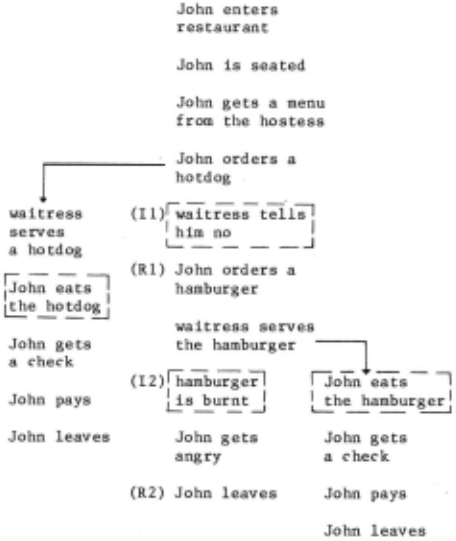
After reading the burnt-hamburger story, SAM answers:
Ql9: Why didn't John eat a hot dog?
Al9: Because the waitress told John they didn't have any hot dogs.
Q20: Why didn't John eat the hamburger?
A20: Because the hamburger was burnt.
These questions are answered by an integrative process that combines the story representation with predictive mechanisms in order to recon struct expectations that were alive at some time during the understanding process. When John or dered a hot dog we had an expectation that he would eat a hot dog until we heard there were none. When John ordered a hamburger we expected him to eat a hamburger until we heard that the hamburger was burnt and John just left. Expec tational questions ask about expectations which were aroused at some point during the under standing process and then subsequently violated by an unexpected turn of events. Had we asked "Why didn't John swim across the lake?" the question would seem unreasonable since we never had any expectations about John going swimming or crossing a lake.
The theories of memory representation im plemented in SAM and PAM adhere to the premise that a story representation should encode infor mation about things that happened in the story. This includes inferences about things that prob ably occurred (but weren't explicitly mentioned) as well as conceptualizations for events that were explicitly described in the input story. But Expectational questions ask about things that didn't happen. To answer an Expectational ques tion, we must use the same predictive processes used during story understanding to reconstruct failed expectations which were alive at some time during understanding. The reconstruction of failed expectations is achieved by an integrative memory process called ghost path generation.
The generation of ghost paths cann.ot be fully understood without a fundamental under standing of script application [see Cullingford '77]. But some sense of what goes on should be apparent from the following diagram. In this diagram, the chain of events in the center cor responds very roughly to information in the story representation that SAM generated at the time it read the burnt-hamburger story. The two chains on either side correspond to the two ghost paths needed to answer Ql9 and Q20.
~Answer Selection
While Expectational questions are interes ting because they cannot be answered on the basis of a story representation alone, there are many questions that do not need information outside of the story representation which are still diffi cult to answer. Causal Antecedent questions are complicated in this respect. A Causal Antecedent question is one which asks for the reason behind an event. After reading the Leone's story, con
sider the following answers:
Q21: Why did John wash dishes?
A2la: Because he couldn't pay the check.
A2lb: Because he had no money.
A2lc: Because he had been pickpocketed on the subway.
SAM answers Q21 "Because he had no money." But is this the best answer of the three? What factors determine the superiority of one answer over an
other?
Effective a~wer selection entails making assumptions about what the questioner knows. Anyone who asks Q2J can be assumed to know that John washed dish~s. If we go on to assume that the questioner knows two more things: · (1) John washed dishes in a restaurant, and (2) washing dishes in a restaurant is classically what hap pens when someone eats and then can't pay, then the questioner can infer: (3) John couldn't pay the check. If the questioner can figure out for himself that John couldn't pay the check then A2la does not tell him anything he doesn't know to begin with. A good answer must take into ac count what the questioner does and doesn't know, and address the knowledge state of the questioner by telling him something new.
A2lb is a weak answ~r for the same reasons that A2la was weak. If someone knows that John couldn't pay a check, they can reasonably infer that John didn't have (enough) money. Both in ferences:
- John couldn't pay the check.
- John didn't have any money.
can be made by the questioner on the basis of general world knowledge and knowing that John washed dishes in a restaurant. But there is no way the questioner can infer that John was pick pocketed on the subway without additional knowl edge of the story. Therefore A2lc is the best answer to Q21 as long as we assume the questioner has knowledge about the world and can make in ferences on the basis of that knowledge.
If we assumed that the questioner knew no thing . about restaurants, A2la would be the best answer. If we assumed that the questioner knew about restaurants but didn't understand about paying for things, A2lb would be the best answer. It is impossible to judge various answers to a question without knowing. (or assuming) something about the person being addressed.
~ Conceptual Organization of Knowledge
When people answer questions, their answers sometimes tell us something about the form and organization of conceptual information in human memory. For example, consider the following story:
John was sitting in a dining car. When the train jerked, the soup spilled.
Suppose we ask:
Q22: Where was the soup?
This is a specification question that can be an swered a number of ways. Two common answers are:
A22a: In a bowl. A22b: On the table.
A much less natural answer would be:
A22c: On a plate.
A22c seems to be very odd answer which conjures up an image of a soup puddle on a plate. This is not the scene most people envision when hearing the story. Most people imagine the soup in a bowl on a plate on a table.
The acceptable and unacceptable answers to Q22 tell us something about human memory organi zation. It never occurs to people to answer "On a plate." Furthermore, when this answer is given it provokes a wrong image of soup resting di rectly on a plate. But "On the table," is a natural answer. Why is it that "On a plate," is a bad answer but "On the table," is perfectly reasonable? The soup does not rest directly on the table any more than it rests directly on a plate. Why is it acceptable in one case but not the other? This phenomenon must be accounted for in terms of memory organization.
When people hear this story they assume a causality between the train jerking and the soup spilling. (If asked "Why did the soup spill?" people will answer "Because the train moved.") This causality relies on the fact that the soup is physically connected to the train in some way. This physical connection can only be recognized by constructing a path of physical objects be tween the soup and the train. This path of con nections must be accessed in order to answer Q22. If a path is constructed the same way people build one, it will be easy to retrieve answers to Q22 that seem natural. If the path is built differently, we may end up with an answer like
A22c.
Suppose we construct a path like the following:
A BAD PATH:
soup (inside-of) bowl (on-top-of) plate (on-top-of) tablecloth (on-top-of) table (on-top-of) floor (inside-of) dining car (part-of)
train
With this memory representation it is not clear how we can extract the answers A22a and A22b without also getting answers like "On a plate," or "On a tablecloth." There is nothing in this memory representation that tells us where the good answers are. What we need is a memory rep resentation that makes it· easy to find a bowl and a table but hard to retrieve a plate.
A BETTER PATH: soup (inside-of) bowl (part-of) placesetting (part-of) tablesetting (on-top-of) table (part-of) dining area (part-of) dining car (part-of)
train This path is tic to trace the connected links. suggests a very simple retrieval heur produce the answers A22a and A22b: path looking for objects which are by either "inside-of" or "on-top-of"
The closer a memory representation is to human memory organization, the easier it will be to produce answers that make sense to people. A system of memory representation for physical ob jects has been proposed [Lehnert '77) which is designed to facilitate inference and retrieval problems of the sort just described. Conceptual descriptions of objects in this system are based on decompositions into a set of seven object primitives in much the same way that Conceptual Dependency [Schank '75) describes actions by de composing them into a set of primitive acts.
The overall question answering process can be intuitively approached in two stages: under standing the question (interpretation) and find ing an answer (memory retrieval). Each of these stages is likewise divided into two parts:
INTERPRETATION:
- [1) Conceptual Categorization
- [2) Inferential Analysis
MEMORY RETRIEVAL:
- [3) Content Specification
- [4) Searching Heuristics
- [1) Conceptual Categorization guides the subse quent processing by dictating which specific in ference mechanisms, elaboration options, and re trieval heuristics should be invoked in the course of answering a question.
- [2) Inferential Analysis is responsible for un derstanding what the questioner really meant when a question should not be taken literally.
- [3) Content Specification determines how much of an answer should be returned in terms of detail and elaborations.
- [4) Searching Heuristics do the actual digging in order to extract an answer from memory.
All of the processes within these four phases are specific to question answering per se and are language-independent, operating within a concep tual representation system.
QUALM represents a theory of question ans wering which is motivated by theories of natural language processing. Within the context of story understanding, QUALM has provided a concrete criterion for judging the strengths and weaknes ses of story representations generated by SAM and PAM. If a system understands a story, it should be able to answer questions about that story in the same way that people do. Although the com puter implementation of QUALM is currently limited to the application of answering questions about stories, the theoretical model [Lehnert '77) goes beyond this particular context · . As a theoretical model QUALM is intended to describe general question answering, where question an swering in its most general form is viewed as a verbal communication device between people.
While many of QUALM's question answering techniques are designed for answering questions about stories, QUALM is not limited to stories about a specific content domain. QUALM is ap plicable to any story that can be understood . in terms of scripts and plans [Schank & Abelson '77). This limitation is not content-specific; it is dependent on the general knowledge struc tures that are used in text understanding. When new scripts and plans are added to the knowledge base for SAM and PAM, questions can be answered about stories using this new knowledge without any additional alterations to QUALM.
BIBLIOGRAPHY
Culling ford, R. E. (1977 ). Organizing World Knowledge for Story Understanding by Computer. (thesis) Department of Engineering and Applied Science. Yale University, New Haven, Ct.
Goldman, N. (1975). Conceptual generation. In R. C. Schank, ed: Conceptual Information Pro cessing. North Holland Amsterdam.
Lehnert, w. (1977). Answering. (thesis) partment of Computer New Haven, Ct. The Process of Question Research Report #88. De Science, Yale University,
Riesbeck, C. and Schank, R. (1976). Compre hension by Computer: Expectation-Based Analysis of Sentences in Context. Research Report #78. Department of Computer Science, Yale University, New Haven, Ct.
Schank, R. Processing. C. (1975). Conceptual Information North Holland, Amsterdam.
Schank, R. C. and Abelson, R. P. (1977). Script~L Plans, Goals and Understanding. Law rence Erlbaum Associates. Hillsdale, N.J.
Shortliffe, E.H. (1974). MYCIN: A Rule-Based Computer Program for Advising Physicians Regard ing Anti-Microbial Therapy Selection. (thesis) Stanford Artificial Intelligence Laboratory Memo-AIM251. Stanford University, Stanford, CA.
Wilensky, R. (1976). Using Plans to Understand Natural Language. Proceedings of the Annual Conference of the Association for Computing Ma chinery. Houston, Texas.
Woods, W.A., Kaplan, R.M., Nash-Webber, B. (1972). The Lunar Sciences Natural Language In formation System: Final Report. BBN Report No. 2378, Bolt, Beraneck and Newman, Inc. Cambridge, Mass.
@inproceedings{ijcai1977p33,
  title     = {A Conceptual Theory of Question Answering},
  author    = {Lehnert, Wendy G.},
  booktitle = {Proceedings of the Fifth International Joint Conference on
               Artificial Intelligence, {IJCAI-77}},
  publisher = {International Joint Conferences on Artificial Intelligence},
  editor    = {Raj Reddy},
  pages     = {158--163},
  year      = {1977},
  note      = {Natural Language},
  url       = {https://ijcai.org/proceedings/1977/33},
}
TY - CPAPER TI - A Conceptual Theory of Question Answering AU - Lehnert, Wendy G. T2 - Proceedings of the Fifth International Joint Conference on Artificial Intelligence, IJCAI-77 PB - International Joint Conferences on Artificial Intelligence PY - 1977 SP - 158 EP - 163 UR - https://ijcai.org/proceedings/1977/33 ER -Copied
Machine-readable versions of this paper, for tools and AI agents:





