
Federal Programs in Artificial Intelligence
Proceedings of the Fifth International Joint Conference on Artificial Intelligence. Invited Panel. Pages 940-949.
© 1977 International Joint Conferences on Artificial Intelligence
Abstract
Full text extracted automatically from the PDF; figures, tables and equations may differ. The PDF is the version of record.
Introduction
I~ the National Science Foundation, the three (3) programs which support the most Artificial Intelligence related research are the Intell-igent Systems Program of the Division of Mathematical and Computer Sciences, the Automation, Bioengineering and Sensing Systems Program of the Division of Engineering and the Production Research and Technology Program of the Division of Advanced Productivity Research and Tech nology. As indicated by the titles of the programs, the interests of the Foundation range from basic research in computer and engineering sciences to fundamental pro blem oriented research addressed to the manufacturing process.
In evaluating proposals submitted to these programs, the Foundation makes extensive use of mail review by peers who help judge the scientific interest and technical integrity of the proposed research. Since intrinsic scientific merit is the primary criterion applied in selecting proposals for support, a clear definition of ~ search objectives, as distinguished from project or implementation objectives, is required. System building will be con sidered for support only to the extent necessary for the study of significant research questions. On the other hand, we are glad to consider research proposals to complement support from other agencies so as to provide more opportunity for studying basic research questions using systems which have been or are being developed primarily for other purposes. Typical grants in these programs range from $40,000/year to $100,000/year in amount. Most grants are for two years although longer or shorter commitments are made when appropriate.
Intelligent Systems Program
The Intelligent Systems Program is briefly described as follows:
"This program is directed toward re search on computer-based systems which have some of the characteris tics of intelligence. Relevant areas include pattern recognition, pattern generation, knowledge representation, problem solving, natural language understanding, theorem proving, and others which relate to the_automatic analysis and handling of complex tasks."
It is one of six programs supporting basic research in computer science, the others being Theoretical Computer Science, Soft ware Systems Science, Software Engineering, Computer Systems Design, and Special Pro jects. Some representative grants from this program are:
- Molgen: A Computer Science Applida tion to Molecular Genetics
The general goal of this research is to develop a computer system (MOLGEN) to assist a molecular geneticist in planning laboratory experiments. The system is to be interactive, drawing on both the expertise of the human geneticist and the expert knowledge stored in the data base. In addition to the knowledge base, the major components of the computer system will be an experimental planning program, an enzyme simulation program, and DNA structure entry and editing system. Extensive use of heuristic and other "reasoning" strategies at decision points in the programs make this a research project in intelligent sys tems.
- Curvature and Convexity in Scene Analysis Problems
This study will investigate the inter relationships that exist among various parameters of surfaces in scenes and how they affect the information that is recorded in pictures of these sur faces. Special attention will be focused on the effects of surface curvature and convexity (or concavity) and the mutual interactions of these parameters and those that are associ ated with the direction of the illu mination, the orientation of the sur face and its texture and light reflecting characteristies.
- Techniques for the Representation of Movement-Related Information Using a Digital Computer
The . long-range goal of this project is computer recognition and descrip tion of patterns of human movement. As a step toward that goal, research is being conducted on a computationally suitable notational system to serve as a low-level language for description of human movement. The notational system is event-oriented, rather than time-interval oriented, and the events themselves are primarily symbolic, rather than numeric: that is, significant events are indicated by changes in sematic relations rather than in numerical quantities. A related focus is the design and implementation of data and control structures appropriate to the description and manipulation of information related to human movement which may then provide a basis for an appropriate low level programming language.
Automation, Bioengineering and Sensing Systems Program
The Automation, Bioengineering and Sensing Systems Program supports research in the engineering sciences related to the general area of machine decision and control. Although this subset of the program is referred to as advanced auto mation, the research overlaps into topics generally thought of as artificial intel ligence. Technical areas include sensing systems, imaging systems to generate or enhance vision of pictures, pattern recog nition and processing, feature extraction, learning systems, feedback decision and control, and robotics and manipulator research. The objective is to develop fundamental knowledge concerning the techniques inherent in automated machine decision making independent of the problem domain. Therefore, the Automation, Bio engineering and Sensing Systems Program is driven by the engineering science involved and not by any specific problem or goal and the individual projects span a wide range of investigations.
In sensing systems research, areas of investigation include physical or chemical sensors, laser ranging, electromagnetic or acoustical probing of physical or biolog ical systems, and nuclear imaging. Holo graphy, ultrasonic, optical, and other imaging techniques are studied both exper imentally and theoretically in various problem domains. Pattern recognition and processing is a major portion of the ad vanced automation area, with emphasis on scene analysis by means of motion, color, texture or other parameters, and applica tions of syntactic pattern recognition methods. In the case of robotics or man ipulator research, primary interest lies in the automatic coordination of joint motion under computer control, utilizing feedback techniques. Although these investigations have applicability to industrial manipulators, prosthetic devices, legged locomotion, muscle-skeleton problems and others, the research concentrates on the basic understanding of the mechanisms of joint motion and feedback control and utilizes computer simulation, kinematic models, and experimental techniques. Investigators supported by the Automation, Bioengineering and Sensing Systems Program perform theoretical and experimental re search, computer modeling and simulation, and studies of the complete system.
Some representative grants from this program are:
- Use of Range and Trispectral Reflec tance Data in Scene Analysis
This research focuses on the use of registered trispectral reflectance and range data of different indoor scenes, developing procedures for extracting geometrical and visual features to recognition of three dimensional objectives by a high level computer program with some knowledge of the environment. Specifically, the program will seek to establish geometrical and re flectance models for objectives with different shape, size, and surface spectral reflectance. Feature ex~ traction will be accomplished by applying the registered range and reflectance data to objects with planar and nonplanar surfaces.
- Research on Space-Variant Optical Computers
This program of research on space variant optical computers involves two major phases. The primary effort during this first year will be aimed at optical techniques for performing coordinate transformations. This will include specifically: An in vestigation of the capabilities and limitations of the methods conceived of by Bryngdahl~ a search for alter native methods using computer gen erated holograms but not subject to severe space-bandwidth product limi tations of the curved-input-output surface method~ a search for new optical methods of any kind for performing space-variant linear fil tering~ and development of experi mental experience with the known methods. The second phase of the program will be devoted to space variant optical filtering of various kinds of data.
- Theory of Pattern Processing Using New Charge-Coupled Device Architectures ·
The central objective of this research is to establish pattern processing theory for .charge coupled device processor architecture to be used in advanced automation. This can be divided into more specific objec tives that include devising fundamen tal architectures for CCD and micro processor-based advanced automation systems, establishing signal process ing algorithms that are best suited for decision and control in such architectures, studies of unique signal processing possibilities such as registration, dilation, illumina tion variation and ranging, and veri fication of results (to the extent possible) using existing experimental systems. The approach will emphasize general solutions so as to have broad applicability.
Production Research and Technology Program
The Production Researc~ and Technology Program's purview is the production system, i.e., the way goods are manufactured and produced. It is concerned with research on the technical problems which underlie both the physical transformations of objects and the informational transforma tions necessary to understand, model, con trol and carry out manufacturing operations. The program recognizes that major modifica tions in manufacturing leading to quantum jumps in productivity would be hastened if such a science base could be established and applied.
The first industrial revolution involved the transfer of skills from man to machine and much has been accomplished in this area. The second industrial revolution, which is in its infancy, involves the transfer of intelligence from man to machine. The Production Research and Technology Program is concerned with identifying and under standing those research problems whose solution is necessary to accomplish this transfer of intelligence from man to machine in the area of manufacturing.
The program's objectives include:
- o Promotion of problem-oriented research in bottleneck areas, where modest re search investments can have high lever age in improving productivity.
- o Promotion of more fundamental, but still problem-oriented, research aimed at establishing a science base for manufacturing.
- o Revitalization of the industry/univer sity collaboration that flourished prior to the late 1950's and 1960's.
Researchers include physicists, applied mathematicians, materials scientists, computer scientists (artificial intelli gence researchers), and engineers (aero space, mechanical, electrical and indus trial).
Some representative grants from this pro gram are:
- Computer Integrated Assembly Systems
The objective of this research is to make manipulation and vision systems for assembly and inspection more ver satile and easier to use. There are four major areas of research. Manipu lator Programming System: Previous research results will be used to com plete a system which is a model for practical industrial systems. That system will be used as a research tool to develop language facilities for pro gramming tasks involving several sensor equipped manipulators. The feasibility of a standard system for use by other labs will be evaluated. Analysis of Assembly: The programming of assembly examples solicited from industry will be studied. Common subtasks and sub task library will be identified. Assembly system and parts will be modeled functionally. Interactive Training System-for Assembly Program ming: A simple interactive training system will be implemented which com bines "teach mode" manipulator pro gramming with simple symbolic commands and a library of models of parts. Re latively few positions will need to be specified because of positi~n calcula tions from part models. A simple means of model building has been provided. Results of the analysis of assembly will be utilized in the form of a library of models. Inspection and Vision Program ming Systems: An analysis of inspec tion tasks will be made to classify what information is necessary for pro gramming inspection. In particular, an investigation will be made of dimen sional inspection to determine what can be automated to aid programming. Un oriented parts in a box will be located and separated visually for grasping by a manipulator. The Vision Language will be used in picking parts, and will be extended to include parts models for that task and to represent the informa tion found important in the analysis of inspection. A simple programming sys tem for vision in assembly will be completed.
- Machine Intelligence Research Applied to Industrial Automation
The objectives of this proposed program are to devise and implement an advanced programmable/adaptable automation sys tem with applicability to large important classes of material handling, inspection, and assembly processes for batch-pro duction discrete part manufactured pro ducts. Two groups of tasks are planned: The major group includes goal-oriented research into advanced vision and mani putation techniques aimed at signifi cantly extending the adaptive capabil i~ies.o~ industrial robots and providing s~mpl~f~ed programming capabilities for automated visual inspection. The second group of tasks is to devise and imple ment software modules widely useful for computerized visual sensing, visual inspection and sensor controlled manip ulation using standard hardware. These modules will reduce to practice past research results and make the research readily available to industry. Research to be pursued includes: development of minimally interactive methods to auto matically generate computer programs for the visual inspection of parts and sub assemblies by "training by showing;" use of solid state cameras to explore visual feedback of manipulators to positioning a robot and effector (hand) in real time; use of visual and tactile sensor feedback to accomplish precision manipulations; use of both range and intensity information requiring faster and more powerful image processing algorithms to apply to complex inspec tion problems to widen the utility of visual sensing.
- General Methods to Enable Robots with "Vision" to Acquire, Orient and Trans port Workpieces
This research effort seeks to develop general methods by which computer controlled robots using visual sensors can (1) acquire a workpiece (part) so that it may be brought to a fixture without a collision; (2) compute the orientation of a workpiece held in the robot hand; and (3) transport the work piece to the fixture without collisions. The research is expected to result in new image processing techniques as well as kinematic equations for manipulators and robot system architecture which will enable a class of presently unsolvable industrial problems to be attacked.
Planned activities include the following: Methods to acquire and orient workpieces with arbitrary resting states will be developed. Features which describe workpieces' orientation will be investi gated. Some of these features will be based on a partial image of the work piece and others on the complete image.
Features based on gray-scale pictures will be used when features based on binary pictures perform unsatisfactorily. Alternative methods to sample image data from different orientations during instruction will be examined. Graphs of image features versus orientation will be made. Procedures to make a decision about workpiece orientation will be developed which use multiple views of . the workpiece. Obstacle avoidance tech niques which employ a programmer's ability to specify a nominal workpiece trajectory using a switchbox will be tested. Experiments will be performed employing an accurate six-degree-of freedom robot and a special fixture which houses dial gauges to measure orientation and position. A probabilis tic model of the overall process will be formulated in an effort to decrease the average cycle time.
AUTOMATION AT THE NATIONAL BUREAU OF STANDARDS
J. Albus N.B.S. Wash., DC 20234
The objectives of the National Bureau of Standards program in Automation Technology are:
- To provide standards for the interfaces between modular components of computer aided manufacturing systems.
- To provide standards for the languages used to program automation systems.
- To provide performance measures for specification and procurement or robots and numerically controlled machine tools.
- To carry out research in dynamic measure ment and computer control techniques.
One of our most significant projects of the current year is our support to the Air Force in interface standards for their In tegrated Computer Aided Manufacturing {ICAM) system. ICAM is envisioned as a set of application programs for design and man ufacturing, integrated with simulation and other utility programs around a common data base. The Air Force plans to spend $75 million in 160 different contracts over the next 5 years to develop this software which must be both compatible and portable.
NBS has identified and evaluated 64 standards concerning the information transfer and data bases involved in the interfaces between the different applications programs, between the applications programs and the operating systems, the Data Base Management System, and the various terminals, peripheral de vices, and satellite computers in a net work system. Our recommendations on the use of these standards by the Air Force in this seminal project will influence the standards used by all manufacturing indus try in the 1980's.
Our program plan for interface standards over the next 5 years is:
- To develop guidelines for the specifica tion of key interfaces for industrial robots, numerically controlled machine tools, and for robots and machine tool combinations.
- To develop a formal Federal standard for these interfaces.
- To continue to support the Air Force regarding Computer Aided Manufacturing standards related to the ICAM project.
In regard to our second program objectives, the development of language standards used in programming automation systems, we are currently engaged in finalizing a Federal standard on the APT programming language. This standard will allow all Federal in stallations to interchange their APT pro grams. The Navy estimates that this one standard will save the Government $3.8 million per year in reprogramming costs.
We will continue this work over the next five years with the publication of stan dard subsets and supersets of the APT language with validation procedures for testing APT compliers.
The third objective of our program is to develop performance measures for the specification, procurement, and evaluation of robots and NC tools.
We have developed a hierarchical classifi~ cation system for different levels of robot control systems and will be providing consulting services to the Air Force on the development of advanced control systems for robots for building the F-16 aircraft. We plan to 0 develop comprehensive performance test methods and evaluation techniques for robots by 1979 and techniques for evaluat ing dynamic performance of machine tools by 1980.
The fourth objective of our program is to carry out research in the technologies of computer control. Under this part of our program we have developed a control sys tem modeled after the cerebellum, which is a part of the brain which computes the functions required for ·precise coordinated control of rapid movements of the limbs, hands, and eyes. This model called CMAC {Cerebellar Model Arithmetic Computer) was recognized by Industrial Research Magazine in its annual IR-100 competition as "one of the 100 most significant new technical products of year 1976." CMAC was consider ed important for a number of reasons:
First, it reduces a significant new neuro physiological theory to a mathematical formalism of sufficient precision to make possible scientific predictions of motor behavior.
Second, it is a new technique of computer memory management which makes practical the real time computation of a large class of important multivariant functions by table look-up. This class of functions includes those frequently encountered in the servo control of machine tools, robots, aerospace vehicles, and many industrial processes.
Third, it is a device which can be imple mented with inexpensive microprocessor technology thereby making its use econom ical for a wide variety of control system applications.
Fourth, it is a device which can be inter connected in a hierarchical structure so as to generate sensory-interactive, adap tive, goal-directed behavior in autonomous systems. CMAC provides an entirely new approach to many significant problems in artificial intelligence, data base manage ment, and large scale distributed comput ing systems.
The NBS Automation Technology Program is currently funded at $540K per year. This is expected to rise to $1.0 million in FY 78 and to about $3.0 by 1980. Of this funding approximately 20% is devoted to developing sensors .and control technology.
OFFICE OF NAVAL RESEARCH PROGRAMS IN ARTIFICIAL INTELLIGENCE
M. Denicoff ONR Arlington, VA 22217
The Office of Naval Research supports two major research efforts in Artificial Intelligence: (1) large file systems and (2) maintenance automation.
I. Large File Systems
The non-numeric large file problem, most characteristic of civiliam and military logistics, management, financial, and personnel and data processing environments, is the problem area most poorly addressed by current computer technology. The re quirement here, barely touched upon by research activity to the time of 1970, is the development of techniques to improve search and runtime efficiency; to design software which faces up to security issues in a highly interactive, network environ ment; to accomplish a major breakthrough by moving away from systems which produce calendar oriented, voluminous output; and to move vigorously toward the toal of real time interaction between decision makers and stored data. In spite of almost twenty years of heralding the arrival of on-line computing, our current systems are largely batch oriented; output is voluminous and calendar directed; management by exception seldom occurs; there is very little direct, on-line manager interaction with computers. Large Data Base research activity, initiated by the Office of Naval Research in 1972, set out td develop a body of techniques for correcting these deficiencies. · Most im portant, the ONR program had the larger goal of moving computation from its current state of constituting a passive capability -- all of that data sitting there in stor age waiting to be asked questions which are seldom or never asked. The 1972 objective was to push strongly in the direction of activist systems which are capable of carrying on extensive English language dialogues, which have an automated capacity for comprehending relationships across data, for making inferences, for using that fac ility to take initiative, in real time, to alert managers to the impending occurrence of critical events. Knowledge systems used to anticipate and prevent crisis, not com puters used to reconstruct the history of past disasters is the ultimate Large Data Base research objective. Large File Sys tem research has two major aspects; one being the design of software to facilitate the managerial data retrieval process; the other, being the creation of mechanisms to improve managerial -- data base interaction. From the software design perspective, the program includes such elements as privacy and selective access control capabilities; procedures for automatic reconfiguration of files across storage media; the inclu sion of smoothing algorithms to control the reconfiguration process; the routine crea tion of "utility files" containing summary data; data structuring to facilitate in ferential search; the capability for pro viding statements on the accuracy or re levance of output; the incorporation of knowledge representation methodologies to create a context for interpreting the meanings of interrogations arriving from diverse sources. From the user perspec tive, the research includes real time interrogation; on-line modeling capabil ities; a text reading, text summarization, and message prioritization capability; the development of a natural language front end to enable direct contact with computers by high level managers -- this interaction ranging from "one liners" to sophisticated on-line browsing and simulation; building a capability for anticipating crisis situations through the setting and monitoring of automatic alarms or triggers.
II. Maintenance Automation
The increasing technological complexity of naval weapons systems, coupled with antic ipated shortages of required manpower skills and rising repair costs, underscore the inevitability of an impending difficult situation in Fleet maintenance. Automa tion of Navy maintenance activities is proposed, not as a substitute for, but as a necessary adjunct to solving the problem by increasing the manpower supply, or im proving the fundamental reliability of weapons.
Research objectives include:
- Automating the processes of equip ment failure diagnosis and repair, includ ing: (1) Use of the computer as an "expert consultant" to the technician in perform ing general diagnosis and repair. (2) Dev eloping fully automated diagnostics and repair capabilities for selected equipment areas. (3) Exploring possibilities of com puter assisted jury rig advice for classes of malfunctions. (4) Where feasible, dev eloping automated procedures for initiat ing/accomplishing jury rig solutions.
b. Automating the function of manufac turing required for unavailable spare parts, including: (1) Development of automated, onboard manufacturing capabilities. Pos sibilities range from use of numerically controlled machines to design of A.I. procedures for one-of-a-kind production. (2) Consideration of stocking rough fin ished (general utility) modules which, with A.I. manufacturing, can be tailored to a unique · end item need.
- The design of A.I. procedures for automating the function of testing for deterioration, damage, or miscalibration of on-the-shelf stocked items.
- Mechanizing the function of equip ment condition monitoring; the interest being that of automatic alarm ringing when pre-established threshold conditions are breached.
- The exploitation of A.I. viewing and manipulation capabilities to reduce both damage and manpower requirements for on board ship materials handling and movement.
- Design of generalized, automated devices for accomplishing manpower inten sive shipboard housekeeping functions.
- The design of A.I. knowledge base, process modelling capabilities to schedule and monitor the totality of maintenance
activities relevant to operating embarked carrier squadrons.
The field of Artificial Intelligence has produced fundamental results in the areas of machine conceptualizing, machine vision, and manipulation; these results are so pro mising as to indicate the advisability of a large investment to test the appropriate ness/feasibility of these techniques for addressing the issues described above. Very recent results demonstrated the utility of A.I. algorithms for: (1) Under standing and responding to natural language questions on the wiring intricacies of a complex circuit design, and (2) automatic recognition and underscoring of circuit malfunctions, and (3) automated guidance to technicians on accomplishing the repair.
ARTIFICIAL INTELLIGENCE R&D AT TH~ NAVAL RESEARCH LABORATORY
J. Slagle NRL
Wash. ·, DC 20375
The need for A.I. technology is increasing rapidly in the Department of Defense in general and the Navy in particular. While the nature of the Navy's responsibilities becomes more difficult and the equipment becomes more sophisticated almost daily, the ability of the Navy to fulfill its missions has not fully kept pace. There are a number of reasons for this, the most significant of which are:
- The people in the military are costly and yet mostly unskilled. The amount of the military budget spent on personnel has increased to 60%, and is likely to increase further with the continuation of the all volunteer military, yet due to some of the disadvantages of military service, it is difficult to draw and keep sufficient skilled labor to operate, maintain, and repair the widespread sophisticated equip ment.
- The training of people to handle and repair sophisticated military equipment is very expensive. Once trained, many mili tary people can obtain substantially higher salaries in private enterprise and there fore often leave before the military has fully recovered the costs of their training.
- Machines can operate in environments hostile to people, for example, under fire or in extreme climates or, for certain Navy applications, under water.
- Successful operation of the modern mil itary complex requires effective, efficient, and rapid command and control of a large complex of people and equipment. However, the systems for command and control have
not fully kept pace with the rapid advances in the equipment being commanded and con trolled.
5. Skilled humans can still far outperform computers in many aspects of processing tasks, such as those associated with noisy signals from radar, radio, and acoustic equipment. Many other tasks such as the handling of day to day reports and mounds of paperwork can be more effectively hand led by computers. It is therefore impor tant that useful and trustworthy systems be made available to free military person nel for those tasks for which humans are best suited.
While it is true that the cost of computer software, expecially A.I. type software, is rising rapidly, the potential benefits from successful A.I. techniques far out weigh the initial costs.
The A.I. R&D at NRL is essentially concen trated in the Computer Science Laboratory in the Communications Sciences Division. The three full-time senior computer scientists have published more than fifty refereed journal articles and a book (Slagle, 1971). These publications have been in Computer Science in general with the main thrust in A.I. encompassing auto matic clustering, pattern recognition, deduction, heuristic search, symbol manip ulation, and intelligent knowledge base management. The current (Fiscal 1977) budget is $200,000. Next year, it is expected to exceed $300,000, a portion of which will go to outside contractors at universities, etc. Current project areas of interest, ordered by increasing funding level, are automatic speech compression, robotics, intelligent knowledge-based management systems, ·and clustering and pattern recognition. These projects will now be discussed.
The objective of the speech compression project is to develop a technique to enable low bit rate speech communication with minimum loss of quality. The main Navy application is to intersubmarine communica tion. The approach in this laboratory has been based on the use of alophones-small identifiable segments of speech similar to but more numerous than phonemes. If speech can be represented by a manageable number of alophones and be fully reconstructable, then the amount of data required to trans mit the speech can be greatly reduced. Using digitized speech in the form of lin ear predictive coding (LPC) coefficients, we are applying cluster analysis techniques to determine candidate sets of alophones for vowel sounds in English.
The purpose of the robotics project is to investigate the feasibility of employing a mechanical arm for automated underwater tasks on an unmanned, free swimming vehicle. Techniques are being developed for the accomplishment of useful tasks without the use of television images or large comple ments of computers. Viable types of sensory feedback, dynamically alterable planning strategies, and information repre sentations must be developed for this pro gram to succeed. As an initial experimen tal tool for this research, we have acquired a model "MIT Robot Arm" such as the one shown in Figure 6. We will acquire 1 design and build sensors as needed.
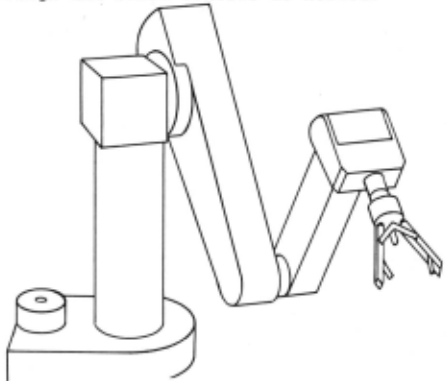
We are developing an intelligent knowledge base management system with the following capabilities:
- Ability to handle very large knowledge bases (order of a billion or more bits).
- Ability to do both explicit and implicit (inferential) question answering.
- Compact information representation.
- Utilizes semantic (domain specific) in formation for both better control of the knowledge base search and inference pro cesses and to assist in maintaining know ledge base integrity.
We are now in the process of "bringing up" the first version of the System for Parallel Representation of Knowledge (SPARK) on the DEC-lO Computer System at NRL. Ex periments employing realistic Navy know ledge bases will be performed with the system to determine its utility and benefits.
We are investigating automatic clustering and pattern recognition from a basic re search and applied point of view. Our main application is emission identifica tion - the process of identifying unfriend ly planes, ships, etc. by means of the passive acquisition of data such as their radar and radio signals. The objective of the automatic emission identification project is to employ clustering*and pattern recognition techniques to automate the process of identification of objects by class (that is to identify ships, for example, by their type but not by name) using data collected from a variety of remote sensing devices.
Reference
J. Slagle: Artificial Intelligence: The Heuristic Programming Approach, McGraw-Hill Book Co., New York, 1971. (Also available in German and Japanese translations.)
* Clustering is a procedure that assigns samples to sets called clusters in such a way that:
- The members of a cluster are similar to one another.
- The members of different clusters are dissimilar.
A sample is a list of parameters (features) for example, (THIN, BLUE, TALL) or (1.0, 2.5, 3.1, -1.0, -11.7, 10.5, 5.0) or (BROWN, 140, BLUE, 67, 36). Clustering may be used to get direct insight into the data (for example, taxonomy) or as a first step to automatic pattern recognition. It may be applied to many kinds of data, for example, emissions, personnel, chemicals, and ships.
ARTIFICIAL INTELLIGENCE RESEARCH FUNDED BY THE ADVANCED RESEARCH PROJECTS AGENCY
W. Gevarter
ARPA funds A.I. research in the areas of:
- Natural Language
- Knowledge-based Inferential Rea soning Systems
- Computer Vision Systems
This research is largely university based.
1. Natural Language
In this area ARPA funds:
- Story-understanding research
- Better man-machine dialogue inter action research
2. Knowledge Based Reasoning Systems
Research in this area includes work on production rule formalisms (rule-based systems). Production systems they have helped support include MYCIN (a diag nostic system for identifying bacteria blood infections and antibody prescrip tion) and DENDRAL (a qualitative chem ical analyses system using mass spec tronomy). Research continues on in ference-based systems that can do rea soning and are self-documenting (indi cating how results were obtained). Interest is also evolving on learning, whereby the computer can acquire its own models and rules empirically.
3. c.omputer Vision Systems
Research in this area is centered on trying to develop automatic recogni tion and extraction of features from scenes.
@inproceedings{ijcai1977p221,
  title     = {Federal Programs in Artificial Intelligence},
  author    = {Gevarter, William B. and Albus, James S. and Caplan, N. and Chern, B. and Curtis, Kent K. and Denicoff, Marvin and Slagle, James R.},
  booktitle = {Proceedings of the Fifth International Joint Conference on
               Artificial Intelligence, {IJCAI-77}},
  publisher = {International Joint Conferences on Artificial Intelligence},
  editor    = {Raj Reddy},
  pages     = {940--949},
  year      = {1977},
  note      = {Invited Panel},
  url       = {https://ijcai.org/proceedings/1977/221},
}
TY - CPAPER TI - Federal Programs in Artificial Intelligence AU - Gevarter, William B. AU - Albus, James S. AU - Caplan, N. AU - Chern, B. AU - Curtis, Kent K. AU - Denicoff, Marvin AU - Slagle, James R. T2 - Proceedings of the Fifth International Joint Conference on Artificial Intelligence, IJCAI-77 PB - International Joint Conferences on Artificial Intelligence PY - 1977 SP - 940 EP - 949 UR - https://ijcai.org/proceedings/1977/221 ER -Copied
Machine-readable versions of this paper, for tools and AI agents:





